
| Unit 8B – Plants |  |
Know the following:
|
|
| Unit 8B – Plants | |
Know the following:
|
|
| Lab 3 Mitosis and Meiosis |  |
Introduction:
All new cells come from previously existing cells. New cells are formed by karyokinesis- the process in cell division which involves replication of the cell’s nucleus and cytokinesis-the process in cell division which involves division of the cytoplasm. Two types of nuclear division include mitosis and meiosis. Mitosis typically results in new somatic, or body, cells. Mitotic cell division is involved in the formation of an adult organism from a fertilized egg, asexual reproduction, regeneration, and maintenance or repair of body parts. Meiosis results in the formation of either gametes in animals or spores in plants. The cells formed have half the chromosome number of the parent cell.
Mitosis is best observed in cells that are growing at a rapid pace, such as in the whitefish blastula or onion root cell tips. The root tips contain a special growth region called the apical meristem where the highest percentage of cells are undergoing mitosis. The whitefish blastula is formed immediately after the egg is fertilized, a period of rapid growth and numerous cell divisions where mitosis can be observed.
There are several stages included in before, during, and following mitosis. Interphase occurs right before a cell enters mitosis. During interphase, the cell will have a distinct nucleus with one or more nucleoli, which is filled with a fine network of threads of chromatin. During interphase, DNA replication occurs. After duplication the cell is ready to begin mitosis. Prophase is when the chromatin thickens until condensed into distinct chromosomes. The nuclear envelope dissolves and chromosomes are in the cytoplasm. The first signs of the microtubule-containing spindle also begin to appear. Next the cell begins metaphase. During this phase, the centromere of each chromosome attaches to the spindle and are moved to the center of the cell. This level position is called the metaphase plate. The chromatids separate and pull to opposite poles during the start of anaphase. Once the two chromatids are separate, each is called a chromosome. The last stage of mitosis is telophase. At this time, a new nuclear envelope is formed and the chromosomes gradually uncoil, forming the fine chromatin network seen in interphase. Cytokinesis may occur forming a cleavage furrow that will form two daughter cells when separated.
Meiosis is more complex than mitotic stages and involves two nuclear divisions called Meiosis I and Meiosis II. They result in the production of four haploid gametes and allow genetic variation because of crossing over of genetic material. Prior the process, interphase replicates the DNA. During prophase I, the first meiotic stage, homologous chromosomes move together to form a tetrad and synapsis also begins. This is where crossing over occurs, resulting in the recombination of genes. In Metaphase I, the tetrads move to the metaphase plate in the middle of the cell as on mitotic metaphase. Anaphase I brings the tetrads back to their original two stranded form and moves them to opposite poles. During Telophase I, the centriole is finished and the cell prepares for a second division. In Meiosis II, in Prophase II, centrioles move to opposite ends of the chromosome group. In Metaphase II, the chromosomes are centered within the center of each daughter cell. Anaphase II involves the centromere of the chromatids separating. Telophase II occurs when the divided chromosomes separate into different cells, known as haploid cells.
Sordaria fimicola, an ascomycete fungus, can be used to demonstrate the results of crossing over during meiosis. It spends most of its life haploid and only becomes diploid when the fusion of the mycelia of two different strains results in the fusion of two different types of haploid nuclei to form a diploid nucleus. Meiosis, followed by mitosis, in Sordaria results in the formation of eight haploid ascospores contained within a sac called an ascus. They are contained in a perithecium, a fruiting body, until mature enough to be released. The arrangement of spores directly reflects whether or not crossing over occurred. If an ascus has four tan ascospores in a row and four black ascospores in a row -4:4 arrangement, then no crossing over has taken place. If the asci has black and tan ascospores in sets of two -2:2:2:2 arrangement, or two pairs of black ascospores and four tan ascospores in the middle -2:4:2 arrangement, then crossing over has taken place.
Hypothesis:
The stages of mitosis can be examined in whitefish blastula and onion root cell tips by using a microscope. The process of crossing over and the stages of meiosis only occur during the creation of gametes and spores.
Materials:
Exercise 3A
The materials necessary for this exercise are a light microscope, prepared slides of whitefish blastula, onion root cell tips, pencil, and paper.
Exercise 3B
For this portion of the lab, materials needed are a bag of color-coded connecting beads and magnetized “centromeres,” several trays, and labels marked interphase, prophase, metaphase, anaphase, and telophase.
Methods:
Exercise 3A.1: Observing Mitosis
During this experiment, prepared slides of whitefish blastula and onion root tips should be observed under the 10X and 40X objectives of a light microscope. A cell in each stage of mitosis should be identified and sketched.
Exercise 3A.2: Time for Cell Replication
In this section of the lab, use the highest power objective on the microscope to observe and count every cell in the field of view. The cells should be counted according to the stage of mitosis they are in. At least 200 cells and 2 fields of view should be examined and counted. The percentage of cells in each stage is then recorded and the amount of time spent in each phase is calculated.
Exercise 3B.1: Simulation of Meiosis
For this portion of the experiment, a chromosome simulation kit will be used to demonstrate meiosis. Two sets of two strands with each set a different color, are connected to simulate DNA replication in both of the homologous pairs, the stage called interphase. Next, the chromosomes were entwined to represent synapsis in the stage known as prophase. Sections of beads were entwined between the pairs as in crossing over and aligned at the equator. Beads of each pair exchange places, representing metaphase. Next, anaphase was simulated by the homologous pairs being separated to opposite sides of the tray, or in terms of the “chromosomes,” the cell. Pushing the chromosomes into two separate cells, or trays, mimicked telophase.
Meiosis II was simulated as well. Prophase II is shown by the separation of the two beads, but no true change. The chromosomes again move to the equator during metaphase II, and in anaphase II, the two chromatids are separated and moved to opposite poles. Telophase II separates the chromosomes into four different cells.
Exercise 3B.2: Crossing Over during Meiosis in Sordaria
Prepared slides of Sordaria fimicola were observed under a light microscope. The asci were identified as either 4:4 or asci showing crossover. These readings were recorded. The percentage of each and map units were calculated.
Results:
Exercise 3A
Whitefish Blastula
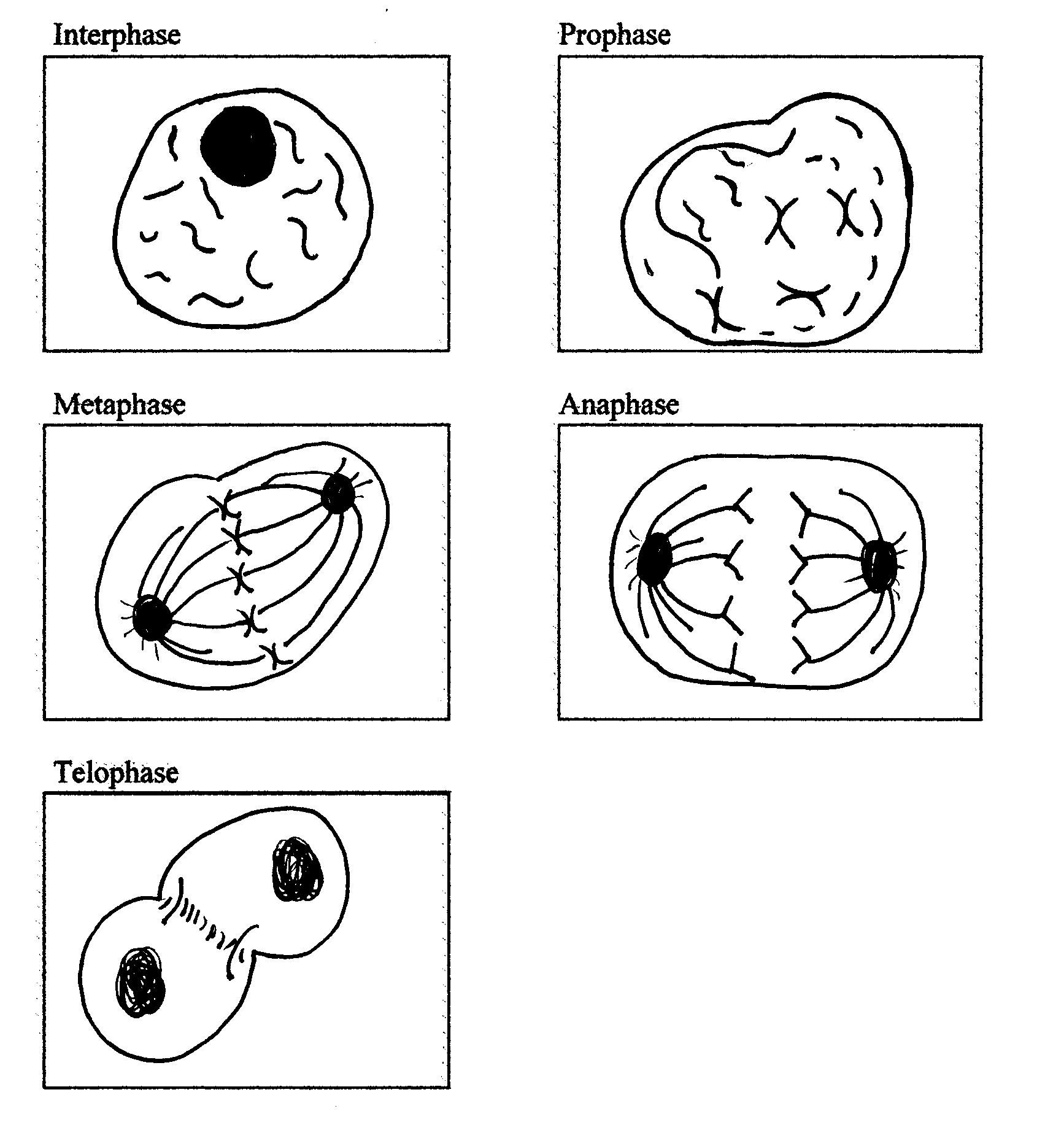
Onion Root Cell Tips

Why is it more accurate to call mitosis “nuclear replication” rather than “cellular division”? It is more accurate to describe mitosis as “nuclear replication” because the cell does not divide in any of the mitotic steps. The entire process of mitosis is a series of steps that divides the nucleus into two separate nuclei at opposite poles. When a cell is truly split, the process is known as cytokinesis.
Explain why the whitefish blastula and onion root tips are selected for a study of mitosis. The blastula is what is formed directly following fertilization and, therefore, the cell is growing and many of the phases can be seen at this time. Onion root tip cells are also specimens that include a large amount of cell growth and a high percentage of cells experiencing mitotic activities.
Table 1: Number of Cells in Each Stage of Mitosis and Amount of Time Spent in Each Stage
|
Number of Cells |
|||||
|
Field 1 |
Field 2 |
Total | |||
|
Interphase |
71 | 101 | 172 | 73.2% | 1054.0 |
|
Prophase |
13 | 15 | 28 | 12.0% | 171.6 |
|
Metaphase |
12 | 13 | 25 | 10.6% | 153.2 |
|
Anaphase |
1 | 2 | 3 | 1.3% | 18.4 |
|
Telophase |
3 | 4 | 7 | 3.0% | 42.9 |
|
Total Cells Counted |
235 | ||||
If your observations had not been restricted to the area of the root tip that is actively dividing, how would your results differ? The majority of the cells would be in the stage of interphase and the results would be more difficult to gain and inaccurate.
Based on the data in Table 3.1, what can you infer about the relative length of time an onion root-tip cell spends in each stage of cell division? Prophase is the longest stage of mitosis (though Interphase, which occurs prior mitosis, takes up the most time of the cell’s life). Then, based on the data gained, the time spent in each stage decreases as you go further along.
Exercise 3B
List three major differences between the events of mitosis and meiosis. In mitosis, the nucleus divides once, and in meiosis, the nucleus is divided twice. Mitosis produces two identical daughter cells and meiosis produces up to four different cells. Synapsis and crossing over do not take place in mitosis, but do in meiosis.
Compare mitosis and meiosis with respect to each of the following.
Table 2: Comparing Mitosis and Meiosis
|
Topic Being Compared |
Mitosis |
Meiosis |
|
Chromosome number of Parent Cells |
Diploid (2n) | Diploid (2n) |
|
Number of DNA Replications |
Once | Once |
|
Number of Divisions |
One | Two |
|
Number of Daughter Cells |
Two | Four |
|
Chromosome Number of Daughter Cells |
Diploid (2n) | Haploid (n) |
|
Purpose |
Growth and repair | Production of gametes or spores |
How are Meiosis I and Meiosis II different? Meiosis I begins with a tetrad and separates the homologous pairs. Meiosis II separates the two sister chromatids into haploids.
How do oogenesis and spermatogenesis differ? Oogenesis produces egg cells and spermatogenesis produces sperm cells.
Why is meiosis important for sexual reproduction? In meiosis the chromosome number is reduced to n so that it can be fertilized and void of any related (fertilized 2n) defects. Crossing- over occurs during meiosis, allowing for variations in the organisms created.
Table 3: The Number of Crossovers and Non-Crossovers
|
Number of 4:4 |
Number of Asci Showing Crossover |
Total Asci |
% Asci Showing Crossover Divided by 2 |
Gene to Centromere Distance (Map Units) |
| 59 | 68 | 127 | 26.8% | (1) |
2. Draw a pair of chromosomes in MI and MII, and show how you would get a 2:4:2 arrangement of ascospores by crossing over.

Error Analysis:
Because the results gathered in the lab were based mostly on observations and sketching, chances of error are slim. However, when counting the number of cells in specific stages in Exercise 3A, mistakes could have occurred. When identifying these stages in Exercise 3A, mistakes were also possible.
Discussion and Conclusion:
The stages of mitosis were observed and timed in Exercise 3A. These stages are prophase, metaphase, anaphase, and telophase. Prophase is the most time-consuming phase, while anaphase is the least time-consuming. Mitosis is just one portion of a cell’s life. The longest time of a cell’s life (73% to be exact) is spent in interphase, a phase just prior to prophase. During this phase, DNA replication takes place. Prophase involves the first signs of cell division with a thickening of the chromatin threads until the chromatin is condensed to chromosomes. In metaphase the chromosomes move to the center of the spindle and the centromere attaches to the spindle. During anaphase the chromatids are separated and moved to opposite ends of the poles. The final stage, telophase, involves the condensation of the chromosomes and the formation of a new nuclear envelope. Following telophase, cytokinesis may occur and the cytoplasm will be divided into two cells.
During the first section of Exercise 3B, the stages of meiosis were simulated using magnetic beads and centromeres with trays serving as the “cell.” Crossing over in Sordaria was observed using a microscope in the second portion of Exercise 3B. Using the information, the map units were then determined. The distance of the gene relative to the centromere in the Sordaria was 26.8 map units.
| AP Biology: Chapter 6 |
METABOLISM & ENZYMES
1. Define the following terms:
a. Catabolic pathway ________________________________________________________
b. Anabolic pathway _________________________________________________________
c. Kinetic energy ____________________________________________________________
d. Potential energy __________________________________________________________
2. The First Law of Thermodynamics is the principle of… _______________________________
___________________________________________________________________________
___________________________________________________________________________
3. The Second Law of Thermodynamics involves changes in… __________________________
___________________________________________________________________________
___________________________________________________________________________
4. What is meant by a change in free energy? ________________________________________
___________________________________________________________________________
5. Compare reactions that are…
a. Exergonic _______________________________________________________________
________________________________________________________________________
b. Endergonic ______________________________________________________________
________________________________________________________________________
6. Sketch the ATP cycle:
7. How does ATP “couple reactions”? ______________________________________________
___________________________________________________________________________
___________________________________________________________________________
8. Sketch the profile of an exergonic reaction.
9. How do enzymes affect the energy profile? ________________________________________
___________________________________________________________________________
10. Define activation energy. ______________________________________________________
___________________________________________________________________________
11. Why are enzymes said to be specific? ____________________________________________
___________________________________________________________________________
___________________________________________________________________________
12. List factors that influence the rate of enzyme reactions. ______________________________
___________________________________________________________________________
___________________________________________________________________________
13. Label the diagram of the catalytic enzyme cycle.

14. How do competitive and noncompetitive inhibitors differ in their enzyme interactions?
___________________________________________________________________________
___________________________________________________________________________
15. What happens during allosteric regulation? ________________________________________
___________________________________________________________________________
___________________________________________________________________________
16. Describe feedback inhibition. ___________________________________________________
___________________________________________________________________________
___________________________________________________________________________
17. Define enzyme cooperativity. ___________________________________________________
___________________________________________________________________________
___________________________________________________________________________
AP Biology: CHAPTER 5A
MACROMOLECULES
1. Define the following:
a. monomer _______________________________________________________________
___________________________________________________________________________
b. polymer _________________________________________________________________
___________________________________________________________________________
c. condensation reaction _____________________________________________________
___________________________________________________________________________
d. hydrolysis _______________________________________________________________
___________________________________________________________________________
2. Which foods do you think will enter the blood the quickest? Why?
___________________________________________________________________________
___________________________________________________________________________
3. What are the general roles of carbohydrates? ______________________________________
___________________________________________________________________________
___________________________________________________________________________
4. List some monosaccharides with their molecular formulas.
___________________________________________________________________________
___________________________________________________________________________
5. Double sugars are called ______________________________________________________
6. List the monosaccharides that form each:
a. maltose _________________________________________________________________
b. sucrose _________________________________________________________________
c. lactose __________________________________________________________________
6. Polymers of sugars form _______________________________________________________
7. Which forms of polysaccharide is best for each function:
a. Strength of structure _______________________________________________________
b. Storage and sugar release __________________________________________________
c. What theme is this addressing? ______________________________________________
8. How does the alpha differ from the beta form of glucose and why is it significant to animals?
___________________________________________________________________________
___________________________________________________________________________
9. How do the role and structure of the following polysaccharides compare?
a. starch___________________________________________________________________
b. glycogen ________________________________________________________________
c. cellulose_________________________________________________________________
10. Ninety percent of Asians, 75% of African-Americans, and a much smaller percent of
northern Europeans are lactose intolerant. Why do you suppose we see this pattern?
___________________________________________________________________________
___________________________________________________________________________
___________________________________________________________________________
| AP Biology: Chapter 9 |
RESPIRATION — GLYCOLYSIS
1. Identify some specific processes the cell does with ATP. _____________________________
___________________________________________________________________________
___________________________________________________________________________
2. Explain why ATP is such a “high energy” molecule. __________________________________
___________________________________________________________________________
___________________________________________________________________________
3. Sketch the ATP cycle:
4. How does ATP “couple reactions”? ______________________________________________
___________________________________________________________________________
___________________________________________________________________________
5. What is the name of enzymes which phosphorylate molecules? ________________________
6. Define each of the following:
a. Oxidation _______________________________________________________________
________________________________________________________________________
b. Reduction _______________________________________________________________
________________________________________________________________________
7. What is the role of NAD+ & FAD+2 in respiration? ___________________________________
___________________________________________________________________________
___________________________________________________________________________
8. Explain why respiration is considered exergonic. ____________________________________
___________________________________________________________________________
___________________________________________________________________________
9. Glycolysis starts with _____________________ and produces _________________________
10. The Kreb’s cycle takes place in the: ______________________________________________
11. Pyruvate is converted to ___________________________________ before the Krebs cycle.
12. The Electron Transport Chain is located in the: _____________________________________
13. Describe the role of the Electron Transport Chain. What happens to the electrons and H+?
___________________________________________________________________________
___________________________________________________________________________
___________________________________________________________________________
14. What is chemiomosis and how is it generated?
___________________________________________________________________________
___________________________________________________________________________
___________________________________________________________________________
15. How does the mitochondrion generate ATP?
___________________________________________________________________________
___________________________________________________________________________
16. Label the diagram. Include: CO2, organic compounds, O2, H2O, respiration, photosynthesis, light, heat, ATP

23. Write the summary equation for cellular respiration:
___________________________________________________________________________
a. Where did the glucose come from? ___________________________________________
b. Where did the O2 come from? _______________________________________________
c. Where did the CO2 come from? ______________________________________________
d. Where did the H2O come from? ______________________________________________
e. Where did the ATP come from? ______________________________________________
f. What else is produced that is not listed in this equation? ___________________________
24. What was the evolutionary advantage of the proto-eukaryotes that engulfed aerobic bacteria
but did not digest them?
___________________________________________________________________________
___________________________________________________________________________
___________________________________________________________________________
25. Why do we eat? _____________________________________________________________
___________________________________________________________________________
___________________________________________________________________________
26. Why do we breathe? __________________________________________________________
___________________________________________________________________________
___________________________________________________________________________
17. What happens to most of the energy released during cell respiration? ___________________
___________________________________________________________________________
___________________________________________________________________________
18. Alcoholic fermentation converts glucose to ________________________________________
19. Alcoholic fermentation is utilized by what organisms? ________________________________
20. Lactic acid fermentation converts glucose to________________________________________
21. Lactic acid fermentation is utilized by what organisms? _______________________________
22. Identify examples of each of the following feedback mechanisms
a. Negative feedback ________________________________________________________
________________________________________________________________________
b. Positive feedback _________________________________________________________
________________________________________________________________________