AP Lecture Guide 25 – Phylogeny and Systematics


AP Biology: CHAPTER 25: PHYLOGENY AND SYSTEMATICS


1. What is phylogeny?

__________________________________________________________________________

__________________________________________________________________________

2. How are fossils significant to our study of biology?

__________________________________________________________________________

__________________________________________________________________________

3. Review these key points in the study of fossils:

a. Sedimentary rocks are the richest source of fossils.

__________________________________________________________________________

__________________________________________________________________________

b. Paleontologists use a variety of methods to date fossils.

__________________________________________________________________________

__________________________________________________________________________

c. The fossil record is a substantial, but incomplete, chronicle of evolutionary history.

__________________________________________________________________________

__________________________________________________________________________

d. Phylogeny has a biogeographic basis in continental drift.

__________________________________________________________________________

__________________________________________________________________________

e. The history of life is punctuated by mass extinctions.

__________________________________________________________________________

__________________________________________________________________________

4. List examples of fossils. ______________________________________________________

__________________________________________________________________________

__________________________________________________________________________

5. What techniques do relative dating use to place fossils in their place in geologic time?

__________________________________________________________________________

__________________________________________________________________________

6. What marks the separation between the major eras in the geologic time scale?

__________________________________________________________________________

__________________________________________________________________________

7. How does absolute dating compare to relative dating?

__________________________________________________________________________

__________________________________________________________________________

8. Describe the two main characteristics of the Linnaean system of classification.

a. _______________________________________________________________________

b. _______________________________________________________________________

9. What modern techniques are used as the basis for grouping creatures with modern

phylogenetic systematics?

__________________________________________________________________________

__________________________________________________________________________

10. What does a phylogenic tree show?

__________________________________________________________________________

__________________________________________________________________________

11. When classifying organisms in a cladistic diagram, identify three pitfalls scientists might

encounter classifying creatures.

a. _______________________________________________________________________

b. _______________________________________________________________________

c. _______________________________________________________________________

12. What do scientists use when placing an organism on a cladistic diagram?

__________________________________________________________________________

__________________________________________________________________________

13. How have molecular clocks influenced our thoughts on evolutionary paths?

__________________________________________________________________________

__________________________________________________________________________

14. Why is the four chamber heart a poor choice of structure to place creatures on a phylogenic

tree?

__________________________________________________________________________

__________________________________________________________________________

15. Why are crocodiles now thought to be closer to birds than other reptiles?

__________________________________________________________________________

__________________________________________________________________________


AP Lecture Guide 17 – From Gene to Protein

AP Biology: CHAPTER 17

FROM GENE TO PROTEIN

1. How did diseases involving metabolic pathways lead to hypotheses about the nature of

genes?

__________________________________________________________________________

__________________________________________________________________________

2. Identify some genetic diseases that occur along metabolic pathways.

__________________________________________________________________________

__________________________________________________________________________

3. What was Beadle and Tatum’s hypothesis regarding enzymes?

__________________________________________________________________________

__________________________________________________________________________

4. How has that hypothesis been modified?

__________________________________________________________________________

__________________________________________________________________________

5. What occurs during transcription?

__________________________________________________________________________

__________________________________________________________________________

6. What occurs during translation?

__________________________________________________________________________

__________________________________________________________________________

7. How does the protein process differ in prokaryotes and eukaryotes?

__________________________________________________________________________

__________________________________________________________________________

8. Briefly explain how Marshall Nirenberg and Heinrich Matthaei “cracked the genetic code?”

__________________________________________________________________________

__________________________________________________________________________

9. What is the genetic code and why is said to be universal?

__________________________________________________________________________

__________________________________________________________________________

10. List several features about the genetic code.

__________________________________________________________________________

__________________________________________________________________________

11. Give an example of what happens if reading frames are altered?

__________________________________________________________________________

__________________________________________________________________________

12. List the highlights of the three stages of transcription.

a. Initiation _______________________________________________________________

__________________________________________________________________________

b. Elongation ______________________________________________________________

__________________________________________________________________________

c. Termination _____________________________________________________________

13. What happens to the transcript RNA before it leaves the nucleus?

__________________________________________________________________________

__________________________________________________________________________

14. What is the advantage of the 5’ cap and poly A tail?

__________________________________________________________________________

__________________________________________________________________________

15. Distinguish between exons and introns.

__________________________________________________________________________

__________________________________________________________________________

16. Describe the mechanism for splicing RNA.

__________________________________________________________________________

__________________________________________________________________________

17. What does alternative RNA processing do for cells?

__________________________________________________________________________

__________________________________________________________________________

18. Identify the roles of the players of the translation process.

a. Transfer RNA ___________________________________________________________

__________________________________________________________________________

b. Aminoacyl-tRNA synthetase _______________________________________________

__________________________________________________________________________

c. Ribosomes _____________________________________________________________

19. Identify and briefly describe the steps of translation. Initiation Elongation Termination

__________________________________________________________________________

__________________________________________________________________________

20. What is the advantage of polyribosomes?

__________________________________________________________________________

__________________________________________________________________________

21. Give an example of how a polypeptide gets into the ER for additional processing.

__________________________________________________________________________

__________________________________________________________________________

22. How does protein synthesis differ between prokaryotes and eukaryotes?

__________________________________________________________________________

__________________________________________________________________________

23. Define point mutations. ______________________________________________________

__________________________________________________________________________

24. Define mutations that are:

a. Missense ______________________________________________________________

__________________________________________________________________________

b. Nonsense ______________________________________________________________

__________________________________________________________________________

c. Insertion or deletion ______________________________________________________

__________________________________________________________________________

25. Use the diagram to trace the flow of chemical information from the gene to the protein product.


AP Lecture Guide HGP

HUMAN GENOME PROJECT
INSIGHTS LEARNED FROM THE SEQUENCE

What has been learned from analysis of the working draft sequence of the human genome? What is still unknown?

By the Numbers

• The human genome contains 3164.7 million chemical nucleotide bases (A, C, T, and G).

• The average gene consists of 3000 bases, but sizes vary greatly, with the largest known human gene being dystrophin at 2.4 million bases.

• The total number of genes is estimated at 30,000 to 35,000, much lower than previous estimates of 80,000 to 140,000 that had been based on extrapolations from gene-rich areas as opposed to a composite of gene-rich and gene-poor areas.

• The order of almost all (99.9%) nucleotide bases are exactly the same in all people.

• The functions are unknown for over 50% of discovered genes.

The Wheat from the Chaff

• Less than 2% of the genome encodes for the production of proteins.

• Repeated sequences that do not code for proteins (“junk DNA”) make up at least 50% of the human genome.

• Repetitive sequences are thought to have no direct functions, but they shed light on chromosome structure and dynamics. Over time, these repeats reshape the genome by rearranging it, thereby creating entirely new genes or modifying and reshuffling existing genes.

• During the past 50 million years, a dramatic decrease seems to have occurred in the rate of accumulation of repeats in the human genome.

How It’s Arranged

• The human genome’s gene-dense “urban centers” are predominantly composed of the DNA building blocks G and C.

• In contrast, the gene-poor “deserts” are rich in the DNA building blocks A and T. GC- and AT-rich regions usually can be seen through a microscope as light and dark bands on chromosomes.

• Genes appear to be concentrated in random areas along the genome, with vast expanses of noncoding DNA between.

• Stretches of up to 30,000 C and G bases repeating over and over often occur adjacent to gene-rich areas, forming a barrier between the genes and the “junk DNA.” These CpG islands are believed to help regulate gene activity.

• Chromosome 1 has the most genes (2968), and the Y chromosome has the fewest (231).

How the Human Genome Compares with That of Other Organisms

• Unlike the human’s seemingly random distribution of gene-rich areas, many other organisms’ genomes are more uniform, with genes evenly spaced throughout.

• Humans have on average three times as many kinds of proteins as the fly or worm because of mRNA transcript “alternative splicing” and chemical modifications to the proteins. This process can yield different protein products from the same gene.

• Humans share most of the same protein families with worms, flies, and plants, but the number of gene family members has expanded in humans, especially in proteins involved in development and immunity.

• The human genome has a much greater portion (50%) of repeat sequences than the mustard weed (11%), the worm (7%), and the fly (3%).

• Although humans appear to have stopped accumulating repeated DNA over 50 million years ago, there seems to be no such decline in rodents. This may account for some of the fundamental differences between hominids and rodents, although gene estimates are similar in these species. Scientists have proposed many theories to explain evolutionary contrasts between humans and other organisms, including those of life span, litter sizes, inbreeding, and genetic drift.

Variations and Mutations

• Scientists have identified about 1.4 million locations where single-base DNA differences (SNPs) occur in humans. This information promises to revolutionize the processes of finding chromosomal locations for disease-associated sequences and tracing human history.

• The ratio of germline (sperm or egg cell) mutations is 2:1 in males vs females. Researchers point to several reasons for the higher mutation rate in the male germline, including the greater number of cell divisions required for sperm formation than for eggs.

What We Still Don’t Know: A Checklist for Future Research

• Exact gene number, exact locations, and functions

• Gene regulation

• DNA sequence organization

• Chromosomal structure and organization

• Noncoding DNA types, amount, distribution, information content, and functions

• Coordination of gene expression, protein synthesis, and post-translational events

• Interaction of proteins in complex molecular machines

• Predicted vs experimentally determined gene function

• Evolutionary conservation among organisms

• Protein conservation (structure and function)

• Proteomes (total protein content and function) in organisms

• Correlation of SNPs (single-base DNA variations among individuals) with health and disease

• Disease-susceptibility prediction based on gene sequence variation

• Genes involved in complex traits and multigene diseases

• Complex systems biology, including microbial consortia useful for environmental restoration

• Developmental genetics, genomics

http://genome.gsc.riken.go.jp/hgmis/project/journals/insights.html

AP Genetics Problems


Genetics Problems

1. A rooster with gray feathers is mated with a hen of the same phenotype. Among their offspring, 15 chicks are gray, 6 are black, and 8 are white.

  • What is the simplest explanation for the inheritance of these colors in chickens?
  • What offspring would you predict from the mating of a gray rooster and a black hen?

2. In some plants, a true-breeding, red-flowered strain gives all pink flowers when crossed with a white-flowered strain: RR (red) x rr (white) —> Rr (pink). If flower position (axial or terminal) is inherited as it is in peas what will be the ratios of genotypes and phenotypes of the generation resulting from the following cross: axial-red (true-breeding) x terminal-white? What will be the ratios in the F2 generation?

3. Flower position, stem length, and seed shape were three characters that Mendel studied. Each is controlled by an independently assorting gene and has dominant and recessive expression as follows:


Character Dominant Recessive
Flower position Axial (A ) Terminal (a )
Stem length Tall (T ) Dwarf (t )
Seed shape Round (R ) Wrinkled (r)


If a plant that is heterozygous for all three characters were allowed to self-fertilize, what proportion of the offspring would be expected to be as follows: (Note – use the rules of probability (and show your work) instead of huge Punnett squares)

  1. homozygous for the three dominant traits
  2. homozygous for the three recessive traits
  3. heterozygous
  4. homozygous for axial and tall, heterozygous for seed shape

4. A black guinea pig crossed with an albino guinea pig produced 12 black offspring. When the albino was crossed with a second one, 7 blacks and 5 albinos were obtained.

  • What is the best explanation for this genetic situation?
  • Write genotypes for the parents, gametes, and offspring.

5. In sesame plants, the one-pod condition (P ) is dominant to the three-pod condition (p ), and normal leaf (L ) is dominant to wrinkled leaf (l) . Pod type and leaf type are inherited independently. Determine the genotypes for the two parents for all possible matings producing the following offspring:

  1. 318 one-pod normal, 98 one-pod wrinkled
  2. 323 three-pod normal, 106 three-pod wrinkled
  3. 401 one-pod normal
  4. 150 one-pod normal, 147 one-pod wrinkled, 51 three-pod normal, 48 three-pod wrinkled
  5. 223 one-pod normal, 72 one-pod wrinkled, 76 three-pod normal, 27 three-pod wrinkled

6. A man with group A blood marries a woman with group B blood. Their child has group O blood.

  • What are the genotypes of these individuals?
  • What other genotypes and in what frequencies, would you expect in offspring from this marriage?

7. Color pattern in a species of duck is determined by one gene with three alleles. Alleles H and I are codominant, and allele i is recessive to both. How many phenotypes are possible in a flock of ducks that contains all the possible combinations of these three alleles?

8. Phenylketonuria (PKU) is an inherited disease caused by a recessive allele. If a woman and her husband are both carriers, what is the probability of each of the following?

  1. all three of their children will be of normal phenotype
  2. one or more of the three children will have the disease
  3. all three children will have the disease
  4. at least one child out of three will be phenotypically normal

(Note: Remember that the probabilities of all possible outcomes always add up to 1)

9. The genotype of F1 individuals in a tetrahybrid cross is AaBbCcDd. Assuming independent assortment of these four genes, what are the probabilities that F2 offspring would have the following genotypes?

  1. aabbccdd
  2. AaBbCcDd
  3. AABBCCDD
  4. AaBBccDd
  5. AaBBCCdd

10. In 1981, a stray black cat with unusual rounded curled-back ears was adopted by a family in California. Hundreds of descendants of the cat have since been born, and cat fanciers hope to develop the “curl” cat into a show breed. Suppose you owned the first curl cat and wanted to develop a true breeding variety.

  • How would you determine whether the curl allele is dominant or recessive?
  • How would you select for true-breeding cats?
  • How would you know they are true-breeding?

11. What is the probability that each of the following pairs of parents will produce the indicated offspring (assume independent assortment of all gene pairs?

  1. AABbCc x aabbcc —-> AaBbCc
  2. AABbCc x AaBbCc —–> AAbbCC
  3. AaBbCc x AaBbCc —–> AaBbCc
  4. aaBbCC x AABbcc —-> AaBbCc

12. Karen and Steve each have a sibling with sickle-cell disease. Neither Karen, Steve, nor any of their parents has the disease, and none of them has been tested to reveal sickle-cell trait. Based on this incomplete information, calculate the probability that if this couple should have another child, the child will have sickle-cell anemia.

13. Imagine that a newly discovered, recessively inherited disease is expressed only in individuals with type O blood, although the disease and blood group are independently inherited. A normal man with type A blood and a normal woman with type B blood have already had one child with the disease. The woman is now pregnant for a second time. What is the probability that the second child will also have the disease? Assume both parents are heterozygous for the “disease” gene.

14. In tigers, a recessive allele causes an absence of fur pigmentation (a “white tiger”) and a cross-eyed condition. If two phenotypically normal tigers that are heterozygous at this locus are mated, what percentage of their offspring will be cross-eyed? What percentage will be white?

15. In corn plants, a dominant allele I inhibits kernel color, while the recessive allele i permits color when homozygous. At a different locus, the dominant gene P causes purple kernel color, while the homozygous recessive genotype pp causes red kernels. If plants heterozygous at both loci are crossed, what will be the phenotypic ratio of the F1 generation?

16. The pedigree below traces the inheritance of alkaptonuria, a biochemical disorder. Affected individuals, indicated here by the filled-in circles and squares, are unable to break down a substance called alkapton, which colors the urine and stains body tissues. Does alkaptonuria appear to be caused by a dominant or recessive allele? Fill in the genotypes of the individuals whose genotypes you know. What genotypes are possible for each of the other individuals?

 
17. A man has six fingers on each hand and six toes on each foot. His wife and their daughter have the normal number of digits (5). Extra digits is a dominant trait. What fraction of this couple’s children would be expected to have extra digits?

18. Imagine you are a genetic counselor, and a couple planning to start a family came to you for information. Charles was married once before, and he and his first wife had a child who has cystic fibrosis. The brother of his current wife Elaine died of cystic fibrosis. What is the probability that Charles and Elaine will have a baby with cystic fibrosis? (Neither Charles nor Elaine has the disease)

19. In mice, black color (B ) is dominant to white (b ). At a different locus, a dominant allele (A ) produces a band of yellow just below the tip of each hair in mice with black fur. This gives a frosted appearance known as agouti. Expression of the recessive allele (a ) results in a solid coat color. If mice that are heterozygous at both loci are crossed, what will be the expected phenotypic ratio of their offspring?

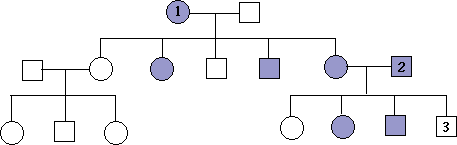
20. The pedigree below traces the inheritance of a vary rare biochemical disorder in humans. Affected individuals are indicated by filled-in circles and squares. Is the allele for this disorder dominant or recessive? What genotypes are possible for the individuals marked 1, 2, and 3.


Solutions

Amylase on Starch Lab


Enzyme Amylase Action on Starch

INTRODUCTION:

In this experiment you will observe the action of the enzyme amylase on starch. Amylase changes starch into a simpler form: the sugar maltose, which is soluble in water. Amylase is present in our saliva, and begins to act on the starch in our food while still in the mouth.
Exposure to heat or extreme pH (acid or base) will denature proteins. Enzymes, including amylase, are proteins. If denatured, an enzyme can no longer act as a catalyst for the reaction.
Benedict’s solution is a test reagent that reacts positively with simple reducing sugars like maltose, but will not react with starch. A positive test is observed as the formation of a brownish-red cuprous oxide precipitate. A weaker positive test will be yellow to orange.

MATERIALS:

Cornstarch
Distilled water
Saliva
Vinegar
Benedict’s qualitative solution
3 graduated cylinders (10mL)
250-ml beaker
Stirring rod
3 test tubes (16 x 125mm)
Test tube rack
Wax pencil
Water Bath

PRE-LAB:

Add 1g of cornstarch to a beaker containing 100ml of cold distilled water. While stirring frequently, heat the mixture just until it begins to boil. Allow to cool.

PROCEDURE:

1. Fill the 250-mL beaker about 3/4 full of water and place on the hot plate for a boiling water bath. Keep the water JUST AT BOILING.

2. Mark 3 test tubes A, B and C. “Spit” between 1 and 2 mL of saliva into each test tube.

3. Into tube A, add 2 mL of vinegar. Into tubes B and C, add 2 mL of distilled water. Thump the tubes to mix.

4. Place tube B into the boiling water bath for 5 minutes. After the five minutes, remove from the bath, and place back into the test tube rack.

5. Add 5 mL of the starch solution to each tube and thump to mix. Allow the tubes to sit for 10 minutes, occasionally thumping the tubes to mix.

6. Add 5 mL of Benedict’s solution to each tube and thump to mix. Place the tubes in the hot water bath. The reaction takes several minutes to begin.

OBSERVATIONS:

Tube A: Starch + saliva treated with vinegar (acid)

    • Was the test positive or negative? _______________________

What does this indicate?__________________________________________________

____________________________________________________________________

____________________________________________________________________

Tube B: Starch + saliva and water, treated in a boiling water bath

    • Was the test positive or negative? _______________________

What does this indicate?__________________________________________________

____________________________________________________________________

____________________________________________________________________

Tube C: Starch + saliva

    • Was the test positive or negative? _______________________

What does this indicate?__________________________________________________

____________________________________________________________________

____________________________________________________________________

QUESTIONS:

1. What is the function of an enzyme?


2. Where does a substrate attach to an enzyme?

3. If an enzyme is present in a reaction, less ________________ _________________ will be needed to get the reaction started.

4. What is a common suffix found at the end of most biological enzymes?

5. Most enzymes are macromolecules called ________________.

6. Define denaturation of proteins.


7. Name 3 things that can denature or unfold an enzyme.


8. In this lab, what weak acid denatured the protein?

9. What was the purpose of placing one test tube in a hot water bath?


10. What happens to enzymes in your body whenever you run fever?