Mollusk

Mollusks


All Materials © Cmassengale  

Phylum Mollusca
Characteristics

  • Soft-bodied invertebrate covered with protective mantle that may or may not form a hard, calcium carbonate shell
  • Includes chitons, snails, slugs, clams, oysters, squid, octopus, & nautilus
  • Second largest animal phylum
  • Have a muscular foot for movement which is modified into tentacles for squid & octopus
  • Complete, one-way digestive tract with a mouth & anus
  • Have a fully-lined coelom
  • Cephalization – have a distinct head with sense organs & brain
  • Have a scraping, mouth-like structure called the radula
  • Go through free-swimming larval stage called trochophore


Trochophore Larva

  • Body organs called visceral mass lie below mantle
  • Have circulatory, respiratory, digestive, excretory, nervous, & reproductive systems
  • Bilaterally symmetrical
  • Most have separate sexes that cross-fertilize eggs
  • Gills between the mantle & visceral mass are used for gas exchange
  • Includes 4 classes — Polyplacophora (chitons), Gastropoda (snails, slugs, nudibranchs, conchs & abalone), Pelecypoda or Bivalvia (clams, oysters, & mussels), & Cephalopoda (squid, octopus, & nautilus)


SNAIL, CLAM, CHITON, & SQUID

Class Polyplacophora
Characteristics

  • All marine
  • Have a shell divided into 8 over-lapping plates
  • Live on rocks along seashore feeding on algae


CHITON

Class Gastropoda
Characteristics

  • Head has a pair of retractable tentacles with eyes located at the ends
  • Have a single shell or valve (snails) or none (slugs)
  • Known as univalves
  • Snails
    * May be marine, freshwater, or terrestrial
    * Aquatic snails breathe through gills & use their radula to scrape algae for food
    * Terrestrial snails use their mantle cavity as a modified lung & saw off leaves
    * Retreat into shell in dry periods & seals opening with mucus
    * Have open circulatory system
    * Secrete mucus & use muscular foot to move
    * Land snails are hermaphrodites
    * Aquatic snails have separate sexes
    * Use internal fertilization

  • Slugs
    * Live in moist terrestrial areas
    * Lack a shell


SLUG

  • Pteropods
    * Called “sea butterflies”
    * Marine
    * Have a wing-like flap for swimming


“SEA BUTTERFLY”

  • Oyster Drills
    * Radula modified to drill into oyster shells


OYSTER DRILL

  • Nudibranch
    * Marine slug
    * Lacks shell


NUDIBRANCH

Class Bivalvia or Pelecypoda
Characteristics

  • Sessile or sedentary
  • Includes marine clams, oysters, shipworms, & scallops and freshwater mussels
  • Filter feeders
  • Have two-part, hinged shell (2 valves)
  • Have muscular foot that extends from shell for movement
  • Scallops clap valves together to move

  • Shell secreted by mantle & made of 3 layers — outer horny layer protects against acids, middle prismatic layer made of calcium carbonate for strength, & inner pearly layer next to soft body
  • Mantle secretes substance called “mother of pearl” to surround irritants like grains of sand
  • Oldest, raised part of shell called umbo
  • Powerful anterior & posterior adductor muscles open & close shell
  • Lack a distinct head
  • Have an incurrent & excurrent siphon that circulate water over the gills to remove food & oxygen

INTERNAL CLAM ANATOMY

  • Have heart & open circulatory system
  • Nervous system made of 3 pairs of ganglia, nerve cords, & sensory cells that detect light, chemicals, & touch
  • Separate sexes with external fertilization of eggs

Class Cephalopoda or Amphineura
Characteristics

  •  Includes octopus, squid, cuttlefish, & chambered nautilus  
  • All marine  


NAUTILUS OCTOPUS SQUID


  • Most intelligent mollusk
  • Well developed head
  • Active, free swimming predators
  • Foot divided into tentacles with suckers
  • Use  their radula & beak to feed
  • Closed circulatory system
  • Lack an external shell
  • Highly developed nervous system with vertebrate-like eyes
  • Separate sexes with internal fertilization

  • Squid
    * Largest invertebrate is the Giant Squid
    * Large, complex brain
    * Ten tentacles with longest pair to catch prey
    * Use jet propulsion to move by forcing water out their excurrent siphon
    * Chromatophores in the skin can help change squid color for camouflage
    * Can squirt an inky substance into water to temporarily blind predators
    * Have internal shell called pen
    * Female lays eggs in jellylike material & protects them until hatching


GIANT SQUID

  • Octopus
    * Eight tentacles
    * Similar to squid
    * Crawls along bottom looking for prey


OCTOPUS

  • Chambered Nautilus
    * Has an exterior shell
    * Lives in the outer chamber of the shell
    * Secretes gas into the other chambers to adjust buoyancy


NAUTILUS

Economic Importance of Mollusks

  • Used  by humans for food
  • Pearls from oysters
  • Shells used for jewelry
  • Do crop & garden damage
  • Serve as intermediate hosts for some parasites such as flukes
Back


Pasteur Experiment

Recreation of Pasteur’s Experiment

Introduction:

Today, we take many things in science for granted. Many experiments have been performed and much knowledge has been accumulated that people didn’t always know. For centuries, people based their beliefs on their interpretations of what they saw going on in the world around them without testing their ideas to determine the validity of these theories — in other words, they didn’t use the scientific method to arrive at answers to their questions. Rather, their conclusions were based on untested observations.

Among these ideas, for centuries, since at least the time of Aristotle (4th Century BC), people (including scientists) believed that simple living organisms could come into being by spontaneous generation. This was the idea that non-living objects can give rise to living organisms. It was common “knowledge” that simple organisms like worms, beetles, frogs, and salamanders could come from dust, mud, etc., and food left out, quickly “swarmed” with life. For example:

Observation: Every year in the spring, the Nile River flooded areas of Egypt along the river, leaving behind nutrient-rich mud that enabled the people to grow that year’s crop of food. However, along with the muddy soil, large numbers of frogs appeared that weren’t around in drier times. Conclusion: It was perfectly obvious to people back then that muddy soil gave rise to the frogs.

Objective:

In this experiment, you will conduct an experiment similar to the one done by Pasteur whenever he disproved spontaneous generation.


Materials Needed:Experiment Set-Up

  • Low-salt broth (chicken or beef, home-made or purchased)
  • 2  250-mL Erlenmeyer flasks
  • 2  1-hole rubber stoppers with bent glass tubing inserted (see diagram)
  • Glycerine
  • Hot plate & pot holders
  • 50-ml Graduated Cylinder
  • Marker

Procedure:

  1. Students should work in teams of 2 to 3 people. Each team should perform the following steps.
  2. Use glycerine and a twisting motion to insert glass tubing into the stoppers. be sure to rinse off excess glycerine with water.
  3. Mark Erlenmeyer flasks accordingly:
    1. Flask 1 with stopper and glass tube going straight up
    2. Flask 2 with stopper and glass tube bent in S-curve
  4. Using a graduated cylinder, place about 50-mL of broth in each Erlenmeyer flask.
  5. Place appropriate lids on flasks.
  6. Use a hot plate to boil broth in flasks with appropriate lids on them for 30 min., then let cool.
  7. For the next ten days, observe the flasks and record any changes in color, turbidity, smell, etc. (Be careful to NOT remove the stoppers from the flasks.)

Data:

Microbial Growth Record
Record the appearance of the flask contents.

Day Flask 1 with Straight Tubing Day Flask 2 with S-shaped Tubing
1 1
2 2
3 3
4 4
5 5
6 6
7 7
8 8
9 9
10 10

Conclusion:

  1. What was the appearance on the broth in each flask on Day 1?
  2. Was their an observed appearance change in flask 1 over the 10 days? Describe the change, if any.
  3. Was their an observed appearance change in flask 2 over the 10 days? Describe the change, if any.
  4. Explain why there was or was not a change in the appearance of the broth in each flask.
  5. Why do you think the idea of spontaneous generation was believed to be true for so long (1000+ years)?
  6. Did your experiment support spontaneous generation of organisms? Explain why or why not?

Moss & Fern

Mosses & Ferns
fern gametophyte
Kingdom Plantae
All Materials © Cmassengale   

Seedless Nonvascular Plants

  • Includes mosses, liverworts, and hornworts
  • Lack vascular tissue (xylem & phloem) to carry water & food
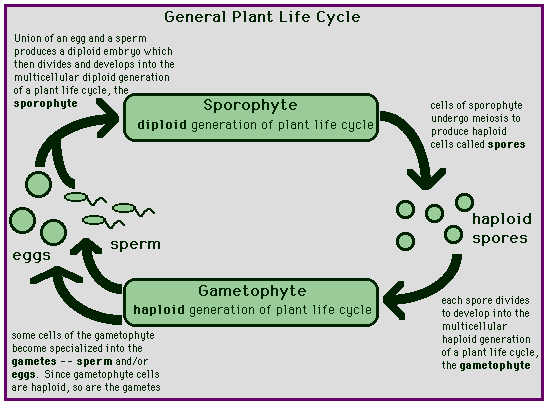
  • Have a Sporophyte & Gametophyte stage known as alternation of generations
  • Gametophyte is dominant stage
  • Reproduce by spores

Division  Bryophyta

 Mosses:

  • Small, nonvascular land plants
  • No true roots, stems, or leaves
  • Class Musci
  • Most common bryophyte
  • Grow on moist areas (brick walls, as thick mats on forest floors, and on the shaded side of trees)
  • Some can survive periodic dry spells & revive when H2O becomes available
  • Must grow close together and must have H2O to complete their life cycle 
  • Sperm swims to egg through drops of water during fertilization
  • H2O moves cell-to-cell by osmosis
  • Sphagnum moss is known for its moisture holding capacity, absorbing up to 20 times its dry weight with water.


MOSS SPOROPHYTES & FERN GAMETOPHYTES

LIFE CYCLE OF MOSSES:

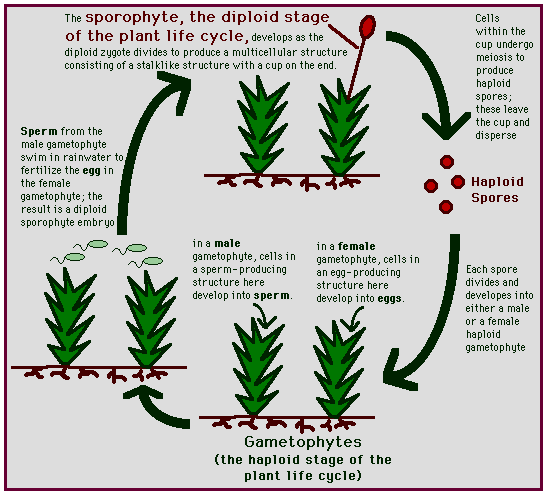
  • Mosses alternate between a haploid (n) gametophyte stage & a diploid (2n) sporophyte stage 
  • Gametophyte is the dominant generation


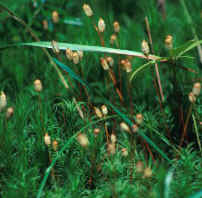
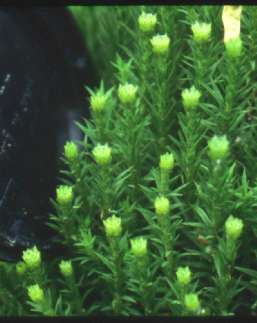
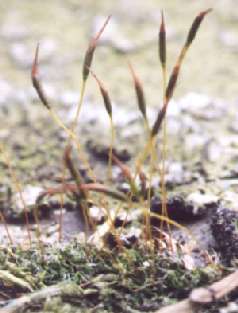
Moss Gametophyte Moss Sporophyte
Polytrichum formosum with moss flowers Tortula muralis?


  • Called alternation of generations

  • The haploid gametophyte stage contains half the chromosome number & produces gametes (egg & sperm) 
  • Gametophyte stage is dominant in the moss’s life cycle
  • Gametophytes are photosynthetic & have root-like rhizoids
  • The diploid sporophyte has a complete set of chromosomes & produces spores by meiosis
  • Sporophyte of a moss is smaller than, & attached to the Gametophyte
  • Sporophytes lack chlorophyll & depend on the photosynthetic gametophyte for food
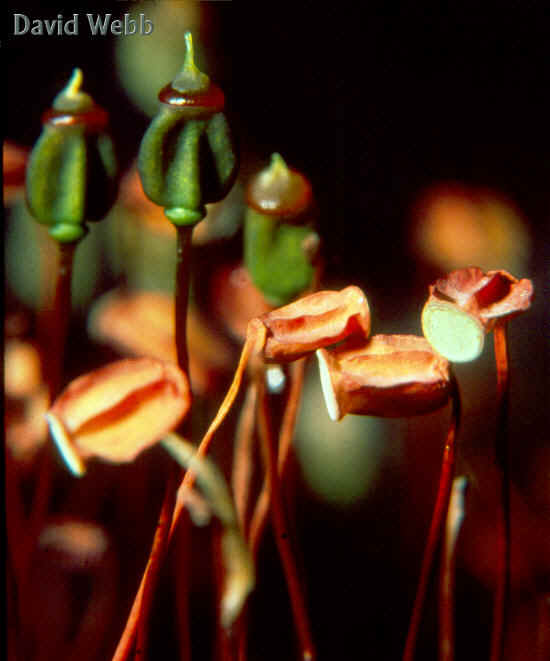
  • Sporophyte has a long, slender stalk topped with a capsule
  • Capsule forms haploid (n) spores 


Moss Capsules

Sexual Reproduction in Moss:

  • Mosses produce 2 kinds of gametes (egg & sperm)
  • Gametes of Bryophytes are surrounded by a jacket of sterile cells that keep the cells from drying out
  • Female gametes or eggs are larger with more cytoplasm & are immobile
  • Flagellated sperm must swim to the egg through water droplets for fertilization
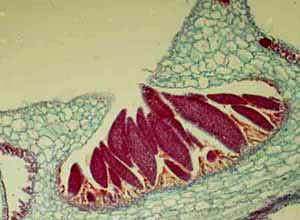
  • Moss gametes form in separate reproductive structures on the Gametophyte — Archegonium & Antheridium


Archegonium Antheridium
moss archegonial head X 40.jpg (102370 bytes) Mnium antheridial head 40X.jpg (660893 bytes)


  • Each Archegonium forms one egg, but each Antheridium forms many sperm
  • Fertilization can occur only after rain when the Gametophyte is covered with water
  • Sperms swim to the egg by following a chemical trail released by the egg 
  • A zygote (fertilized egg) forms that undergoes mitosis and becomes a Sporophyte
  • Cells inside mature Sporophyte capsule undergoes meiosis and form haploid spores
  • Haploid spores germinate into juvenile plants called protonema
  • Protonema begin the Gametophyte generation

Protonema of Funaria hygrometrica
Protonema

  • Spores are carried by wind & sprout on moist soil forming a new Gametophyte

Asexual reproduction in Mosses:

  • Asexual reproduction in moss may occur by fragmentation or gemmae
  • Pieces of a Gametophyte can break off & form new moss plants (fragmentation)
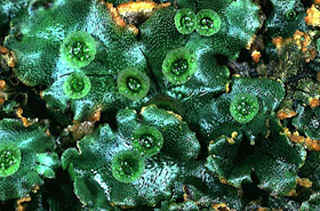
  • Gemmae are tiny, cup shaped structures on the Gametophytes 
  • Raindrops separate gemmae from the parent plant so they can spread & form new Gametophytes


Gemmae cups


Uses for Moss:

  • Help decomposer dead logs
  • Serve as pioneer plants on bare rock or ground
  • Help prevent erosion
  • Provide shelter for insects & small animals
  • Used as nesting materials by birds & mammals
  • Sphagnum or peat moss forms peat bogs (wet ecosystem)
  • Peat is burned as fuel in some areas

Division  Hepatophyta  

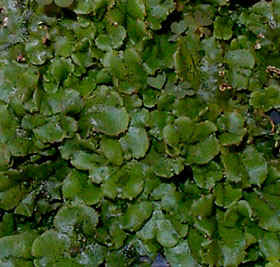
Liverworts:

  • Nonvascular
  • Undergo alternation of generations with Sporophyte attached to Gametophyte
  • Gametophytes are green & leafy and the dominant generation


Liverwort

  • Need abundant water for fertilization
  • Reproduce by spores
  • Grow on moist rocks or soil
  • Reproduce asexually by gemmae and by growing new branches

Division  Anthocerophyta

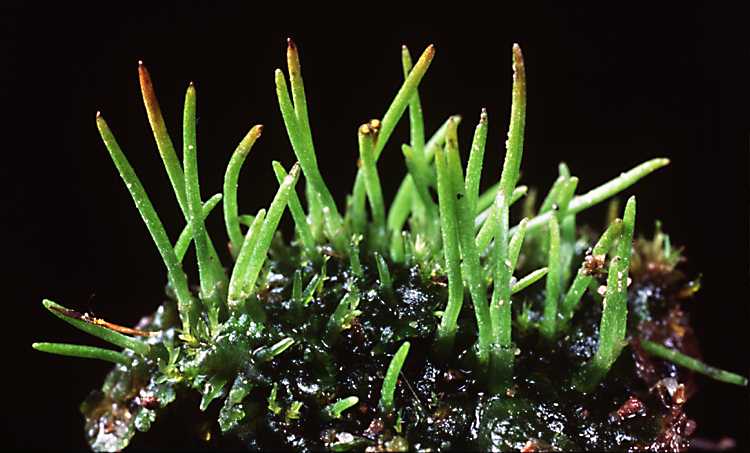
Hornworts:

  • Small, nonvascular bryophytes
  • Gametophyte leafy like liverworts
  • Archegonia & antheridia form inside the plant
  • After fertilization, zygotes develop into long, horn-shaped Sporophytes
  • Horn-shaped Sporophytes capable of photosynthesis so not completely dependent on Gametophyte


Hornwort

Seedless Vascular Plants

  • Includes club mosses, whisk ferns, horsetails, & ferns
  • Have specialized vascular tissues (xylem & phloem) to transport H2O, food, etc.
  • Have a Sporophyte & Gametophyte stage known as alternation of generations
  • Sporophyte is the dominant stage
  • Reproduce by spores

Division  Psilophyta

Whisk Ferns:

  • Photosynthetic, aerial stem forks repeatedly to form a small twiggy bush
  • No true roots, stems, or leaves
  • Have horizontal, underground stems called rhizomes
  • Root-like structures called rhizoids anchor plant
  • Reproduce by spores & vegetatively from rhizomes
  • Only 2 living genera


Whisk Fern

Division  Lycophyta

Club Mosses:

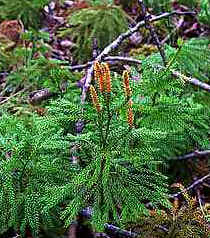
  • Low growing plants resembling pine trees
  • Have a club-shaped spore producing structure


Club Moss

  • Some like Lycopodium contain chemicals that burn quickly
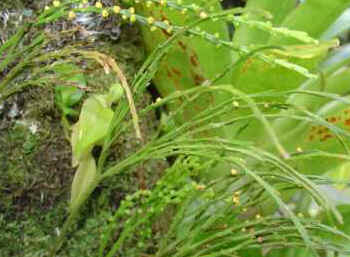
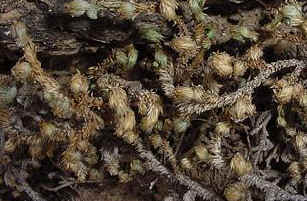
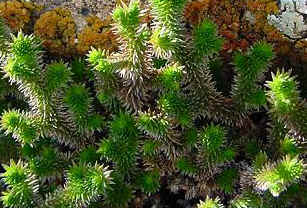
  • Resurrection moss is green (after rains) when moist and brown when dry.


Resurrection Plant
resurrection plant


Division  Sphenophyta

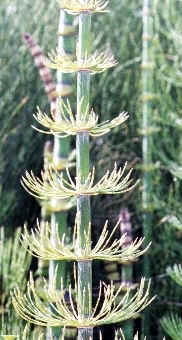
Horsetails:

  • Equisetum called scouring rush is the only living species
  • Photosynthetic aerial stems & underground rhizomes
  • Stems contain silica & were once used to scrub pots
  • Reproduce by means of spores made in small cones at the tip of branches
  • In prehistoric times, some plants of this family grew to be large trees
  • Found in wetlands


Horsetail

Division  Pterophyta

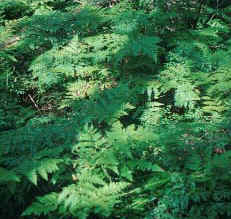
Fern Gametophyte:

  • Largest group of living seedless vascular plants
  • Live in moist habitats
  • Alternates between dominant Sporophyte stage & Gametophyte stage
  • Sporophyte stage has true roots, stems, & leaves
  • Produce spores on the underside of leaves 

fern sporangia.jpg (47544 bytes)

  • Leaves are called fronds & are attached by a stem-like petiole


FERNS

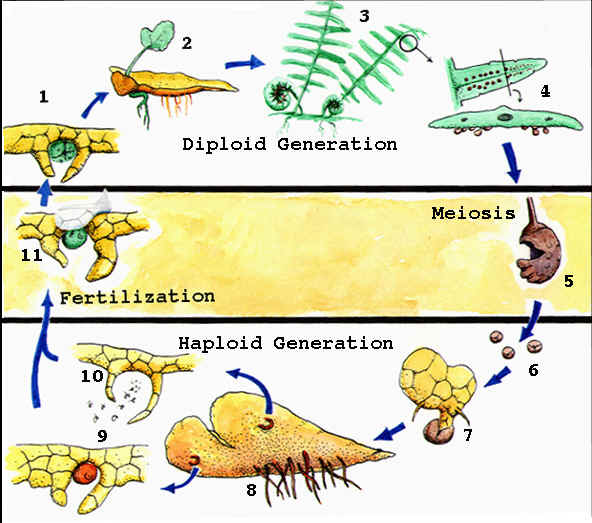
Fern Life Cycle:

  • Spores produced on underside of fronds in clusters of sporangia called sori
  • Spores undergo meiosis, are spread by wind, & germinate on moist soil to form prothallus
  • Prothallus begins the Gametophyte stage
  • Mature Gametophytes are small, heart-shaped structures that live only a short time
  • Male antheridia & female archegonia grow on the prothalli
  • Sperm must swim to the egg to fertilize it & developing embryo becomes the Sporophyte generation
  • Newly forming fronds are called fiddleheads & uncurl

Uses for Ferns:

  • Prevent erosion
  • Fiddleheads serve as food
  • Ornamental plants
  • Formed coal million of years ago
BACK


Mrs Nerg


      Seven Life Processes
Movement

Reproduction

Sensitivity

Nutrition

Excretion

Respiration

Growth

Mrs Nerg

MRS NERG


What one MAIN characteristic do ALL organisms have in common?

They’re all made of cells!

Osmosis & Diffusion in Egg Lab


Osmosis & Diffusion in an Egg


Objective:
In this investigation, you will use a fresh hen’s egg to determine what happens during osmosis & diffusion across membranes.

Materials: (per lab group)
1-2 fresh hen eggs in their shells, masking tape & marker, distilled water, clear sugar syrup (Karo, for example), vinegar, clear jar with lid, tongs, electronic balance, paper towels, paper, pencil

Procedure:

Day 1   

  1. Label the jar with your lab group & the word “vinegar”.
  2. Mass the egg with the electronic balance & record in the data table.
  3. Carefully place the raw egg into the jar & cover the egg with vinegar.
  4. Loosely re-cap the jar & allow the jar to sit for 24 to 48 hours until the outer calcium shell is removed.

Day 2   

  1. Open the jar & pour off the vinegar.
  2. Use tongs to carefully remove the egg to a paper towel & pat it dry.
  3. Record the size & appearance of your egg in your data table.
  4. Mass the egg on an electronic balance & record.
  5. Clean and re-label the jar with your lab group & the word “distilled water”.
  6. Carefully place the egg into the jar & cover the egg with distilled water.
  7. Loosely re-cap the jar & allow it to sit for 24 hours.

Day 3   

  1. Open the jar & discard the distilled water.
  2. Use tongs to carefully remove the egg to a paper towel & pat it dry.
  3. Record the size & appearance of your egg in your data table.
  4. Mass the egg on an electronic balance & record.
  5. Clean and re-label the jar with your lab group & the word “syrup”.
  6. Carefully place the egg into the jar & cover the egg with clear syrup.
  7. Loosely re-cap the jar & allow it to sit for 24 hours.

Day 4   

  1. Open the jar & pour off the syrup.
  2. Use tongs to very carefully remove the egg & rinse off the excess syrup under slow running water.
  3. Pat the egg dry on a paper towel.
  4. Record the size & appearance of your egg in your data table.
  5. Mass the egg on an electronic balance & record.
  6. Clean up your work area & put away all lab equipment.

Data:


RESULTS OF DIFFUSION

Original Mass Final Mass Appearance of Egg
VINEGAR
WATER
SYRUP


Questions & Conclusion:

1. Vinegar is made of acetic acid & water. Explain how it was able to remove the calcium shell.


2. (a) What happened to the size of the egg after remaining in vinegar?

(b) Was there more or less liquid left in the jar?

   (c) Did water move into or out of the egg? Why?


3. (a) What happened to the size of the egg after remaining in distilled water?

(b) Was there more or less liquid left in the jar?

   (c) Did water move into or out of the egg? Why?


4. (a) What happened to the size of the egg after remaining in syrup?

(b) Was there more or less liquid left in the jar?

   (c) Did water move into or out of the egg? Why?


5. Was the egg larger after remaining in water or vinegar? Why?


6. Why are fresh vegetables sprinkled with water at markets?


7. Roads are sometimes salted to melt ice. What does this salting do to the plants along roadsides & why?