| Seven Life Processes | |
| Movement
Reproduction Sensitivity Nutrition Excretion Respiration Growth |
MRS NERG |
|
What one MAIN characteristic do ALL organisms have in common? |
|
| They’re all made of cells! | |
Origin Of Life
ppt Questions
Early Thoughts on Life
1. What was Aristotle’s idea about how life arose called?
2. What is another name for spontaneous generation?
3. Explain spontaneous generation of life.
4. How long did the idea of abiogenesis or spontaneous generation last?
5. The idea of abiogenesis lasted so long because, instead of testing their ideas, people based their beliefs on what?
6. Were their observations tested?
7. Did they use the scientific method for their observations?
Examples of Spontaneous Generation
8. What observation about new life did Egyptians make when the Nile River flooded each year?
9. What observation about new life did Medieval farmers make when they stored their grain each year?
10. The English people centuries ago, threw their garbage and sewage out on the streets. What observation about new life did these people make?
11. This practice led to a plague that killed many Europeans. What was this plague called and what carried the disease organism?
12.Before refrigerators, large slabs of meat were hung after being purchased. What observation about new life was made from this practice?
13. People believed so strongly in abiogenesis that they had recipes for making living things. Name two organisms that had accepted recipes.
Disproving Spontaneous Generation
14. Francesco ____________ was an early scientists who conducted experiments to try and disprove spontaneous generation.
15. What was Redi’s hypothesis?
16. Explain how Redi tried to prove this.
17. What were the results Redi found in the closed jars & why?
18. What were the results in the open jars?
19. How did maggots appear in the open jars?
20. Complete this table summarizing Redi’s experiment:
| Evidence Against Spontaneous Generation | |
| Unsealed Jar | |
| Sealed Jar | |
| Gauze Covered jar | |
21. Redi’s experiment disproved spontaneous generation for _____________ organisms.
Use of the Scientific Method
22. Did Francesco Redi use the scientific method in his experiment?
23. What served as the control in Redi’s experiment?
24. What jars served as the experimental groups?
25. What was Redi’s conclusion?
Disproving Spontaneous Generation of Microbes
26. Anton Van _______________ made one of the first simple microscopes.
27. Leeuwenhoek called the living things he saw in pond water ______________.
28. By the end of the 19th century, these organisms were known as ______________.
29. John _____________ did experiments with microorganisms growing in broths.
30. Needham believed there was a __________ __________ present in nonliving substances like air.
31. Why were bacteria able to grow in Needham’s soups?
32. What could have been done to the broths to kill the bacteria already present?
33. What scientists repeated this experiment but with boiled broth?
34. After boiling, what did Spallanzani do to the tops of the bottles? how did this help?
35. Critics of Spallanzani’s experiment said there was not enough _______ for the bacteria to survive and that boiling had destroyed the _________ __________.
The Theory Changes
36. What did the Paris Academy of Science do in 1860 to solve the problem?
37.Who won the prize?
38. What was Pasteur’s experimental hypothesis?
39. What was the shape of Pasteur’s flasks? Include a sketch.
40. What was the special S-shaped neck intended to do?
41. Did Pasteur boil the broth in his flasks? Why?
42. The flasks were left at ___________ locations.
43. Did the broth change cloudy because microbes were growing in it?
44. What was visible in the neck of the flask after collecting there?
45. Once the S-shaped stem was broken off the top of the flasks, what happened to the broth and why?
46. Pasteur’s S-shaped flasks kept ___________ out but let ______ inside.
47. Pasteur’s experiment proved that living things only come from other _________ ___________.
48. What is the name of Pasteur’s theory?
Review
49. Where did the maggots come from in Redi’s experiment?
50. What was the purpose of the sealed jars?
51. Redi was trying to disprove – spontaneous generation or biogenesis?
52. Where did the microbes come from in Needham’s broth?
53. Needham & Spallanzani were trying to disprove – spontaneous generation or biogenesis?
54.Who proved biogenesis?
Nucleic Acids, Protein Synthesis, & DNA Technology Study Guide

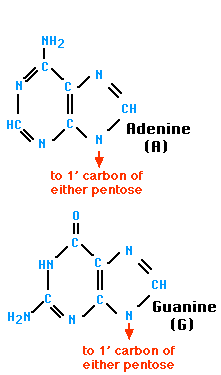
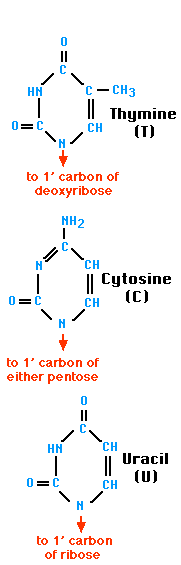
1. What are purines & pyrimidines and give examples of each?
2. Which scientists determined the structure of DNA?
3. DNA and RNA are named by their __________.
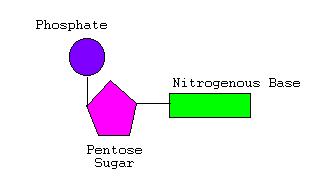
4. What three things make up a nucleotide?
5. Describe the structure of DNA.
6. An organism’s characteristics are coded for by molecules of __________.
7. What are the subunits called that make up DNA?
8. Sketch the basic structure of a nucleotide.
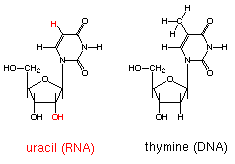
9. What 2 things are found on RNA, but are not found on DNA molecules?
10. What is the primary function of DNA?
11.What did Rosalind Franklin’s x-ray photographs of DNA crystals tell us about this molecule?
12. State Chargaff’s rule.
13. What happens to tRNA anticodons during translation?
14. What is a codon & where are they found?
15. What is the function of rRNA?
16. What bases pair with each other on: a) DNA? b) RNA?
17. Name the 3 types of RNA & tell the function of each.
18. What is the function of DNA polymerase?
19. If the code on DNA is TTAGCCTGA, what will be the code on the complementary section of DNA when it’s copied during replication?
20. List all the ways that RNA differs from DNA?
21. Where does mRNA go for proteins to be made in a cell?
22. What is transcription?
23. What is translation?
24. Which RNA carries instructions for making proteins?
25. What is the function of DNA helicases?
26. What is the job of restriction enzymes?
27. What are “sticky ends” and how are they helpful?
28. What is the difference between introns & exons?
29. What is an operon and in what type of cell would they be found?
30. What does RFLP stand for? How is this process used?
31. What is meant by cloning?
32.What is DNA fingerprinting and how can it be used?
33. How is recombinant DNA formed?
Recreation of Pasteur’s Experiment
Introduction:
Today, we take many things in science for granted. Many experiments have been performed and much knowledge has been accumulated that people didn’t always know. For centuries, people based their beliefs on their interpretations of what they saw going on in the world around them without testing their ideas to determine the validity of these theories — in other words, they didn’t use the scientific method to arrive at answers to their questions. Rather, their conclusions were based on untested observations.
Among these ideas, for centuries, since at least the time of Aristotle (4th Century BC), people (including scientists) believed that simple living organisms could come into being by spontaneous generation. This was the idea that non-living objects can give rise to living organisms. It was common “knowledge” that simple organisms like worms, beetles, frogs, and salamanders could come from dust, mud, etc., and food left out, quickly “swarmed” with life. For example:
Observation: Every year in the spring, the Nile River flooded areas of Egypt along the river, leaving behind nutrient-rich mud that enabled the people to grow that year’s crop of food. However, along with the muddy soil, large numbers of frogs appeared that weren’t around in drier times. Conclusion: It was perfectly obvious to people back then that muddy soil gave rise to the frogs.
Objective:
In this experiment, you will conduct an experiment similar to the one done by Pasteur whenever he disproved spontaneous generation.
Materials Needed:
Procedure:
Data:
Microbial Growth Record
|
|||
| Day | Flask 1 with Straight Tubing | Day | Flask 2 with S-shaped Tubing |
| 1 | 1 | ||
| 2 | 2 | ||
| 3 | 3 | ||
| 4 | 4 | ||
| 5 | 5 | ||
| 6 | 6 | ||
| 7 | 7 | ||
| 8 | 8 | ||
| 9 | 9 | ||
| 10 | 10 | ||
Conclusion:
Nucleic Acids and Protein Synthesis
All Materials © Cmassengale
Cell à Nucleus à Chromosomes à Genes à DNA
Proteins
DNA


![]() |
![]() |

DNA Replication


OKAZAKI FRAGMENTS


mRNA
tRNA

rRNA
Amino Acids
Genetic Code (RNA)
| Amino Acid | 3 Letter Abbreviation |
Codons |
| Alanine | Ala | GCA GCC GCG GCU |
| Arginine | Arg | AGA AGG CGA CGC CGG CGU |
| Aspartic Acid | Asp | GAC GAU |
| Asparagine | Asn | AAC AAU |
| Cysteine | Cys | UGC UGU |
| Glutamic Acid | Glu | GAA GAG |
| Glutamine | Gln | CAA CAG |
| Glycine | Gly | GGA GGC GGG GGU |
| Histidine | His | CAC CAU |
| Isoleucine | Ile | AUA AUC AUU |
| Leucine | Leu | UUA UUG CUA CUC CUG CUU |
| Lysine | Lys | AAA AAG |
| Methionine | Met | AUG |
| Phenylalanine | Phe | UUC UUU |
| Proline | Pro | CCA CCC CCG CCU |
| Serine | Ser | AGC AGU UCA UCC UCG UCU |
| Threonine | Thr | ACA ACC ACG ACU |
| Tryptophan | Trp | UGG |
| Tyrosine | Tyr | UAC UAU |
| Valine | Val | GUA GUC GUG GUU |
| Start | AUG | |
| Stop | UAA UAG UGA |
Practice Table:
| DNA Codon |
mRNA Codon |
tRNA Anticodon |
Amino Acid |
GCU |
|||
| TAC | |||
| AUU | |||
| UUU | |||
| TCA | |||
| UCU | |||
| CTT | |||
| ACU | |||
| ACU |
Protein Synthesis
Steps in Transcription

Steps in Translation