Dichotomous Keying


Dichotomous Keying

Introduction to Dichotomous Key Maker:

The identification of biological organisms can be greatly simplified using tools such as dichotomous keys.  A dichotomous key maker is an organized set of couplets of mutually exclusive characteristics of biological organisms.  You simply compare the characteristics of an unknown organism against an appropriate dichotomous key.  These keys will begin with general characteristics and lead to couplets indicating progressively specific characteristics. If the organism falls into one category, you go to the next indicated couplet.  By following the key and making the correct choices, you should be able to identify your specimen to the indicated taxonomic level.

Couplets can be organized in several forms.  The couplets can be presented using numbers (numeric) or using letters (alphabetical).  The couplets can be presented together or grouped by relationships.  There is no apparent uniformity in presentation for dichotomous keys.

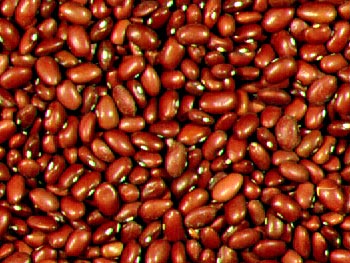
Sample keys to some common beans used in the kitchen:

Numeric key with couplets presented together.  The major advantage of this method of presentation is that both characteristics in a couple can be evaluated and compared very easily.


1a. Bean round Garbanzo bean
1b. Bean elliptical or oblong Go to 2
2a. Bean white White northern
2b. Bean has dark pigments Go to 3
3a. Bean evenly pigmented Go to 4
3b. Bean pigmentation mottled Pinto bean
4a. Bean black Black bean
4b. Bean reddish-brown Kidney bean


Alphabetical key with couplets grouped by relationship.  This key uses the same couplet choices as the key above.  The choices within the first and succeeding couplets are separated to preserve the relationships between the characteristics.


A. Bean elliptical or oblong Go to B
   B.  Bean has dark pigments Go to C
            C.  Bean color is solid Go to D
            C.  Bean color is mottled Pinto bean
                     D.  Bean is black Black bean
                     D.  Bean is reddish-brown Kidney bean
   B.  Bean is white White northern
A. Bean is round Garbanzo bean


Rules for Using Dichotomous Keys: 

When you follow a dichotomous key, your task becomes simpler if you adhere to a few simple rules of thumb:

  1. Read both choices in a couplet carefully.  Although the first description may seem to fit your sample, the second may apply even better.
  2. Keep notes telling what sequence of identification steps you took.  This will allow you to double-check your work later and indicate sources of mistakes, if they have been made.
  3. If you are unsure of which choice to make in a couplet, follow both forks (one at a time).  After working through a couple of more couplets, it may become apparent that one fork does not fit your sample at all.
  4. Work with more than one sample if at all possible.  This will allow you to tell whether the one you are looking at is typical or atypical.  This is especially true when working with plants – examine more than one leaf, branch, cone, seed, flower,…etc.
  5. When you have keyed out an organism, do not take your effort as the final result.  Double check your identification scheme, using your notes.  Find a type specimen (if available) and compare your unknown to the type specimen.  If a type specimen is unavailable, find a good description of the indicated taxonomic group and see if your unknown reflects this description.
  6. When reading a couplet, make sure you understand all of the terms used.  The best keys will have a glossary of technical terms used in the key.  If a glossary is unavailable, find a good reference work for the field (textbook, biological dictionary,…etc.) to help you understand the term.
  7. When a measurement is indicated, make sure that you take the measurement using a calibrated scale.  Do not “eyeball” it or take a guess.

Exercise 1:

Using a container of beans, use one of the dichotomous keys above to identify the beans.  Glue the beans to the card provided and label them with their common name. Indicate what steps you followed to arrive at your answer.  Turn the card in to your instructor.  Compare your answers to the instructor’s descriptions and type specimen.

Exercise 2:

Obtain samples of the snack chips provided.  Develop a dichotomous key to identify the snacks.  In your notebook, keep track of the characteristics you used to differentiate between the different snack families.  What are the values of the characteristic for each snack food?

Exercise 3:

Use the dichotomous key to conifers provided below to identify conifers.

A Key to Selected North American Native and Introduced Conifers


01a Leaves needle-like Go to 02
01b Leaves flattened and scale-like Go to 27
02a Leaves are in clusters Go to 03
02b Leaves are borne singly Go to 15
03a Two to five leaves in a cluster Go to 04  Genus Pinus
03b More than five leaves in a cluster Go to 14
04a Leaves mostly 5 in a cluster White Pine (Pinus strobus)
04b Leaves 2 or 3 in a cluster Go to 05
05a Leaves mostly 3 in a cluster Go to 06
05b Leaves mostly 2 in a cluster Go to 08
06a Leaves twisted, less than 5 inches long Pitch Pine (Pinus rigida)
06b Leaves straight, more than 5 inches long Go to 07
07a Leaves 5-10 inches long, cones very thorny Loblolly pine (Pinus taeda)
07b Leaves mostly over 10 inches long, cones unthorned Longleaf pine (Pinus palustris)
08a Leaves mostly longer than 3 inches Go to 09
08b Leaves mostly shorter than 3 inches Go to 11
09a Leaves rigid, bark grayish Black pine (Pinus nigra)
09b Leaves narrower than 1.6mm; bark reddish brown or brown Go to 10
10a Cones thornless, twigs brown Norway pine (Pinus resinosa)
10b Cones thorny, twigs whitish Shortleaf pine (Pinus echinata)
11a Leaves mostly wider than 1.5 mm Go to 12
11b Leaves mostly narrower than 1.5 mm Go to 13
12a Leaves mostly longer than 35 mm Mugho pine (Pinus mugo)
12b Leaves mostly shorter than 35 mm Jack pine (Pinus banksiana)
13a

Twigs whitened

Virginia pine (Pinus virginiana)
13b Twigs not whitened Scotch pine (Pinus sylvestris)
14a Leaves deciduous, clusters of 20-40 Larch (Larix sp.)
14b Leaves persistent, stiff, and four sided True cedar (Cedrus sp.)
15a Needles short and sharp Giant Sequioa  (Sequioadendron giganteum)
15b Needles longer than 12 mm Go to 16
16a Tiny pegs on twigs Go to 17
16b No pegs on twigs Go to 22
17a Pegs square, needles sharp Go to 18 Genus Picea
17b Pegs round, needles flat and blunt Hemlock (Tsuga sp.)
18a Leaves dark green or yellow green Go to 19
18b Leaves blue-green Go to 20
19a Branchlets droop Norway spruce (Picea abies)
19b Branchlets do not droop Red spruce (Picea rubens)
20a Leaves at right angles to stems Blue spruce (Picea pungens)
20b

Leaves point forward

Go to 21
21a Leaves about 12 mm long, seed cones 15-32 mm in length, crown narrow and pointed Black spruce (Picea mariana)
21b Leaves about 19 mm long, seed cones 50 mm in length, spire-like crown

White spruce (Picea glauca)

22a Buds large and pointed Douglas fir (Pseudotsuga sp.)
22b Buds small and rounded Go to 23
23a Terminal buds round and clustered True fir (Abies sp.)
23b Terminal buds not clustered Go to 24
24a Needles white underneath Go to 25
24b Needles green underneath Go to 26  Genus Taxus
25a Needles pointed

Redwood (Sequoia sempervirens)

25b Needles blunt Hemlock (Tsuga sp.)
26a Leaves 18 mm long or less with inconspicuous midrib American Yew (Taxus canadensis)
26b Leaves 25 mm long or more with conspicuous midrib Japanese Yew (Taxus cuspidata)
27a All leaves short and sharp Giant Sequioa  (Sequioadendron giganteum)
27b Some leaves not sharp Go to 28
28a Cones round Go to 29
28b Cones not round Go to 31
29a Cones soft and leathery Juniper (Juniperus sp.)
29b Cones woody Go to 30
30a Cones under 12 mm in diameter False cypress  (Chamaecyparis)
30b Cones over 12 mm in diameter Cypress (Cuppressus)
31a Cones resemble rosebuds White cedar or arbor vitae (Thuja)
31b Cones resemble duck bills Incense cedar (Calocedrus)


Conifers to Identify:

1. Name: 2. Name:

3. Name: 4. Name:

5. Name: 6. Name:


7. Name: 8. Name:


9. Name: 10. Name:


11. Name: 12. Name:


13. Name: 14. Name:


15. Name: 16. Name:

Photos Copyright Nearctica.com

Click here for correct answers to conifer key


Egg Osmosis Sample 1 Lab

Osmosis through the Cell Membrane of an Egg

Introduction:
The cell or plasma membrane is made up of phospholipids and different types of proteins that move laterally. These include peripheral proteins, which are attached to the interior and exterior surface of the cell membrane. Integral proteins are embedded in the lipid bilayer. Attached to these integral proteins are carbohydrate chains. These carbohydrates may hold adjoining cells together, or act as sites where viruses or chemical messengers such as hormones can attach. Cell membranes are selectively permeable. They allow some substances to pass through, but not others. Small molecules that are usually nonpolar, such as oxygen, water, and carbon dioxide, easily move through the lipid bilayer. Larger molecules, such as glucose, the food for all living things, must seek aid from the carrier proteins in a process called facilitated diffusion. Facilitated diffusion is a process used for molecules that cannot diffuse rapidly through cell membranes. Integral proteins are used by calcium, potassium, and sodium ions to move through the cell membrane. The muscles and nerves use these ions.
Diffusion is the movement of molecules from an area of higher concentration to an area of lower concentration. This difference in the concentration of molecules across a space is called a concentration gradient. Diffusion is a type of passive transport, meaning it does not require energy input by the cell. This type of transport and osmosis are the two processes used in this lab. Osmosis is the process by which water molecules diffuse across a cell membrane from an area of higher concentration to an area of lower concentration. When the concentration of the solute is higher outside of the cell, it is known as a hypertonic solution. When the concentration of the solute is lower outside of the cell, it is known as a hypotonic solution.

Hypothesis:
The substance, syrup, which has a higher solute concentration than the interior of the eggs, will cause water to leave the eggs’ membrane; the other substance, distilled water, which has a lower solute concentration than the eggs’ interior, will cause liquid to enter the eggs’ membrane.

Materials:
The materials necessary for this lab are: two fresh eggs in their shells, a felt tip marker, 200mL graduated cylinder, five jars, clear Saran wrap, white vinegar, clear sugar syrup (Karo), distilled water, tap water, pencil, paper, eraser, computer, electronic scale, and a plastic tray.

Methods:
Day One: On day one, label the five jars, with the felt tip marker: one labeled vinegar, two labeled syrup, and two labeled distilled water. Also put the group number on each jar. Find the mass of each egg and record this information in the data table. Place the two eggs in the jar labeled vinegar. Add vinegar until both eggs are submerged by it. Cover the jar with the clear Saran wrap. Place the jar on the plastic tray and allow to set for 24 hours.

Day Two: On day two, observe what has happened to your eggs. Record this in a data table. Now that the eggs’ shells are dissolved, gently remove the eggs from the vinegar. Rinse each egg with tap water. Pat the eggs dry with paper towels and mass them separately on the electronic balance. Record this in the data table. Place the eggs in the jars labeled syrup. Add syrup to each jar (labeled egg 1 or egg 2) until the eggs are submerged in syrup. Loosely cover each jar with Saran wrap. Place the jars on the tray and allow them to soak for 24 hours.

Day Three: On day three, observe what has happened to the eggs and record this information in the data table. Carefully remove the eggs from the syrup and rinse them with tap water. Pat dry with paper towels. Using the electronic balance, find the mass of each egg separately and record these masses in the data table. Place the eggs in the jars labeled distilled water (labeled egg 1 and egg 2). Add distilled water to each jar until the eggs are covered. Cover the jars with the Saran wrap and allow them to sit on the tray for 24 hours.

Day Four: On day four, remove the eggs from the jars and record the eggs’ appearance. Mass each egg on the electronic balance. Record this in the data table. Dispose of the eggs in the container provided by the teacher.

Results:

Egg 1 Data Table


Substance egg submerged in Egg’s mass before placed in substance Egg’s mass after removed from substance Observations of egg before placed in solution Observations of egg after removed from substance
Vinegar 59.2 g 86.0 g The egg’s shell is intact and is included in the first mass. The egg’s shell dissolved and wasn’t included in the 2nd mass.
Syrup 86.0 g 53.2 g The egg is swollen and soft, yet firm to touch. The liquid inside the egg diffused into the syrup.
Distilled Water 53.2 g 86.5 g The egg has lost some of its firmness. The water diffused into the egg, increasing the egg’s mass.


Egg 2 Data Table


Substance egg submerged in Egg’s mass before place in substance Egg’s mass after removed from substance Observations of egg before placed in solution Observations of egg after removed from substance
Vinegar 58.8 g 85.6 g The egg’s shell is intact and is included in the first mass. The egg’s shell is mostly dissolved and so wasn’t included in 2nd mass.
Syrup 85.6 g 52.2 g The egg is rough to touch and feels rather sturdy. The liquid inside the egg diffused into the syrup.
Distilled Water 52.2 g 88.9 g The egg feels more fragile and lighter in weight. The water diffused into the egg increasing the egg’s mass.


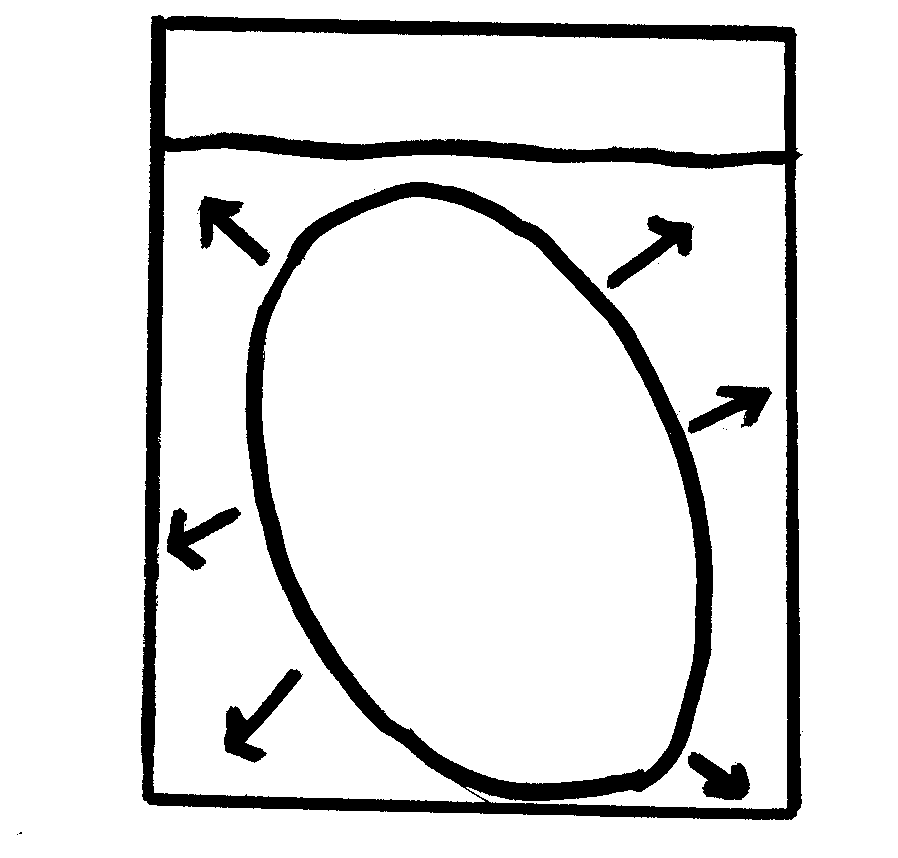
Egg in Hypotonic Solution of Vinegar & Plasmolyzed Egg in Distilled Water Egg in Hypertonic Solution of Syrup


1. When the egg was place in the water, in which direction did the water molecules move? The water moved into the eggs from the surrounding environment.

2. On what evidence do you base this? The eggs’ masses had increased from the time they were placed in the water to when the eggs were removed.

3. How do you explain the volume of liquid remaining when the egg was removed from the syrup? The volume of the liquid remaining when the egg was removed from the syrup must have increased because the eggs’ masses had decreased. The liquid within the eggs left the eggs and diffused into the surrounding syrup.

4. When the egg was place in the water after being removed from the syrup, in which direction did the water move? The water moved into the eggs.

Error Analysis:
Several errors may have occurred during this lab. When finding the eggs’ masses, on each occasion, an error may have occurred. Mistakes may have been made when recording these masses on the data table. Some of the eggs’ shell may have been left on the eggs’ membranes and changed the outcome of this lab. When the eggs were rinsed, after being placed in the vinegar and syrup, a small amount of water could have entered through the membranes of the eggs, effecting their masses. These are just a few of the errors that may have taken place throughout the lab.

Discussion and Conclusion:
The hypothesis was correct. When the eggs were placed in the syrup, their masses decreased greatly. This shows that the interior of the eggs must have had a lower solute concentration than their surrounding environment of syrup. The water within the eggs left through the membrane and diffused into the syrup, decreasing its solute concentration. When the eggs were placed in the distilled water, their masses greatly increased. This shows that the interior of the eggs must have had a higher solute concentration than their surrounding environment of distilled water. The distilled water diffused into the eggs’ membrane, decreasing the interior of the eggs’ solute concentration.

Back

Egg Osmosis Sample 2 lab


Osmosis through the Cell Membrane of an Egg


Introduction:
Transport can be either passive or active. Passive transport is the movement of substances across the membrane without any input of energy by the cell. Active transport is the movement of materials where a cell is required to expend energy. In the case of this lab the discussion will be centered on passive transport.
The simplest type of passive transport is diffusion. Diffusion is the movement of molecules from an area of higher to an area of lower concentration without any energy input. Diffusion is driven by the kinetic energy found in the molecules. Diffusion will eventually cause the concentration of molecules to be the same throughout the space the molecules occupy, causing a state of equilibrium to exist.
Another type of passive transport is that of osmosis. Osmosis is the movement of water across a semi-permeable membrane. The process by which osmosis occurs is when water molecules diffuse across a cell membrane from an area of higher concentration to an area of lower concentration. The direction of osmosis depends on the relative concentration of the solutes on the two sides. In osmosis, water can travel in three different ways.
If the molecules outside the cell are lower than the concentration in the cytosol, the solution is said to be hypotonic to the cytosol, in this process, water diffuses into the cell until equilibrium is established. If the molecules outside the cell are higher than the concentration in the cytosol, the solution is said to be hypertonic to the cytosol, in this process, water diffuses out of the cell until equilibrium exists. If the molecules outside and inside the cell are equal, the solution is said to be isotonic to the cytosol, in this process, water diffuses into and out of the cell at equal rates, causing no net movement of water.
In osmosis the cell is selectively permeable, meaning that it only allows certain substances to be transferred into and out of the cell. In osmosis, the proteins only on the surface are called peripheral proteins, which form carbohydrate chains whose purpose is used like antennae for communication. Embedded in the peripheral proteins are integral proteins that can either be solid or have a pore called channel proteins. Channel proteins allow glucose, or food that all living things need to live, pass through.


Hypothesis:
In the syrup solution, there will be a net movement of molecules out of the egg, and in the water solution, the molecules will diffuse in and out of the cell at equal rates.


Materials:
The materials used in this lab were 2 fresh eggs in the shell, an overhead marker, 400 ml of water, graduated cylinder, 1 large beaker, 2 medium beakers, 1 small beaker, white vinegar, Karo syrup, distilled water, pencil, paper, lab apron, lab goggles, saran wrap, masking tape, plastic tray, tongs, electronic balance, osmosis lab sheet, and computer.


Methods:
On day 1, measure the masses of both the eggs with the shell. Label 1 beaker vinegar, and then use the graduated cylinder to measure 400 mL of vinegar to put in the labeled beaker. Place both eggs in the solution (place a small beaker on top of the eggs, if necessary) then cover. Let the eggs stand for 24 hours or more to remove the shell.


On day 2, record the observations of what happened to the eggs in the vinegar solution. Carefully, remove the eggs from the vinegar, gently rinsing the eggs off in water. Clean the beakers used for the vinegar solution preparing them for the syrup solution, and then label the 2 medium beakers syrup. Before the eggs are placed in the syrup solution record the mass of both eggs then put it on the datasheet. After that has been done, place the eggs in the beaker, pouring enough syrup to cover the eggs, cover them loosely and let them stand for 24 hours.

On day 3, record the observations of the egg from the syrup solution. Carefully, remove the eggs from the beakers, gently rinsing the syrup off of the eggs. Pour the remaining syrup in the container provided by the teacher. Clean the two beakers used in the syrup solution, preparing them for the water solution. Before the eggs are placed in the water solution record the mass of both eggs then put it on the datasheet. After that has been done, using a graduated cylinder, measure out 200 mL of water for each beaker. Place the eggs in the water solution, cover and let stand 24 hours.

On day 4, record the observations of the egg from the water solution. Carefully remove the eggs from the beakers, gently rinsing them off. Mass both of the eggs. After the teacher has came and looked at the eggs, discard in the proper place.


Results:


Isotonic Solution Hypotonic (Vinegar is acid in Water)
Hypertonic


Table 1- Egg 1 Data


Egg mass before added into the solution (g)


Egg mass after added into the solution (g)


Observations


Vinegar

70.8 g (with shell) 98.0 g (without shell) Before the egg was added into the vinegar, it was large, but the after effect was that the egg increased in size and had become hard. After two days, the shell was completely removed.
 

Syrup

98.0 g 65.0 g When the egg was removed from the syrup, it had shrunk and it was softer than before it was added into the solution
 

Water

65.0 g 105.3 g When the egg was removed out of the water, the color looked of a pale yellow. The water had diffused into the egg, because the egg was larger in size before it was added into the water.


Table 2- Egg 2 Data


Egg mass before added into the solution (g)


Egg mass after added into the solution (g)


Observations


Vinegar

71.6 g (with shell) 99.1 g (without shell) Egg 2s’ mass was greater than egg 1s’ mass before and after it was added into the vinegar solution. The mass had increased some 20 grams with the shell off.
 

Syrup

99.1 g 64.0 g The mass of the egg had decreased some 30 grams after it the egg was removed from the syrup solution. The mass of the egg 2 was smaller than the mass of egg1.
 

Water

64.0 g 105.2 g The mass of egg 2 had increased some 50 grams after being added into the water solution. The mass of egg 1, though, was larger than the mass of 2 by 1 gram. If the egg would have remained in the water a little while longer, the egg would have probably went through cytolysis.


1. When the egg was placed in the water in which direction did the water molecules move?     The water molecules moved in the egg.

2. On what evidence do you base this? The molecules moved in, because the size of the egg increased

3. How do you explain the volume of liquid remaining when the egg was removed from the syrup? Since, the cell is selectively permeable, it only allowed a certain amount of the syrup to be present in the cell, just enough to shrink it and also equilibrium was reached..

4. When the egg was placed in the water after being removed from the syrup in which direction did the water move? The water moved in.

5. Why did the water molecules travel better inside the cell than the syrup molecules? The water molecules traveled better into the cell because smaller molecules travel better than other larger molecules.

6. What was the purpose of placing the egg in vinegar? The  vinegar solution was only used to remove the shell off the egg.

Error Analysis:
A possible error in this lab occurred by having to leave the egg in vinegar for two days instead of one to remove the shell. This caused the egg to initially take in more water.


Discussion and Conclusion:
Based on the data collected and the results of the experiment, the hypothesis was  correct. The egg appeared shriveled after removing it from the syrup because of the movement of water out of the egg. The syrup solution was hypertonic so water moved out of the egg from an area where water was more concentrated to the outside of the egg where water was less concentrated due to the high amount of sugar or solute. The acetic acid in vinegar did remove the shell from the egg, because the egg required two days to completely remove the shell, some water did move into the egg causing its initial mass without the shell to be higher than the egg’s mass with its shell. Whenever the egg was transferred from the syrup to the distilled water, the concentration of water outside the shriveled egg was greater than the water concentration inside the egg; therefore, water moved into the egg until equilibrium was reached. At that point, movement into and out of the egg continued with no net movement of water molecules.
Additional research  to see if the egg would have went through cytolysis in another 24 or more hours in the water solution would have been interesting.

BACK

DNA Model


Structure of DNA Lab


Introduction:

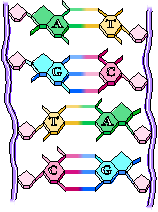
Deoxyribonucleic acid (DNA) is one of the two types of nucleic acids found in organisms and viruses. The structure of DNA determines which proteins particular cells will make. The general structure of DNA was determined in 1953 by James Watson and Francis Crick. The model of DNA that they constructed was made of two chains now referred to as the double helix. Each chain consists of linked deoxyribose sugars and phosphates units. The chains are complementary to each other. One of four nitrogen-containing bases connects the chains together like the rungs of a ladder. The bases are cytosine, guanine, thymine, and adenine. The DNA molecule looks like a spiral staircase. The structure of DNA is illustrated by a right handed double helix, with about 10 nucleotide pairs per helical turn.

DNA is a polymer. The monomer units of DNA are nucleotides. Each nucleotide consists of a 5-carbon sugar (deoxyribose), a nitrogen containing base attached to the sugar, and a phosphate group. (See Table 1.) There are four different types of nucleotides found in DNA, differing only in the nitrogenous base. Adenine and guanine are purines. Purines are the larger of the two types of bases found in DNA. They have two rings of carbons & nitrogens. Cytosine and thymine are pyrimidines and have a single carbon-nitrogen ring. (See Table 2.) The sequence of these bases encodes hereditary instructions for making proteins—which are long chains of amino acids. These proteins help build an organism, act as enzymes, and do much of the work inside cells.

Table 1


DNA Nucleotide
(Sugar + Phosphate + Base)


 Table 2


Pyrimidine
(single ring of C & N)
Purine
(double ring of C & N)


Materials:

Colored paper (any 5 different colors to run templates), scissors, transparent tape, coat hanger, hole punch, string or fishing line

Procedure:

  1. Use the section of DNA you have been assigned (Human hemoglobin or Chicken Hemoglobin), and figure out the sequence of bases present on the complementary strand of this molecule Table 1.


Human Hemoglobin Chicken Hemoglobin
Left Strand Complementary Strand Left Strand Complementary Strand
TAA GTT
TGT TGT
CGA CCG
CCG CCG
CTG CGA
GTC GTC
CAA TAT
GTC CGA
CTT TTG
TGA AGG


  1. Count the number of bases (A, T, C, and G) you will need for both strands of the DNA model your group has been assigned, and cut out these bases. (60 total)
  2. Cut out a sugar and a phosphate for each of your DNA bases. (120 of each)
  3. Construct a nucleotide for each base that you have cut (sugar + phosphate + base) by taping these together. (20 total nucleotides)
  4. Using your assigned DNA sequence from Table 1, line up the nucleotides in the right order forming he left strand of your DNA molecule. (30 nucleotides)
  5. Add the other complementary nucleotides to form the right strand by taping the bases together (A bonds with T; C bonds with G).
  6. Once the strand is complete, secure it by adding more transparent tape or ask your teacher to laminate your model.
  7. Punch two holes at the top of your model, and attach the DNA model to a coat hanger with string.
  8. Carefully twist your model into a double helix (5 base pairs in a 1/2 turn and 10 in a complete turn).
  9. Attach thin fishing line to the sides of the nucleotides to hold the turns in place.
  10. Hang your model from the ceiling using the top of your coat hanger.

TEMPLATES:

Questions & Observations:

1. What 2 molecules make up the sides of the DNA molecule?

2. What nitrogen bases form the rungs of the DNA double helix?

3. What is meant by the complementary strand of DNA?


4. What sugar makes up DNA nucleotides?

5. How are nucleotides named?


6. DNA is the instructions for building what molecule in our cells?

7. What would happen if one or more bases on the DNA strand were changed?


Echinoderm

Echinoderms

All Materials © Cmassengale  

Phylum Echinodermata
Characteristics

  • All marine
  • Known as spiny-skinned animals
  • Endoskeleton known as the test is made of calcium plates or ossicles with protruding spines
  • Includes sea stars, brittle stars, sand dollars, sea urchins, & sea cucumbers
  • Undergo metamorphosis from bilateral, free-swimming larva to sessile or sedentary adult
  • Larval stage known as dipleurula or bipinnaria
  • Adults have pentaradial ( 5 part) symmetry
  • Lack segmentation or metamerism
  • Coelomate
  • Breathe through skin gills as adults
  • Capable of extensive regeneration


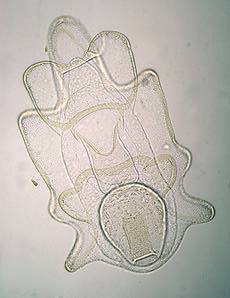
Bipinnaria Larva

  • Ventral (lower) surface called the oral surface & where mouth is located
  • Dorsal (upper) surface known as aboral surface & where anus is located
  • Have a nervous system but no head or brain in adults
  • No circulatory, respiratory, or excretory systems
  • Have a network of water-filled canals called the water vascular system to help move & feed
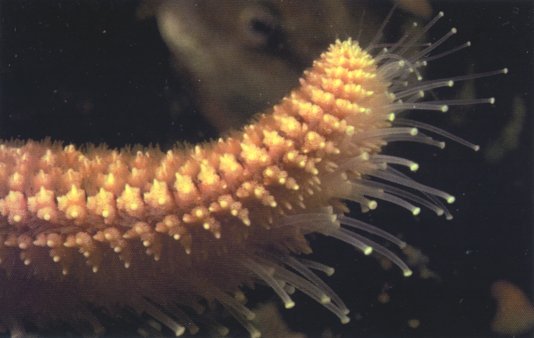
  • Tube feet on the underside of arms help in moving & feeding
  • One-way digestive system consists of mouth with oral spines, gut, & anus
  • Deuterostomes (blastopore becomes the anus)
  • Separate sexes
  • Reproduce sexually & asexually
  • Includes 5 classes:
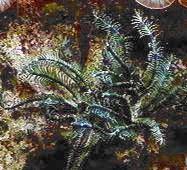
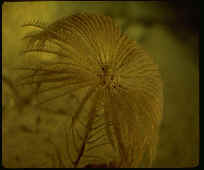
    * Crinoidea – sea lilies & feather stars
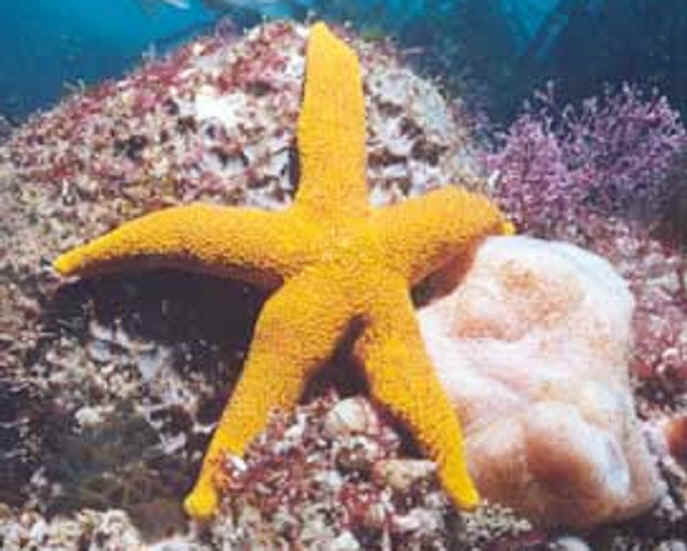
    * Asteriodea – starfish
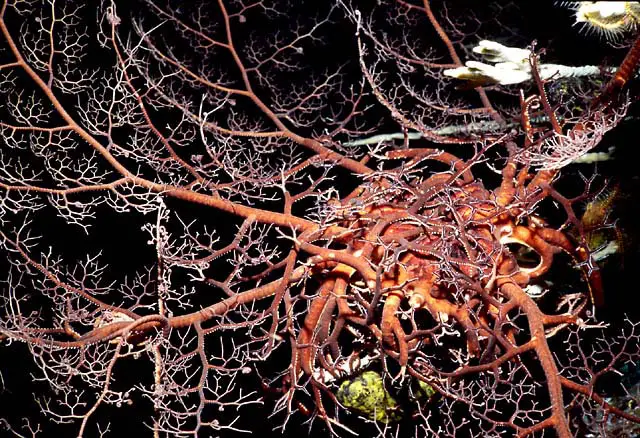
    * Ophiuroidea – basket stars & brittle stars
    * Echinoidea – sea urchins & sand dollars
    * Holothuroidea – sea cucumbers

Class Crinoidea
Characteristics

  • Sessile
  • Sea lilies & feather stars


FEATHER STAR

SEA LILY


  • Have a long stalk with branching arms that attach them to rocks & the ocean bottom
  • Can detach & move around
  • Mouth & anus on upper surface
  • May have 5 to 200 arms with sticky tube feet to help capture food (filter feeders) & take in oxygen
  • Common in areas with strong currents & usually nocturnal feeders

Class Asteroidea
Characteristics

  • Usually sedentary along shorelines
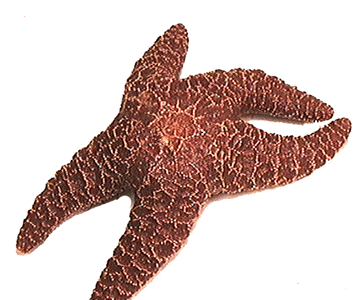
  • Starfish or sea stars
  • Come in a variety of colors
  • Prey on bivalve mollusks such as clams & oysters


Starfish Feeding on Clam

  • Have 5 arms that can be regenerated
  • Arms project from the central disk
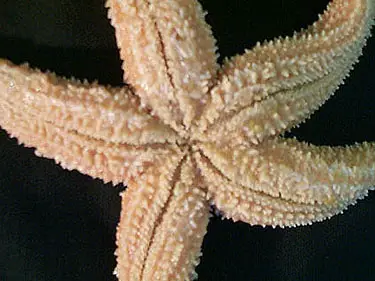
  • Mouth on oral surface (underside)


STARFISH

Class Ophiuroidea
Characteristics

  • Largest class of echinoderms
  • Includes basket stars & brittle stars


BASKET STAR

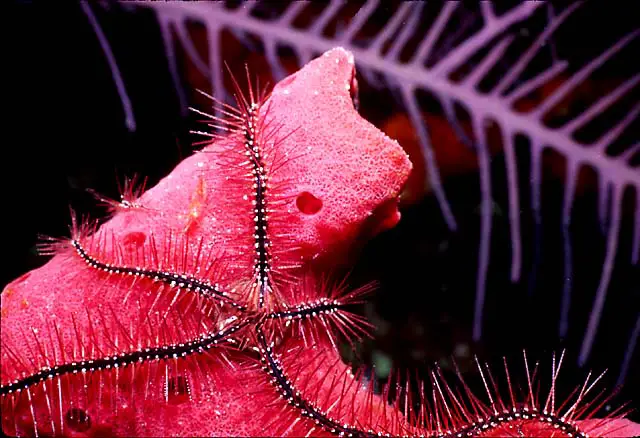
BRITTLE STAR


  • Live on the ocean bottom beneath stones, in crevices, or in holes
  • Have long, narrow arms resembling a tangle of snakes
  • Arms readily break off & regenerate
  • Move quicker than starfish
  • Feed by raking in food with arms or trapping it with its tube feet

Class Echinoidea
Characteristics

  • Includes sea urchins & sand dollars


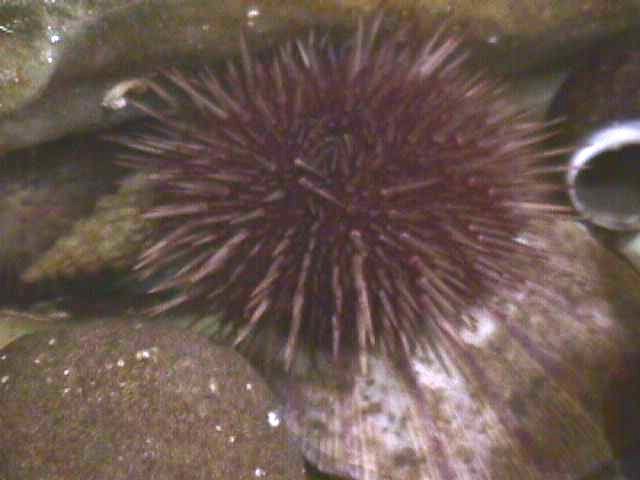
SEA URCHIN

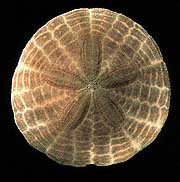
SAND DOLLAR


  • Internal organs enclosed by endoskeleton or test made of fused skeletal plates
  • Body shaped like a sphere (sea urchin) or a flattened disk (sand dollar)
  • Lack arms
  • Bodies covered with movable spines
  • Have a jawlike, crushing structure called Aristotle’s lantern to grind food
  • Use tube feet to move
  • Sea Urchins:
    * Spherical shape
    * Live on ocean bottom
    * Scrape algae to feed
    * Long, barbed spines make venom for protection
  • Sand Dollars:
    * Flattened body
    * Live in sand along coastlines
    * Shallow burrowers
    * Have short spines

Class Holothuroidea
Characteristics

  • Includes sea cucumber


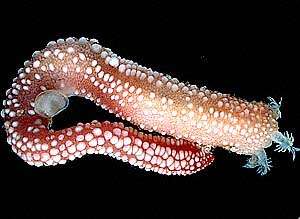
SEA CUCUMBER

  • Lack arms
  • Shaped like a pickle or cucumber
  • Live on ocean bottoms hiding in caves during the day 
  • Have a soft body with a tough, leathery outer skin
  • Five rows of tube feet run lengthwise on the aboral (top) surface of the body
  • Have a fringe of tentacles (modified tube feet) surrounding the mouth to sweep in food & water
  • Tentacles have sticky ends to collect plankton
  • Show bilateral symmetry
  • Can eject parts of their internal organs (evisceration) to scare predators; regenerate these structures in days

Structure & Function of Starfish
Body Plan

  • Range in size from 1 centimeter to 1 meter
  • Mouth located on oral surface (underside)
  • Have an endoskeleton made of calcium plates
  • Sharp, protective spines made of calcium plates called ossicles found under the skin on the aboral (top) surface


ABORAL SURFACE

  • Have pedicellariae or tiny, forcep-like structures surrounding their spines to help clean the body surface

Water Vascular System

  • Network of canals creating hydrostatic pressure to help the starfish move


WATER VASCULAR SYSTEM

  • Water enters through sieve plate or madreporite on aboral surface into a short, straight stone canal
  • Stone canal connects to a circular canal around the mouth called the ring canal
  • Five radial canals extend down each arm & are connected to the ring canal
  • Radial canals carry water to hundreds of paired tube feet


TUBE FEET

  • Bulb-like sacs or ampulla on the upper end of each tube foot contract & create suction to help move, attach, or open bivalves
  • Rows of tube feet on oral surface (underside) are found in ambulcaral grooves under each arm


Tube Feet in Ambulcaral Grooves

Feeding & Digestion

  • Tube feet attach to bivalve mollusk shells & create suction to pull valves apart slightly
  • Starfish everts (turns inside out) its stomach through its mouth & inserts it into prey
  • Stomach secretes enzymes to partially digest bivalve then stomach withdrawn & digestion completed inside starfish

Other Body Systems

  • No circulatory, excretory, or respiratory systems
  • Coelomic fluid bathes organs & distributes food & oxygen
  • Gas exchange occurs through skin gills & diffusion into the tube feet
  • No head or brain
  • Have a nerve ring surrounding the mouth that branch into nerve cords down each arm
  • Eyespots on the tips of each arm detect light
  • Tube feet respond to touch

Reproduction

  • Separate sexes
  • Two gonads (ovaries or testes) in each arm produce eggs or sperm
  • Have external fertilization
  • Females produce up to 200,000,000 eggs per season
  • Fertilized eggs hatch into bipinnaria larva which settles to the bottom after 2 years & changes into adult
  • Asexually reproduce by regenerating arms
BACK