Crayfish Dissection


Crayfish Dissection
Objectives:
• Describe the appearance of various organs found in a crayfish.
• Name the organs that make up systems of the crayfish.


Materials:
• safety goggles, gloves, magnifying glass, a lab apron, plastic zip lock bag preserved crayfish,  pen, dissecting tray, paper towels, scissors, forceps, dissecting needle, and dissecting pins.


Purpose:
In this lab, you will observe the external structures of a crayfish and dissect it to study its internal structures and systems.


Background:
Like all crustaceans, a crayfish has a fairly hard exoskeleton that covers its body. As shown in the diagram on the next page, its body is divided into two main parts, the cephalothorax and the abdomen. The cephalothorax consists of the cephalic (or head) region and the thoracic region. The part of the exoskeleton that covers the cephalothorax is called the carapace. The abdomen is located behind the cephalothorax and consists of six clearly divided segments. The cephalothorax consists of 13 segments. Each segment of both the cephalothorax and the abdomen contains a pair of appendages. The head (or cephalic) region has five pairs of appendages. The antennules are organs of balance, touch, and taste. Long antennae are organs for touch, taste, and smell. The mandibles, or jaws, crush food by moving from side to side. Two pairs of maxillae hold solid food, tear it, and pass it to the mouth. The second pair of maxillae also helps to draw water over the gills. Of the eight pairs of appendages on the cephalothorax, the first three are maxillipeds, which hold food during eating. The chelipeds are the large claws that the crayfish uses for defense and to capture prey. Each of the four remaining segments contains a pair of walking legs. In the abdomen, the first five segments each have a pair of swimmerets, which create water currents and function in reproduction. The sixth segment contains a modified pair of uropods. In the middle of the uropods is a structure called the telson, which bears the anus. The uropod and telson together make up the tail fan. The crayfish moves backward by forcing water forward with its  tail fan.

Procedure Part 1—External Anatomy of a Crayfish

1. Put on safety goggles, gloves, and a lab apron.


2. Place a crayfish on its side in a dissection tray. Use the diagram below to locate the cephalothorax and the abdomen. The carapace, a shield of chitin, covers the dorsal surface of the cephalothorax. On the carapace, observe an indentation, the cervical groove, that extends across the midregion and separates the head and thoracic regions. On the thoracic region, locate the prominent suture or indentation on the cephalothorax that defines a central area separate from the sides. Note the individual segments of the abdomen.


What is the main difference between the cephalothorax and abdomen?

___________________________________________________________

3. Turn the crayfish with its DORSAL side upward, and locate the rostrum, which is the pointed extension of the carapace at the head of the animal shown in the diagram above. Beneath the rostrum locate the two eyes. Notice that each eye is at the end of a stalk.

4. Locate the five pairs of appendages on the head region. First locate the antennules in the most anterior segment. Behind them observe the much longer pair of antennae.

Why is it useful to view the specimen on its Dorsal side for this part of your study?
______________________________________________________________

5. Locate the mouth. Then observe the mandibles, or true jaws, behind the antennae. Now locate the two pairs of maxillae, which are the last appendages in the cephalic region.

Which appendages in the cephalic region are related to the eating of food?
_____________________________________________________________


6. On the thoracic portion of the cephalothorax, observe the three pointed maxillipeds.

How are the maxillipeds related to eating?
______________________________________________________________


7. Next observe the largest prominent pair of appendages, the chelipeds, or claws. Behind the chelipeds locate the four pairs of walking legs, one pair on each segment.


8. Now use the walking legs to determine the sex of your specimen. Locate the base  segment of each pair of walking legs. The base segment is where the leg attaches to the body. Use a magnifying glass to study the inside surface of the base segment of the third pair of walking legs. If you observe a crescent-shaped slit, you have located a genital pore of a female. In a male, the sperm duct openings are on the base segment of the fourth pair of walking legs. Use a magnifying glass to observe the opening of a  genital pore.


Is your specimen a male or a female?
_____________________________________________________________

Exchange your specimen with a nearby classmate who has a crayfish of the opposite sex. Then study its genital pores.


9. On the abdomen, observe the six distinct segments. On each of the first five segments, observe a pair of swimmerets.

10. On the last abdominal segment, observe a pair of pointed appendages modified into a pair of uropods. In the middle of the uropods, locate the triangular-shaped telson.


11. Now turn the crayfish ventral side up. Observe the location of each pair of appendages from the ventral side.

From which view, dorsal or ventral, can you see the location of the appendages on the segments more clearly?
______________________________________________________________

12. Remove all jointed appendages of the crayfish and attach them to the table on the crayfish worksheet.

If dissection is two day, complete steps 13 and 14 only!


13. Next you will study the internal anatomy of a crayfish. If you must store your specimen until the next lab period, cover it with a dampened paper towel. Then place the specimen on the tray in a plastic bag. Close the bag with a twist tie. Write your name on the bag with a felt-tip marking pen, and give your specimen to your teacher.


14. Clean up your work area and wash your hands before leaving the lab.


Part 2—Internal Anatomy of a Crayfish

15. Put on a lab apron, gloves, and safety goggles.


16. Using one hand to hold the crayfish dorsal side up in the dissecting tray, use scissors to carefully cut through the back of the carapace along dissection cut line 1,  as shown in the diagram below. Cut along the indentations that separate the thoracic portion of the carapace into three regions. Start the cut at the posterior edges of the carapace, and extend it along both sides in the cephalic region.


17. Use forceps to carefully lift away the carapace. Be careful not to pull the carapace away too quickly. Such action would disturb or tear the underlying structures.

18. Place the specimen on its side, with the head facing left, as shown in the diagram below. Using scissors, start cutting at the base of cut line 1. Cut along the side of the crayfish, as illustrated by cut line 2. Extend the cut line forward toward the rostrum (at the top of the head).


19. Use forceps to carefully lift away the remaining parts of the carapace, exposing the underlying gills and other organs.


20. Use the diagram below to locate and identify the organs of the digestive system. Locate the maxillae that pass the pieces of food into the mouth. The food travels down the short esophagus into the stomach. Locate the digestive gland, which produces digestive substances and from which the absorption of nutrients occurs. Undigested material passes into the intestine. Observe that the intestine is attached to the lobed stomach. The undigested material is eliminated from the anus.

Rows of chitinous teeth line the stomach. Predict their function.
_____________________________________________________________


21. Use the diagram below to locate and identify the organs of the respiratory system. Locate the gills, which are featherlike structures found underneath the carapace and attached to the chelipeds and walking legs. A constant flow of blood to the gills releases carbon dioxide and picks up oxygen.

The feathery nature of the gills gives them a very large surface area. Why is this important?
____________________________________________________________


22. Use the diagram of the internal anatomy of the crayfish to locate and identify the organs of the circulatory system. Locate the dorsal tubular heart and several arteries. The crayfish has an open circulatory system in which the blood flows from arteries into sinuses, or spaces, in tissues. The blood flows over the gills before returning to the heart.


23. Use the same diagram to locate and identify the organs of the nervous system. Find the ventral nerve cord. Locate a ganglion, one of the enlargements of the ventral nerve cord. Locate the dorsal brain, which is located just behind the compound eyes. Note the two large nerves that lead from the brain, around the esophagus, and join the ventral nerve cord.

Many nerves leave from each ganglion. Where do you think these nerves go?
__________________________________________________________


24. Use the same diagram to locate and identify the organs of the excretory system. The blood carries cellular wastes to the disk-like green glands. Locate these organs just in front of the stomach. The green glands excrete waste through pores at the base of each antenna.

What organs in your body carry out the same function as the green glands?

      ____________________________________________________________


25. Use the diagram once again to locate and identify the organs of the reproductive system. The animal shown in the diagram is a male crayfish. If your specimen is a male, locate the testis. The testis is the long, white organ under the heart and a bit forward. The sperm ducts that carry sperm from the testis open at the fifth walking leg. If your specimen is a female, locate the bi-lobed ovary. It is in the same relative position as the testis, but the ovary appears as a large, reddish mass under the heart. Then locate the short oviducts that extend from near the center of each side of the ovary and open at the third walking leg. Exchange your specimen with a nearby classmate who has a crayfish of the opposite sex. Then study its reproductive system.

25. Dispose of your materials according to the directions from your teacher.


26. Clean up your work area and wash your hands before leaving lab.

Crayfish Worksheet Crayfish Appendage Table

BACK

Crayfish Worksheet

Name(s)__________________________________ Group______ Date ________ Period_____

Crayfish Dissection Worksheet

1. What structures are used for capturing prey and securing and eating food?


2. How are the antennae, chelipeds, other walking legs, and swimmerets related?


3. What are the main structures you could have observed when you removed the exoskeleton of the abdomen and tell the function of each?


4. Is the crayfish most vulnerable to its enemies from the dorsal or ventral side? Why?


5. The crayfish usually molts, or sheds its exoskeleton, twice a year. Why does the crayfish “hide” after it molts?


6. Name the appendages found on the head of a crayfish & tell the function of each.


.


7. Of the systems studied, which two are most unlike the related human system? Why?


8. Although the crayfish has an inflexible cephalothorax, the crayfish is classified as a segmented animal. Why?


9. Name the appendages found on the thorax of the crayfish and tell the function of each.


10. Name the appendages on the abdomen of the thorax and tell the function of each.


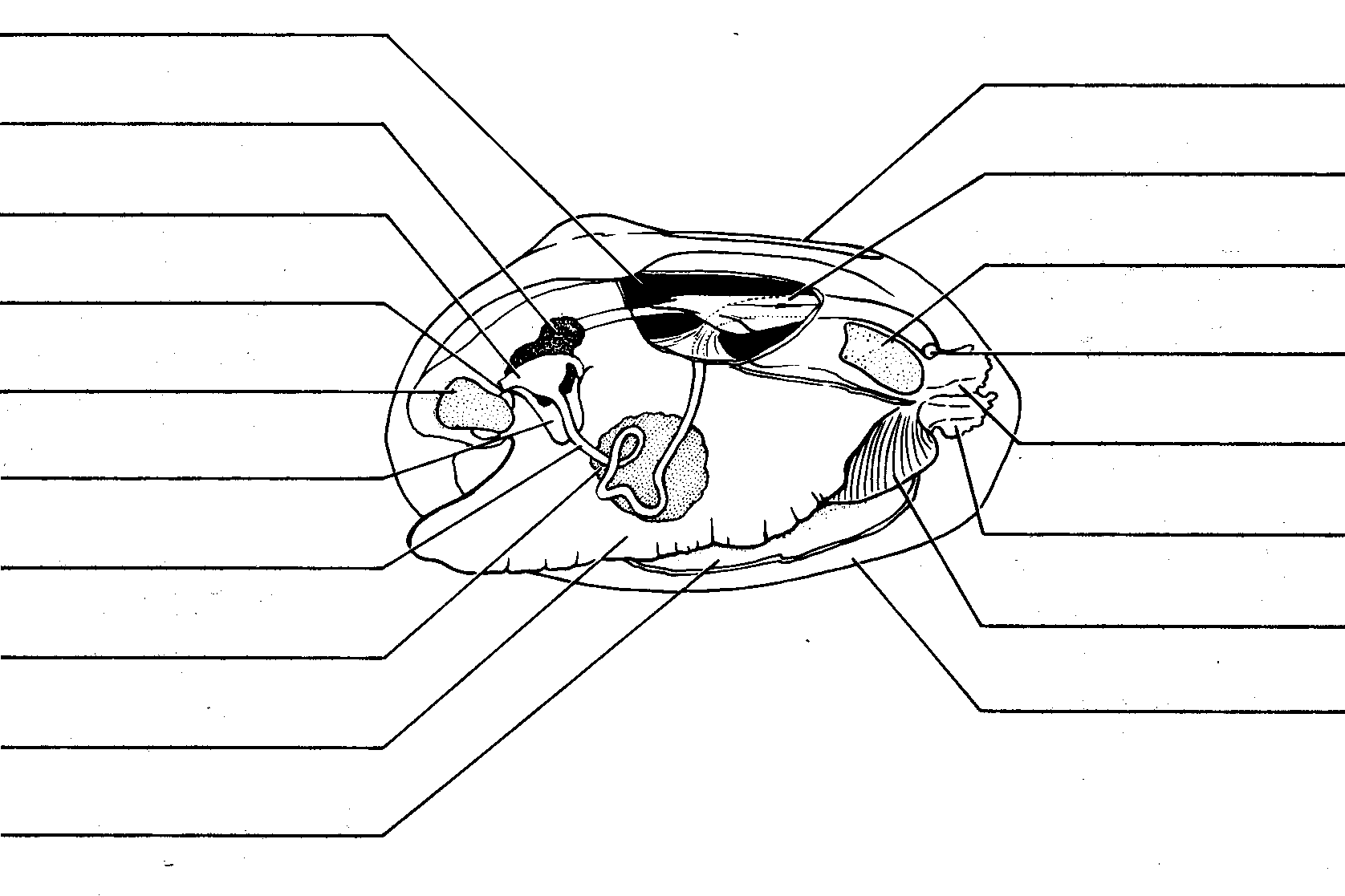
11. Label the drawing of the crayfish.

BACK


Chromosomes & Inheritance Worksheet Bi


Chromosomes & Inheritance

Section 12-1 Sex Determination

1. Geneticist Thomas Hunt Morgan conducted breeding experiments with what animal?

2. How many pairs of chromosomes are found in Drosophila.

3. Are the chromosomes in male & female fruit flies the same? Explain.

4. What did Morgan name the 2 chromosomes in the non-identical pair?

5. Describe the shape of the 2 chromosomes in the non-identical pair.

6. Morgan hypothesized that the non-identical pair were the _____________ chromosomes.

7. All other chromosomes except X and Y are called ______________________________.

8. What is the genotype for males? Females?

9. When male & female fruit flies are crossed, what percent of the offspring will be male? Female?

10. Because the X chromosome was much bigger than the Y chromosome, what did Morgan hypothesize?

11. Genes on the X chromosome are ____________________________ genes.

12. What is meant by sex linkage?

13. Did Morgan’s experiments prove or disprove the existence of sex-linked traits?

14. Name a trait that Morgan discovered was carried on the X chromosome in fruit flies.

15. Use a Punnett Square to show the results of crossing a red-eyed female (XRXR) with a white-eyed male XrY.

16. Use a Punnett Square to show the results of crossing a red-eyed female (XRXr) with a red-eyed male XRY.

17. What are linkage groups?

18. What 2 fruit fly traits did Morgan discover were linked?

19. What is the effect of crossing-over on genes?

20. Do genes that are close together or far apart get crossed over more often?

21. What is a chromosome map?

22. What scientist made a chromosome map of Drosophila?

23. How is one amp unit determined?

24. What is germ cell mutation & what is its effect?

25. What are somatic mutations, give an example, & can they be passed on to offspring?

26. What are lethal mutations?

27. What are chromosome mutations?

28. Name & describe 4 types of chromosome mutations.

29. What are gene mutations?

30. What are point mutations?

31. What are substitutions & give an example of a disease caused by this type of gene change?

32. What are frame shift mutations?

Section 12-2 Human Genetics

33. What is a pedigree?

34. Write the symbol that would appear on a pedigree for each of the following:

a. Male carrier?

b. Male with trait?

c. Female carrier?

d. Female with trait?

35. Name several single allele traits (both dominant & recessive).

36. Name 3 sex-linked traits.

37. What are polygenic traits and name four.

38. What influences the expression of a sex-influenced trait?

39. Name & describe 2 types of nondisjunction.

40. What causes Down syndrome?

41. When would genetic screening be useful?

42. What is amniocentesis?

43. What disease is genetically screened fro immediately after birth in the U.S.?

Chromosome Notes


 Chromosomes Linkage

Genes on the same chromosome are linked.

Example: Unlinked Genes

G = gray body

g = black (ebony) body


R = red eyes

r = purple eyes

The diagrams below show that the locus for body color (G or g) is on a different chromosome than the locus for eye color (R or r).  These two loci will assort independently to produce either GR and gr gametes or Gr and gR gametes.

cross: GgRr X ggrr

gametes: GR, Gr, gR, gr X gr

Ratio expected: 1:1:1:1

Example: Linked Genes

Suppose G and R are linked as shown below. If the body color and eye color loci are on the same chromosome, they will not assort independently unless crossing-over occurs frequently.

In this case, GgRr can produce only two kinds of gametes: GR and gr.

GgRr X ggrr

gametes: GR, gr X gr

If G and R are linked, then whenever you have a G, you have an R. Any gray, purple offspring (G-rr) would result from crossing over because a Gr gamete is needed.

Suppose out of 100 offspring, you got 46 gray, red, 46 black purple, 4 gray purple and 4 black red.  Eight percent of the offspring resulted from crossing over. These offspring are recombinant.

Crossing Over

Crossing over is more likely to occur between genes that are far apart. The farther apart genes are, the greater the probability that crossing over will occur between them.

In the example above, we had 8% crossing over.

The percent of recombination (crossing over) can beused as a measure of how far apart genes are.   1% crossing over = 1 map unit.

Example

G = gray body

g = black (ebony) body


R = red eyes

r = purple eyes

Suppose that G and R are linked (on the same chromosome) in a particular individual and g and r are also linked

P1 GgRr X ggrr

If there is no crossing-over, possible gametes for the first parent are GR and gr.

If there is crossing-over, possible gametes are gR and Gr.

the following results were obtained:

How far apart are the G and R loci?

Sex Chromosomes

Humans have 23 pairs of chromosomes (46 total) chromosomes. Two of these are called sex chromosomes, the other 44 are called autosomes.

There are two kinds of sex chromosomes, called the X chromosome and the Y chromosome. The X chromosome is larger and contains many genes. The Y chromosome is much smaller and contains very few genes.

Normally, human females have two X chromosomes (XX) and males have one X and one Y chromosome (XY).

Occasionally, an accident happens in which a person is born with too many or too few sex chromosomes. In these cases, the person will be male if they inherit a Y chromosome and female if they do not.

Examples of four different possibilities that produce males are shown below. The last three are abnormal.

XY
XXY
XXXY
XYY

Examples of four different possibilities that produce females are shown below. Normal females are XX.

X
XX
XXX
XXXX

The cross below shows that normal females produce eggs that have one X chromosome. Half of the sperm produced by normal males have an X chromosome and the other half have a Y chromosome.

XX   x   XY

¯

This analysis shows that half of the offspring are expected to be male, half are expected to be female.


Chromosomal Determination of Sex

Males


The Y chromosome contains a gene called SRY (for sex-determining region of Y).


Females


Testicular Feminization


The body cells of people with testicular feminization are insensitive to testosterone and therefore develop the female phenotype even though they have a Y chromosome.

It has an X-linked recessive mode of inheritance.

Guevodoces

Guevodoces refers to a condition in which the male phenotype develops after puberty.

It is due to delayed testosterone production.

X-Linkage

Morgan (Columbia U):

P1      red-eyed X white-eyed

¯

F1            all red-eyed

F2           3:1 (red:white) but all white were male

explanation:

These genes are found on the X chromosome but not on the Y chromosome. An XrY male will therefore have red eyes. Details of this cross are below.

P1     XRXR       X XrY
   female male

gametes: XR (female) and Xr, Y (male)

The offspring produced from the above cross are crossed with each other (below):

F1      XRXr   X   XRY

¯

gametes: XR and Xr (from female); XR and Y (from male)

F2:

Notice that there are three possible genotypes for females and two possible genotypes for males.

Females Males
Genotypes Phenotypes Genotypes Phenotypes
XRXR red XRY red
XRXr red XrY white
XrXr white

X-Linked Inheritance

Males inherit their X chromosome from their mother. Their Y chromosome comes from their father. A male, therefore, cannot pass an X-linked trait to his sons. Males inherit all of their X-linked traits from their mother.

If a male inherits an X-linked recessive trait, it will be expressed because males do not have a homologous X chromosome.

Females can be carriers of X-linked traits without expressing them because they might carry the dominant allele on the other X chromosome. For example, the following genotype will have a dominant phenotype: XAXa.

Dosage Compensation

Although females have twice as many X-linked genes, the amount of protein produced by these genes is the same in females as it is in males.


Reduced protein production (called dosage compensation) occurs as a result of inactivating one X chromosome by coiling and condensing it. When condensed, it cannot be transcribed, that is, it cannot be used to produce mRNA.

Condensed X chromosomes, called Barr bodies, are visible using ordinary light microscope techniques.

The table below shows the number of Barr bodies in normal cells and in the cells of people with an abnormal number of X chromosomes. Normal males do not have Barr bodies because they only have one X chromosome.

Genetic Condition  

# Barr Bodies per Cell

normal male 0
normal female 1
XXX female 2
XXXX female 3
XXY (Klinefelter male) 1

In summary, one X chromosome remains active, the others are inactivated by forming Barr bodies.


Inactivation


Inactivation occurs early in embryonic development (12-16 days).

In females, each cell normally contains two X chromosomes. The X chromosome that is inactivated is determined randomly.

img006.gif (6009 bytes)


img007.gif (6184 bytes)

Once inactivation occurs, all daughter cells of a particular cell have the same X chromosome inactivated.

All of the “pink” chromosomes in the drawing below (left side of diagram) have been inactivated. All future cells produced by this cell will have the pink chromosome inactivated. In the diagram on the right, all of the blue chromosomes have been inactivated. All future generations of this cell will have the blue chromosome inactivated.

img008.gif (6206 bytes)

Females are therefore mosaics with respect to the X chromosome. Patches of body cells will have the maternally inherited X chromosome inactivated and other patches will have the paternally inherited one inactivated.


Example of Mosaicism: Calico Cats


A calico cat has patches of orange and patches of black

X = orange

X1 = black

MALES:

XY = orange

X1Y = black

FEMALES:

XX = orange

X1 X1 = black

X X1 = orange or black patches

All cells descended from an X1 cell (X is inactive) are orange-yellow.

All cells descended from an X cell (X1 is inactive) are black.


Human Example – Anhydrotic Dysplasia


Anhydrotic dysplasia is a disease that results in the absence of sweat glands.

It is inherited as an X-linked recessive disease.

Let X = normal sweat glands and X’ = absence of sweat glands. Normal males are XY. Affected males are X’Y and do not have sweat glands.

Normal females are XX, heterozygous females are XX’ and have patches of skin with sweat glands and patches of skin without sweat glands. Females that are X’X’ do not have sweat glands.


Other Information


Should heterozygous females for colorblindness be able to see color?

Suppose: X = color vision

x = colorblind


The Retina of a heterozygous (Xx) female will have some cells with the “X” inactivated and other cells with the “x” inactivated.

A heterozygous carrier of red-green colorblindness has some colorblind cells in her retina. The non-colorblind cells enable her to see color.

Turner’s syndrome is an abnormality in females where there is only one X chromosome; the other is missing.   These people have abnormalities that will be discussed in the next chapter.   Why aren’t Turners syndrome females normal?  Evidence indicates that some genes in the Barr body remain active. Their DNA is uncoiled and extends from the Barr body. If the Barr bodies of a normal female were missing, she would exhibit Turners Syndrome.


Home      General Biology 1      General Biology 2      Human Biology      Anatomy and Physiology