Pre AP Grades


Pre AP Biology Grades  

August 20, 2011
Fourth Nine Weeks Grades

1st Period 8th Period
CHERYL MASSENGALE COMPLETE DETAILED RECORD – Quarter 1
1 PREAP BIOLOGY 1 2
Qtr. 1 Aug 18, 2011 100100 QUARTER Method: Weight/Categories
Student H T HOMEWORK LAB QUIZ TEST Qtr. 1
= = > 91100 A- 91% A 100% A 99%
= = > 94 94 A 94% A 94% A 94%
= = > 91 94 A- 91% A 94% A 94%
= = > 88 94 B+ 88% A 94% A- 93%
= = > 91 89 A- 91% B+ 89% B+ 89%
= = > 88 89 B+ 88% B+ 89% B+ 89%
= = > 79 89 C+ 79% B+ 89% B+ 88%
= = > 73 89 C- 73% B+ 89% B+ 87%
= = > 94 83 A 94% B- 83% B 84%
= = > 91 83 A- 91% B- 83% B 84%
= = > 88 83 B+ 88% B- 83% B 84%
= = > 85 83 B 85% B- 83% B- 83%
= = > 83 B- 83% B- 83%
= = > 80 83 B- 80% B- 83% B- 83%
= = > 73 83 C- 73% B- 83% B- 82%
= = > 97 78 A 97% C+ 78% B- 80%
= = > 91 78 A- 91% C+ 78% C+ 79%
= = > 88 78 B+ 88% C+ 78% C+ 79%
= = > 85 78 B 85% C+ 78% C+ 79%
= = > 82 78 B- 82% C+ 78% C+ 79%
= = > 85 72 B 85% C- 72% C 74%
= = > 73 72 C- 73% C- 72% C- 72%
Average = = > 87 85 B+ 87% B 85% B 85%
WT.10% WT.20% WT.70% Weight/PercentagesASSIGNMENTS FOR 1 PREAP BIOLOGY Quarter 1
AUG 17 1 H 100 SAFETY WKSHT AUG 18 2 T 100 SAFETY TEST
CHERYL MASSENGALE COMPLETE DETAILED RECORD – Quarter 1
8 PREAP BIOLOGY 1 2
Qtr. 1 Aug 18, 2011 100100 QTR PTS. QUARTER Method: Cumulative Points
Student H T HOMEWORK LAB QUIZ TEST Qtr. 1
= = > 91 89 180/200 A- 91% B+ 89% A- 90%
= = > 79100 179/200 C+ 79% A 100% B+ 89%
= = > 85 94 179/200 B 85% A 94% B+ 89%
= = > 88 89 177/200 B+ 88% B+ 89% B+ 89%
= = > 82 94 176/200 B- 82% A 94% B+ 88%
= = > 85 89 174/200 B 85% B+ 89% B+ 87%
= = > 79 94 173/200 C+ 79% A 94% B 86%
= = > 88 83 171/200 B+ 88% B- 83% B 86%
= = > 82 89 171/200 B- 82% B+ 89% B 86%
= = > 79 89 168/200 C+ 79% B+ 89% B 84%
= = > 73 94 167/200 C- 73% A 94% B 84%
= = > 82 83 165/200 B- 82% B- 83% B- 83%
= = > 76 89 165/200 C 76% B+ 89% B- 83%
= = > 79 83 162/200 C+ 79% B- 83% B- 81%
= = > 76 78 154/200 C 76% C+ 78% C+ 77%
= = > 55 83 138/200 F 55% B- 83% D+ 69%
= = > NC 94 94/200 F 0% A 94% F 47%
= = > NC 89 89/200 F 0% B+ 89% F 45%
Average = = > 75 89 164/200 C 75% B+ 89% B- 82%
WT. 50% WT. 0% WT. 0% WT. 50% Cumulative PointsASSIGNMENTS FOR 8 PREAP BIOLOGY Quarter 1
AUG 17 1 H 100 SAFETY WKSHT AUG 18 2 T 100 SAFETY TEST

Massengale

Plant Classification Study Guide

PLANT EVOLUTION AND CLASSIFICATION

1. There are more than ________________ different plant species.

2. Plants share Four Characteristics:
A._________________________________________________________________

    B._________________________________________________________________

    C._________________________________________________________________

    D._________________________________________________________________

3. In their characteristics plants are most similar to the ________________________.

4. Plants and Green Algae Have these Characteristics in Common:
A.__________________________________________________________________

    B.__________________________________________________________________

    C.__________________________________________________________________

    D.__________________________________________________________________

5. There are also some important Difference:
A.__________________________________________________________________

    B.__________________________________________________________________

    C.__________________________________________________________________

    D.__________________________________________________________________

6. All plants are photosynthetic, multicellular, __________________________ organisms, and can _________________________  _________________________.

7.  A ____________________ is a ripen ovary that surrounds the seeds of angiosperms.

8. All plants probably evolved from ______________________   __________________.

9. One of the greatest problems that encountered by the first land plants was the need for
___________________________.

10.   How does water aid the fertilization of some organisms? ______________________
____________________________________________________________________

11.   _________________________ of _______________________ means that there are TWO
phases in the life cycle of plants:

    A.  The first phase: ___________________  ______________________ phase that produces ________________________ and _______________________.

    B. The second phase: ___________________  _____________________ phase that produces ________________________.

12.  Sexual reproduction ensures there will be __________________________  ______________________ in plants.

13.  The type of vascular tissue that transports organic compounds is ____________________________.

14.   The _____________________ is a waxy, waterproof layer that coats the parts of a plant
exposed to air.

15.   The earliest plants were probably __________________, and had NO true ___________,
____________________, or ______________________.

16.   __________________ is a hard compound that strengthens cell walls, enabling cells to support additional weight.

17.  The 12 Phyla of plants can be divided into two groups based on the presence of __________________________  ___________________________.

18. One adaptation that help land plants to slow the evaporation of water was a
____________________________.

19. The type of vascular tissue that transports water is _________________________.

20. This type of angiosperm has parallel leaf venation __________________________.

21. The waxy covering on plant surfaces is called _____________________________.

22.  The plant material in peat bogs decomposes very ________________________ because the bogs are ____________________________.

23. How many plant phyla produce seeds? _____________________

24. What type of gymnosperm produces fleshy seeds? ____________________________

25. What is the photosynthetic phase of a moss called? ______________________________

26.  Bryophytes, instead of roots, they have long, thin strands of cells called ____________________ that attach the plant to the soil.

27.   Vascular plants absorb water from the soil through underground structures called
_____________________.  They also provide a plant with ___________________.

28.  Non-woody plants are usually called ___________________________.

29.  _____________________ carries organic compounds in any direction depending on the plant’s needs.

30.   In order to reproduce, a nonvascular plant must have ________________________.

31.   Rhizoids are long, thin strands of cells that resemble ________________________.

32.   The roots of vascular plants absorb water and _________________________  _________________________.

33. What is the non-photosynthetic phase of a moss called ____________________________.

34. Gymnosperms produce “_____________________” seeds, while angiosperms produce _______________________ protected inside a _____________________________.

35. This type of angiosperm has net leaf venation __________________________.

36. The _________________________ allow for the exchange of carbon dioxide and oxygen.

37. Sphagnum is often used to ______________________ soil and help it ____________________  __________________________.

38.   A ___________________ is a protective structure that contains a plant
__________________, and _________________  __________________.

39.   A __________________ is a structure that develops in plants with flowers and contains the
____________________.

40.  Nonvascular plants are distinguished by the absence of ______________________ and ____________________________.

41. All nonvascular plants are collectively called _______________________________.

42.   Vascular plants are classified into one of Two Types: _______________________ or
________________________________ plants.

43.   What are the Four Phyla of Seedless Vascular Plants? ________________________,
________________________, ______________________, ________________________.

44.   What are the Five Phyla of Seed Vascular Plants? _______________________,
_________________________, _________________________,
________________________, and  ______________________________.

45.  Vascular seed plants are subdivided into TWO general categories according to the type of seeds they produce: _________________________________ and
____________________________________.

46. A ____________________________ is a special reproductive structure composed of hard scales, that produces seeds without a fruit.

47.   ____________________ are vascular plants that produce seeds lacking a protective
_______________________.  They are often called _______________  _________.

48.  A seed is a _________________________ embryo inside a __________________________  _____________________.

49.   The _____________________ are vascular plants that produce seeds enclosed and
__________________ by a __________________.

50.   All angiosperms produce _________________ and _________________.

51.   The protective structure that contains the seed or seeds of an angiosperm is the
______________________.

52. One way of distinguishing among the many types of angiosperms is by counting the number of seed leaves or ________________________.

53.  Angiosperms with only ONE cotyledon are called _______________________________  or simply  _____________________.

54.  An angiosperm whose embryo has TWO cotyledons are called __________________________________ or simply _______________________.

56.   Plants that produce seed protected by a fruit are called _______________________________.

57.   A dicot is an angiosperm whose embryo has Two _______________________.

58. Plants remove carbon dioxide from the air by the process of ________________________.

59. Bryophytes are _______________-growing plants that live in _____________________  ________________________________.

60. All vascular plants have __________________________ tissues and _____________________________ of _________________________________.

61. True roots, stems, and leaves are characteristics of all ______________________  _________________________.

62. What are the primary functions of spores and seeds?

63. In what ways do green algae differ from plants?

64. Why do nonvascular plants have to live in moist environments?

65. Name three bryophytes, and identify their common characteristics.

66. Which plant phylum contains the tallest and most massive plants?  Is this a phylum of nonvascular, seedless vascular, or seed plants?

67.  Conifers are often found living at high elevations in locations with cold, dry winters.  What characteristic enables them to retain their leaves in these conditions?



Pre AP Lab Reports


Pre AP Lab Reports

Calorimetry of Food Energy
Sample 1     Sample 2     Sample 3
Scientific Method – All Thumbs!
Sample 1     Sample 2
Osmosis Through an Egg Membrane
Sample 1     Sample 2    Sample 3     Sample 4
Environmental pH
Sample 1     Sample 2
Chromatography of Plant Pigments
Sample 1     Sample 2     Sample 3
Planarian Regeneration
Sheep Heart Dissection Chromatography of Pigments
Metric Measurement Water Properties
 
BACK

Plant Analytical Questions

Plant Analytical Questions

Plant Structures and Function

Part 1: Use the following diagram of a seedling to answer these questions.

  1. What tropisms are being exhibited by the various parts of this seedling?


  1. What hormones are involved in these responses?


Part 2: Use the diagram below to complete lines a – f.

The diagrams represent three conditions of day & night length. A short-day plant, with a critical night length of 14 hours, and a long-day plant, with a critical night length of 8 hours, are grown under each condition. On lines a – f, indicate whether each plant will flower under each condition.


Preap Biochemistry Study Guide


Biochemistry Review 


1. Molecules with a slightly negative end and a slightly positive end are called ___________________  _____________________________.

2. A monomer of protein is called an __________________  __________________.

3. An attractive force between like particles is called ___________________________.

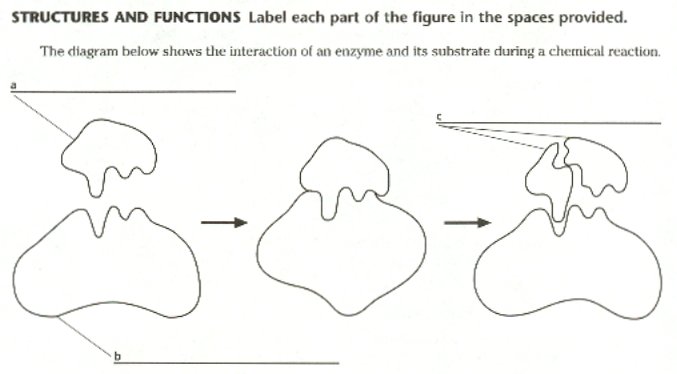
4. Organic molecules that catalyze reactions in living systems are ______________________.

5. The compound found in living things that supplies the energy in one of its chemical bonds directly to cells is ______________________.

6. Enzymes lower activation energy by___________ to the ____________________ and ______________________ bonds within the ________________________.

7. The monomers that make up nucleic acids are called __________________________.

8. The type of attraction that holds two water molecules together is called __________________________  __________________________.

9. The sharing of three pairs of electrons is called a ___________________  _____________.

10.  The structural building block that determines the characteristics of a compound is called the _____________________________  _______________________.

11.  Large carbon compounds are built from smaller molecules called ______________________________.

12.  What is the type of reaction that forms large molecules from smaller ones? _________________________________  _____________________________.

13.  What type of reaction breaks large molecules into smaller ones? _______________________

14.  What is the by product of a condensation reaction? __________________________

15.  The attractive force between unlike particles is called ____________________________.

16.  A compound that is stored as glycogen in animals and as a starch in plants is ____________________________________.

17.  Lipids are good energy storage molecules because they have many _________________-___________________ bonds.

18.  What are the components of many lipids? ________________________  ______________________

19.  What is the monomer of many polysaccharides? ______________________________

20.  What kind of reaction allows amino acids to become linked together? ________________________________  _____________________________.

21.  Nucleic acids function primarily to carry __________________________  ____________________ and direct _____________________  ______________________.

22. Tends not to react with water, “Water Fearing”  ________________________________

23. Attracted to water molecules, “Water Loving” _________________________________

24. Water is called a ___________________________  ___________________________.
DIRECTIONS: Read Chapter 3, Biochemistry, and Answer the questions below as completely and as thoroughly as possible. Answer the question in essay form (not outline form), using complete sentences. You may use diagrams or pictures to supplement your answers, but a diagram or picture alone without appropriate discussion is inadequate.

1. Describe the structure of a water molecule, and explain how the electrical charge is distributed over the molecule.

2. Describe the structure of amino acids and proteins.

3. What are the structural differences between monosaccharides, disaccharides, and polysaccharides?

4. What is capillarity? Include defining Adhesion and Cohesion.

5. How does a condensation reaction differ from a hydrolysis reaction?

6. Give Three reasons why water is an effective solvent.

7. What is an organic compound?

8. What property allows carbon compounds to exist in a number of forms?

9. The presence of four electrons in the outermost energy level of a carbon atom enables
carbon atoms to form what THREE Things.

10. Living things contain many different proteins of vastly different shapes and functions.
What determines the shape and thus the function of a particular protein?

11. How does the structure of a phospholipid, linear molecules with a polar end and a
nonpolar end, relate to their function in the cell membrane?