|
Pre AP Lab Reports
|
|||||||||||||||||||||
BACK |
|||||||||||||||||||||
|
Pre AP Lab Reports
|
|||||||||||||||||||||
BACK |
|||||||||||||||||||||
Plant Analytical Questions
Plant Structures and Function
Part 1: Use the following diagram of a seedling to answer these questions.

Part 2: Use the diagram below to complete lines a – f.
The diagrams represent three conditions of day & night length. A short-day plant, with a critical night length of 14 hours, and a long-day plant, with a critical night length of 8 hours, are grown under each condition. On lines a – f, indicate whether each plant will flower under each condition.

| Biochemistry Review |  |
1. Molecules with a slightly negative end and a slightly positive end are called ___________________ _____________________________.
2. A monomer of protein is called an __________________ __________________.
3. An attractive force between like particles is called ___________________________.
4. Organic molecules that catalyze reactions in living systems are ______________________.
5. The compound found in living things that supplies the energy in one of its chemical bonds directly to cells is ______________________.
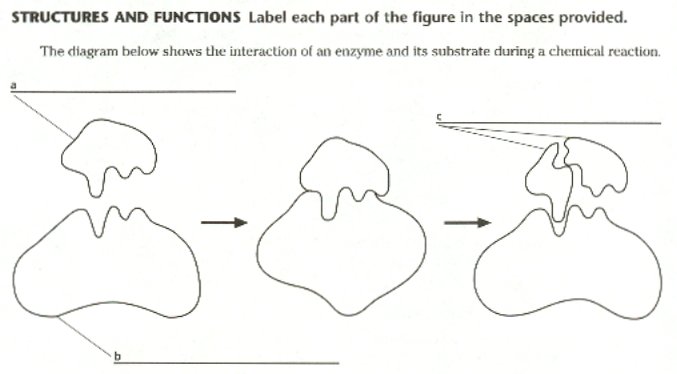
6. Enzymes lower activation energy by___________ to the ____________________ and ______________________ bonds within the ________________________.
7. The monomers that make up nucleic acids are called __________________________.
8. The type of attraction that holds two water molecules together is called __________________________ __________________________.
9. The sharing of three pairs of electrons is called a ___________________ _____________.
10. The structural building block that determines the characteristics of a compound is called the _____________________________ _______________________.
11. Large carbon compounds are built from smaller molecules called ______________________________.
12. What is the type of reaction that forms large molecules from smaller ones? _________________________________ _____________________________.
13. What type of reaction breaks large molecules into smaller ones? _______________________
14. What is the by product of a condensation reaction? __________________________
15. The attractive force between unlike particles is called ____________________________.
16. A compound that is stored as glycogen in animals and as a starch in plants is ____________________________________.
17. Lipids are good energy storage molecules because they have many _________________-___________________ bonds.
18. What are the components of many lipids? ________________________ ______________________
19. What is the monomer of many polysaccharides? ______________________________
20. What kind of reaction allows amino acids to become linked together? ________________________________ _____________________________.
21. Nucleic acids function primarily to carry __________________________ ____________________ and direct _____________________ ______________________.
22. Tends not to react with water, “Water Fearing” ________________________________
23. Attracted to water molecules, “Water Loving” _________________________________
24. Water is called a ___________________________ ___________________________.
DIRECTIONS: Read Chapter 3, Biochemistry, and Answer the questions below as completely and as thoroughly as possible. Answer the question in essay form (not outline form), using complete sentences. You may use diagrams or pictures to supplement your answers, but a diagram or picture alone without appropriate discussion is inadequate.
1. Describe the structure of a water molecule, and explain how the electrical charge is distributed over the molecule.
2. Describe the structure of amino acids and proteins.
3. What are the structural differences between monosaccharides, disaccharides, and polysaccharides?
4. What is capillarity? Include defining Adhesion and Cohesion.
5. How does a condensation reaction differ from a hydrolysis reaction?
6. Give Three reasons why water is an effective solvent.
7. What is an organic compound?
8. What property allows carbon compounds to exist in a number of forms?
9. The presence of four electrons in the outermost energy level of a carbon atom enables
carbon atoms to form what THREE Things.
10. Living things contain many different proteins of vastly different shapes and functions.
What determines the shape and thus the function of a particular protein?
11. How does the structure of a phospholipid, linear molecules with a polar end and a
nonpolar end, relate to their function in the cell membrane?

Plant Pigments and Photosynthesis
Introduction:
In this laboratory you will separate plant pigments using chromatography. You will also measure the rate of photosynthesis in isolated chloroplasts. The measurement technique involves the reduction of the dye DPIP. The transfer of electrons during the light-dependent reactions of photosynthesis reduces DPIP, changing it from blue to colorless.
Exercise 4A: Plant Pigment Chromatography:
Paper chromatography is a useful technique for separating and identifying pigment and other molecules from cell extracts that contain a complex mixture of molecules. The solvent moves up the paper by capillary action, which occurs as a result of the attraction of solvent molecules to the paper and the attraction of the solvent molecules to one another. As the solvent moves up the paper, it carries along any substances dissolved in it. The pigments are carried along at different rates because they are not equally soluble in the solvent and because they are attracted, to different degrees, to the fibers of the paper through the formation of intermolecular bonds, such as hydrogen bonds.
Beta carotene, the most abundant carotene in plants, is carried along near the solvent front because it is very soluble in the solvent being used and because it forms no hydrogen bonds with cellulose. Another pigment , Xanthophyll differs from carotene in that it contains oxygen. Xanthophyll is found further from the solvent font because it is less soluble in the solvent and has been slowed down by hydrogen bonding to the cellulose. Chlorophyll’s contain oxygen and nitrogen and are bound more tightly to the paper than the other pigments. Chlorophyll a is the primary photosynthetic pigment in plants. A molecule of chlorophyll a is located at the reaction center of the photo systems. The pigments collect light energy and send it to the reaction center. Carotenoids also protect the photosynthetic systems from damaging effects of ultraviolet light.
Procedure:
1. Obtain a 250 mL beaker which has about 2 cm of solvent at the bottom. Cover the beaker with aluminum foil to prevent the vapors from spreading. It is also suggested this work be done under a fume hood.
2. Cut a piece of filter paper which will be long enough to reach the solvent. Draw a line about 1.0 cm from the bottom of the paper. See Figure 4.1 below.
Figure 4.1

3. Use a quarter to extract the pigments from spinach leaf cells. Place a small section of leaf on the top of the pencil line. Use the ribbed edge of the coin to to crush the leaf cells. Be sure the pigment line is on top of the pencil line. Use a back and forth movement exerting firm pressure through out.
4. Place the chromatography paper in the cylinder. See Figure 4.2 below. Do not allow the pigment to touch the solvent.
Figure 4.2

5. Cover the beaker. When the solvent is about 1 cm from the top of the paper, remove the paper and immediately mark the location of the solvent front before it evaporates.
6. Mark the bottom of each pigment band. Measure the distance each pigment migrated from the bottom of the pigment origin to the bottom of the separated pigment band. Record the distance that each front, including the solvent front, moved in Table 4.1 Depending on the species of plant used, you may be able to observe 4 or 5 pigment bands.
Table 4.1
Distance moved by Pigment Band (millimeters)
| Band Number | Distance (mm) | Band Color |
| 1 | ||
| 2 | ||
| 3 | ||
| 4 | ||
| 5 |
Distance Solvent Front Moved _________________
Analysis of Results:
The relationship of the distance moved by a pigment to the distance moved by the solvent is a constant called Rf . It can be calculated for each of the four pigments using the formula:
| Rf | = | distance pigment migrated (mm)_____ |
| distance solvent front migrated (mm) |
Record your Rf values in Table 4.2
Table 4.2
| ___________________________ | = Rf for carotene (yellow to yellow -orange) |
| ___________________________ | = Rf for xanthophyll (yellow) |
| ___________________________ | = Rf for Chlorophyll a (bright green to blue green) |
| ___________________________ | = Rf for Chlorophyll b (yellow green to olive green) |
Topics for Discussion:
1. What factors are involved in the separation of the pigments?
_______________________________________________________________________________
_______________________________________________________________________________
_______________________________________________________________________________
_______________________________________________________________________________
_______________________________________________________________________________
2. Would you expect the Rf value of a pigment to be the same if a different solvent were used? Explain.
_______________________________________________________________________________
_______________________________________________________________________________
_______________________________________________________________________________
_______________________________________________________________________________
_______________________________________________________________________________
3. What type of chlorophyll does the reaction center contain? What are the roles of the other pigments?
_______________________________________________________________________________
_______________________________________________________________________________
_______________________________________________________________________________
_______________________________________________________________________________
_______________________________________________________________________________
Exercise 4B: Photosynthesis / The Light Reaction:
Light is a part of a continuum of radiation or energy waves. Shorter wavelengths of energy have a greater amounts of energy. For example, high-energy ultraviolet rays can harm living things. Wavelengths of light within the visible spectrum of light power photosynthesis. when light is absorbed by leaf pigments, electrons within each photosystem are boosted to a higher energy level and this energy level is used to produce ATP and to reduce NADP to NADPH. ATP and NADPH are then used to incorporate CO2 into organic molecules, a process called carbon fixation.
Design of the Exercise:
Photosynthesis may be studied in a number of ways. For this experiment, a dye-reduction technique will be used. The dye-reduction experiment tests the hypothesis that light and chloroplasts are required for the light reactions to occur. In place of the electron accepter, NADP, the compound DPIP ( 2.6-dichlorophenol-indophenol), will be substituted. When light strikes the chloroplasts, electrons boosted to high energy levels will reduce DPIP. It will change from blue to colorless.
In this experiment, chloroplasts are extracted from spinach leaves and incubated with DPIP in the presence of light. As the DPIP is reduced and becomes colorless, the resultant increase in light transmittance is measured over a period of time using a spectrophotometer. The experimental design matrix is presented in Table 4.3.

Table 4.3: Photosynthesis Setup
|
Cuvettes |
|||||
| 1
Blank
|
2
Unboiled Chloroplasts Dark |
3
Unboiled Chloroplasts Light |
4
Boiled Chloroplasts Light |
5
No |
|
| Phosphate Buffer | 1 ml. | 1 ml. | 1 ml. | 1 ml. | 1 ml. |
| Distilled Water | 4 ml. | 3 ml. | 3 ml. | 3 ml. | 3 ml + 3 drops |
| DPIP | —- | 1 ml. | 1 ml. | 1 ml. | 1 ml. |
| Unboiled Chloroplasts | 3 drops | 3 drops | 3 drops | —- | —- |
| Boiled Chloroplasts | —- | —- | —- | 3 drops | —- |
Procedure:
1. Turn on the spectrophotometer to warm up the instrument and set the wavelength to 605 nm by adjusting the wavelength control knob.
2. While the spectrophotometer is warming up, your teacher may demonstrate how to prepare a chloroplast suspension from spinach leaves.
3. Set up an incubation area that includes a light, water flask, and test tube rack. The water in the flask acts as a heat sink by absorbing most of the light’s infrared radiation while having little effect on the light’s visible radiation.
Figure 4.2: Incubation Setup
Flood Light ——-Water Heat Sink——-Cuvettes
4. Your teacher will provide you with two beakers, one containing unboiled chloroplasts. Be sure to keep these on ice at all times.
5. At the top rim, label the cuvettes 1,2,3,4, and 5, respectively. Using lens tissue, wipe the outside walls of each cuvette ( Remember: handle cuvettes only near the top). Using foil paper, cover the walls and bottom of cuvette 2. Light should not be permitted inside cuvette 2 because it is a control for this experiment.
6. Refer to Table 4.3 to prepare each cuvette. Do not add unboiled or boiled chloroplasts yet. To each cuvette, add 1 ml of phosphate buffer.
7. Bring the spectrophotometer to zero by adjusting the amplifier control knob until the meter reads 0% transmittance. Cover the top of cuvette 1 with Parafilm@ and invert to mix. Insert cuvette 1 into the sample holder and adjust the instrument to 100% transmittance by adjusting the light -control knob. Cuvette 1 is the blank to be used to recalibrate the instrument between readings. For each reading, make sure that the cuvettes are inserted into the sample holder so that they face the same way as in the previous reading.
8. Obtain the unboiled chloroplast suspension, stir to mix, and transfer three drops to cuvette 2. Immediately cover and mix cuvette 2. Then remove it from the foil sleeve and insert it into the spectrophotometer’s sample holder, read the % transmittance, and record it as the time 0 reading in Table 4.4 . Replace cuvette 2 into the foil sleeve, and place it into the incubation test tube rack. Turn on the flood light. Take and record additional readings at 5,10,and 15 minutes. Mix the cuvette’s contents just prior to each readings. Remember to use cuvette 1 occasionally to check and adjust the spectrophotometer to 100% transmittance.
9. Obtain the unboiled chloroplast suspension, mix, and transfer three drops to cuvette 3. Immediately cover and mix cuvette 3. Insert it into the spectrophotometer’s sample holder, read the % transmittance, and record it in Table 4.4 . Replace cuvette 3 into the incubation test tube rack. Take and record additional readings at 5,10,and 15 minutes. Mix the cuvette’s contents just prior to each readings. Remember to use cuvette 1 occasionally to check and adjust the spectrophotometer to 100% transmittance.
10. Obtain the boiled chloroplast suspension, mix, and transfer three drops to cuvette 4. Immediately cover and mix cuvette 4. Insert it into the spectrophotometer’s sample holder, read the % transmittance, and record it in Table 4.4 . Replace cuvette 4 into the incubation test tube rack. Take and record additional readings at 5,10,and 15 minutes. Mix the cuvette’s contents just prior to each readings. Remember to use cuvette 1 occasionally to check and adjust the spectrophotometer to 100% transmittance.
11. Cover and mix the contents of cuvette 5. Insert it into the spectrophotometer’s sample holder, read the % transmittance, and record it in Table 4.4 . Replace cuvette 5 into the incubation test tube rack. Take and record additional readings at 5,10,and 15 minutes. Mix the cuvette’s contents just prior to each readings. Remember to use cuvette 1 occasionally to check and adjust the spectrophotometer to 100% transmittance.
Table 4.4: Transmittance (%)
Time (minutes)
| Cuvette | 0 | 5 | 10 | 15 |
| 2 Unboiled /Dark | ||||
| 3 Unboiled/ Light | ||||
| 4 Boiled / Light | ||||
| 5 No Chloroplasts |
Analysis of Results:
Plot the percent transmittance from the four cuvettes on the graph below.
a. What is the dependent variable? ____________________________________________
b. What is the independent variable? __________________________________________
Graph Title: __________________________________________________________________
Graph 4.1

Topics for Discussion:
1. What is the purpose of DPIP in this experiment?
___________________________________________________________________________
___________________________________________________________________________
___________________________________________________________________________
2. What molecule found in chloroplasts does DPIP “replace” in this experiment? _________________
3. What is the source of the electrons that will reduce DPIP? _________________________________
4. What was measured with the spectrophotometer in this experiment? ____________________________________________________________________________
____________________________________________________________________________
____________________________________________________________________________
____________________________________________________________________________
5. What is the effect of darkness on the reduction of DPIP? Explain.
____________________________________________________________________________
____________________________________________________________________________
____________________________________________________________________________
____________________________________________________________________________
6. What is the effect of boiling the chloroplasts on the subsequent reduction of DPIP? Explain.
____________________________________________________________________________
____________________________________________________________________________
____________________________________________________________________________
____________________________________________________________________________
7. What reasons can you give for the difference in the percent transmittance between the live chloroplasts that were incubated in the light and those that were kept in the dark?
_____________________________________________________________________________
_____________________________________________________________________________
_____________________________________________________________________________
_____________________________________________________________________________
Genetics Review 
| The two genes or alleles that combine to determine a trait would be the organism’s _______________. |
| Type AB blood, having two genes dominant for a trait, is an example of ________. |
| State Mendel’s law of segregation. |
| Rr x Rr is an example of what type of cross —– P1, F1, or F2? |
| If both alleles are the same in a genotype, is the genotype homozygous or heterozygous? |
| Which cross is a cross between two hybrids —– P1, F1, or F2? |
| __________ dominance results in the blending of genes in the hybrid. Give an example using flower color. |
| What is another term for a heterozygous genotype? |
| The _____________ is the physical feature such as round peas that results from a genotype. |
| How many traits are involved in a monohybrid cross? |
| What type of organism was used in the first genetic studies done by Gregor Mendel? |
| What is a karyotype? |
| The two genes for a trait represented by capital & lower case letters are called __________. |
| How many traits are involved in a dihybrid cross? |
| Which of Mendel’s laws states that the dominant gene in a pair will be expressed? |
| If both alleles are the same, is the genotype homozygous or heterozygous? Write an example. |
| Write an example of a hybrid or heterozygous genotype. |
| The genes for sex-linked traits are only carried on which chromosome? |
| Who is considered to be the “father of genetics”? |
| A second filial or F2 cross is also called a ____________ cross. |
| The failure of chromosomes to separate during meiosis (egg & sperm formation) is known as _________________. |
| A cross between two pure or homozygous organisms is called what type of cross —– P1, F1, or F2? |
| What genetic disorder results from a sex-linked trait that affects color vision? |
| The genetic disorder called _______________ is known as the “free bleeders” disease. |
| Having three 21st chromosomes causes the genetic disorder known as _________. |
| A person suffering from the genetic disorder called ______________ can not digest fats. |
| _____________________ disease is a genetic disorder where red blood cells carry less oxygen. |
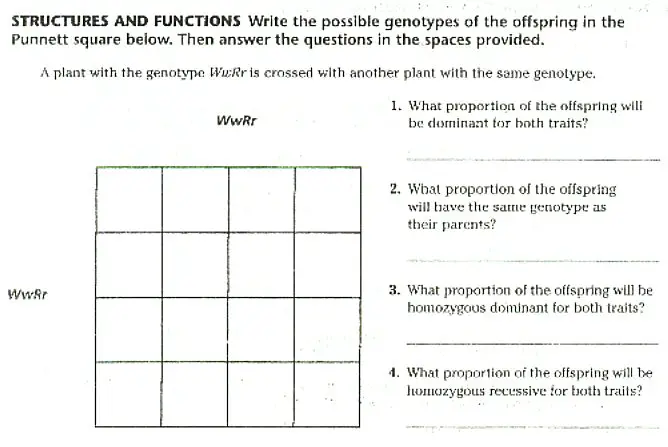
| Work a P1 cross for plant height in peas. |
| Work an F1 cross for plant height in peas. |
DIRECTIONS: Answer the questions below as completely and as thoroughly as possible. Answer the question in essay form (not outline form), using complete sentences. You may use diagrams or pictures to supplement your answers, but a diagram or picture alone without appropriate discussion is inadequate.
1. State the two laws of heredity that resulted from Mendel’s work.
2. What happens during meiosis that would allow genes located on the same chromosome to separate independently of one another?
3. List the steps in Mendel’s experiments on pea plants. Include the P generation, F1 generation, and F2 generation.
4. Write the equation for probability.
5. Distinguish between codominance and incomplete dominance. Give an example of each type of inheritance.
6. Define the terms, dominant and recessive.
7. Relate the events of meiosis to the law of segregation.
8. Explain the difference between a monohybrid cross and dihybrid cross. Give an example of each.
9. Explain how you would use a Punnett square to predict the probable outcome of a monohybrid cross. Draw a Punnett square to demonstrate your monohybrid cross.
10. Explain the terms genotype and phenotype.
11. Explain the terms homozygous and heterozygous.