Needed Materials

AP Materials

  • 3-ring notebook with pockets
  • loose-leaf paper
  • graphing paper
  • pencil
  • black ink pen
  • calculator
  • textbook, lab book, tutorial CD

Pre AP Biology

  • 3-ring notebook with pockets
  • loose-leaf paper
  • graphing paper
  • pencil
  • black ink pen
  • calculator

Biology I

  • 3-ring notebook with pockets
  • loose-leaf paper
  • pencil
  • black ink pen
BACK

Pasteur Experiment

Recreation of Pasteur’s Experiment

Introduction:

Today, we take many things in science for granted. Many experiments have been performed and much knowledge has been accumulated that people didn’t always know. For centuries, people based their beliefs on their interpretations of what they saw going on in the world around them without testing their ideas to determine the validity of these theories — in other words, they didn’t use the scientific method to arrive at answers to their questions. Rather, their conclusions were based on untested observations.

Among these ideas, for centuries, since at least the time of Aristotle (4th Century BC), people (including scientists) believed that simple living organisms could come into being by spontaneous generation. This was the idea that non-living objects can give rise to living organisms. It was common “knowledge” that simple organisms like worms, beetles, frogs, and salamanders could come from dust, mud, etc., and food left out, quickly “swarmed” with life. For example:

Observation: Every year in the spring, the Nile River flooded areas of Egypt along the river, leaving behind nutrient-rich mud that enabled the people to grow that year’s crop of food. However, along with the muddy soil, large numbers of frogs appeared that weren’t around in drier times. Conclusion: It was perfectly obvious to people back then that muddy soil gave rise to the frogs.

Objective:

In this experiment, you will conduct an experiment similar to the one done by Pasteur whenever he disproved spontaneous generation.


Materials Needed:Experiment Set-Up

  • Low-salt broth (chicken or beef, home-made or purchased)
  • 2  250-mL Erlenmeyer flasks
  • 2  1-hole rubber stoppers with bent glass tubing inserted (see diagram)
  • Glycerine
  • Hot plate & pot holders
  • 50-ml Graduated Cylinder
  • Marker

Procedure:

  1. Students should work in teams of 2 to 3 people. Each team should perform the following steps.
  2. Use glycerine and a twisting motion to insert glass tubing into the stoppers. be sure to rinse off excess glycerine with water.
  3. Mark Erlenmeyer flasks accordingly:
    1. Flask 1 with stopper and glass tube going straight up
    2. Flask 2 with stopper and glass tube bent in S-curve
  4. Using a graduated cylinder, place about 50-mL of broth in each Erlenmeyer flask.
  5. Place appropriate lids on flasks.
  6. Use a hot plate to boil broth in flasks with appropriate lids on them for 30 min., then let cool.
  7. For the next ten days, observe the flasks and record any changes in color, turbidity, smell, etc. (Be careful to NOT remove the stoppers from the flasks.)

Data:

Microbial Growth Record
Record the appearance of the flask contents.

Day Flask 1 with Straight Tubing Day Flask 2 with S-shaped Tubing
1 1
2 2
3 3
4 4
5 5
6 6
7 7
8 8
9 9
10 10

Conclusion:

  1. What was the appearance on the broth in each flask on Day 1?
  2. Was their an observed appearance change in flask 1 over the 10 days? Describe the change, if any.
  3. Was their an observed appearance change in flask 2 over the 10 days? Describe the change, if any.
  4. Explain why there was or was not a change in the appearance of the broth in each flask.
  5. Why do you think the idea of spontaneous generation was believed to be true for so long (1000+ years)?
  6. Did your experiment support spontaneous generation of organisms? Explain why or why not?

Needed Materials

AP Materials

  • 3-ring notebook with pockets
  • loose-leaf paper
  • graphing paper
  • pencil
  • black ink pen
  • calculator
  • textbook, lab book, tutorial CD

Pre AP Biology

  • 3-ring notebook with pockets
  • loose-leaf paper
  • graphing paper
  • pencil
  • black ink pen
  • calculator

Biology I

  • 3-ring notebook with pockets
  • loose-leaf paper
  • pencil
  • black ink pen
BACK

Preap Nucleic Acid Study Guide

Nucleic Acids, Protein Synthesis, & DNA Technology Study Guide
1. What are purines & pyrimidines and give examples of each?

2. Which scientists determined the structure of DNA?

3. DNA and RNA are named by their __________.

4. What three things make up a nucleotide?

5. Describe the structure of DNA.

6. An organism’s characteristics are coded for by molecules of __________.

7. What are the subunits called that make up DNA?

8. Sketch the basic structure of a nucleotide.

9. What 2 things are found on RNA, but are not found on DNA molecules?

10. What is the primary function of DNA?

11.What did Rosalind Franklin’s x-ray photographs of DNA crystals tell us about this molecule?

12. State Chargaff’s rule.

13. What happens to tRNA anticodons during translation?

14. What is a codon & where are they found?

15. What is the function of rRNA?

16. What bases pair with each other on: a) DNA?   b) RNA?

17. Name the 3 types of RNA & tell the function of each.

18. What is the function of DNA polymerase?

19. If the code on DNA is TTAGCCTGA, what will be the code on the complementary section of DNA when it’s copied during replication?

20. List all the ways that RNA differs from DNA?

21. Where does mRNA go for proteins to be made in a cell?

22. What is transcription?

23. What is translation?

24. Which RNA carries instructions for making proteins?

25. What is the function of DNA helicases?

26. What is the job of restriction enzymes?

27. What are “sticky ends” and how are they helpful?

28. What is the difference between introns & exons?

29. What is an operon and in what type of cell would they be found?

30. What does RFLP stand for?  How is this process used?

31. What is meant by cloning?

32.What is DNA fingerprinting and how can it be used?

33. How is recombinant DNA formed?

NOTES                STUDY GUIDES

Nucleic Acids & Protein Synthesis

Nucleic Acids and Protein Synthesis
All Materials © Cmassengale

Cell   à   Nucleus    à    Chromosomes   à   Genes    à     DNA 

Proteins

  • Organic molecules (macromolecules) made by cells
  • Make up a large part of your body
  • Used for growth, repair, enzymes, etc.
  • Composed of long chains of small units called amino acids bonded together by peptide bonds
  • Twenty amino acids exist

DNA

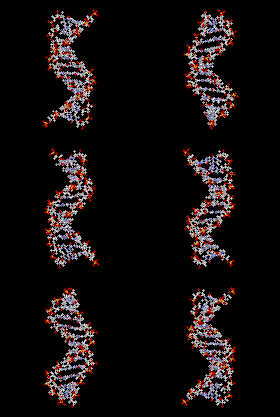
  • Deoxyribonucleic acid is a coiled double helix carrying hereditary information of the cell

  • Contains the instructions for making proteins from 20 different amino acids
  • Appears as chromatin when cell not dividing

  • Structure discovered by Watson & Crick in 1953
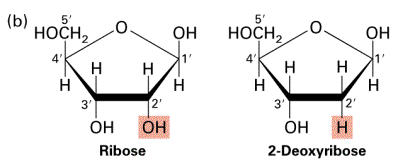
  • Sides made of pentose (5-sided) sugars attached to phosphate groups by phosphodiester bonds
  • Pentose sugar called Deoxyribose

  • Steps or rungs of DNA made of 4 nitrogen-containing bases held together by weak hydrogen bonds
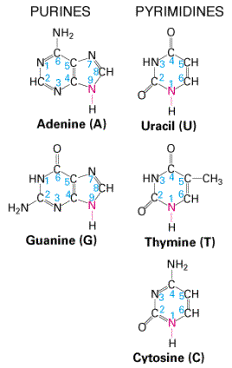
  • Purines (double carbon-nitrogen rings) include adenine (A) and guanine (G)
  • Pyrimidines (single carbon-nitrogen rings) include thymine (T) and cytosine (C)

  • Base pairing means a purine bonds to a pyrimidine   (Example:  A — T   and   C — G)
  • Coiled, double stranded molecule known as double helix
  • Make up chromosomes in the nucleus
  • Subunits of DNA called nucleotides
  • Nucleotides contain a phosphate, a Deoxyribose sugar, and one nitrogen base (A,T,C, or G)

  • Free nucleotides also exist in nucleus
  • Most DNA is coiled or twisted to the right
  • Left twisted DNA is called southpaw or Z-DNA
  • Hot spots which can result in mutations occur where right & left twisted DNA meet


History of DNA discovery

  • Freidrich Miescher (1868) found nuclear material to be ½ protein & ½ unknown substance
  • 1890’s, unknown nuclear substance named DNA
  • Walter Sutton (1902) discovered DNA in chromosomes
  • Fredrick Griffith (1928) working with Streptococcus pneumoniae conducted transformation experiments of virulent & nonvirulent bacterial strains
  • Levene (1920’s) determined 3 parts of a nucleotide
  • Hershey & Chase (1952) used bacteriophages (viruses) to show that DNA, not protein, was the cell’s hereditary material
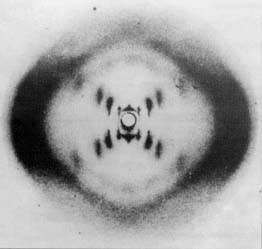
  • Rosalind Franklin (early 1950’s) used x-rays to photograph DNA crystals


Click for larger picture!


  • Erwin Chargraff (1950’s) determined that the amount of A=T and amount of C=G in DNA; called Chargaff’s Rule
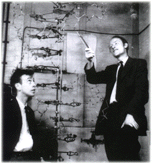
  • Watson & Crick discovered double helix shape of DNA & built the 1st model

Click for larger picture!

 DNA Replication

  •  Process by which DNA makes a copy of itself
  • Occurs during S phase of interphase before cell division
  • Extremely rapid and accurate (only 1 in a billion are incorrectly paired)
  • Requires many enzymes & ATP (energy)
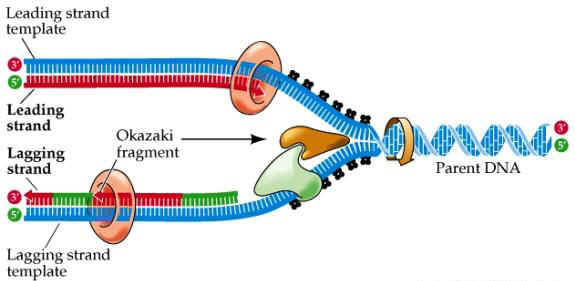
  • Begins at special sites along DNA called origins of replication where 2 strands open & separate making  a replication fork


  • Nucleotides added & new strand forms at replication forks
  • DNA helicase (enzyme) uncoils & breaks the weak hydrogen bonds between complementary bases (strands separate)
  •  DNA polymerase adds new nucleotides to the exposed bases in the 5’ to 3’ direction

  •  Leading strand (built toward replication fork) completed in one piece
  • Lagging strand (built moving away from the replication fork) is made in sections called Okazaki fragments


OKAZAKI FRAGMENTS

  •  DNA ligase helps join Okazaki segments together

  • DNA polymerase proofreads the new DNA checking for errors & repairing them; called excision repair
  • Helicase recoils the two, new identical DNA molecules

RNA

  • Ribonucleic acid
  • Single stranded molecule  

  • Found in nucleus & cytoplasm
  • Contains ribose sugar
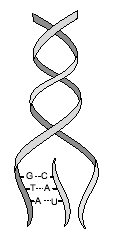
  • Contains the nitrogen base uracil (U) instead of thymine so A pairs with U
  • Base pairings are A-U and C-G
  • Three types of RNA exist (mRNA, TRNA, & rRNA)

mRNA

  • Messenger RNA
  • Single, uncoiled, straight strand of nucleic acid
  • Found in the nucleus & cytoplasm
  • Copies DNA’s instructions & carries them to the ribosomes where proteins can be made
  • mRNA’s base sequence is translated into the amino acid sequence of a protein
  • Three consecutive bases on mRNA called a codon (e.g. UAA, CGC, AGU)
  • Reusable

tRNA

  • Transfer RNA
  • Single stranded molecule containing 80 nucleotides in the shape of a cloverleaf
  • Carries amino acids in the cytoplasm to ribosomes for protein assembly
  • Three bases on tRNA that are complementary to a codon on mRNA are called anticodons (e.g. codon- UUA; anticodon- AAU)
  • Amino Acid attachment site across from anticodon site on tRNA
  • Enters a ribosome & reads mRNA codons and links together correct sequence of amino acids to make a protein
  • Reusable  

rRNA

  • Ribosomal RNA
  • Globular shape
  • Helps make up the structure of the ribosomes  
  • rRNA & protein make up the large & small subunits of ribosomes
  • Ribosomes are the site of translation (making polypeptides)

  • Aids in moving ribosomes along the mRNA strand as amino acids are linked together to make a protein

Amino Acids

  • 20 exist
  • Linked together in a process called protein synthesis in the cytoplasm to make polypeptides (subunits of proteins)
  • DNA contains the instructions for making proteins but is too large to leave the nucleus
  • Three consecutive bases on DNA called a triplet (e.g. TCG, ATG, ATT)
  • mRNA codon table tells what 3 bases on mRNA code for each amino acid (64 combinations of 3 bases)
  • Methionine (AUG) on mRNA is called the start codon because it triggers the linking of amino acids
  • UAA, UGA,  & UAG on mRNA signal ribosomes to stop linking amino acids together

Genetic Code (RNA)


 Amino Acid  3 Letter
Abbreviation
 Codons
 Alanine  Ala  GCA GCC GCG GCU
 Arginine  Arg  AGA AGG CGA CGC CGG CGU
 Aspartic Acid  Asp  GAC GAU
 Asparagine  Asn  AAC AAU
 Cysteine  Cys  UGC UGU
 Glutamic Acid  Glu  GAA GAG
 Glutamine  Gln  CAA CAG
 Glycine  Gly  GGA GGC GGG GGU
 Histidine  His  CAC CAU
 Isoleucine  Ile  AUA AUC AUU
 Leucine  Leu  UUA UUG CUA CUC CUG CUU
 Lysine  Lys  AAA AAG
 Methionine  Met  AUG
 Phenylalanine  Phe  UUC UUU
 Proline  Pro  CCA CCC CCG CCU
 Serine  Ser  AGC AGU UCA UCC UCG UCU
 Threonine  Thr  ACA ACC ACG ACU
 Tryptophan  Trp  UGG
 Tyrosine  Tyr  UAC UAU
 Valine  Val  GUA GUC GUG GUU
 Start  AUG
 Stop  UAA UAG UGA


  Practice Table:

DNA
Codon
mRNA
Codon
tRNA
Anticodon
Amino
Acid

GCU

TAC    
    AUU
  UUU  
TCA    
    UCU
CTT    
  ACU
ACU  

Protein Synthesis

  • Consists of 2 parts — Transcription & Translation
  • Begins in the nucleus with mRNA copying DNA’s instructions for proteins (transcription)
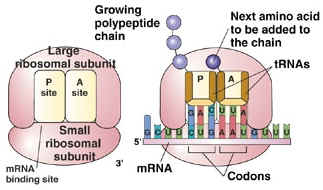
  • Completed in the cytoplasm when tRNA enters ribosomes to read mRNA codons and link together amino acids (translation)

 Steps in Transcription

  1. DNA helicase (enzyme) uncoils the DNA molecule
  2. RNA polymerase  (enzyme) binds to a region of DNA called the promoter which has the start codon TAC to code for the amino acid methionine
  3. Promoters mark the beginning of a DNA chain in prokaryotes, but mark the beginning of 1 to several related genes in eukaryotes
  4. The 2 DNA strands separate, but only one will serve as the template & be copied
  5. Free nucleotides are joined to the template by RNA polymerase in the 5’ to 3’ direction to form the mRNA strand
  6. mRNA sequence is built until the enzyme reaches an area on DNA called the termination signal
  7. RNA polymerase breaks loose from DNA and the newly made mRNA
  8. Eukaryotic mRNA is modified (unneeded sections snipped out by enzymes & rejoined) before leaving the nucleus through nuclear pores, but prokaryotic RNA isn’t
  9. All 3 types of RNA called transcripts are produced by this method

Steps in Translation

  1. mRNA brings the copied DNA code from the nucleus to the cytoplasm
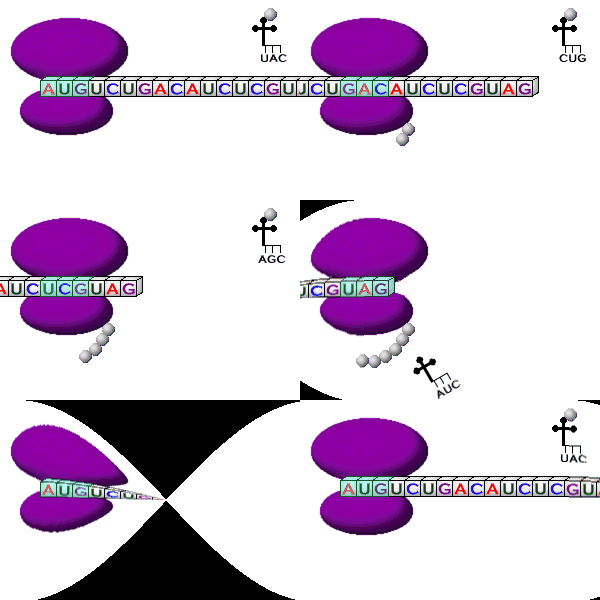
  2. mRNA attaches to one end of a ribosome; called initiation
  3. tRNA’s attach the correct amino acid floating in the cytoplasm to themselves
  4. tRNA with its attached amino acid have 2 binding sites where they join the ribosome
  5. The tRNA anticodon “reads” & temporarily attaches to the mRNA codon in the ribosome
  6. Two amino acids at a time are linked together by peptide bonds to make polypeptide -chains (protein subunits); called elongation
  7. Ribosomes) move along the mRNA strand until they reach a stop codon (UAA, UGA, or UAG); called termination

  1. tRNA’s break loose from amino acid, leave the ribosome, & return to cytoplasm to pick up another amino acid

Click here for an animation of Translation 

BACK