Matter Outline

MATTER

MATTER


PHYSICAL PROPERTIES

  1. Everything is made up of matter.
  2. The formal definition is anything that has mass and takes up space
  3. Can be measured or observed

c. Match the property to the definition below:

Mass the concentration of matter in an object

Weight the amount of matter in an object

Volume measure of the pull of gravity on an object

Density the amount of space an object takes up

II. Mixtures and Solutions

a. A bowl of cereal and milk is an example of a mixture. That’s a combination of two or more different kinds of matter, each of which keeps its own physical properties.

b. In a solution the particles of two or more substances are evenly distributed.

c. When a substance can be dissolved in another substance (like sugar in water) we call this solubility.

III. Changes in State

a. The three stages of matter are solid, liquid and gas.

b. Draw the arrangement of the particles in each state of matter and describe the speed of their movement as well as how close together they are using the diagram below.

gas, moving very fast,

& really far apart

liquid, faster moving,

& spread apart

Solid, slow moving,

& close together

c. When heat is added to a substance, the particles vibrate faster and move apart.

d. When heat is removed from a substance, the particles vibrate slower and move closer.

IV. Physical and Chemical Changes

a. When a physical change occurs the matter may look different, but

it doesn’t change.

b. When a chemical change occurs a new substance may form.

c. List three ways to know that a chemical change may have occurred.

gas produced, light, and heat.

d. Draw circles around chemical changes & underline physical changes below:

i. cutting a piece of paper into small pieces

ii. boiling water

iii. a nail rusting

iv. freezing water

e. The chemical property of combustibility describes substances that result in flame or burning.

f. The ability of a substance to react chemically is reactivity.

V. Conservation of Matter

a. Matter cannot be created nor destroyed.

b. In class we dissolved Alka Seltzer in a bottle of water. A gas was produced. We caught the gas in a balloon. Though a new substance was formed (the gas) the total mass didn’t change.

VI. Atoms and Electrons

a. The atomic number refers to the number of protons in the nucleus of an atom. The number ofprotons also determines what kind of element an atom is.

b. The element oxygen has 8 protons in its nucleus. All atoms that have 8 protons in the nucleus are oxygen atoms.

c. Be able to label the diagram of an atom. (see notes)

VII. Metals

a. Match the property to its definition by drawing a line:

Malleable electricity and heat travel easily through metals

Ductile shiny

Conductor used as a wire

Luster able to be hammered or rolled

VIII. Compounds and the Periodic Table

a. A compound is different from an element because a compound has more than one type of element in it.

b. The Periodic Table has elements arranged in order of increasing atomic number.


McMush Lab

McMush

Introduction:
Carbohydrates, proteins, fats, vitamins, and other nutrients  provide your body with energy  necessary to carry on life activities. These compounds are present in the plants and animals you use as food. In this lab, you will test for specific compounds and then determine if those compounds are present in ordinary foods.

Objective:
To determine the compounds present in food.

Materials
McDonald’s Happy Meal (fries + drink included) (no toy!), beaker, graduated cylinder, test tubes, test tube clamp,  hot plate, Benedict’s solution, Biuret solution,  Indophenol (DPIP) solution, Lugol’s iodine solution,  1% silver nitrate solution, blender

Procedure:
Part I – Testing of Known Substances

Protein test: 

  1. Place 5 ml of the gelatin solution into your test tube.
  2. Add ten drops of Biuret solution.
  3. Observe any color change 

Glucose test:

  1. Place 5 ml of the glucose solution into your test tube.
  2. Add 3 ml of Benedict’s solution.
  3. Place the tube in a beaker of boiling water and boil for five minutes
  4. Use test tube clamps to hold hot test tubes.
  5. Observe any color change 

Starch test:

  1. Place 5 ml of the starch solution into your test tube.
  2. Add 5 drops of Lugol’s iodine solution.
  3. Observe any color change

Vitamin C test:

  1. Place 5 ml of the vitamin C solution into your test tube.
  2. Add 5 drops of indophenol solution.
  3. Observe any color change

Chloride test:

  1. Place 5 ml of the salt solution into your test tube.
  2. Add 5 drops of silver nitrate solution.
  3. Observe any color change.


Record your results in a data table: 


Food Substance    Reagent test           Results
Gelatin                  Biuret solution  
Glucose  Benedict’s solution  
Starch Lugol’s iodine solution  
Vitamin C             indophenol solution  
Sodium chloride   silver nitrate solution  


Procedure:
Part II –
Testing McMush

  1. Place the Happy in a blender. Add enough water to cover and blend until you get an emulsion.
  2. Filter the mush in to a beaker.
  3. Predict the substances you will find in the McMush solution. Record your predictions in the data table using   a “ +” or “-“.
  4. Repeat the reagent tests above using 5 ml of the McMush solution.
  5. Describe and record your results.


Food Substance    Prediction Reagent test           Results
Protein Biuret Solution  
Sugar  Benedict’s Solution  
Starch Lugol’s solution  
Vitamin C Indophenol Solution  
Sodium Chloride Silver Nitrate Solution


Adapted from a lab by C. Sheldon


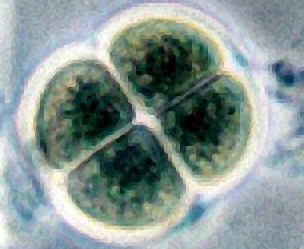
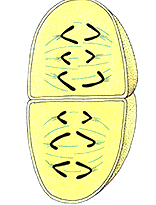
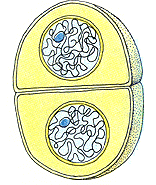
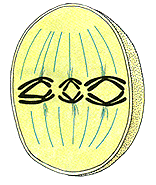
Meiosis Labeling


Meiosis


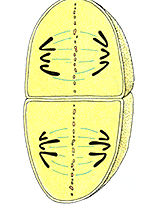
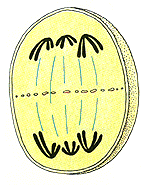
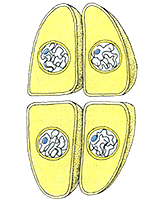
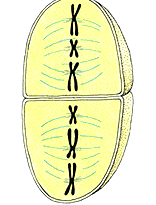
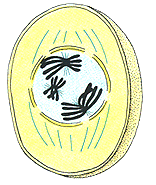
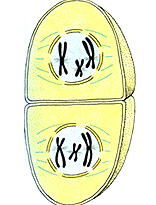
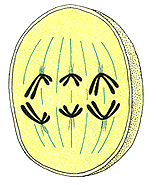
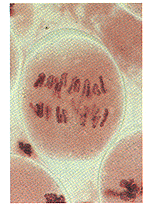
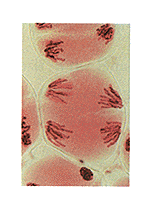
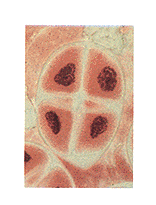
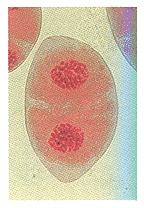
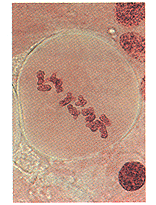
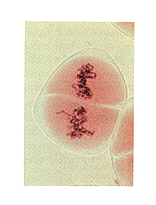
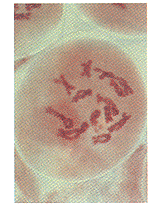
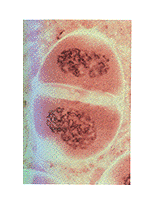
On each of the images, label the phase of meiosis

1. _______________

2. _______________

3. _______________

4. _______________

5. _______________

6. _______________

7. _______________

8._______________

9._______________

10. _______________


11. A cell with a diploid number of 20 undergoes meiosis. This will produce ________ daughter cells, each with ________ chromosomes.

12. Synapsis occurs during this phase: _______________________

13 How many different possible combinations are there for a cell that has 10 chromosomes (5 pairs): _____________

14. Tetrads line up along the equator during this phase: ______________

15. At the end of meiosis I, ________ daughter cells are created. These daughter cells are [ diploid | haploid ].

16. Meiosis occurs in what type of cells: ____________________________


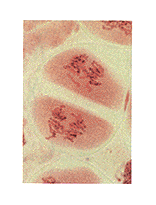
Now label the photographs.
17. _______________
18. _______________
19. _____________
20. _______________
21. _______________
22. _____________
23. _______________
24. _______________
24. _____________
25. _______________


Genetics


Mendelian Genetics
All Materials © Cmassengale 


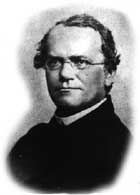
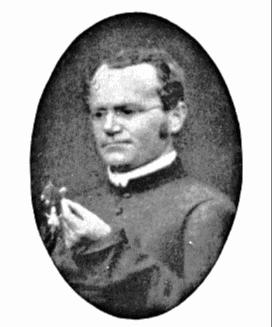
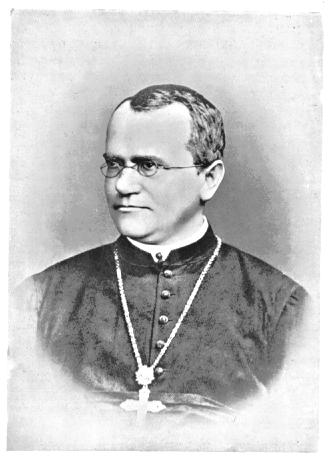
Mendel 1862 Mendel 1868 Mendel 1880
1862 1868 1880


Genetic Terminology:

  • Trait – any characteristic that can be passed from parent to offspring
  • Heredity – passing of traits from parent to offspring
  • Genetics – study of heredity
  • Alleles – two forms of a gene (dominant & recessive)
  • Dominant – stronger of two genes expressed in the hybrid; represented by a capital letter (R)
  • Recessive – gene that shows up less often in a cross; represented by a lowercase letter (r)
  • Genotype – gene combination for a trait (e.g. RR, Rr, rr)
  • Phenotype – the physical feature resulting from a genotype (e.g. tall, short)
  • Homozygous genotype – gene combination involving 2 dominant or 2 recessive genes (e.g. RR or rr); also called pure 
  • Heterozygous genotype – gene combination of one dominant & one recessive allele    (e.g. Rr); also called hybrid
  • Monohybrid cross – cross involving a single trait
  • Dihybrid cross – cross involving two traits
  • Punnett Square – used to solve genetics problems

Blending Concept of Inheritance:

  • Accepted before Mendel’s experiments
  • Theory stated that offspring would have traits intermediate between those of its parents such as red & white flowers producing pink
  • The appearance of red or white flowers again was consider instability in genetic material
  • Blending theory was of no help to Charles Darwin’s theory of evolution 
  • Blending theory did not account for variation and could not explain species diversity
  • Particulate theory of Inheritance, proposed by Mendel, accounted for variation in a population generation after generation
  • Mendel’s work was unrecognized until 1900

Gregor Mendel:

  • Austrian monk
  • Studied science & math at the University of Vienna
  • Formulated the laws of heredity in the early 1860’s
  • Did a statistical study of  traits in garden peas over an eight year period


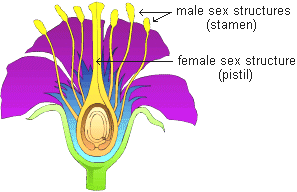
drawing of a flower cross-section showing both male and female sexual structures


Why peas, Pisum sativum?

  • Can be grown in a small area
  • Produce lots of offspring
  • Produce pure plants when allowed to self-pollinate several generations
  • Can be artificially cross-pollinate

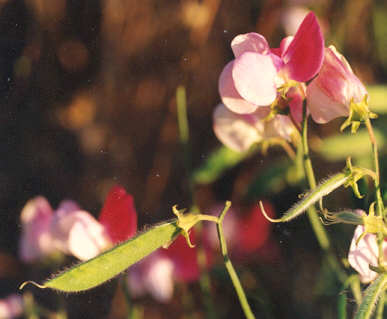
Picture of Pisum sativum
GARDEN PEA

Mendel’s Experiments:

  • Mendel studied simple traits from 22 varieties of  pea plants (seed color & shape, pod color & shape, etc.)
  • Mendel traced the inheritance of individual traits & kept careful records of numbers of offspring
  • He used his math principles of probability to interpret results
  • Mendel studied pea traits, each of which had a dominant & a recessive form (alleles)
  • The dominant (shows up most often) gene or allele is represented with a capital letter, & the recessive gene with a lower case of that same letter (e.g. B, b)
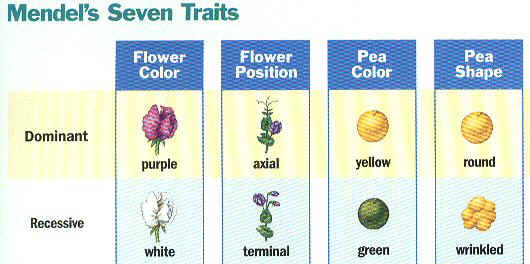
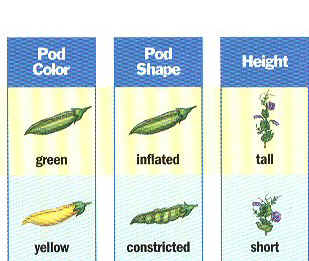
  • Mendel’s traits included:

         a. Seed shape —  Round (R) or Wrinkled (r)
            b. Seed Color —- Yellow (Y) or  Green (y)
            c. Pod Shape — Smooth (S) or wrinkled (s)
            d. Pod Color —  Green (G) or Yellow (g)
            e. Seed Coat Color —  Gray (G) or White (g)
            f. Flower position — Axial (A) or Terminal (a)
            g. Plant Height — Tall (T) or Short (t)
            h. Flower color — Purple (P) or white (p)


  •  Mendel produced pure strains by allowing the plants to self-pollinate for several generations
  • These strains were called the Parental generation or P1 strain
  • Mendel cross-pollinated two strains and tracked each trait through two
    generations (e.g. TT  x  tt )


                  Trait – plant height

                  Alleles – T tall, t short

    P1 cross    TT  x  tt

    genotype      —    Tt
    t t phenotype    —    Tall
    T Tt Tt genotypic ratio –all alike
    T Tt Tt phenotypic ratio- all alike


  • The offspring of this cross were all hybrids showing only the dominant trait & were called the First Filial or F1 generation
  • Mendel then crossed two of his F1 plants and tracked their traits; known as an F1 cross


              Trait – plant height

              Alleles – T tall, t short

F1 cross    Tt  x  Tt

genotype      —    TT, Tt, tt
T t phenotype    —    Tall & short
T TT Tt genotypic ratio —1:2:1
t Tt tt phenotypic ratio- 3:1


  • When 2 hybrids were crossed, 75% (3/4) of the offspring showed the dominant trait & 25% (1/4) showed the recessive trait; always a 3:1 ratio
  • The offspring of this cross were called the F2 generation
  • Mendel then crossed a pure & a hybrid from his F2 generation; known as an F2 or test cross


Trait   –  Plant Height
Alleles – T  tall, t  short

F2 cross       TT  x Tt

F2 cross       tt  x Tt

T t T t
T TT Tt t Tt tt
T TT Tt t Tt tt
          genotype – TT, Tt           genotype – tt, Tt
          phenotype  –  Tall           phenotype  –  Tall & short
          genotypic ratio  – 1:1           genotypic ratio  – 1:1
          phenotypic ratio – all alike           phenotypic ratio – 1:1


  • 50% (1/2) of the offspring in a test cross showed the same genotype of one parent & the other 50% showed the genotype of the other parent; always a 1:1 ratio

Problems: Work the P1, F1, and both F2 crosses for all of the other pea plant traits & be sure to include genotypes, phenotypes, genotypic & phenotypic ratios.

  • Mendel also crossed plants that differed in two characteristics (Dihybrid Crosses)
    such as seed shape & seed color
  • In the P1 cross, RRYY  x  rryy, all of the F1 offspring showed only the dominant form for both traits; all hybrids, RrYy


Traits:      Seed Shape & Seed Color

Alleles:     R round                Y yellow
r wrinkled             y green

 P1 Cross:     RRYY          x     r r yy  


ry Genotype:      RrYy
RY RrYy
Phenotype:      Round yellow seed
Genotypic ratio:      All alike
Phenotypic ratio:      All Alike


  • When Mendel crossed 2 hybrid plants (F1 cross), he got the following results


Traits:       Seed Shape & Seed Color

Alleles:     R round                Y yellow
r wrinkled             y green

     F1 Cross:     RrYy           x     RrYy                   
RY Ry rY ry
RY
RRYY

RRYy

RrYY

RrYy
Ry
RRYy

RRyy

RrYy

Rryy
rY
RrYY

RrYy

r rYY

r rYy
ry
RrYy

Rryy

r rYy

r ryy


Genotypes Genotypic Ratios Phenotypes Phenotypic Ratios
RRYY 1 Round yellow seed
9
RRYy 2
RrYY 2
RrYy 4
RRyy 1 Round green seed
3
Rryy 2
r rYY 1 Wrinkled yellow seed
3
r rYy 2
r ryy 1 Wrinkled green seed
1


Problems: Choose two other pea plant traits and work the P1 and F1 dihybrid crosses. Be sure to show the trait, alleles, genotypes, phenotypes, and all ratios. 

Results of Mendel’s Experiments:

  • Inheritable factors or genes are responsible for all heritable characteristics
  • Phenotype is based on Genotype
  • Each trait is based on two genes, one from the mother and the other from the father
  • True-breeding individuals are homozygous ( both alleles) are the same
  • Law of Dominance states that when different alleles for a characteristic are inherited (heterozygous), the trait of only one (the dominant one) will be expressed. The recessive trait’s phenotype only appears in true-breeding (homozygous) individuals


Trait: Pod Color
Genotypes: Phenotype:
GG Green Pod
Gg Green Pod
gg Yellow Pod


  • Law of Segregation states that each genetic trait is produced by a pair of alleles which separate (segregate) during reproduction


Rr
R r


  • Law of Independent Assortment states that each factor (gene) is distributed (assorted) randomly and independently of one another in the formation of gametes


RrYy

RY Ry rY ry


Other Patterns of Inheritance:

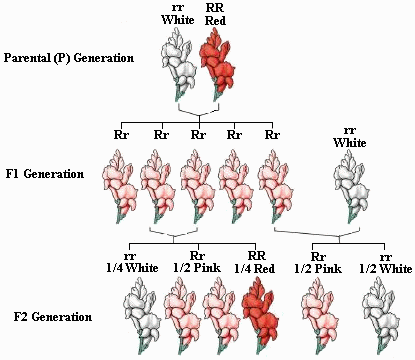
  • Incomplete dominance occurs in the heterozygous or hybrid genotype where the 2 alleles blend to give a different phenotype
  • Flower color in snapdragons shows incomplete dominance whenever a red flower is crossed with a white flower to produce pink flowers

  • In some populations, multiple alleles (3 or more) may determine a trait such as in ABO Blood type
  • Alleles A & B are dominant, while O is recessive


Genotype Phenotype
IOIO Type O
IAIO Type A
IAIA Type A
IBIO Type B
IBIB Type B
IAIB Type AB


  • Polygenic inheritance occurs whenever many variations in the resulting phenotypes such as in hair, skin, & eye color
  • The expression of a gene is also influenced by environmental factors (example: seasonal change in fur color)


Mammal


Mammals
All Materials © Cmassengale 


Main Characteristics of mammals:

  • Endothermy – maintain high, constant body temperature through their metabolism
  • Pelage – hair or fur made of protein called keratin covering all or part of the body for insulation & camouflage
  • Four chambered heart ( two atria & two ventricles) keep oxygenated & deoxygenated blood from mixing; double circulation

Mammal Heart

  • Mammary glands in females are modified sweat glands that make milk containing sugars, proteins, & fats to nourish young
  • Single jawbone
  • Specialized teeth for biting, cutting, & chewing
  • Highly developed brain (large cerebrum)

  • Diaphragm – muscle below lungs that aids respiration
  • Most are viviparous (live birth)
  • Uterus in females where young develop
  • Placenta lines uterus & provides nutrients and gas & waste exchange for developing young
  • Have sweat glands for cooling & scent glands for attracting mates & marking territories

Mammal Ancestors:

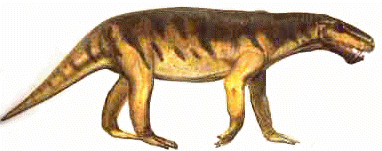
  • Fossil records show mammals arose from group of reptiles called therapsids at the end of the Paleozoic era
  • Therapsids were endotherms with specialized teeth like mammals

Lycaenops: drawing by Steve Kirk - Illustrated Encyclopedia of Dinosaurs and Prehistoric Animals, ed.. Barry Cox
Therapsid
Early Mammals:

  • First mammalian fossil found in Mesozoic era (hair, single jawbone, specialized teeth, & endothermic)
  • Early mammals were small, shrew like, insect eaters that had large eye sockets making them probably nocturnal
  • When dinosaurs became extinct, new habitats & food supplies opened up for mammals
  • “Age of mammals” occurred during Cenozoic era
  • Oviparous (egg laying) monotremes evolved first


sunset on kangaroo island
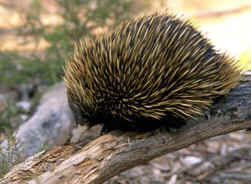
Echidna Platypus
Monotremes


  • Viviparous (live birth) marsupials with incomplete uterine development appeared next & then placental mammals 


 title illustration 
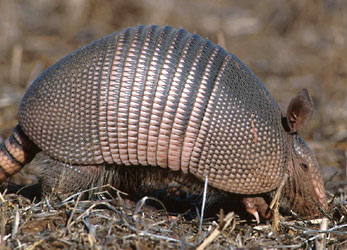
Tasmanian Devil Armadillo
Marsupial Placental


Section 1 Review


Specializations of the mouth & digestive system:

  • Single jawbone
  • Incisors – specialized, chisel like front teeth for biting & chewing
  • Canines – pointed teeth or fangs behind incisors to help grip, puncture, & tear prey
  • Bicuspids – teeth with two points behind the canines used to shear & shred food
  • Molars – flattened back teeth to grind & crush
  • Baleen – thin plates in the roof of the mouth of some whales that strain food from water
  • Microorganisms living in the gut help some mammals digest cellulose from plants
  • Hoofed mammals (cows, sheep, giraffes…) have a four-chambered stomach with bacteria living in the first chamber or rumen
  • Cud – digested food in the rumen that is regurgitated, swallowed, & then chewed again to break down plant cellulose
  • Caecum – stomach chamber in elephants, horses, & rabbits that contains bacteria to digest cellulose

Adaptations for Endothermy:

  • High demand for oxygen
  • Right & left sides of heart separated by septum so oxygenated & deoxygenated blood don’t mix
  • Left side of heart pumps blood to lungs & back (pulmonary circulation)
  • Right side of blood pumps oxygenated blood to body cells (systemic circulation)
  • Diaphragm – sheet of muscle below lungs that moves up & down in chest to change air pressure so gas moves into & out of the lungs
  • Alveoli or air sacs in the lungs are surrounded by capillaries and increase the surface area for the absorption of oxygen
  • Hair or fur and a fat layer insulates and prevents heat loss

Nervous System Adaptations:

  • Largest vertebrate brain
  • Cerebrum surface is folded to increase surface area without increasing volume
  • Cerebrum controls sensory organs, coordinates movement, regulates behavior, & is responsible for memory & learning
  • Have five major senses — vision, hearing, olfaction (smell), touch, & taste
  • Bats, whales, dolphins, porpoises  use echolocation (bouncing off of high frequency sounds) to navigate & find prey

Reproductive Adaptations:

  • Each of the 3 mammal groups — monotremes, marsupials, & placentals— has a unique reproductive pattern
  • Monotreme females lay 1-2 leathery-shelled eggs containing yolk & incubates them with her body heat

  • Young monotremes are small & partially developed at hatching so depend on mother for protection and milk from mammary glands
  • Marsupials have short development period inside of the mother & newborns must crawl to the mother’s pouch or marsupium after birth, attach to a nipple for milk, and finish developing

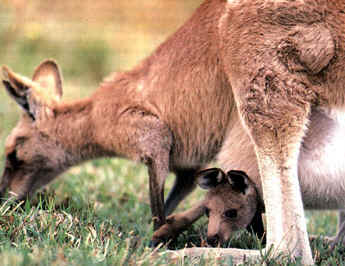
photograph of kangaroo and her joey
Mother Kangaroo & “Joey”

  • Placentals are the largest group of mammals
  • Gestation (period of development inside mother) is longer in placental mammals
  • Nutrients, wastes, gases exchanged through membrane lining uterus called the placenta
Section 2 Review

Order Monotremata:

  • Oviparous
  • Not completely endothermic (lower body temperature & it fluctuates)
  • Have a cloaca where wastes, eggs, & sperm are emptied
  • Includes duck-billed platypus & spiny anteaters or echidna
 title illustration   title illustration 
Echidna Platypus
Monotremes
  • Live only in Australia & New Zealand
  • Platypus:
    1. Waterproof fur
    2.Webbed feet
    3. Flattened tail for swimming
    4. Flat, sensitive, rubbery muzzle used to root for worms & crayfish
    5. Digs a den in bank of river to lay eggs
    6. Female curls around eggs & incubates them
    7. Newborns lick milk from nippleless mammary glands    
  • Echidnas:
    1. Terrestrial
    2. Coat of protective spines
    3. Long snout to probe ant hills & termite nests
    4. Incubate eggs in a brood pouch on female’s belly

Order Marsupialia:

  • Found in New Guinea, Australia, & the Americas
  • Dominate animal in Australia due to lack of competition from placental mammals
  • Known as pouched animals
  • Pouch called marsupium
  • Viviparous (live birth)
  • Tiny, immature young must crawl to mother’s pouch after birth
  • Young attach to mammary gland nipple to nurse until able to survive outside of pouch
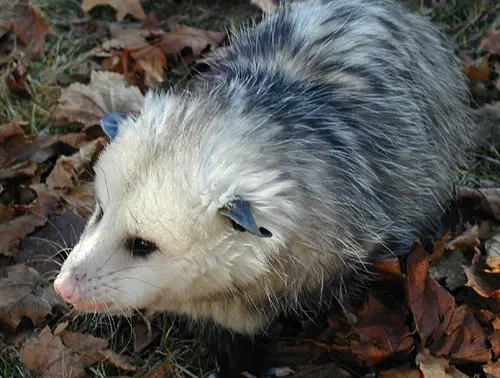
  • Includes opossum, kangaroo, wombat, & koala


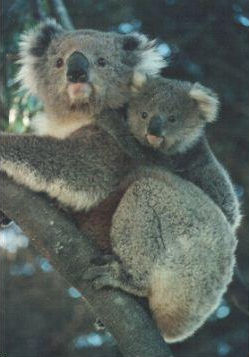
Koala and joey. Photograph © Mick Stevic. Dykiel.A.02.01.27.Opossum.jpg
Koala & baby Opossum


Placental Mammals :

  • Young carried in uterus & nourished by placenta
  • Gestation periods (time of development within uterus) varies among species
  • Adapted for life on land in water, and in air
  • Mammal species make up 95 % of all animals
  • At least 18 orders exist

Order Insectivora:

  • Includes moles, hedgehogs, & shrews
  • Small with high metabolic rate
  • Found in North America, Europe, & Asia
  • Have long, pointed noses to grub for insects & worms
  • Teeth adapted to pick up & pierce prey
  • Adapted to live on & under ground, in trees, and in water
  • Shrews feed above ground & have claws to help sweep invertebrates into their mouths
  • Moles live underground, have reduced eyes & no external ears, and have short limbs to dig tunnels


Mole Shrew


Order Rodentia:

  • Largest mammal order (40% of all species)
  • Found everywhere except Antarctica
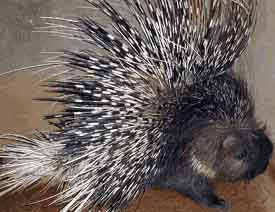
  • Includes squirrels, chipmunks, gophers, rats, mice, & porcupines
  • Have two instead of four incisors
  • Teeth continue to grow throughout their life
  • Feed on hard seeds, twigs, roots, & bark
  • Gnawing keeps incisors sharp
  • High reproductive capacity
  • Guinea pig & capybaras are two rodents found in South America


Seh - Porcupine - Photograph
Chipmunk Porcupine


Order Lagomorpha:

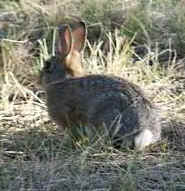
  • includes rabbits, hares, & pikas
  • Found worldwide
  • Have a double row of upper incisors & two large front teeth backed up by two smaller teeth
  • Continuous growing teeth
  • Herbivores


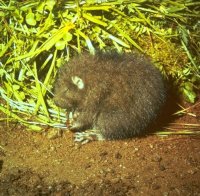
Mountain Beaver A wild hare
Pika Hare


Order Edentata:

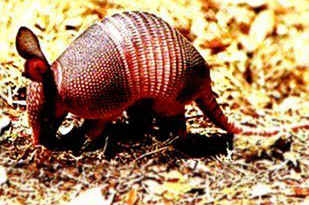
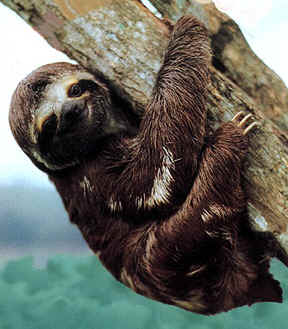
  • Includes anteaters, armadillos, & sloths
  • Found in North, Central, & South America
  • Means “without teeth”
  • Only anteaters are completely toothless
  • Armadillos & sloths have peg-like teeth without enamel
  • Have long sticky tongues & claws on powerful front paws to open ant hills& termite nests
  • Sloths are herbivores
  • Armadillos eat small reptiles, frogs, mollusks, & dead animals


picture of a cute armadillo photo of baby sloth
Armadillo Sloth


Order Chiroptera:

  • Only flying mammals
  • Includes bats found everywhere except polar regions
  • Front limb is modified into a wing with a skin membrane stretching from the finger bones to the hind limb
  • Clawed thumb, extending from top edge of wing, is used for walking, climbing, & grasping
  • Most are nocturnal (night active)
  • Use echolocation (emission of high frequency sounds that bounce off objects) to navigate and locate food
  • Have small eyes & large ears
  • Feed mainly on insects
  • Tropical bats don’t use echolocation, but have large eyes & keen sense of smell to find fruit to feed on & nectar

Order Cetacea:

  • Includes whales, dolphins, & porpoises
  • Most inhabit oceans, but some dolphins live in freshwater rivers
  • Have a fish shaped body
  • Forelimbs modified as flippers
  • No hind limbs
  • Broad, flat tails to propel through water
  • Breathe through a blowhole on top of the head
  • Divided into two groups — toothed whales & baleen whales
  • Toothed whales:
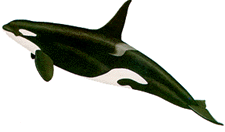
    1. Includes beaked, sperm, beluga, & killer whales; narwhals; dolphins; porpoises
    2. Have 1 to more than 100 teeth
    3. Prey on fish, squid, seals, & other whales


Narwhal Beluga Orca 


  • Baleen whales:
    1. Lack teeth
    2. Includes blue, grey, right & humpbacked whales
    2. Have baleen or thin plates of fingernail like material that hangs from the roof of the mouth
    3. Baleen strain shrimp & other invertebrates from water as food


Blue Whale Humpbacked Whale


Order Sirenia:

  • Includes manatees & dugongs
  • Large herbivores
  • Inhabit tropical seas, estuaries, & rivers
  • Front limbs modified into flippers
  • No hind limbs
  • Flattened tail for propulsion


Manatee photograph by Greg Geffner
Manatees Dugongs


Order Carnivora:

  • Found worldwide
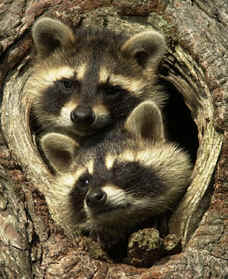
  • Includes cats, dogs, raccoons, bears, hyenas, & otters
  • Meat eaters (carnivores) mainly
  • Many feed on both plants & animals (omnivores)
  • Have long canine teeth & strong jaws
  • Clawed toes for seizing & holding prey
  • Keen sense of sight & smell
  • Long limbs for running fast


raccoon photograph Hyena Cub, Ngorongoro Crater
Raccoons Hyena


Order Pinnipedia:

  • Aquatic carnivores
  • Includes sea lions, seals, & walruses
  • Streamlined bodies adapted for swimming
  • Steer & propel through water using broad, flattened tail
  • Called pinnipeds
  • Return to land to feed & give birth
  • Spend much of their time in cold water
  • Large land carnivores so this helps maintain endothermy
  • Can remain under water for 5 minutes to an hour for some species

Order Artiodactyla:

  • Known as ungulates or hoofed mammals
  • Have an even number of toes
  • Includes deer, elk, bison, moose, sheep, cows, caribou, goats, pigs, & camels
  • Herbivores
  • Have large flat molars for grinding plants
  • Found everywhere except Antarctica
  • Cloven or split hooves
  • Fast runners (used for defense)
  • Have storage chamber called rumen in stomach where bacteria break down cellulose
  • Stored food called cud is chewed again & then swallowed to go through digestive system a second time

Order Perissodactyla:

  • Odd toed ungulates
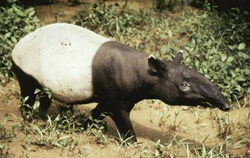
  • Includes horses, zebras, rhinoceroses, & tapir
  • Most are native to Africa & Asia
  • Tapirs are found in Central & South America
  • Have a large, convoluted caecum or blind sac near the small intestine where bacteria digest cellulose


Malaysian Tapir (<I>Tapirus indicus</I>), Sumatra, Indonesia
Caribou (even-toed) Tapir (odd-toed)


Order Proboscidea:

  • Have a boneless trunk or proboscis
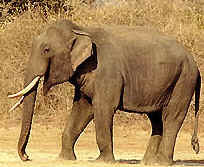
  • Includes the African & Asian elephant
  • Wooly mammoth is an extinct member of this order
  • Largest terrestrial mammal
  • Weigh more than 6 tons
  • Feed on plants up to 18 hours a day
  • Proboscis used to gather leaves from high branches & to suck water without lowering the head
  • Modified incisors called tusks help dig for roots & strip bark
  • Jagged molars up to 30 cm long grind plants
  • Have the longest gestation period (20 months for females & 22 months for males)
  • Females can continue to have calves until they are 70 years old


African Elephant Picture asian elephant
African Elephant Asian Elephant


Order Primates:

  • Includes 2 main groups — Prosimians & Anthropoids
  • Most are omnivores
  • Have teeth suitable for a varied diet
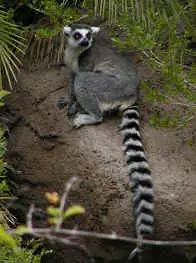
  • Prosimians include lemurs, tarsiers, & lorises
  • Anthropoids include monkeys, apes, & humans
  • Anthropoids have a larger brain
  • Show more complex behaviors than other animals
  • Highly organized social groups
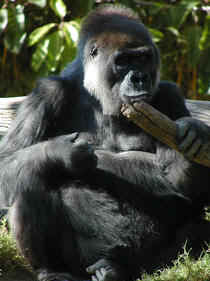
  • Gorilla is the largest primate
  • Have 2 forward-facing eyes for depth perception
  • Have grasping hands & most with grasping feet
  • Some have a grasping tail for life in trees
  • Live in a variety of habitats


Ring Tailed Lemur Photograph Gorilla Photograph
Lemur Gorilla


Section 3 Review


BACK