Chromatography of Plant Pigments Sample 2 PreAP


Chromatography of Plant  Pigments


Introduction

Chromatography is a way of separating a mixture using differences in the abilities of the components to move through a material. All chromatography involves two phases – a stationary phase and a mobile phase. The movement of the mobile phase through the stationary phase allows separation to take place. Because the components of a mixture move at different rates, they eventually separate.

Paper chromatography is a common way to separate various components of a mixture. The components of the mixture separate because different substances are selectively absorbed by paper due to differences in polarity. A solution can be separated by allowing it to flow along a stationary substance. Water or some other solvent is used as the mobile phase. The solvent moves upward along the paper because of capillary action. As it reaches the spot, the mixture dissolves in the solvent. For instance, the pigments in an ink solution can be separated by passing the ink through a piece of paper. The pigments respond differently to the paper. The differences in the migration rates result in differences in the distances the separated components travel, some pigments are held back while other moves ahead. Eventually, a pattern of colors results that shows the separated pigments.

Hypothesis

Paper can be used to separate mixed chemicals.

Materials

The materials used for this lab are paper, pencil, scissors, eraser, filter paper, test tube, cork, paper clip, metric ruler, black felt-tip pen, and a calculator.

Methods

The first step to this experiment was to bend a paper clip so that it is straight with a hook at one end. Push the straight end of the paper clip into the bottom of a cork stopper. Next, hang a thin strip of filter paper on the hooked end of the paper clip. Insert the paper strip into the test tube so it does not touch the sides, but almost the bottom of the test tube. Next, remove the paper strip from the test tube and draw a solid 5 mm wide band about 25 mm from the bottom of the paper, using a black felt tip pen. Use a pencil to draw a line across the top of the paper strip 10 cm from the top.

Pour about 2 mL of water into the test tube with the bottom of the paper in the water and the black band above the water. Observe what happens as the liquid travels up the paper. Record the changes you see. When the solvent has reached the pencil line, remove the paper from the test tube. Let the paper dry on the desk. With a metric ruler, measure the distances form the starting point to the top edge of each color. Record the data in a data table. Calculate a ration for each color by dividing the distance the color traveled by the distance the solvent traveled.

Results

The results of the experiment are shown in a chart and a graph.

Distance color traveled and Rf value.


Color of ink (list in order Distance traveled by each color (mm) Distance solvent traveled (mm) Ration traveled =
Distance color moved /Distance water moved
Yellow 50 120 5/12
Orange 85 120 17/24
Pink 100 120 5/6
Red 105 120 7/8
Blue 115 120 23/24
Violet 120 120 1


Questions

1. How many colors separated from the black ink? Six colors separated from the black ink: yellow, orange, pink, red, blue, violet.

2. What served as the solvent for the ink? Water served as the solvent because it is the universal solvent.

3. As the solvent travel up the paper, what color appeared first? Orange appeared first as the solvent traveled up the paper.

4. List the colors in order from top to bottom that separated from the black ink? The colors that separated from top to bottom: violet, blue, red, pink, orange, and yellow.

5. In millimeters, how far did the solvent travel. The solvent traveled 120mm.

6. From your results, what can you conclude is true about black ink. That black ink is a combination of several colors and that can be separated by water.

7. Why did the inks separate? The ink separated because each pigment has its own characteristics and molecular structure.

8. Why did some inks move a greater distance? Different pigments were absorbed at different rates.

Error analysis

There could be an error by the way the ink was distributed on the paper or by the amount of water put in the test tube.

Conclusion

The hypothesis was correct. This experiment showed the way black ink could be separated. Black ink is made from a various colors— yellow, orange, pink, red, blue, and violet. The colors separate because of the differences in their molecular characteristics, their solubility in water and their rate of absorption by the paper.

BACK


Cow Eye Dissection Worksheet


Cow Eye Dissection
Worksheet


1. Tell three observations you made when you examined the surface of the eye:

  1. ______________________________
  2. ______________________________
  3. ______________________________

2. Identify the following structures:

  1. cornea
  2. tear gland-
  3. optic nerve
  4. iris-
  5. pupil-
  6. retina

3. Name the three layers you sliced through when you cut across the top of the eye:

  1. ______________________________
  2. ______________________________
  3. ______________________________

4. Match the following parts of the eye to their function: (ciliary body, sclera, iris, retina, lens, & tapetum lucidum)

____________________ Contains the photoreceptors for vision.
____________________ The colored portion of the eye.
____________________ This structure changes shape to focus light on the retina.
____________________ The opening in the iris through which light passes.
____________________ The iridescent portion of the choroid layer in nocturnal animals.
____________________Consists of muscles, which control and shape the lens.
____________________ The white of the eye.

4. Use the pictures below to name the parts of the eye:

  1. ________________________________________
  2. ________________________________________
  3. ________________________________________
  4. ________________________________________
  5. ________________________________________
  6. ________________________________________
  7. ________________________________________
  8. ________________________________________
  9. ________________________________________
  10. ________________________________________
  11. ________________________________________
  12. ________________________________________
BACK

Dichotomous Key Activity


Dichotomous Key Activity


Directions: Give each of the following creatures a name. You may want to print this out before you proceed.


1. ________________

5. _________________

8. ___________________

2. ________________

4. __________________

6. __________________

9. ___________________

3. __________________

7. _________________

10. __________________


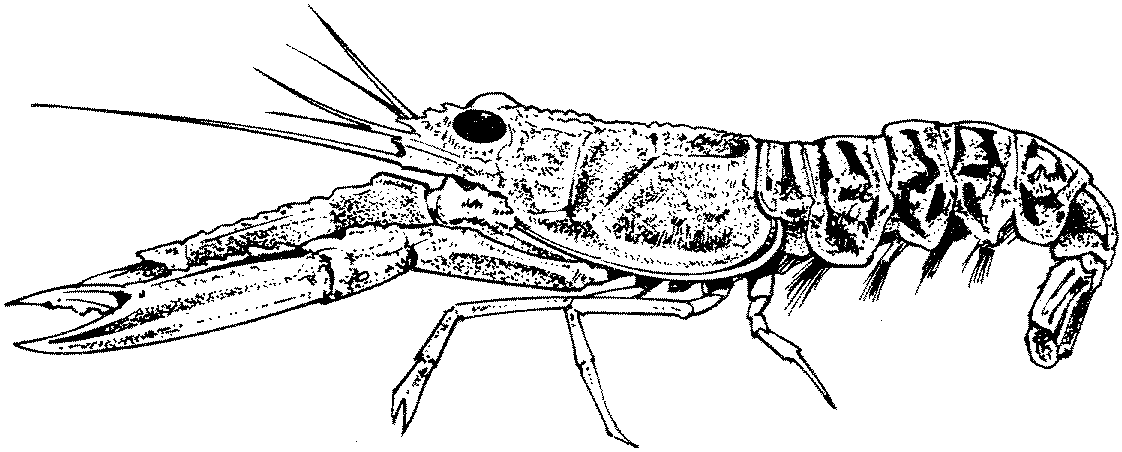
Crayfish Dissection


Crayfish Dissection


Virtual Crayfish Dissection – Cornell Virtual Crayfish Dissection – Penn State
crayfish_mini1.gif (6395 bytes) bottom.jpg (95862 bytes)


By Day:    Day 1        Day 2        Day 3

By Region: External Anatomy    Internal Anatomy

By Topic:      Skeletal       Integumentary     Cardiovascular     Muscular    Endocrine    Nervous
Reproductive     Respiratory    Excretory    Digestive


You must create a series of labeled drawings that illustrate the structures outlined below:

Day 1

I. Abdomen – Ventral View          (Day 1)         top

Place the crayfish supine (ventral surface up) on the dissecting tray and DRAW the following:


  1. Telson (What is the telson’s function?)
  2. Uropod  (Describe the location of the Uropod to the telson.   How do the add to the telson’s function?)
  3. Anus (In which of the two structures above did you find the anus? 1 or 2 way digestive system?)
  4. Swimmerets -numbered in pairs, 1-5 w/ the 5th one the most posterior (What is their function, and how is it different from the telson’s function?)
  5. Is your Crayfish a male or a female (Note the anterior-most swimmeret.   In the male, its function is to guide the sperm toward the female during copulation; as such, it will be enlarged, and pointed anteriorly in the male.  In the female there is no difference between the swimmerets)?  (Describe the appearance of the crayfish’s swimmerets in your answer.)
  6. Walking Legs (How many are there?  In terms of this feature alone, is this organism closer to an insect, or an arachnid?)
  7. Chelipeds – some people like this meat the best . . . (What is their function?)


II. Head – Ventral View             (Day 1-2)         top


  1. Mandibles – 2 – hard & white  (What are they equivalent to in humans?  How is their action – think direction of movement – different from that of humans?)
  2. Maxilla – softer w/ jagged edges  (Given the difference in texture, how is their function different from that of the mandibles?)
  3. Maxillapeds, or “mouth-feet” -3 pairs  (What is their function?  Why not use the Chelipeds?)
  4. Green Gland Ducts – (From what organ do they open out?  What is the equivalent organ in humans? What is the purpose of the duct?  Is its location at all disturbing to you?)


II. Cephalothorax – Dorsal View             (Day 1-2)         top

  1. Rostrum (What is cephalization?  Given that, what organ would you expect to be inside the rostrum?)
  2. Eyes (Does this organism have binocular vision – depth perception, why or why not?)


    Eye


  3. Carapace (What is the function of the carapace?  What two body systems in humans perform equivalent functions?  The support function is in reference to one system in particular; given the external location of the carapace, explain the name of the type of system compared to our own, internal variety.  The support function implies specifically the attachment of organs of what body system to the inside of the carapace?

Day 2

Make a Dorsal Midline Incision from the posterior end of the thorax to the posterior end of the rostrum using the rounded scissors w/ the rounded end down! Open the carapace and pin it back.

III. Thorax – Dorsal View, Part I          (Day 2)         top

  1. Heart & Ostia – the opening on the heart’s superior surface (Is this a sign of an open or closed circulatory system?  Differentiate between the two in your answer.)
  2. Gills (What are they equivalent to in humans?  To what body system do they belong?  Why are the gills so feathery – i.e., how does this aid in their function?)
  3. Cardiac Stomach -draw whole (There appear to be fibers attached to the outside of the stomach.  What is their purpose in relation to the stomach and the esophagus?)

IV. Thorax – Dorsal View, Part II         (Day 2)         top

  1. Remove one gill and draw on high power (What is the red/pink material within each “finger” of each gill?  How does this material relate to the function of the gill?)
  2. GENTLY remove one walking leg, and you will see that a gill is attached to each walking leg.  (How is this important to the function of the gills?  In your answer refer to the different requirements of the body during times of high physical activity, and how they are related to the gill-walking leg connection.)
  3. Cut open the Cardiac Stomach and draw the Gastric Mill – reddish-brown lateral “teeth” – on high power  (What is their function?  What type of digestion involves the gastric mill?  Do we accomplish that type of digestion in our own stomach?)

Day 3

V. Thorax – Dorsal View, Part III         (Day 3)         top

Gently remove the Heart.

  1. The Intestine (Given its location posterior to the stomach, what is its function?  What function of the stomach is lacking in the intestine?)
  2. The Hepatopancreas Gland (What two organs is this equivalent to in humans?  What are some of the functions of this gland?  How is its location important to its function?)
  3. The Seminifierous Tubules or Ovaries  (What is the function of each? To what body system do these belong?  Which of the two does your specimen contain?  How is this related to the swimmerets?)


VI. Thorax – Dorsal View, Part IV         (Day 3)         top

Gently remove the Cardiac Stomach.

  1. Esophagus  (Describe how it’s position relative to the stomach is different from the worm and the human.)
  2. Green Gland (What is/are the equivalent organ(s) in humans?   Do/does the analogous organ(s) appear in pairs in humans?  To what body system do the green glands belong?  What organ in our equivalent body system is missing in the crayfish?)
  3. Brain (Describe the appearance of the brain and the nerves in terms of the type of symmetry.  There are nerves that are attached to the front and the back of the brain.  Describe the function of both the anterior and the posterior nerve pairs.)

VII. Abdomen – Dorsal View, Part I       (Day 3)        top

Make a Dorsal Midline Incision from the anterior end of the abdomen to the posterior end of the abdomen using the rounded scissors w/ the rounded end down! Open the exoskeleton and pin it back.


In order for a Crayfish to determine BALANCE, it must insert a grain of sand in one of it’s appendages.
Every time it molts and makes a new exoskeleton, it must get a new grain of sand!
(In what part of the body is that function taken up by the human body?)


  1. Dorsal Blood Vessel  (Is this vessel sending the blood to, or away from, the heart?  What name would we give to that type of vessel in our body?)
  2. Large Intestine (How is the location of this organ related to the name of this section of the body [it is NOT a tail]?  What is the function of the large intestine?  Given it’s contents, is it wise, or unwise, to eat it when eating a lobster?  Explain.)
  3. Abdominal Flexor Muscles  (How do muscles function, by shortening,   lengthening, of both?  Moving the abdominal flexor muscles will cause flexion, but what is flexion?  How will the abdomen – it is NOT a tail – change shape during flexion?  What direction will the crayfish move during flexion?  Given the size and strength of the muscle, during what circumstances would the crayfish use this muscle over its walking legs?)

VIII. Abdomen – Dorsal View, Part II        (Day 3)        top

Gently remove the Abdominal Flexor Muscles.

  1. Ventral Blood Vessels  (Given that there is no main ventral blood vessel, how does the blood return to the heart?  Is this a sign of an open or closed circulatory system?)
  2. Ventral Nerve Cord  (To what phylum does the crayfish belong?   How is the location of the nerve cord different from creatures in our own phylum?   Name our own nerve cord.  How is the protection of the nerve cord different in both phyla?)

Drawings:

  1. Use a PENCIL!!

  2. Make the drawings “larger than life” size, as the specimens are so small.

  3. Draw the general shape (outline) and location of the organs, as the squiggles so many of you use to “shade” your drawings make your drawings sloppy and hard to interpret.

  4. Include Labels on all drawings.

  • Labels should start outside the drawing, and be connected to the structure by arrows with tips (===>).

  • The Tip of the arrow should be touching the structure.

  • Be sure to include the magnification for any drawings done with the dissecting microscope.

Hang on to the drawings; they will all be handed in later, together with some questions to answer!


Day 1        Day 2        Day 3         top

Modified from  Lazaroff Biology