Crayfish Dissection
Objectives:
• Describe the appearance of various organs found in a crayfish.
• Name the organs that make up systems of the crayfish.
Materials:
• safety goggles, gloves, magnifying glass, a lab apron, plastic zip lock bag preserved crayfish, pen, dissecting tray, paper towels, scissors, forceps, dissecting needle, and dissecting pins.
Purpose:
In this lab, you will observe the external structures of a crayfish and dissect it to study its internal structures and systems.
Background:
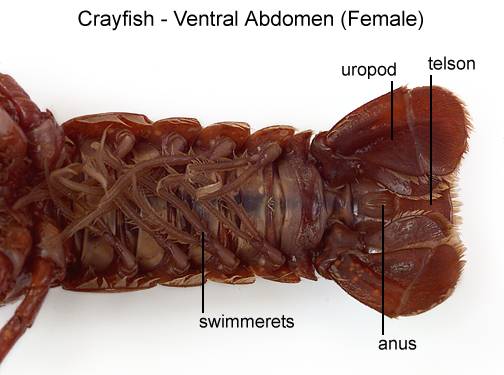
Like all crustaceans, a crayfish has a fairly hard exoskeleton that covers its body. As shown in the diagram on the next page, its body is divided into two main parts, the cephalothorax and the abdomen. The cephalothorax consists of the cephalic (or head) region and the thoracic region. The part of the exoskeleton that covers the cephalothorax is called the carapace. The abdomen is located behind the cephalothorax and consists of six clearly divided segments. The cephalothorax consists of 13 segments. Each segment of both the cephalothorax and the abdomen contains a pair of appendages. The head (or cephalic) region has five pairs of appendages. The antennules are organs of balance, touch, and taste. Long antennae are organs for touch, taste, and smell. The mandibles, or jaws, crush food by moving from side to side. Two pairs of maxillae hold solid food, tear it, and pass it to the mouth. The second pair of maxillae also helps to draw water over the gills. Of the eight pairs of appendages on the cephalothorax, the first three are maxillipeds, which hold food during eating. The chelipeds are the large claws that the crayfish uses for defense and to capture prey. Each of the four remaining segments contains a pair of walking legs. In the abdomen, the first five segments each have a pair of swimmerets, which create water currents and function in reproduction. The sixth segment contains a modified pair of uropods. In the middle of the uropods is a structure called the telson, which bears the anus. The uropod and telson together make up the tail fan. The crayfish moves backward by forcing water forward with its tail fan.
Procedure Part 1—External Anatomy of a Crayfish
1. Put on safety goggles, gloves, and a lab apron.

2. Place a crayfish on its side in a dissection tray. Use the diagram below to locate the cephalothorax and the abdomen. The carapace, a shield of chitin, covers the dorsal surface of the cephalothorax. On the carapace, observe an indentation, the cervical groove, that extends across the midregion and separates the head and thoracic regions. On the thoracic region, locate the prominent suture or indentation on the cephalothorax that defines a central area separate from the sides. Note the individual segments of the abdomen.

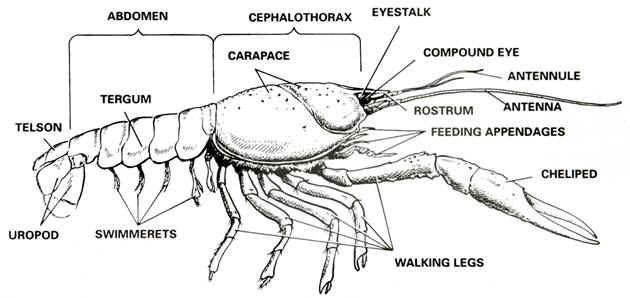
What is the main difference between the cephalothorax and abdomen?
___________________________________________________________
3. Turn the crayfish with its DORSAL side upward, and locate the rostrum, which is the pointed extension of the carapace at the head of the animal shown in the diagram above. Beneath the rostrum locate the two eyes. Notice that each eye is at the end of a stalk.

4. Locate the five pairs of appendages on the head region. First locate the antennules in the most anterior segment. Behind them observe the much longer pair of antennae.
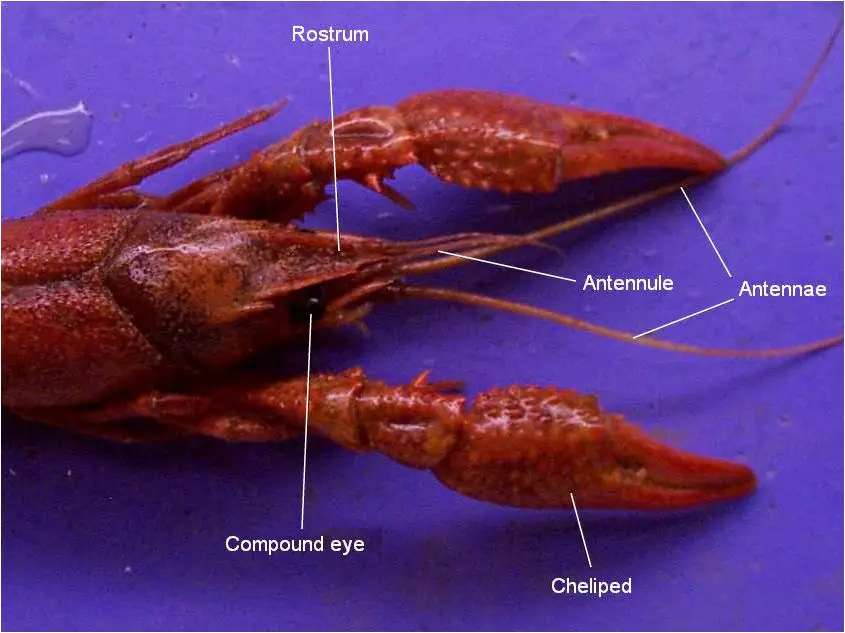
Why is it useful to view the specimen on its Dorsal side for this part of your study?
______________________________________________________________
5. Locate the mouth. Then observe the mandibles, or true jaws, behind the antennae. Now locate the two pairs of maxillae, which are the last appendages in the cephalic region.

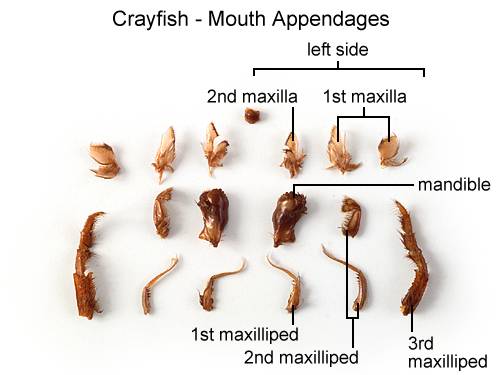
Which appendages in the cephalic region are related to the eating of food?
_____________________________________________________________

6. On the thoracic portion of the cephalothorax, observe the three pointed maxillipeds.
How are the maxillipeds related to eating?
______________________________________________________________
7. Next observe the largest prominent pair of appendages, the chelipeds, or claws. Behind the chelipeds locate the four pairs of walking legs, one pair on each segment.


8. Now use the walking legs to determine the sex of your specimen. Locate the base segment of each pair of walking legs. The base segment is where the leg attaches to the body. Use a magnifying glass to study the inside surface of the base segment of the third pair of walking legs. If you observe a crescent-shaped slit, you have located a genital pore of a female. In a male, the sperm duct openings are on the base segment of the fourth pair of walking legs. Use a magnifying glass to observe the opening of a genital pore.
Is your specimen a male or a female?
_____________________________________________________________
Exchange your specimen with a nearby classmate who has a crayfish of the opposite sex. Then study its genital pores.
9. On the abdomen, observe the six distinct segments. On each of the first five segments, observe a pair of swimmerets.
10. On the last abdominal segment, observe a pair of pointed appendages modified into a pair of uropods. In the middle of the uropods, locate the triangular-shaped telson.
11. Now turn the crayfish ventral side up. Observe the location of each pair of appendages from the ventral side.
From which view, dorsal or ventral, can you see the location of the appendages on the segments more clearly?
______________________________________________________________
12. Remove all jointed appendages of the crayfish and attach them to the table on the crayfish worksheet.
If dissection is two day, complete steps 13 and 14 only!
13. Next you will study the internal anatomy of a crayfish. If you must store your specimen until the next lab period, cover it with a dampened paper towel. Then place the specimen on the tray in a plastic bag. Close the bag with a twist tie. Write your name on the bag with a felt-tip marking pen, and give your specimen to your teacher.
14. Clean up your work area and wash your hands before leaving the lab.
Part 2—Internal Anatomy of a Crayfish
15. Put on a lab apron, gloves, and safety goggles.
16. Using one hand to hold the crayfish dorsal side up in the dissecting tray, use scissors to carefully cut through the back of the carapace along dissection cut line 1, as shown in the diagram below. Cut along the indentations that separate the thoracic portion of the carapace into three regions. Start the cut at the posterior edges of the carapace, and extend it along both sides in the cephalic region.

17. Use forceps to carefully lift away the carapace. Be careful not to pull the carapace away too quickly. Such action would disturb or tear the underlying structures.
18. Place the specimen on its side, with the head facing left, as shown in the diagram below. Using scissors, start cutting at the base of cut line 1. Cut along the side of the crayfish, as illustrated by cut line 2. Extend the cut line forward toward the rostrum (at the top of the head).
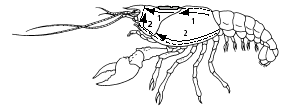
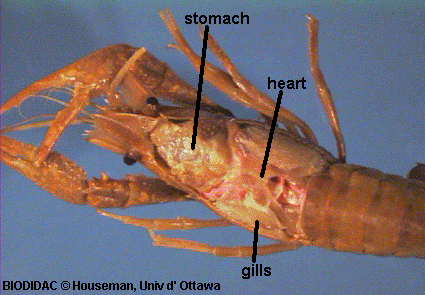
19. Use forceps to carefully lift away the remaining parts of the carapace, exposing the underlying gills and other organs.

20. Use the diagram below to locate and identify the organs of the digestive system. Locate the maxillae that pass the pieces of food into the mouth. The food travels down the short esophagus into the stomach. Locate the digestive gland, which produces digestive substances and from which the absorption of nutrients occurs. Undigested material passes into the intestine. Observe that the intestine is attached to the lobed stomach. The undigested material is eliminated from the anus.
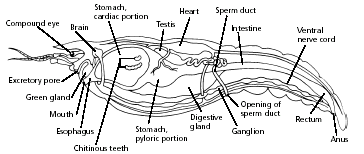

Rows of chitinous teeth line the stomach. Predict their function.
_____________________________________________________________
21. Use the diagram below to locate and identify the organs of the respiratory system. Locate the gills, which are featherlike structures found underneath the carapace and attached to the chelipeds and walking legs. A constant flow of blood to the gills releases carbon dioxide and picks up oxygen.
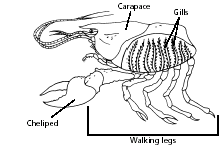
The feathery nature of the gills gives them a very large surface area. Why is this important?
____________________________________________________________
22. Use the diagram of the internal anatomy of the crayfish to locate and identify the organs of the circulatory system. Locate the dorsal tubular heart and several arteries. The crayfish has an open circulatory system in which the blood flows from arteries into sinuses, or spaces, in tissues. The blood flows over the gills before returning to the heart.
23. Use the same diagram to locate and identify the organs of the nervous system. Find the ventral nerve cord. Locate a ganglion, one of the enlargements of the ventral nerve cord. Locate the dorsal brain, which is located just behind the compound eyes. Note the two large nerves that lead from the brain, around the esophagus, and join the ventral nerve cord.
Many nerves leave from each ganglion. Where do you think these nerves go?
__________________________________________________________
24. Use the same diagram to locate and identify the organs of the excretory system. The blood carries cellular wastes to the disk-like green glands. Locate these organs just in front of the stomach. The green glands excrete waste through pores at the base of each antenna.
What organs in your body carry out the same function as the green glands?
____________________________________________________________

25. Use the diagram once again to locate and identify the organs of the reproductive system. The animal shown in the diagram is a male crayfish. If your specimen is a male, locate the testis. The testis is the long, white organ under the heart and a bit forward. The sperm ducts that carry sperm from the testis open at the fifth walking leg. If your specimen is a female, locate the bi-lobed ovary. It is in the same relative position as the testis, but the ovary appears as a large, reddish mass under the heart. Then locate the short oviducts that extend from near the center of each side of the ovary and open at the third walking leg. Exchange your specimen with a nearby classmate who has a crayfish of the opposite sex. Then study its reproductive system.
25. Dispose of your materials according to the directions from your teacher.
26. Clean up your work area and wash your hands before leaving lab.
|
Crayfish Worksheet | |
Crayfish Appendage Table |
 Crayfish Dissection Worksheet