Earthworm Worksheet

Name(s)_______________________________ Group_______ Date__________ Period_______

Earthworm Worksheet 


1. What is the name of the pumping organs of an earthworm?


2. Trace the parts of the digestive tract through which food passes.


3. Which parts of the earthworm serve as its brain?  How are these parts connected to the rest of the body?


4. Which of the parts of the worm’s body that you saw are included in the excretory system?


5. How can you find out whether an earthworm eats soil?


6. Among the earthworm’s structural adaptations are its setae. How do you think the earthworm’s setae make it well adapted to its habitat?


7. How is the earthworm’s digestive system adapted for extracting relatively small amounts of food from large amounts of ingested soil?


8. Your dissection of the earthworm did not go beyond segment 32. What will you observe if you dissect the remainder of the worm to its posterior end?


9. On a separate piece of paper, draw and label the parts of the earthworm you observed, and color code the systems. Use green for the reproductive system, yellow for the digestive system, blue for the excretory system, and red for the nervous system.


10. During mating, two earthworms exchange sperm. Fertilization is external, and cocoons are produced from which the young eventually emerge. Refer again to steps 5 and 11, where you located the earthworm’s reproductive organs. Use a reference to identify the role of each organ in the reproductive process of the earthworm. On a separate paper, summarize your findings.
BACK

Echinoderm

Echinoderms

All Materials © Cmassengale  

Phylum Echinodermata
Characteristics

  • All marine
  • Known as spiny-skinned animals
  • Endoskeleton known as the test is made of calcium plates or ossicles with protruding spines
  • Includes sea stars, brittle stars, sand dollars, sea urchins, & sea cucumbers
  • Undergo metamorphosis from bilateral, free-swimming larva to sessile or sedentary adult
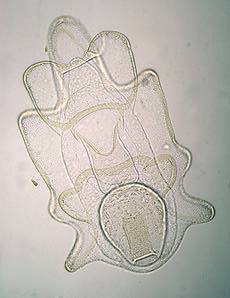
  • Larval stage known as dipleurula or bipinnaria
  • Adults have pentaradial ( 5 part) symmetry
  • Lack segmentation or metamerism
  • Coelomate
  • Breathe through skin gills as adults
  • Capable of extensive regeneration


Bipinnaria Larva

  • Ventral (lower) surface called the oral surface & where mouth is located
  • Dorsal (upper) surface known as aboral surface & where anus is located
  • Have a nervous system but no head or brain in adults
  • No circulatory, respiratory, or excretory systems
  • Have a network of water-filled canals called the water vascular system to help move & feed
  • Tube feet on the underside of arms help in moving & feeding
  • One-way digestive system consists of mouth with oral spines, gut, & anus
  • Deuterostomes (blastopore becomes the anus)
  • Separate sexes
  • Reproduce sexually & asexually
  • Includes 5 classes:
    * Crinoidea – sea lilies & feather stars
    * Asteriodea – starfish
    * Ophiuroidea – basket stars & brittle stars
    * Echinoidea – sea urchins & sand dollars
    * Holothuroidea – sea cucumbers

Class Crinoidea
Characteristics

  • Sessile
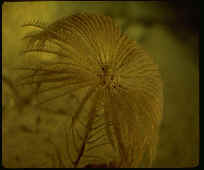
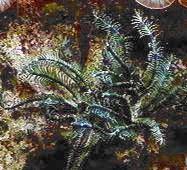
  • Sea lilies & feather stars


FEATHER STAR

SEA LILY


  • Have a long stalk with branching arms that attach them to rocks & the ocean bottom
  • Can detach & move around
  • Mouth & anus on upper surface
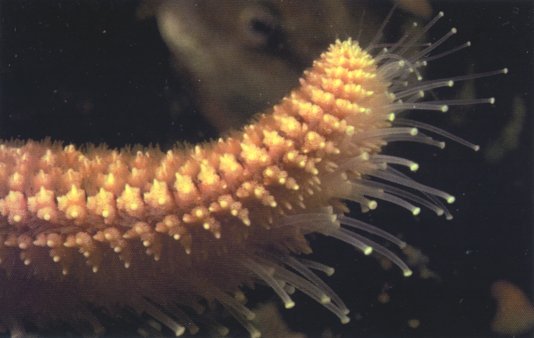
  • May have 5 to 200 arms with sticky tube feet to help capture food (filter feeders) & take in oxygen
  • Common in areas with strong currents & usually nocturnal feeders

Class Asteroidea
Characteristics

  • Usually sedentary along shorelines
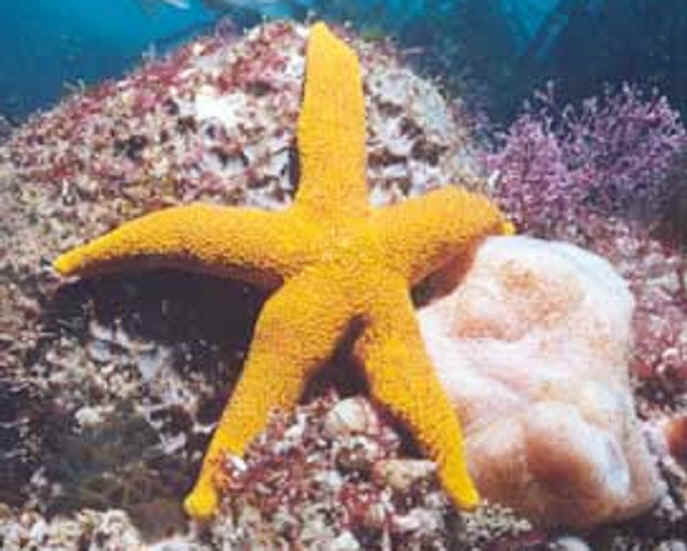
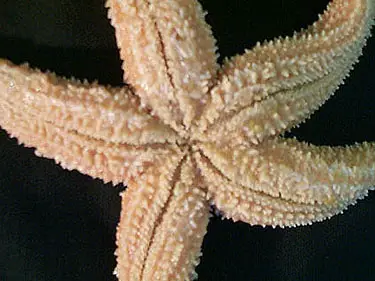
  • Starfish or sea stars
  • Come in a variety of colors
  • Prey on bivalve mollusks such as clams & oysters


Starfish Feeding on Clam

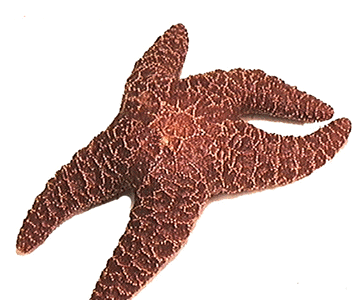
  • Have 5 arms that can be regenerated
  • Arms project from the central disk
  • Mouth on oral surface (underside)


STARFISH

Class Ophiuroidea
Characteristics

  • Largest class of echinoderms
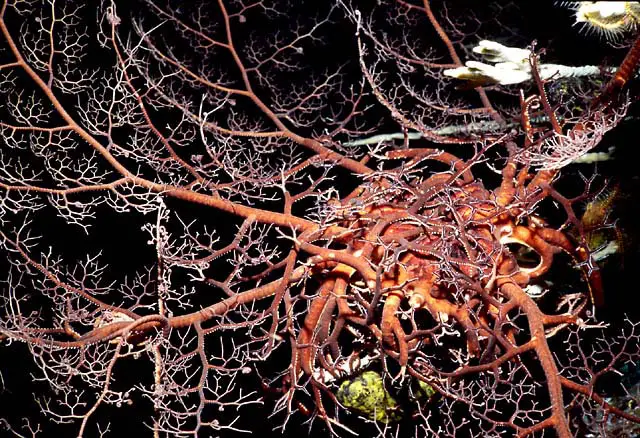
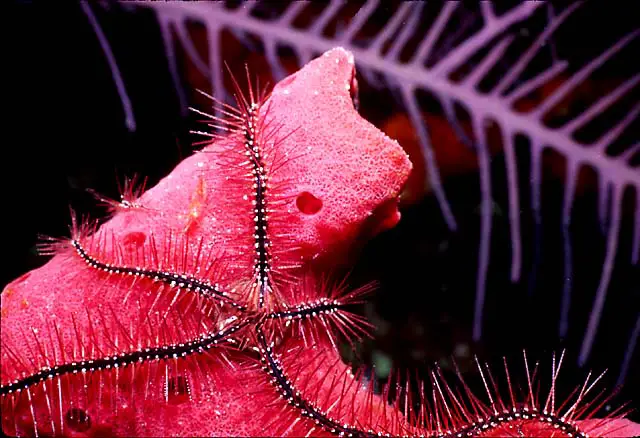
  • Includes basket stars & brittle stars


BASKET STAR

BRITTLE STAR


  • Live on the ocean bottom beneath stones, in crevices, or in holes
  • Have long, narrow arms resembling a tangle of snakes
  • Arms readily break off & regenerate
  • Move quicker than starfish
  • Feed by raking in food with arms or trapping it with its tube feet

Class Echinoidea
Characteristics

  • Includes sea urchins & sand dollars


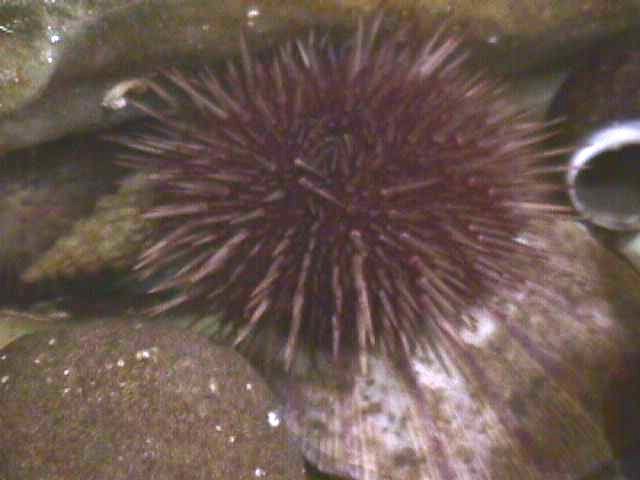
SEA URCHIN

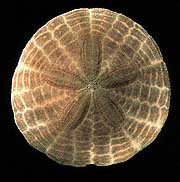
SAND DOLLAR


  • Internal organs enclosed by endoskeleton or test made of fused skeletal plates
  • Body shaped like a sphere (sea urchin) or a flattened disk (sand dollar)
  • Lack arms
  • Bodies covered with movable spines
  • Have a jawlike, crushing structure called Aristotle’s lantern to grind food
  • Use tube feet to move
  • Sea Urchins:
    * Spherical shape
    * Live on ocean bottom
    * Scrape algae to feed
    * Long, barbed spines make venom for protection
  • Sand Dollars:
    * Flattened body
    * Live in sand along coastlines
    * Shallow burrowers
    * Have short spines

Class Holothuroidea
Characteristics

  • Includes sea cucumber


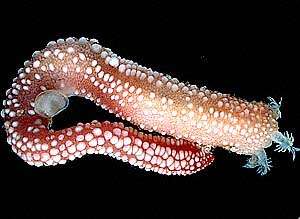
SEA CUCUMBER

  • Lack arms
  • Shaped like a pickle or cucumber
  • Live on ocean bottoms hiding in caves during the day 
  • Have a soft body with a tough, leathery outer skin
  • Five rows of tube feet run lengthwise on the aboral (top) surface of the body
  • Have a fringe of tentacles (modified tube feet) surrounding the mouth to sweep in food & water
  • Tentacles have sticky ends to collect plankton
  • Show bilateral symmetry
  • Can eject parts of their internal organs (evisceration) to scare predators; regenerate these structures in days

Structure & Function of Starfish
Body Plan

  • Range in size from 1 centimeter to 1 meter
  • Mouth located on oral surface (underside)
  • Have an endoskeleton made of calcium plates
  • Sharp, protective spines made of calcium plates called ossicles found under the skin on the aboral (top) surface


ABORAL SURFACE

  • Have pedicellariae or tiny, forcep-like structures surrounding their spines to help clean the body surface

Water Vascular System

  • Network of canals creating hydrostatic pressure to help the starfish move


WATER VASCULAR SYSTEM

  • Water enters through sieve plate or madreporite on aboral surface into a short, straight stone canal
  • Stone canal connects to a circular canal around the mouth called the ring canal
  • Five radial canals extend down each arm & are connected to the ring canal
  • Radial canals carry water to hundreds of paired tube feet


TUBE FEET

  • Bulb-like sacs or ampulla on the upper end of each tube foot contract & create suction to help move, attach, or open bivalves
  • Rows of tube feet on oral surface (underside) are found in ambulcaral grooves under each arm


Tube Feet in Ambulcaral Grooves

Feeding & Digestion

  • Tube feet attach to bivalve mollusk shells & create suction to pull valves apart slightly
  • Starfish everts (turns inside out) its stomach through its mouth & inserts it into prey
  • Stomach secretes enzymes to partially digest bivalve then stomach withdrawn & digestion completed inside starfish

Other Body Systems

  • No circulatory, excretory, or respiratory systems
  • Coelomic fluid bathes organs & distributes food & oxygen
  • Gas exchange occurs through skin gills & diffusion into the tube feet
  • No head or brain
  • Have a nerve ring surrounding the mouth that branch into nerve cords down each arm
  • Eyespots on the tips of each arm detect light
  • Tube feet respond to touch

Reproduction

  • Separate sexes
  • Two gonads (ovaries or testes) in each arm produce eggs or sperm
  • Have external fertilization
  • Females produce up to 200,000,000 eggs per season
  • Fertilized eggs hatch into bipinnaria larva which settles to the bottom after 2 years & changes into adult
  • Asexually reproduce by regenerating arms
BACK


Design Controlled Experiment


Developing a Controlled Experiment

Directions: Using your knowledge of the Scientific Method, complete the following situations.

1. Define hypothesis? 

2. Define experimental variable? 

3. Why is it important for an experiment to contain a control? 

4. Develop a controlled experiment to back up the following hypothesis:

The temperature of a lake has an effect on a fish’s ability to produce viable offspring.

  1. List the equipment needed to carry on this experiment.
  2. List the steps of the controlled experiment so that any one can follow.
  3. What is the experimental variable?
  4. What are the control(s) of the experiment?
BACK

Cornell Note Sample

Cornell Note-taking System Sample


Reduce or Question (After Lecture)

  • write key words, phrases or questions that serve as cues for notes taken in class
  • cue phrases and questions should be in your own words

Recite

  • with classroom notes covered, read each key word or question
  • recite the fact or idea brought to mind by key word or question
Record (During Lecture)

  • write down facts and ideas in phrases
  • use abbreviations when possible (After Lecture)
  • read through your notes
  • fill in blanks and make scribbles more legible

Reflect and Review

  • review your notes periodically by reciting
  • think about what you have learned
Recapitulation (After Lecture)

  • summarize each main idea
  • use complete sentences