| Chromatography of Simulated Plant Pigments |

Introduction
This experiment is conducted to investigate the components Plant Pigments separating visibly. There are a couple of different types of components in plant pigments, and they became clearly visible during this lab. The most important and abundant chemical pigment found in plants is chlorophyll. This pigment exists in two forms; chlorophyll a and chlorophyll b. Chlorophyll absorbs two main colors from light quite well. These are blue, and red. The chlorophyll reflects green light very well, however, the two different types of chlorophyll have their maximum absorption at different wavelengths of light. Chlorophyll a, being the main photosynthetic pigment, has a primary purpose to convert light energy to chemical energy used by the plant itself. Chlorophyll b absorbs light in a region of the spectrum apart from the dominant chlorophyll, and transfers the energy it produces to chlorophyll a. Along with chlorophyll b in transferring their energy produced to the dominant chlorophyll, two other pigments that are found in plants are carotenes and xanthophylls, which are orange and yellow respectively. Since chlorophyll is such a dominant pigment in green plants, this domination hides the color of the carotenes and xanthophylls in the leaves. This causes most plant leaves to appear green most of the time. During the autumn, however, the chlorophyll starts to break down, causing the carotenes and xanthophylls to show their bright red, orange and yellow colors.
These brilliant colors can be separated another way. This different technique, known as paper chromatography, separates mixtures in a liquid into individual components. The technique is based on the fact that each substance in a mixture has a specific affinity for a solid surface and a specific solubility in different solvents. By this method, the solid surface is the cellulose fibers in the chromatography paper, and the solvent is the solution that was placed in the bottom of the developing chamber.
This separation takes place through a process of absorption and capillary action. Just a small drop of the mixture, in this case plant pigment to be separated, is placed at the bottom of the strip of chromatography paper. The chromatography paper is then placed in the developing chamber with a solvent, which wicks up the paper, pulling the solvent up the paper by capillary action, and the mixture of pigments is dissolved as the solvent passes over it. The different components of the mixture move upward at different rates. A compound with greater solubility will travel farther than one with less solubility. The pigments then show up as color streaks on the chromatography paper. These substances have formed a pattern called a chromatogram on the chromatography paper.
The Rf values for each pigment is calculated to establish the relative rate of migration for each pigment. This value represents the ratio of the distance a pigment traveled on the chromatogram relative to the distance the solvent front moved. Scientists use the Rf value of a sample to identify the molecule. Any molecule in a given solvent matrix system has a uniquely consistent Rf value. The formula for this value is as follows:
Rf = Distance each pigment traveled ¸ Distance solvent front traveled
Hypothesis
Using paper chromatography, the pigments that give a leaf its color can be separated and observed to determine the Rf value of each pigment and their function during photosynthesis.
Materials
For this experiment the following items are used — one chromatography reaction chamber, one paper chromatography strip, one capillary pipette, a pencil and paper, calculator, ruler, 50 ml beaker, colored pencils, approximately 10 ml of solvent depending on the size of the reaction chamber, scissors, and simulated plant pigment.
Procedure
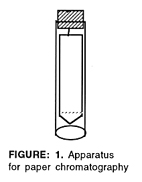
Use scissors to cut the bottom of the chromatography paper to a tapered end. Measure the strip and cut the length to equal slightly longer than the reaction chamber. Draw a faint pencil line at the bottom of the tapered end and use a capillary pipette to add some simulated plant pigment to this line. Add 5-10 ml of solvent to the reaction chamber. Extend the chromatography strip through the slit in the lids of the reaction chamber and carefully lower the strip into the chamber so the tapered end is in the solvent and the pencil line is above the solvent level. Make sure the strip does not touch the walls of the chamber and do not bump the chamber as the pigments begin to separate. After the pigments have completely separated and the solvent front has reached the top of the chamber, remove the strip and mark the solvent front with a pencil line before it evaporates. Measure and record the distance the solvent and each pigment traveled. Use a calculator to determine the Rf values for each pigment.
Data
Table 1 |
||||
| Band # | Pigment | Color | Migration distance (mm) | Rf value |
| 1 | Carotene | Orange | 59mm | .94 |
| 2 | Xanthophyll | Yellow | 56mm | .89 |
| 3 | Chlorophyll a | Light green | 29mm | .46 |
| 4 | Chlorophyll b | Dark green | 14mm | .22 |
| Solvent | 63mm | |||
Questions
1. Describe what happened to the original spot of simulated plant pigments? The solvent separated the original spot by wicking up the solvent while dissolving the various pigments in the spot.
2. List some other uses of chromatography? Chromatography can be used to separate various mixtures of subtances, liquids and gases.
3. Which of the 4 pigments migrated the furthest and why? carotene ( orange) because it was the most soluble in the solvent
4. Which type of chlorophyll was the most soluble? chlorophyll a
5. Explain why leaves change color in the fall? In Autumn, chlorophyll starts to break down which allows the other brilliant plant pigment colors to show. These pigments include the red, orange, and yellow colors.
6. What is the function of plant pigments in photosynthesis? Plant pigments trap light energy and convert it into chemical energy that can be used by the plant to make glucose or sugar.
Error Analysis
The chromatography paper touched the sides of the chamber during the waiting time which caused the migration to go slightly to the side instead of straight to the top. Also the strip was bent at the top so there could have been a slight error in measuring the migration of the solvent front.
Conclusion
Paper chromatography proved to be an accurate method of separating and observing the various colors of plant pigments. The pigments dissolved in the solvent and migrated upward. The colors were observed and their migration distances measured & recorded. The Rf value of each pigment was determined by dividing its migration by the migration of the solvent. It was determined that 4 pigments were present in the original spot — carotene, xanthophyll, chlorophyll a, and chlorophyll b. Carotene was the most soluble, while chlorophyll b was the least soluble.