| Chapter 16 Molecular Basis of Inheritance | ||||||||||||||||||||||||||||||||||||||||||||
| Objectives | ||||||||||||||||||||||||||||||||||||||||||||
|
||||||||||||||||||||||||||||||||||||||||||||
| BACK | ||||||||||||||||||||||||||||||||||||||||||||
| Chapter 16 Molecular Basis of Inheritance | ||||||||||||||||||||||||||||||||||||||||||||
| Objectives | ||||||||||||||||||||||||||||||||||||||||||||
|
||||||||||||||||||||||||||||||||||||||||||||
| BACK | ||||||||||||||||||||||||||||||||||||||||||||
Cell Study Guide
| What type of cells did Hooke view when he discovered cells? |
| What are the smallest units of life called? |
| Which increases faster, the surface area or the volume of a cell? |
| What limits how large a cell can grow? |
| What do you call organisms that do not have a nucleus? |
| Give an example of a prokaryote. |
| Name several eukaryotic cells. |
| What type of cells have membrane-bound organelles? |
| Prokaryotes have a cell membrane and a ___________ around the outside. |
| What are cell membranes? |
| Give 2-3 functions of the cell membrane. |
| The cell membrane is selectively permeable. What does this mean? |
| If a cell is very active and needs more energy, what type of organelle will it need more of? |
| What organelle makes a cell’s ATP? |
| Proteins are made by what organelle? |
| What organelle is the packaging & export center of the cell? |
| What double membrane surrounds the nucleus? |
| Name the 3 main parts to all eukaryotic cells. |
| What canals connect the nuclear membrane with the cell membrane for the movement of materials? |
| In what organelle are chromosomes found? |
| Name 2 structures found in plant cells but not in animal cells. |
| Where does photosynthesis occur in a cell? |
| In what organelles is the green pigment chlorophyll found? |
| What is the purpose of large vacuoles in plant cells? |
| List the levels of organization in order from simplest to most complex starting with the cell. |
 |
Cells |
Section 4-1 Introduction to the Cell
1. What is a cell?
2. Who was the first person to use a simple microscope and view microscopic organisms?
3.. What English scientist was first to view dead plant cells?
4. State the 3 parts to the cell theory.
5. Tell how each of these scientists contributed to the cell theory — Matthias Schleiden, Theodor Schwann, and Rudolf Virchow.
6. Give 3 ways that cells are not alike.
7. What is one of the longest animal cells?
8. Explain why cells are limited in how large they can grow.
9. The shape of a cell reflects its ______________________. Give an example of this.
10. Define organelle & tell what they do for a cell.
11. What surrounds the outside of all cells?
12. Where is the nucleus of a cell & what does it do?
13. What two characteristics do all eukaryotes share?
14. What type of cell is a bacterium?
15. Where is the genetic information (chromosome) of a bacterium found?
16. What are prokaryotes & are they in the same kingdom as eukaryotes?
Section 4-2 Parts of the Eukaryotic Cell
17. Why can cells not survive if they are totally isolated from their environment?
18. What controls what enters or leaves a cell?
19. Define selectively permeable.
20. Describe the phospholipid make up of cell membranes.
21. Cells are bathed in an aqueous environment. What does this mean?
22. Sketch the lipid bilayer of a cell showing the inside & outside of the cell. Be sure to label all parts of the membrane.
23. What is the difference between peripheral & integral proteins in the cell membrane?
24. What is the purpose of the carbohydrate tails attached to some integral proteins?
25. Do all integral proteins look alike? Explain.
26. Explain the fluid mosaic model of the cell membrane.
27. Name 12 organelles found in cells. (See table 4-2)
28. In what part of a cell are organelles found?
29. What is cytosol & what does it contain?
30. Name 3 organelles found in plant, but not animal cells. (See bottom of table 4-2)
31. What is the function of mitochondria? What energy molecule is made there?
32. Why do liver & muscle cells have more mitochondria than other types of cells?
33. Describe the outer covering of the mitochondria.
34. What are cristae & what is their purpose?
35. Mitochondria are able to reproduce inside cells because they have their own ___________.
36. What organelles are the most numerous inside cells?
37. What two things make up ribosomes & are ribosomes surrounded by membrane like other organelles?
38. Ribosomes are made inside the _______________ of a cell.
39. Ribosomes may remain unattached or __________ in cytosol or attach to what other organelle’s surface?
40. What organic compounds to ribosomes synthesize or make?
41. What does ER stand for & what is the ER in a cell?
42. What is the ER’s function?
43. Name the two types of ER inside cells.
44. What is on the surface of rough ER?
45. Rough ER synthesizes large amounts of _________________ for cells.
46. Give 3 functions of smooth ER.
47. What is the Golgi apparatus?
48. Golgi is a system of ________________ or flattened _____________.
49. How does the Golgi work with the endoplasmic reticulum of a cell?
50. What are lysosomes & what do they do?
51. Name 8 things that the enzymes inside lysosomes digest?
52. In what type of cells are lysosomes common? In what type of cell are they rare?
53. Where is the cytoskeleton & what is its function?
54. What are the two major components of the cytoskeleton?
55. How do microfilaments & microtubules differ from each other?
56. What are spindle fibers & what are they made of?
57. What protein makes up microfilaments?
58. Compare cilia & flagella.
59. What is the purpose of the nuclear matrix?
60. What double membrane surrounds the nucleus?
61. Where is chromatin found & what 2 things is it made of?
62. When a cell is ready to divide, chromatin condenses & coils into _____________________.
63. What is the purpose of DNA inside the nucleus?
64. How do nuclear pores help RNA?
65. Where is the nucleolus found and what is made there?
66. Where is the cell wall in plants found, what is its function, and what is it made of?
67. What are the 2 types of cell walls in plants?
68. What is the difference between the primary & secondary cell walls?
69. What is found inside plant vacuoles?
70. What takes up much of the volume of plant cells? What happens to the other organelles?
71. How are plastids similar to mitochondria?
72. What is found inside of plastids?
73. Name the most familiar plastid & tell its function.
74. What are thylakoids?
Section 4-3 Multicellular Organization
75. Cells are organized into ______________________. Give an example.
76. What is an organ & give an example?
77. What forms organ systems?
78. The digestive system is an organ system. Name the organs that make up this system.
79. All the systems working together make up an ______________________ such as a plant or animal.
Meiosis – Gamete Production
ppt Questions
Meiosis Facts
1. Define meiosis.
2. What is the symbol for the diploid number of chromosomes in a cell?
3. What is the symbol for the monoploid or haploid number of chromosomes in a cell?
4. Is meiosis sexual or asexual reproduction?
5. How many times does a cell divide during Meiosis?
6. What are the divisions of meiosis called?
7. During meiosis, sex cells divide to form ____________.
8. Name the 2 gametes.
9. How many chromosomes do gametes have compared to a normal body or somatic cell?
10. If a human body cell has 46 chromosomes, how many chromosomes do the gametes (egg and sperm) have?
11. Where does meiosis occur in the body in males? in females?
12. Testes and ovaries are known as ____________.
13. Meiosis in males is called _____________ and produces ________ cells.
14. Meiosis in females is called _____________ and produces ________ cells.
15. a. Make a sketch of a diploid (2n=46) sperm cell in Meiosis I and Meiosis II.
b. Make a sketch of a diploid (2n=46) egg cell in Meiosis I and Meiosis II.
Meiosis I
16. Name the 1st stage of meiosis.
17. When are chromosomes (DNA) replicated?
18. Each duplicated chromosome consists of a pair of _________ __________.
19. What attaches sister chromatids to each other?
20. What two structures in the center of a cell are visible at the beginning of Interphase I?
21. Name the 4 stages of Meiosis I.
22. What is the longest phase of meiosis? What pwercent of the division time is this?
23. During Prophase I, what happens to chromosomes?
24. __________ occurs after chromosomes condense.
25. Explain synapsis.
26. What is a tetrad?
27. A tetrad is made of ________ sister and two, nonsister ____________.
28. Sketch a tetrad.
29. What is meant by homologous chromosomes?
30. Homologous chromosomes form a ________ during Prophase I.
31. Homologs carry _________ controlling the ________ inherited traits.
32. What is a locus?
33. What is true about the loci of genes on homologous chromosomes?
34. Humans have _______ pairs of homologous chromosomes.
35. What are autosomes?
36. What is the last pair of chromosomes called?
37. What is the chromosome pair for a female? a male?
38. Sketch a tetrad and show the location of two different genes on the chromatids.
39. Define crossing over.
40. Crossing over creates __________ in the chromosomes.
41. The sites where crossing over occurs are called __________.
42. Crossing over occurs between __________ chromatids.
43. Sketch a tetrad with crossing over occurring. Label the chiasmata.
44. Sketch a tetrad where crossing over occurred and shade the sections of the chromosomes that were exchanged causing variation.
45. Compare the size of an X and a Y chromosome.
46. Spindle and aster fibers form from centrioles during _______________ in humans.
47. What is the shortest meiotic stage?
48. What happens to the tetrads during Metaphase I?
49. When the chromosome pairs of the tetrad separate, they move ____________ to the opposite poles of the cell.
50. This random separation of homologs is called ______________ ___________.
51. What effect does independent assortment have on cells?
52. Give the formula for determining the number of variations in cells.
53. If 2n=6, how many combinations are possible?
54. How many different combinations of sperm are possible in a human male?
55. What happens to homologous chromosomes during Anaphase I?
56. Do sister chromatids separate? Explain.
57. How many chromosomes are at the poles in telophase I?
58. In humans, the haploid number is _________.
59. ____________ occurs at the end of Telophase I forming _______ new daughter cells.
Meiosis II
60. Is DNA replicated again before Meiosis II?
61. Name the stages of Meiosis II.
62. What occurs during Prophase II?
63. Where are the sister chromatids during Metaphase II?
64. During what stage do sister chromatids separate from each other?
65. During Telophase II, the _____________ and nucleolus reform.
66. _______________ occurs again at the end of Telophase II forming __________ new daughter cells.
67. The 4 new cells at the end of Telophase II are _____________ or 1n cells.
68. In spermatogenesis, the newly formed gametes are called ____________.
69. In Oogenesis, the newly formed gametes are called ____________.
Variation
70. What is another name for variation?
71. Why is variation important?
72. Which individuals are most likely to survive & reproduce in a population?
73. What is this process known as?
74. Name the 3 sources of genetic variation that occur in sexual reproduction and tell when EACH occurs.
75. If a diploid cell is 2n=20, what will be the 1n number of the daughter cells?
76. How many daughter cells will there be at the end of meiosis?
77. What is a karyotype?
78. Where are the autosomes found on a karyotype?
79. Where are the sex chromosomes found?
80. How does a karotype of a Down Syndrome child look?
81. What is a zygote?
82. What process produces zygotes? What cells join or fuse?
| Mitosis & Meiosis PPT Questions |
|||||||||||||||||||||||||
| 1. From where do new cells arise?
2. Why does the body constantly make new cells?
3. Is cell division the same in all cells? Explain.
4. Why must each new cell get a complete copy of the original cell’s DNA?
5. Copying DNA is known as ____________________. 6. The original cell that divides is called the _____________ cell, while the two, new identical cells are called ______________ cells. Chromosomes 7. Describe the chromosome of a prokaryote like a bacterial cell.
8. About how many chromosomes are in the body cell of eukaryotes? 9. How many chromosomes are in a human body cell? 10. What makes up each chromosome?
11. Chromosomes can only be seen when a cell is __________________. 12. Uncoiled chromosomes are called ____________________. 13. DNA tightly coils by wrapping around what kind of proteins? 14. What are duplicated (doubled) chromosomes called? 15. What holds chromatids together? 16. Sketch & label all parts of sister chromatids.
17. What is a karyotype?
18. Where are autosomes found on a karyotype? 19. Where are sex chromosomes found on a karyotype? 20. What is the genotype for males? For females? 21. The presence of which chromosome determines the sex of the child?
Cell Reproduction22. What is asexual reproduction?
23. Give 2 examples of asexual reproduction. a. b.
24. What is sexual reproduction and give an example? 25. Which process produces identical new cells — mitosis, meiosis, or both? Prokaryotic Cell Division26. Name a prokaryote that reproduces by binary fission. 27. Sketch and explain how binary fission occurs in a bacterial cells.
28. What forms to divide the 2 new bacterial cells?
Cell Cycle29. Name the 5 phases of the cell cycle.
30. What is the longest phase of the cell cycle? the shortest phase? 31. Which phase has 3 stages & name them?
32. Which phase has 4 stages & name them?
33. Describe what occurs in the G1 stage of interphase.
34. When is DNA copied? 35. How do the new copies of DNA compare to the original DNA? 36. What does a cell make during the G2 stage right before mitosis?
37. Name a structure needed for cell division that is made during the G2 stage. In what type of cell is this organelle found?
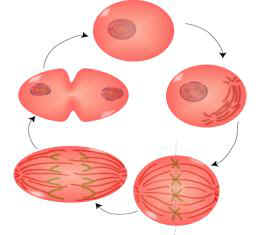
38. Can the nucleus and nucleolus be seen during interphase? 39. Sketch & label all parts of the cell cycle.
Mitosis40. What part of a cell actually divides during mitosis? 41. Give another name for mitosis. 42. In which type of cell does mitosis occur — prokaryote or eukaryote? Explain why.
43. Name a type of cell that doesn’t undergo mitosis. 44. Name, in order, the four stages of mitosis.
45. Name 2 things that happen to a cell during Early Prophase. a.
b. 46. What happens to the nucleus & nucleolus during prophase?
47. Why do chromosomes become visible during prophase?
48. What are kinetochores?
49. Where do kinetochore fibers attach to a chromosome? 50. What finishes forming by the end of Late Prophase?
51. Sketch and label a kinetochore fiber attached to a chromosome.
52. From what does the spindle form in plants? in animals? 53. What are polar fibers? Do they attach to chromosomes?
54. What are asters & where are they in a cell?
55. Where are the poles of a cell? the equator of a cell?
56. Sketch & label the parts of a spindle.
57. What happens to chromosomes during metaphase?
58. During metaphase, where do chromosomes line up & what MOVES them there?
59. Which mitotic phase occurs rapidly? 60. What happens to sister chromatids during anaphase?
61. What pulls sister chromatids apart during anaphase? 62. Where are chromatids located during telophase? 63. What disassembles in telophase? 64. What reforms around each set of sister chromatids during telophase? 65. What organelle reappears inside the nucleus? 66. During telophase as the chromosomes uncoil, they reappear as ____________________. 67. What process or phase follows telophase? 68. What divides during cytokinesis? 69. Explain how cytokinesis occurs in plants.
70. Explain how cytokinesis occurs in animals.
71. How does the chromosome number of the parent cell compare to that of the 2 daughter cells? How do the 3 cells compare in size?
72. What is the first thing the daughter cells must do following cytokinesis?
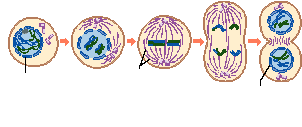
73. If the parent cell has a chromosome number of 2n = 6, what will be the chromosome number of the daughter cells? 74. Label these mitosis diagrams.
75. Label these stages.
76. Eukaryotic cell division is used for _______________ and _____________ of cells. 77. Parent cells before division are diploid or _______ chromosome number. What will be the chromosome number of the two new cells?
78. Name these actual stages of cell division.
TEST YOURSELF ON MITOSIS 79. Identify these stages.
80. Locate the four mitotic stages.
81. Eukaryotic cells before and after mitosis are ________________ or 2n. 82. What happens if mitosis is NOT controlled?
83. What are oncogenes? Meiosis80a. Do chromosomes replicate or double before meiosis? 81a. How many divisions occur in meiosis? Is this the same as mitosis? Explain.
82a. Meiosis is also called _____________________________________. 83. The original cell that divides by meiosis is ________________ or 2n. 84. How many daughter cells can be produced by meiosis? Is this the same as mitosis? Explain.
85. What is the chromosome number of the daughter cells produced by meiosis? How does this compare to the number of chromosomes in the original cell?
86. What are the daughter cells called that are produced by meiosis? Name them.
87. Name the 2 types of meiosis. a. b. 88. Where does spermatogenesis occur? 89. Where does oogenesis occur? 90. In humans, how many chromosomes are in the original that undergoes meiosis? Are they single or double stranded? 91. After one division, how many chromosomes are in the cells? Are they single or double stranded?
92. After the second division, how many chromosomes are in the cells? Are they double or single stranded?
93. Is meiosis sexual or asexual reproduction? 94. Are eggs & sperm haploid or diploid? 95. What process joins the egg & sperm to restore the original chromosome number of the organism?
96. When a sperm fertilizes an egg, a new 2n cell forms called the _____________________. 97. ________________ are pairs of sister chromatids that have the same genes, but may have different alleles. 98. _____________ reduces the chromosome number by half, while ____________ restores it. 99. In Meiosis I, what separates?
100. In Meiosis II, what separates?
101. Name these stages of Meiosis I.
102. Name 2 things that occur in Early Prophase I.
103. Name 3 things that happen in Late prophase I.
104. What is a tetrad? Label the centromere and put a box around a sister chromatid.
105. ____________ is the process in prophase I that forms tetrads. 106. Once tetrads form, what happens to the homologous chromosomes? What is this called?
107. Crossing-over results in genetic ________________ in the offspring. 108. What happens during Metaphase I?
109. Name 2 things that occur in Anaphase I?
110. Name 3 things that occur in Telophase I?
111. At the beginning of Meiosis II, each cell has how many homologs of each chromosome?
112. Sister chromatids carry ____________ genetic information (same genes & same alleles). 113. The gametes at the end of Meiosis II will have how many copies of a gene for a trait?
114. Name the stages in Meiosis II.
115. What happens in Prophase II? 116. Where are the sister chromatids in Metaphase II? 117. What happens to the sister chromatids during Anaphase II?
118. Name 4 things that occur in Telophase II?
119. Meiosis results in __________ haploid cells called _________ that have _______ copy of each chromosome and _________ allele for each gene in different ___________________. Gametogenesis 120. Gametogenesis that produces sperm cells is called ______________________________. 121. Where does spermatogenesis occur? 122. Immature sperm cells are called ___________________. 123. How do mature sperm cells move? 124. Approximately how many sperm do men produce each day? 125. Label the diagram of spermatogenesis.
126. Where does oogenesis occur?
127. Name the 4 cells produced by oogenesis. 128. What happens to the polar bodies & WHY?
129. ________________ are immature eggs. 130. How often do females produce an oocyte & starting at what age? 131. Label the diagram of oogenesis.
Comparing Mitosis & Meiosis 132. Complete the following table comparing mitosis & meiosis.
|
|||||||||||||||||||||||||
 |