Cell Exploration Webquest


CELL EXPLORATION WEBQUEST


INTRODUCTION

Every living thing is composed of at least one cell. Bacteria, amoebae, and paramecia are made of one cell and are capable of the activities of life. Organisms made of one cell are unicellular. Most living things are made of more than one cell and are called multicellular. Cells of these organisms function together to accomplish life activities. How many cells do you think make up your body? The human body is made of trillions of cells.

In order to understand how the cell functions in your body, we have to take a look at how your body is organized. Since you are made of matter, and all matter is made of atoms, your body is a collection of atoms. These atoms combined in specific ways to form molecules. Some of the important molecules in your body are proteins, carbohydrates, lipids, salts, water, and nucleic acids. These molecules combined to form the structures that make up a cell. Since each cell is capable of the activities of life, it is the smallest unit of life.

Cells that are similar can function together. These collections of cells are called tissues. Some tissues that you may be familiar with are the muscle tissue that makes up your heart, epithelial tissue that makes up your skin, and connective tissue that holds your body together. Different groups of tissues can be arranged to form organs. Some organs that you may be familiar with are the stomach, intestines, heart, and lungs. For example, the stomach has epithelium to line the outside and inside surfaces for protection and the muscle tissue allows your stomach to squeeze and churn. Groups of organs can work together as an organ system to perform a specific function. The digestive system functions to breakdown and absorb food so that our bodies can use the energy. The pancreas, stomach, intestines, gall bladder, and esophagus are some of the organs that make up the digestive system. There are 13 systems in the human body that function together to produce an organism – YOU!

To review:

ATOMS ——> MOLECULES ——-> CELLS ——-> TISSUES ——-> ORGANS ——> SYSTEMS ——> ORGANISM
The focus of this activity is to learn more about the cell and how it functions in your body.

CELL SIZE

Cells are very small and you must use a microscope to look at them. Watch this video (click on “start animation”), then look at the size of cells and answer the following questions. To give you an idea about size, the length of a key on the keyboard is about 1 cm.

Question:
Answer:
A. Is a bacterium larger or smaller than an animal cell?
B. How many bacteria can fit into an animal cell?
C. Are plant cells larger or smaller than animal cells?


EUKARYOTIC CELL ORGANELLES

Since the cell is the fundamental unit of life, it must be capable of independent existence. Some of the necessary life activities are communication, metabolism, protection, and waste disposal. In order to carry out these jobs, the cell has different organs inside of it just like your body has organs. These “tiny organs” are called organelles. Different organs have different jobs and they need the proper supplies of ATP (cellular energy), proteins, oxygen, and other nutrients to carry out their jobs.
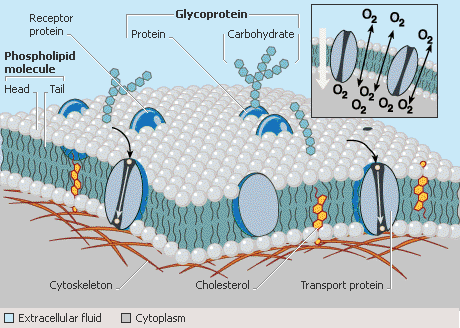
There are different types of cells that have different functions, but all cells have some common features. The things common to all cells are a cell membrane (plasma membrane), cytoplasm, and organelles. Take a look at a drawing of an animal cell. (Hold cursor over organelle to identify it.)

To understand how the cell carries out its functions, you should know more about the cytoplasm, cell membrane, and organelles. Click on each structure given in the table below to learn more about each cell part. Complete the table by writing a brief description and function for each part.

Structure
Description
Function
CYTOPLASM
PLASMA MEMBRANE
NUCLEUS
MITOCHONDRION
ENDOPLASMIC RETICULUM
RIBOSOME
GOLGI COMPLEX
CENTRIOLE
LYSOSOME
CYTOSKELETON


The things common to all cells are a cell membrane (plasma membrane), cytoplasm, and organelles. Remember that plant cells have three structures that animal cells don’t.  Now look at a drawing of a plant cell.  (Hold cursor over organelle to identify it.)

COMPLETE THE TABLE BELOW:

Structure
Description
Function
 CHLOROPLAST
 CELL WALL
CENTRAL VACUOLE 

 
PROKARYOTIC CELLS


        Remember that prokaryotic cells are only found in bacteria!  They’re simpler than eukaryotic cells.  Look at the bacterial cell, and complete the table below:

Structure
Description
Function

After you have read about  cells, take the cell quiz. Check your answer after you answer each question.


BACK

Campbell Problem 6

Molecular Genetics Problem 6
6. A space probe discovers a planet inhabited by creatures who reproduce with the same hereditary patterns as those in humans. Three phenotypic characters are height (T = tall, t = dwarf), hearing appendages (A = antennae, a = no antennae), and nose morphology (S = upturned snout, s = downturned snout). Since the creatures were not “intelligent” Earth scientists were able to do some controlled breeding experiments, using various heterozygotes in testcrosses. For a tall heterozygote with antennae, the offspring were tall-antennae, 46; dwarf-antennae 7; dwarf-no antennae 42; tall-no antennae 5. For a heterozygote with antennae and an upturned snout, the offspring were antennae-upturned snout 47; antennae-downturned snout, 2; no antennae-downturned snout, 48: no antennae-upturned snout 3. Calculate the recombination frequencies for both experiments.

Experiment 1 (Frequency/Distance between T and A).

Determine the recombination frequency for the genes controlling Tallness and Antennae:

46 tall-antennae = 46% expected
42 dwarf-no antennae = 42% expected
7 dwarf-antennae = 7% recombinant
5 tall-no antennae = 5% recombinant

Total = 100

Therefore this recombination frequency between genes T and A is 12%

Experiment 2. (Frequency/Distance between A and S)

Determine the recombination frequency for the genes controlling Antennae and Snout:

47 antennae-upturned snout = 47% expected
48 no antennae-downturned snout = 48% expected
2 antennae-downturned snout = 2% recombinant
3 no antennae-upturned snout = 3% recombinant

Total = 100

Therefore this recombination frequency between genes A and S is 5%

BACK 

Bird Adaptations


It’s For the Birds!  


Introduction:

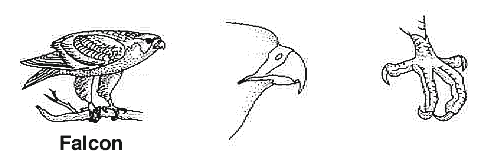
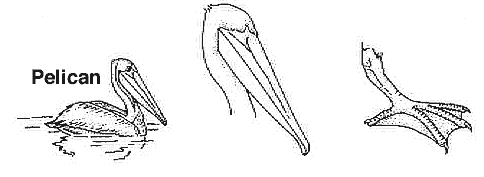
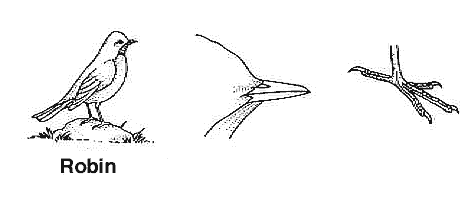
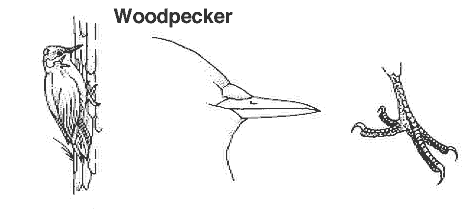
Did you ever wonder why there are so many types of bird beaks (scientists call them bills)? The most important function of a bird bill is feeding, and it is shaped according to what a bird eats. You can use the type of bill as one of the characteristics to identify birds. Here are some common bill shapes and the food they are especially adapted to eat:


SHAPE TYPE ADAPTATION
Cracker Seed eaters like sparrows and cardinals have short, thick conical bills for cracking seed.
Shredder Birds of prey like hawks and owls have sharp, curved bills for tearing meat.
Chisel Woodpeckers have bills that are long and chisel-like for boring into wood to eat insects.
Probe Hummingbird bills are long and slender for probing flowers for nectar.
Strainer Some ducks have long, flat bills that strain small plants and animals from the water.
Spear Birds like herons and kingfishers have spear-like bills adapted for fishing.
Tweezer Insect eaters like warblers have thin, pointed bills.
Swiss Army Knife Crows have a multi-purpose bill that allows them to eat fruit, seeds, insects, fish, and other animals.


Another characteristic that can be used to learn more about birds is feet shapes! The shape of the feet reflects the habitat that the bird will be found in and the type of food it might eat. Here are some common feet shapes and the environment they are especially adapted to live in:


SHAPE TYPE ADAPTATION
Grasping Raptors like Osprey use their large curved claws to snatch fish from the water.
Scratching Pheasants and other birds that scratch the soil for food have nail-like toes.
Swimming Ducks and other webbed lined swimming birds use their feet like paddles.
Perching Robins have a long back toe, which lets them grab a perch tightly.
Running Many fast-running birds have three toes rather than four.
Climbing A woodpecker’s hind toes enable it to climb without falling backward.


Objective:

Students will observe adaptations of feet and beaks of birds and relate these to the bird’s method of feeding and to the bird’s environment.

Materials:

Lab paper, pictures of birds, pencil

Procedure:

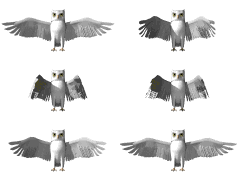
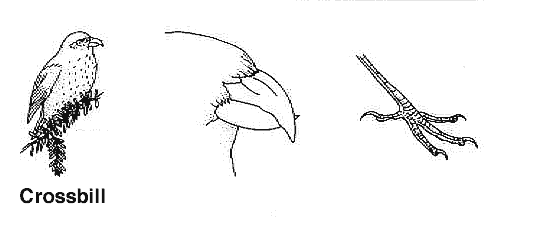
  1. Look at the pictures of the birds. Examine the beak of each bird and determine the type of each beak based on its shape and function. Some beak types may be used more than once.
  2. Place your choices on the chart in the column marked Beak for: (Some of the same beaks may be found on different birds).
  3. Examine the pictures of each bird and determine the type of feet each bird contains.
  4. Place the name of the bird on the line that best describes their type of feet.
  5. Also place the foot type on the chart in column 3 titled Feet for. (Some foot types may contain more than one bird.)


Bird Images For Bird Lab


Data:

Chart of Characteristics


Name of Bird Habitat Beak for Feet for
Woodpecker
Heron
Falcon
Eagle
Quail
Jacana
Pelican
Hummingbird
Robin
Whippoorwill
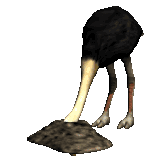
Ostrich
Crossbill

Questions:

  1. Birds living near lakes, pond or the ocean are most likely to eat the following organisms.
  2. If you see birds walking around a lawn in front of your house, what types of things could serve as a food supply for these birds?
  3. Explain why dead or diseased trees can serve as a food source for some birds.
  4. Based on the talons found on an eagle, what type of beak would it contain?
  5. A hawk looks like it has perching feet. What type of claws does it contain based on the hooked beak?
  6. Which bird contain the longest legs? What type of food do you think it eats?
  7. If you found a bird with climbing feet, what type of food would you expect it to eat?
  8. How many of there birds live near water? How can we tell?
BACK


Biology Calendar


Biology First Semester
2016-2017


AUGUST SEPTEMBER OCTOBER NOVEMBER DECEMBER JANUARY FEBRUARY MARCH APRIL MAY

Changes may be made to daily assignments!

Russellville Pacing Guide
HRW Modern Biology – PreAP
Prentice-Hall Biology – BI
MOODLE


MONDAY TUESDAY WEDNESDAY THURSDAY FRIDAY
8 9 10 11 12

Professional Development

Professional Development

Professional Development

Professional Development

Professional Development
15 16 17 18 19
22 23 24 25 26
29 30 31


TOP


MONDAY TUESDAY WEDNESDAY THURSDAY FRIDAY
1 2
5 6 7 8 9
12 13 14 15 16
19 20 21 22 23
5-Week Progress Reports
26 27 28 29 30


TOP


MONDAY TUESDAY WEDNESDAY THURSDAY FRIDAY
3 4 5 7
10 11 12 13 14
END of 1ST NINE WEEKS!
17 18 19 20 21
24 25 26 27 28
PD/PT Conference K-5
PD/PT Conference 6-12
31


TOP


MONDAY TUESDAY WEDNESDAY THURSDAY FRIDAY
1 2 3 4
7 8 9 10 11
14 15 16 17 18
5 Weeks Progress Report
21 22 23 24 25
FLEX DAY- NO SCHOOL FLEX DAY- NO SCHOOL
GIVE THANKS!
28 29 30


TOP


MONDAY TUESDAY WEDNESDAY THURSDAY FRIDAY
1 2 3 1 2
5 6 7 8 9
12 13 14 15 16
SEMESTER TESTS SEMESTER TESTS SEMESTER TESTS
19 20 21 22 23

26 27 28 29 30


TOP


Biology Second Semester


MONDAY TUESDAY WEDNESDAY THURSDAY FRIDAY
2 3 4 5 6

Professional Development
3rd Quarter Starts
9 10 11 12 13
REPORT CARDS!
16 17 18 19 20

MLK DAY!
23 24 25 26 27
30 31


TOP


MONDAY TUESDAY WEDNESDAY THURSDAY FRIDAY
1 2 3
6 7 8 9 10
PD/PT Conference 6-12
PD/PT Conference K-5
13 14 15 16 17
20 21 22 23 24
27 28


TOP


MONDAY TUESDAY WEDNESDAY THURSDAY FRIDAY
1 2 3
6 7 8 9 10
13 14 15 16 17
END of 3RD NINE WEEKS
20 21 22 23 24

27 28 29 30 31


TOP


MONDAY TUESDAY WEDNESDAY THURSDAY FRIDAY
3 4 5 6 7
REPORT CARDS!
10 11 12 13 14
17 18 19 20 21
24 25 26 27 28
PROGRESS REPORTS!


TOP


MONDAY TUESDAY WEDNESDAY THURSDAY FRIDAY
1 2 3 4 5
8 9 10 11 12
15 16 17 18 19
2-HOUR EARLY DISMISSAL
22 23 24 25 26
SEMESTER TESTS
29 30 31
MEMORIAL DAY- NO SCHOOL


TOP


MONDAY TUESDAY WEDNESDAY THURSDAY FRIDAY
1 2
5 6 7 8 9


BACK