Bar Graph Problems

Sample Problems on Bar Graphs

Problem 1:

The following table illustrates the average employee salary at Smith, Inc. for each of the last fifteen years. Mrs. Smith, the general manager of Smith, Inc., has been asked to submit to the local newspaper a bar graph illustrating the average employee salary in her company for each of the last 15 years.


Year Salary
1983 32,500
1984 33,250
1985 33,350
1986 37,400
1987 32,000
1988 35,800
1989 37,800
1990 34,480
1991 40,000
1992 39,500
1993 36,100
1994 35,400
1995 37,500
1996 38,000
1997 36,900


Problem 2:

Your basketball team, the Ricebirds, has been asked to create a bar graph illustrating your team’s scores for each of its last ten games. The following table illustrates these scores.


Game Score
1 67
2 72
3 71
4 68
5 70
6 65
7 75
8 78
9 77
10 80


Problem 3:

Quality Motor Company is claiming that their cars have increased in quality more significantly than the cars of their competitors. They want to use bar graphs showing the average longevity of cars from each company, as well as their own, for each of the last 12 years. Given the following data for the company, create this bar graph.


Year Avg. # Years Until
Repairs are Needed
1986 2.6
1987 2.3
1988 2.5
1989 2.5
1990 2.8
1991 1.9
1992 3.0
1993 3.1
1994 2.8
1995 3.2
1996 3.6
1997 3.5


Problem 4:

You are the manager of the local mall, and you want to express to the public the safety of your mall. Use the following data that has been collected during the past year to make a bar graph.


Month # Crimes
Reported
Jan. 2
Feb. 1
Mar. 1
Apr. 3
May 4
June 5
July 5
Aug. 4
Sept. 1
Oct. 2
Nov. 1
Dec. 3


Bi Sample Metric Measure


Metric Measurement Lab   

Introduction:

            Every scientific experiment in some way involves measurement.  Scientists worldwide use the metric system to display the results of measurements.  This system simplifies calculations based on a decimal system (powers of ten), opposed to the confusing English system of measurement.  Less confusion and better communication between scientists around the world makes the metric system more efficient than the English system for use in experiments.  The useful prefixes of the metric system are also known as the International System of Units (SI).

            Two measurements explored in this lab are mass and volume.  Mass is represented by grams, while volume is represented by milliliters (liquid) and cubic centimeters (solids with ruler measurement).  The purpose of this investigation is to get acquainted with and be accurate with the metric system.

Hypothesis:

By using a graduated cylinder, mass balance, and metric ruler, mass and volume can be found.  

Materials:

The materials used in this experiment include a graduated cylinder, an eyedropper, and a beaker of water for Part A; 20 ml of water, a graduated cylinder, and three marbles for Part B; a metric ruler, mass balance, three marbles, and a graduated cylinder for Part C; a metric ruler for Part D; and a graduated cylinder, eyedropper, six labeled test tubes, and three 25ml beakers of colored water (one with red, one with blue, and one with yellow) for Part E.  

Methods:

Part A:  Count you drops!

Fill a small graduated cylinder with 10 ml of water.  Count and record the number of drops it takes to raise the water to 11ml.  Leave the water in the graduated cylinder and count and record the number of drops it takes to raise the water to 12ml.  Leave the water in the graduated cylinder and count and record the number of drops it takes to raise the water to 13ml.  Calculate the average number of drops and round to the nearest tenth.

Part B:  Water Displacement

Add 20ml of water to a 100ml graduated cylinder.  Record this amount in the chart.  Add three marbles to the cylinder and measure and record the volume.  Find the difference between the two measurements and record it in the chart.  The difference between the two measurements will be the volume of the three marbles.

Part C:  Mass Mania

Check to see that the Pinter on the balance is pointing to zero.  If it is not, check to see that all the Riders (weights) are all the way to the left at the Zero mark.  Adjust the balance by turning the Adjustment Screw slowly until it points at zero.  Place the metric ruler on the pan and read and record the ruler’s mass.  After resetting the balance to zero, measure and record the mass of the empty 50ml graduated cylinder and then the three marbles.  Reset the balance to zero when all items have been massed. 

Part D:  Volume by Formula

Use the formula Volume=length x width x height to find the volume of the box.  Measure to the nearest centimeter before calculating the answer.  If necessary, round the answer to two decimal places.

Part E:  Color Challenge

Obtain the following items from the teacher:  3 beakers with colored water-25ml of each color (red, blue, and yellow), 1 graduated cylinder (25ml to 50ml), 1 eyedropper, and 6 test tubes labeled A, B, C, D, E, and F.  Perform each of the following steps using accurate measurements.  Measure 17ml of red water from the beaker and po9ur it into test tube A.  Measure 21ml of yellow water from the beaker and pour it into test tube C.  Measure 22ml of blue water from the beaker and pour it into test tube E.  Measure 5ml of water from test tube A and pour it into test tube B.  Measure 6ml of water from test tube C and pour it into test tube D.  Measure 8ml of water from test tube E and pour it into test tube F.  Measure 5ml of water from test tube C and pour it into test tube B.  Measure 2ml of water from test tube A and pour it into test tube F.  Measure 4ml of water from test tube E and pour it into test tube D.  Record the results in the chart.

Results:

Part A:  Count your drops!

# of drops to 11ml # of drops to 12ml # of drops to 13ml Average
24 26 25 25
  1. Take a guess—how many drops of water will it take to equal 1 milliliter?  18 drops.
  2. Based on your average, how close were you to your guess?  7 drops off of average.
  3. Based on your average, how many drops would it take to make 1 liter?  25,000 drops.

Part B:  Water Displacement


Volume of Water Before Adding Marbles (ml) Volume of Water After Adding Marbles (ml) Difference in Volume (ml) Volume of 3 marbles (ml)
20ml 25ml 5ml 5ml


Part C:  Mass Mania


Mass of Metric Ruler (g) Mass of Empty 50ml graduated cylinder (g) Mass of 3 Marbles (g)
3.0g 31.5g 11.0g


Part D:  Volume by Formula

Volume= length x width x height

7.0 cm x 1.0 cm x 3.0 cm = 21.0 cubic centimeters

Part E:  Color Challenge


Test Tube Color Final Volume (ml)
A Red 10ml
B Orange 10ml
C Yellow 10ml
D Green 10ml
E Blue 10ml
F Purple 10ml


Discussion and Conclusion:

By using a graduated cylinder, mass balance, and metric ruler, mass and volume can be found.  The purpose of Part A was to be accurate with reading graduated cylinders and how many drops of water make one milliliter.  This was accomplished by using an eyedropper to count the drops and reading the bottom of the meniscus to see when to stop dropping.  The average was found by adding the number of drops it took to reach the next milliliter (three times repeated) together and dividing by how many times the experiment was repeated which was three times.  (24+26+25)/3=25 average drops.  The purpose of Part B was to use water displacement to find volume.  In this particular experiment, water displacement was used to find the volume of three marbles.  To do this, the volume of the water before adding the marbles (20ml) was subtracted from the volume of the water after adding the marbles (25ml), to get the difference in the two volumes (5ml) which ultimately was the volume of the three marbles (5ml).  25ml-20ml=5ml.  The purpose of part C was to learn to use the balance accurately to determine the mass of an object(s).  To use a balance, the pointer and weights must be set at zero.  The mass of the three marbles, empty graduated cylinder, and metric ruler were found by placing them on the pan of the balance and moving the weights until the pointer was at zero again.  Mass is measured in grams.  The purpose of Part D was to use a metric ruler properly and apply your measurements to a formula to find volume.  To fill in the volume formula, length, width, and height of the box was found in the nearest centimeter with the metric ruler.  After those measurements were found, they had to be multiplied together to find the volume in cubic centimeters.  7cm x 1cm x 3cm=21 cubic cm.  Volume is expressed with cubic centimeter for solids and milliliters for liquids.  The purpose of Part e was to be accurate in liquid measurements to find the color and volume of the six test tubes.  This was accomplished by taking certain amounts of colored water from some beakers of test tubes and adding them to other test tubes.  If something was not measured right, the water in the test tube would not be the correct color.  It is important to always use accurate methods and measurements because details matter in science and experiments.


Semester I Calendar 2001

AP Calendar 2006


week topics text chapters/activities supplemental readings/URLs
see you in late August!!


week 1

Aug 24-26

  • intro to AP Bio
  • summer assignments   
  • bonding
  • buffers, acids and bases
  • element cycles
  • homeostasis
  • chemical basis of life: carbon, water and life
  • elements for life


ch 1, 50-55-due Aug. 24-your first day back!!**check study guide (SG) and question set (QS)

powers of ten see the size of everything!

ch 2


handouts/AP website


scientific method -The Biology Project

size and biology -The Biology Project


dissociation of water

acid-base explained

water movement click on animations

water movement ions, simulations of pH solutions


week topics text chapters/activities supplemental readings/URLs
week 2

Aug 29-Sept 2

  • biomolecules
    • organic compounds
    • carbohydrates, fats, proteins and nucleic acids
ch 3


BBC guru condensation and structure of molecules


central dogma animation

molecules -animated (rotate)

dehydration synthesis -animation

the biological basis of life for condensation

week 3

Sept 6-9

Sept 5 off-Labor Day


  • metabolism
  •  enzyme kinetics t
  • test over ch 2, 3, and 6 on Friday…be ready!!


ch 6 interactives catalysis, enzyme inhibition

BBC guru this is the enzyme site we used in class


week 4

CAMP KERN (but you are responsible for everything!!)

Sept 12-16

  • ecology and geography
  • human ecology
  • population ecology 


population clock population estimation

climate graphs/biomes

dissolved O2 lab 


Nova-The World in Balance  Human Numbers/Time               The Earth in  Peril      Be a Demographer         Population Trend quiz

nitrogen cycle -animation


week 5

Sept 19-23


  • community ecology
  • ecosystems and the biosphere


interesting ecology simulations, including:     biomass succession

biomass succession 2


week topics text chapters/activities supplemental readings/URLs
week 6

Sept 26- 30


  • early evolution of life


ch 20

burgess shale -resources

early life  -Burgess Shale

geologic time scale

the Origins Game

Aliens in the Milky Way?

week 7

Oct 3-7

  • prokaryotic and eukaryotic cells
  • viruses and bacteria


ch 4 


ch 7 


Military Medicine through Time
evolution

microbe clock

microscopy  -CellsAlive

eukaryotic vs pro, quizzes on plant and animal cell

show big is? (cell biology) -CellsAlive

microbe world

microbiology

binary fission movie

lysogenic cycle -animation

micro sites

week 8

Oct 10-14

Oct 11 off

-teacher inservice

  • plant vs animal cells
  • subcellular organization
ch 4

these are the links that we used in class-

virtual cell -virtual cell textbook

cell comparison -check yourself

flagella and cilia movement

the cell -ThinkQuest


inside the cell -NIH/NIGMS

cell parts -cells.de link of the month

drop/drag organelles

plant and animal cells -structure and function

endoplasmic reticulum

problem sets and tutuorials -The Biology Project, includes: studying cells tutorial  and cytoskeleton  among others-best site

cell similarity -GeoCities-fun stuff

click on animations -HHMI

week 9

Oct 17-21

Oct 22-end of Q1


  • biological membranes


  • transport across membranes


ch 5

membrane structure  -simple

pathways in and out of the cell 

antibiotic resistance

BBC guru

drop/drag membrane ZeroBio

membrane structure power point tutorial-advanced

cell signaling Access Excellence

osmosis tutorial Cornell BioG101-104

osmosis simulation Colorado

osmosis simulation2  UMV

osmosis animation Oklahoma State

osmotic pressure sanger

reverse osmosis gearfiltration

ion channels (cell biology, myocyte) CellsAlive

membrane animation HHMI

cell transport animation

Na/K pump Brookscole

membrane tutorial The Biology Project

week 10

Oct 24-28


  • test over eukaryotic cells and transport
    • aerobic respiration
 

ch 7


not active….

cell respiration -tutorial

overview  -respiration

electron transport chain and ATP synthesis -movies

glycolysis and fermentation -excellent molecular animations

glucose catabolism U. Alberta-overview

intro to metabolism animation

metabolic process location animation

citric acid cycle animation

oxydative phosphorylation electron transport chain animation

cellular respiration -Kimball’s pages

cellular respiration -showing molecular models

glycolysis explained in animations

oxydative phosphorylation explained inanimations


week topics text chapters/ activities supplemental readings/URLs
week 11

Oct 31-Nov 4


  • photosynthesis
  • test over respiration and photosynthesis


ch 8


photosynthesis light rxn -The Biology Project

photosynthesis carbo formation -The Biology Project

photosynthesis sites -Arizona State University

interactives

photosynthesis animation

oxygenic photosynthesis animation U. Alberta

photosynthesis -Maricopa bio181


week 12

Nov 7-11

  • The cell cycle


  • chromosomes


  • mitosis, meiosis/ gametogenesis, cell cycle


ch 9

Online Onion Tips  -The biology Project

more animations -BSC Courseware

BBC guru

cell cycle  -The Biology Project

cell cycle animation, myocyctes, cytoskeleton, apoptosis (cell biology, cell models, cell gallery)  -CellsAlive

human genome size

mitosis review -Nebraska Wesleyan

interactive mitosis (cell biology)-CellsAlive

mitosis -The Biology Project

modeling mitosis -Cornell BioG101-104  click either random or assignment……

mitosis/meiosis animations -About: homework help

mitosis and meiosis tutorial -Cornell BioG101-104

meiosis vs mitosis -WGBH (PBS)

cancer growth -WGBH (PBS)

metastasis -animation

week 13

Nov 14-18


  • principles of heredity
  • inheritance patterns


ch 10, 15

Dogs Around the World

mendelian genetics  -The Biology Project

human karyotyping  -The Biology Project

genetics -University of Utah

harlequin chromosomes -J. Kimball

drop/drag genetic cross ZeroBio

week 14

Nov 21-22


  • RNA and DNA structure and function


Nov 23-25 off Thanksgiving!


ch 11

http://ull.chemistry.uakron.

edu/genobc/animations/


BBC guru


Central Dogma animation

Anatomy of photo 51

DNA movies*

nucleic acids  -The Biology Project

Hershey/Chase -AccessExcellence

DNA basics -The Biology Project

DNA animations*

DNA replication animation

Cracking the code   (PBS)

DNA structure -subunit animation


week topics text chapters/ activities supplemental readings/URLs
week 15


 Nov 28-Dec 2


  • RNA and DNA structure  and function
  • mutations

ch  12
DNA structure/function

 
transformation movie

translation animation ZeroBio

protein synthesis animation

Beginner’s Guide to Molecular Biology -Molecular Biology Notebook

DNA from the Beginning -DNA from the Beginning


week 16

Dec 5-9


  • gene regulation
  • molecular genetics
  • genes and development


ch 13, 16


gene regulation -Indiana State University

RNA splicing -movie

cloning animation

developement  -The Biology Project

gene expression  -The Biology Project

gene expression in prokaryotes  -The Biology Project

signal transduction animation

week 17

Dec 12-16


  • DNA technology
ch 14

build a family tree


Sequence for Yourself      Create a DNA fingerprint

Blackett family  -The Biology Project

DNA profiling  -The Biology Project

Western Blot  -The Biology Project

recombinant DNA  -The Biology Project

PCR animation

human genome project -National Human Genome Research Institute

bacterial genetics/recombinant DNA tutorial -Cornell BioG101-104

forensics  -The Biology Project

genetic engineering


Dec 21

Winter Vacation starts at end of day


ch 17 are yours for the break–Happy Holidays!! (you would be bored without this work….

End of First semester


week topics text chapters/activities supplemental readings/URLs
week 18

Jan 3-7


  • Darwinian evolution
  • evolutionary changes in populations


ch 1718

Evolution


The Shape of Life

dating techniques -Geology Labs on-line

Darwin’s life and works -Cal. State University, Dr. C. Urbanowicz

population drift -simulation

genetic drift -simulation

week 19

Jan 10-14

Jan 14-end of Sem I


semester I final exam week


AP sample exam


Semester I Calendar 2001

AP Calendar 2006


week topics text chapters/activities supplemental readings/URLs
see you in late August!!


week 1

Aug 24-26

  • intro to AP Bio
  • summer assignments   
  • bonding
  • buffers, acids and bases
  • element cycles
  • homeostasis
  • chemical basis of life: carbon, water and life
  • elements for life


ch 1, 50-55-due Aug. 24-your first day back!!**check study guide (SG) and question set (QS)

powers of ten see the size of everything!

ch 2


handouts/AP website


scientific method -The Biology Project

size and biology -The Biology Project


dissociation of water

acid-base explained

water movement click on animations

water movement ions, simulations of pH solutions


week topics text chapters/activities supplemental readings/URLs
week 2

Aug 29-Sept 2

  • biomolecules
    • organic compounds
    • carbohydrates, fats, proteins and nucleic acids
ch 3


BBC guru condensation and structure of molecules


central dogma animation

molecules -animated (rotate)

dehydration synthesis -animation

the biological basis of life for condensation

week 3

Sept 6-9

Sept 5 off-Labor Day


  • metabolism
  •  enzyme kinetics t
  • test over ch 2, 3, and 6 on Friday…be ready!!


ch 6 interactives catalysis, enzyme inhibition

BBC guru this is the enzyme site we used in class


week 4

CAMP KERN (but you are responsible for everything!!)

Sept 12-16

  • ecology and geography
  • human ecology
  • population ecology 


population clock population estimation

climate graphs/biomes

dissolved O2 lab 


Nova-The World in Balance  Human Numbers/Time               The Earth in  Peril      Be a Demographer         Population Trend quiz

nitrogen cycle -animation


week 5

Sept 19-23


  • community ecology
  • ecosystems and the biosphere


interesting ecology simulations, including:     biomass succession

biomass succession 2


week topics text chapters/activities supplemental readings/URLs
week 6

Sept 26- 30


  • early evolution of life


ch 20

burgess shale -resources

early life  -Burgess Shale

geologic time scale

the Origins Game

Aliens in the Milky Way?

week 7

Oct 3-7

  • prokaryotic and eukaryotic cells
  • viruses and bacteria


ch 4 


ch 7 


Military Medicine through Time
evolution

microbe clock

microscopy  -CellsAlive

eukaryotic vs pro, quizzes on plant and animal cell

show big is? (cell biology) -CellsAlive

microbe world

microbiology

binary fission movie

lysogenic cycle -animation

micro sites

week 8

Oct 10-14

Oct 11 off

-teacher inservice

  • plant vs animal cells
  • subcellular organization
ch 4

these are the links that we used in class-

virtual cell -virtual cell textbook

cell comparison -check yourself

flagella and cilia movement

the cell -ThinkQuest


inside the cell -NIH/NIGMS

cell parts -cells.de link of the month

drop/drag organelles

plant and animal cells -structure and function

endoplasmic reticulum

problem sets and tutuorials -The Biology Project, includes: studying cells tutorial  and cytoskeleton  among others-best site

cell similarity -GeoCities-fun stuff

click on animations -HHMI

week 9

Oct 17-21

Oct 22-end of Q1


  • biological membranes


  • transport across membranes


ch 5

membrane structure  -simple

pathways in and out of the cell 

antibiotic resistance

BBC guru

drop/drag membrane ZeroBio

membrane structure power point tutorial-advanced

cell signaling Access Excellence

osmosis tutorial Cornell BioG101-104

osmosis simulation Colorado

osmosis simulation2  UMV

osmosis animation Oklahoma State

osmotic pressure sanger

reverse osmosis gearfiltration

ion channels (cell biology, myocyte) CellsAlive

membrane animation HHMI

cell transport animation

Na/K pump Brookscole

membrane tutorial The Biology Project

week 10

Oct 24-28


  • test over eukaryotic cells and transport
    • aerobic respiration
 

ch 7


not active….

cell respiration -tutorial

overview  -respiration

electron transport chain and ATP synthesis -movies

glycolysis and fermentation -excellent molecular animations

glucose catabolism U. Alberta-overview

intro to metabolism animation

metabolic process location animation

citric acid cycle animation

oxydative phosphorylation electron transport chain animation

cellular respiration -Kimball’s pages

cellular respiration -showing molecular models

glycolysis explained in animations

oxydative phosphorylation explained inanimations


week topics text chapters/ activities supplemental readings/URLs
week 11

Oct 31-Nov 4


  • photosynthesis
  • test over respiration and photosynthesis


ch 8


photosynthesis light rxn -The Biology Project

photosynthesis carbo formation -The Biology Project

photosynthesis sites -Arizona State University

interactives

photosynthesis animation

oxygenic photosynthesis animation U. Alberta

photosynthesis -Maricopa bio181


week 12

Nov 7-11

  • The cell cycle


  • chromosomes


  • mitosis, meiosis/ gametogenesis, cell cycle


ch 9

Online Onion Tips  -The biology Project

more animations -BSC Courseware

BBC guru

cell cycle  -The Biology Project

cell cycle animation, myocyctes, cytoskeleton, apoptosis (cell biology, cell models, cell gallery)  -CellsAlive

human genome size

mitosis review -Nebraska Wesleyan

interactive mitosis (cell biology)-CellsAlive

mitosis -The Biology Project

modeling mitosis -Cornell BioG101-104  click either random or assignment……

mitosis/meiosis animations -About: homework help

mitosis and meiosis tutorial -Cornell BioG101-104

meiosis vs mitosis -WGBH (PBS)

cancer growth -WGBH (PBS)

metastasis -animation

week 13

Nov 14-18


  • principles of heredity
  • inheritance patterns


ch 10, 15

Dogs Around the World

mendelian genetics  -The Biology Project

human karyotyping  -The Biology Project

genetics -University of Utah

harlequin chromosomes -J. Kimball

drop/drag genetic cross ZeroBio

week 14

Nov 21-22


  • RNA and DNA structure and function


Nov 23-25 off Thanksgiving!


ch 11

http://ull.chemistry.uakron.

edu/genobc/animations/


BBC guru


Central Dogma animation

Anatomy of photo 51

DNA movies*

nucleic acids  -The Biology Project

Hershey/Chase -AccessExcellence

DNA basics -The Biology Project

DNA animations*

DNA replication animation

Cracking the code   (PBS)

DNA structure -subunit animation


week topics text chapters/ activities supplemental readings/URLs
week 15


 Nov 28-Dec 2


  • RNA and DNA structure  and function
  • mutations

ch  12
DNA structure/function

 
transformation movie

translation animation ZeroBio

protein synthesis animation

Beginner’s Guide to Molecular Biology -Molecular Biology Notebook

DNA from the Beginning -DNA from the Beginning


week 16

Dec 5-9


  • gene regulation
  • molecular genetics
  • genes and development


ch 13, 16


gene regulation -Indiana State University

RNA splicing -movie

cloning animation

developement  -The Biology Project

gene expression  -The Biology Project

gene expression in prokaryotes  -The Biology Project

signal transduction animation

week 17

Dec 12-16


  • DNA technology
ch 14

build a family tree


Sequence for Yourself      Create a DNA fingerprint

Blackett family  -The Biology Project

DNA profiling  -The Biology Project

Western Blot  -The Biology Project

recombinant DNA  -The Biology Project

PCR animation

human genome project -National Human Genome Research Institute

bacterial genetics/recombinant DNA tutorial -Cornell BioG101-104

forensics  -The Biology Project

genetic engineering


Dec 21

Winter Vacation starts at end of day


ch 17 are yours for the break–Happy Holidays!! (you would be bored without this work….

End of First semester


week topics text chapters/activities supplemental readings/URLs
week 18

Jan 3-7


  • Darwinian evolution
  • evolutionary changes in populations


ch 1718

Evolution


The Shape of Life

dating techniques -Geology Labs on-line

Darwin’s life and works -Cal. State University, Dr. C. Urbanowicz

population drift -simulation

genetic drift -simulation

week 19

Jan 10-14

Jan 14-end of Sem I


semester I final exam week


AP sample exam


Ap Lab 1 Sample 5


Osmosis & Diffusion – Lab 1 

Introduction:

All molecules have kinetic energy and are constantly in motion.  This motion causes the molecules to bump into each other and move in different directions.  The result is diffusion.  Diffusion is the random movement of molecules from an area of high concentration to an area of low concentration. This will continue until dynamic equilibrium is reached; no net movement will occur.  Osmosis is a special kind of diffusion.  It is the diffusion of water through a selectively permeable membrane. A selectively permeable membrane means that the membrane will only allow certain molecules through such as water, small solutes, oxygen, carbon dioxide, and glucose, because no additional ATP is required. The membrane will not let ions, nonpolar molecules, or large molecules through because extra ATP is needed for them to travel across the membrane.  Active transport is how molecules (such as ions) move against the concentration gradient.  Additional ATP is required to perform this process.

Water will travel from an area of high water potential to an area of low water potential.  Water potential is the measure of free energy of water in a certain solution.  It is measured by using the Greek letter psi (ψ).  The formula for figuring water potential is:

ψ          =             ψp             +           ψs

Water Potential   =   Pressure Potential   +  Solute Potential

Water potential is affected by 2 different factors.  They are the addition of a solute and the pressure potential.  If a solute is added to the water, then the water potential is lowered.  If more pressure is placed on the water, then the potential is raised. The addition of a solute and water potential are inversely proportional.  Pressure being placed onto the water and the potential of the water are directly proportional.

Solutions can have three relationships with each other; isotonic, hypertonic, or hypotonic.  When the solutions have the same concentration of solutes, they are isotonic.  There is no net change in the amount of water on each side of the membrane.  If the solutions differ in their solute concentrations, the solution that has the most solute is hypertonic to the other solution.  The solution with the smaller amount of solute is hypotonic to the other solution. The net movement of water will be from the hypertonic solution to the hypotonic solution. Net movement will occur until dynamic equilibrium is reached, then there will be no net movement of water.

Hypothesis:

In this lab, osmosis and diffusion will occur between the solutions of different concentration until dynamic equilibrium is reached and there is no net movement of water.

Materials:

Exercise 1A:

The materials used include a 30cm piece of 2.5cm dialysis tubing, string, scissors, 15mL of 15% glucose/1% starch solution, 250mL beaker, distilled water, and 4mL of Lugol’s solution (Iodine Potassium-Iodine or IKI).

Exercise 1B:

This exercise required six 30cm strips of presoaked dialysis tuning, six 250mL cups or beakers, string, scissors, a balance, and 25mL of  these solutions: distilled water, 0.2M sucrose, 0.4M sucrose, 0.6M sucrose, 0.8M sucrose, and 1.0M sucrose.

Exercise 1C:

The materials that were required include 100mL of these solutions: distilled water, 0.2M sucrose, 0.4M sucrose, 0.6M sucrose, 0.8M sucrose, and 1.0M sucrose, six 250mL beakers or cups, a potato, a cork borer, a balance, paper towel, and plastic wrap.

Exercise 1D:

The materials used include a calculator, and a pencil.

Procedure:

Exercise 1A:

Soak the dialysis tubing in water.  Tie off one end of the tubing to form a bag.  Open the bag and place the glucose/starch solution in it.  Tie off the other end of the bag, leaving enough room for expansion of the contents in the bag.  Record the color of the solution in Table 1.1.  Next, test the glucose/starch solution for the presence of glucose.  Record the results in Table 1.1.  Fill a 250mL beaker or cup with 2/3 full with distilled water.  Add 4mL of Lugol’s solution to the distilled water and record the color of the solution in Table 1.1.  Test the solution for glucose and record the results in Table 1.1.  Immerse the bag in the beaker of solution.  Allow the beaker and bag to stand for approximately 30 minutes or until you see a distinct color change in the bag and the beaker.  Record the final color of the solution in the bag, and the solution in the beaker, in Table 1.1.  Test the liquid in the beaker and in the bag for the presence of glucose.  Record the results in Table 1.1.

Exercise 1B:

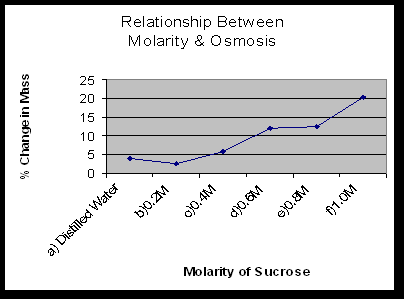
Obtain the six strips of presoaked dialysis tubing and create a bag out of each one by tying off one end.  Pour 25mL of the 6 solutions into separate bags. Tie off the other end of the 6 bags.  Rinse each bag gently with distilled water and blot dry.  Determine the mass of each bag and record it in Table 1.2.  Immerse each bag in one beaker filled will distilled water and label the beaker to indicate the molarity of the solution in the bag.  Let the setups stand for 30 minutes.  Remove the bags from the water.  Carefully blot them dry and determine their masses.  Record them in Table 1.2.  Obtain the other lab groups data to complete Table 1.3.

Exercise 1C:

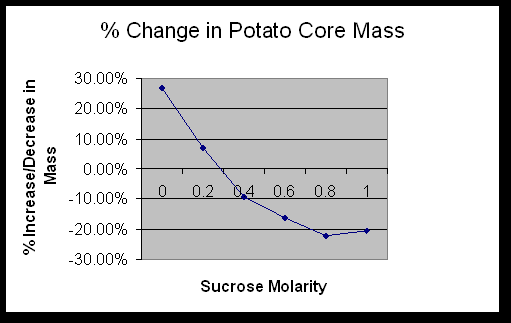
Pour 100mL of the solutions into a labeled 250mL beaker.  Use a cork borer to cut potato cylinders.  You need 4 cylinders for each cup.  Determine the mass of the 4 cylinders together and record the amount in Table 1.4.  Place the cylinders into the beaker of sucrose solution.  Cover the beaker with plastic wrap to prevent evaporation.  Let it stand overnight.  Remove the cores from the beaker and blot them gently on a paper towel and determine their total mass.  Record the results in Table 1.4.  Calculate the percentage change.  Do this for the individual and class data.  Graph the class average percentage change in mass.

Exercise 1D:

Determine the solute, pressure, and water potential of the sucrose solution.  Then, graph the information that is given about the zucchini cores.

Results:

Exercise 1A:

 Table 1.1


Initial Contents Initial Color Final Color Initial Presence of Glucose Final Presence of Glucose
Bag 15% glucose & 1% starch Cloudy White Purple Yes Yes
Beaker Water & IKI Brown Orange No Yes


  1. Which substances are entering the bag and which are leaving the bag? What evidence supports the answer?  Distilled water and IKI are  leaving and entering.  Glucose is able to leave the bag.
  2. Explain the results that were obtained.  Include the concentration differences and membrane pore size in the discussion.  Glucose and small molecules were able to move through the pores.  Water and IKI moved from high to low concentration.
  3. How could this experiment be modified so that quantitative data could be collected to show that water diffused into the dialysis bag?  You could mass the bag before and after it was placed into the solution.
  4. Based on your observations, rank the following by relative size, beginning with the smallest: glucose molecules, water molecules, IKI molecules, membrane pores, and starch molecules.  Water molecules, IKI molecules, Glucose molecules, Membrane pores, and Starch molecules
  5. What results would you expect if the experiment started with a glucose and IKI solution inside the bag and only starch and water outside?  The glucose and IKI would move out of the bag and turn the starch and water solution purple/blue.  The starch couldn’t move inside the bag because its molecules are too big to pass through the membrane of the tubing.

Exercise 1B:


Table 1.2: Dialysis Bag Results: Individual Data


Contents in dialysis bag Initial mass (g) Final mass (g) Mass difference (g) % Change in mass
Distilled Water 24.7 23.7 1 4.1
0.2M 26.7 27.4 .7 2.62
0.4M 27.4 29 1.6 5.84
0.6M 25.9 29 3.1 12
0.8M 29 32.6 3.6 12.41
1.0M 28 33.7 5.7 20.4


Table 1.3: Dialysis Bag Results: Class Data


Group 1

Group 2

Group 3

Total Class Average
Distilled Water 4.1% .7% 1.6% 6.4% 2.13%
0.2M 2.62% 6.4% 4.1% 13.12% 4.37%
0.4M 5.84% 9.9% 9.5% 25.24% 8.41%
0.6M 12% 13.4% 9.3% 34.37% 11.57%
0.8M 12.41% 14.6% 15.2% 42.21% 14.07%
1.0M 20.4% 19.7% 15.9% 56% 18.67%


  1. Explain the relationship between the change in mass and the molarity of sucrose within the dialysis bags.  The solute is hypertonic and water will move into the bag.  As the molarity increases the water moves into the bag.
  2. Predict what would happen to the mass of each bag in this experiment if all the bags were placed in a 0.4M sucrose solution instead of distilled water.  Explain.  With the 0.2M bag, the water would move out.  With the 0.4M bag, there will be no net movement of water because the solutions reach dynamic equilibrium.  With the 0.6M-1M bags, the water would move into the bag.
  3. Why did you calculate the percent change in mass rather than simply using the change in mass?  This was calculated because each group began with different initial masses and we would have different data.  All the groups needed consistent data.
  4. A dialysis bag is filled with distilled water and then places in a sucrose solution.  The bag’s initial mass is 20g and its final mass is 18g.  Calculate the percent change of mass, showing your calculations.  ((18-20)/20) x 100 = 10%
  5. The sucrose solution in the beaker would have been hypotonic to the distilled water in the bag.

Exercise 1C


Table 1.4: Potato Core: Individual Data


Contents of Beaker Initial Mass (g) Final Mass (g) Difference in Mass % Change in Mass
Distilled Water 2.8 3.7 .9 32.14
0.2M 2.9 3.1 .2 7
0.4M 2.5 2.2 .3 12
0.6M 2.3 1.9 .4 17.39
0.8M 2.5 1.9 .6 24
1.0M 2.3 1.8 .5 21.74


Table 1.5: Potato Core: Class Data


Group 1 Group 2 Total Class Average
Distilled Water 32.14% 21.1% 53.24% 26.62%
0.2M 7% 6.7% 13.7% 6.85%
0.4M -12% -6.5% -18.5% -9.25%
0.6M -17.39% -15.2% -32.59% -16.30%
0.8M -24% -20% -44% -22%
1.0M -21.74% -19% -40.74% -20.37%


Determine the molar concentration of the potato core.  0.3M

Exercise 1D
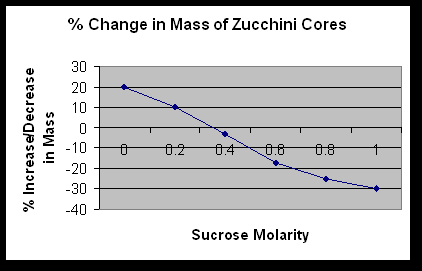


What is the molar concentration of the zucchini cores? .35M


  1. If a potato core is allowed to dehydrate by sitting in the open air, would the water potential of the potato cells decrease or increase? Why?  It would decrease because the water would leave the cells and cause the water potential to go down.
  2. If a plant cell has a lower water potential than its surrounding environment and if pressure is equal to zero, is the cell hypertonic or hypotonic to its environment? Will the cell gain water or lose water?  It is hypotonic and it will gain water.
  3. The beaker is open to the atmosphere.  What is the pressure potential of the system?  The pressure potential is zero.
  4. Where is the greatest water potential?  In the dialysis bag.
  5. Water will diffuse out of the bag. Why? It is because the water moves from and area of high water potential to an area of lower water potential.
  6. What effect does adding solute have on the solute potential component of that solution? Why?  It makes is more negative.
  7. Consider what would happen to a red blood cell placed in distilled water: a) Which would have the higher concentration of water molecules?  Distilled Water  b) Which would have the higher water potential?  Distilled Water  c)  What would happen to the red blood cell? Why?  It would lyce, because it would take on too much water.

Error Analysis:

Possible errors that could have affected the results of the lab include incorrectly mixing the solutions, ineffectively tying the dialysis tubing, inaccurately measuring , and inaccurately calculating.

Conclusion:

            During Exercise 1A the data that was collected help determine which molecules can and can not move across a cell membrane. Obviously, because of the color change in the bag, the IKI was able to move across the membrane.  It is small enough to fit through the pores in the selectively permeable membrane, along with water.  Starch was too large to move across the membrane. Glucose, as the Benedict’s test proves, was able to move freely along with the water and IKI solution.

In Exercise 1B, it was proven that water moves faster across the cell membrane than sucrose.  The water moved to help reach dynamic equilibrium between the 2 solutions.  The sucrose molecules are too big to move across the membrane as fast as water can.

The data in Exercise 1C showed that the potatoes contained sucrose.  The sucrose in the potato raised the solute potential, which lowered the water potential.  The beaker of distilled water had a high water potential.  Water moves down the concentration gradient, causing the potato cores to take on water.

Exercise 1D helped better understand the lab with simple algebra equations.  It proved that the data that was collected was correct through mathematics.