| Bacteria Study Guide |
 |
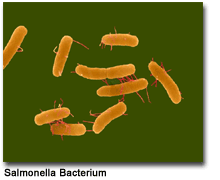
1. What are rod-shaped bacteria are called?
2. Bacteria are the only organisms characterized as____________________.
3. The earliest known group of living organisms on Earth was__________________.
4. Bacteria can be classified according to what three things?
A.
B.
C.
5. What does the prefix “archea” mean?
6. Archaebacteria can be divided into 3 Groups. Name and describe each group.
A.
B.
C.
7. The most numerous organisms on Earth are ________________.
8. Name the type of bacteria that does not have peptidoglycan in its cell walls.
9. Name the type of bacteria that obtain energy from inorganic substances.
10. Name the type of bacteria that obtain nutrients from dead organisms.
11. Organisms that lack a cell nucleus and membrane-bound organelles are called ______________.
12. Most prokaryotes are ________________organisms.
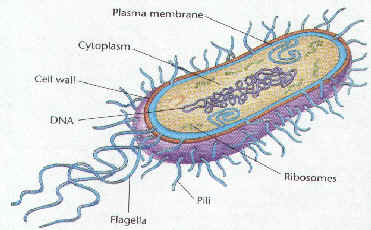
13. Escherichia coli is an example of a bacterium that has short, thin, hairlike projections called __________. What is their function?
14. Bacteria lack true nucleus and membrane-bound organelles so they are classified as __________.
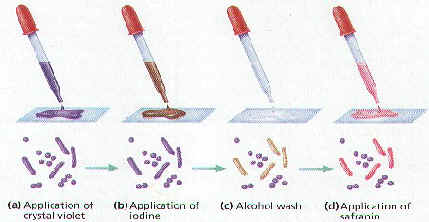
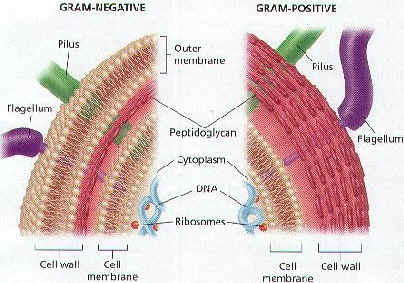
15. What is the procedure called that is used to distinguish between two types of bacterial cell wall structures ?
16. _______________ are protective structures that some bacteria may form under harsh conditions.
17. Spiral- shaped bacteria are known as what?
18. Almost all prokaryotes are ____________________ than the smallest Eukaryotes.
19. Prokaryotes have ___________________ that are different from those of Eukaryotes.
20. What are the 2 kingdoms of bacteria and briefly describe each?
21. ________________ is the process by which bacteria cells pick up and incorporate DNA from dead bacteria cells.
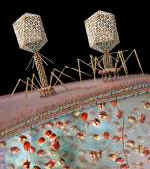
22. _____________ is the process of using a virus to transfer DNA from one bacterial cell to another.
23. When living conditions become ______________, some bacteria from special
dehydrated cells called__________________.
24. Bacteria that form ___________________ have an advantage for ____________________.
25. Bacteria the feed on and that break down dead organic material are called ___________.
26. _______________ is a type of bacteria that produces many antibiotics.
27. ________________ is a type of bacteria that produces endotoxins.
28. The ____________________ are a group of bacteria that live in harsh environments.
29. Bacteria that take on the purple color when stained are called what?
30. Gram-positive Bacteria used to make antibiotics are called _________________.
31. Gram-positive bacteria cause many diseases in humans by producing ____________ which are poisons to our bodies.
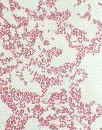
32. Bacteria that appear pink after staining are called what?
33. Gram-negative bacteria have an extra layer of ________________ on the outside
of the ____________ ____________ and appear ___________ after the gram staining.
44. The lipid layer _______________ the purple stain from entering the cell wall.
35. The Archaebacteria that produce methane are called ____________________.
36. Archaebacteria that thrive in very salty conditions, such as the Dead Sea, are called what?
37. The prefix “eu” means __________________.
38. What is the important tool used for classifying Eubacteria called?
39. During Gram staining, depending on structure of their __________ ____________, the
bacteria’s cell walls absorbs either the _______________ or ________________dye.
40. Gram-negative bacteria are distinguished by an extra layer of _________________.
41. ______________ are Gram-negative bacteria that perform plant-like ___________________ and release oxygen as a by-product.
42. ________________ are much __________ than many other prokaryotes.
43. Organisms that obtain energy from oxidizing inorganic compound instead of sunlight are called what?
44. Whiplike structures used by bacteria for movements are called __________________.
45. Photoautotrophs are bacteria that use ______________________ as an energy source.
46. Bacteria can be one of three different shapes:
A. _____________________________________________(Rod)
B. _____________________________________________(Sphere)
C. _____________________________________________(Spiral)
47. Gram-negative bacteria do absorb the ____________ stain during the Gram-staining process.
48. The extra layer of lipids also stops many _________________ from entering the bacteria.
49. Scientist think that gram-negative bacteria may have evolved from a_____________ ________________.
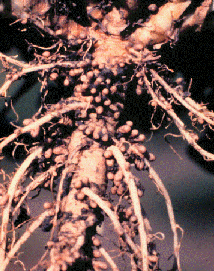
50. ______________________ grow in the root nodules of such plants as soybean, clover, and alfalfa.
51. Rhizobacteria fix ______________________ from the atmosphere into a form that plants
and animals can use (this greatly helps both plants and animals). They convert gaseous
nitrogen into compounds such as __________________________ (NH3).
52. Organisms that use oxygen during cellular respiration are called ________________. Organisms
that do not use oxygen are called __________________________. Typically they get their energy through ________________________.
53. Bacteria called ______________ __________________ cannot live without oxygen.
54. Most bacteria reproduce by a process called ____________ _______________.
55. Binary fission is a process in which the __________________________ replicate,
after which the ________________ divides.
56. Binary fission is a type of ____________________ reproduction.
57. Some bacteria contain smaller pieces of circular DNA called _________________.
58. Bacteria can exchange genes by one of three special means. Name these means.
A.
B.
C.
59. The process of exchanging genetic material through cell to cell contact is called
_______________.
60. Where are pili found? Do all bacteria have them?
61. Bacteria usually gain part of their ____________________ from their shape.
62. Two major differences between groups of bacteria are their source of ________________
and whether or not they use ________________ for cellular respiration.
63. Most bacteria act as _______________________ getting their energy by consuming (eating) organic molecules.
64. Some are __________________ that make their own food from ________________.
65. ___________________ obtain their food from inorganic compound instead of sunlight.
66. _________________________ use sunlight for energy.
67. Bacteria that can only survive in the absence of oxygen are called what?
68. Gram-negative bacteria appear ________________ when they undergo the Gram-stain procedure.
69. A type of bacteria that performs nitrogen fixation is _________________________.
70. Bacteria called ____________ _______________ cannot live in the presence of oxygen.
71. Type of bacteria that peptidoglycan is present in cell walls __________________.
72. What bacteria are thought to be responsible for establishing the Earth’s oxygen-rich atmosphere?
73. Bacteria cells typically lack _________________________.
74. Bacterial disease of the intestines are usually transmitted by contaminated ____________ or ______________.
75. What are the 3 mechanism of action of an antibiotic?
76. The cell walls of Gram-negative Eubacteria are composed of a combination of polysaccharide and polypeptide called what?
77. Bacteria that obtain their energy by removing electrons from inorganic molecules, rather than obtaining energy from the sun, are called _____________________ bacteria.
78. In general, organisms that obtain their energy from sunlight are called _________________.
79. Bacteria that are heterotrophic and feed on dead organic matter are called _____________.
80. A(n) _________________ is a substance that can be obtained from bacteria or fungi and can be used as a drug to fight pathogenic bacteria.
81. Many bacteria are ________________ and play an important role in recycling carbon, nitrogen, and other elements, while other bacteria are ___________________ and assemble organic compounds from carbon dioxide, nitrogen, and other elements.
82. A pathogen is an agent that is ________________________.
83. Bacteria cells such as E. coli transfer pieces of genetic material in a process called ____________________.
84. Archaebacteria that can live in extremely hot or acidic water are called _____________.
85. Spherical bacteria are called ________________.
86. Bacteria called ________________ __________________ can use oxygen when it is available,
but do not depend on it.
87. Nitrogen-fixing bacteria convert atmospheric _________________ into _________________.
88. Structurally, bacteria have one of two types of _______________ _______________.
89. Certain cyanobacteria, such as Anabaena, can fix nitrogen by using enzymes contained in specialized structures called what?
90. The oxidation of ammonia to nitrates that can be used by plants is called what?
TRUE OR FALSE
_____91. Bacterial cells have membrane-bound organelles and chromosomes.
_____92. Certain antibiotics have become ineffective against certain strains of bacteria. These bacteria have developed a resistance, which may be passed on from one generation of bacteria to the next.
_____93. Bacteria that can survive only in the absence of oxygen are called obligated aerobes.
_____94. The photoautotrophic bacteria are the only bacteria that are indirectly beneficial to humans.
_____95. Bacterial cells are usually much larger than eukaryotic cells.
_____96. Gram-negative bacteria have a thick layer of peptidoglycan that stains purple.
_____97. Ancient bacteria known as Archaebacteria are now extinct.
_____98. Although there are some bacteria that are heterotrophic, the vast majority are autotrophic.
_____99. Bacteria lack nuclei and therefore also lack genetic material.
_____100. Photosynthetic bacteria are present in leguminous plants and convert atmospheric nitrogen into a form that is usable by the plant.
_____101. Gram-negative bacteria appear purple when they undergo the Gram-stain procedure.
_____102. Bacteria are incapable of movement themselves; they an only get to new locations by growing toward them or by forming endospores and being carried in air or water.
_____103. The bacterial cell wall prevents the passage of antibiotics and is only means by which bacteria can resists antibiotics.
_____104. Some bacteria cannot survive in the presence of oxygen.
_____105. The terms Eubacteria and Archaebacteria refer to members of a single kingdom.
_____106. When bacteria undergo nonreproductive genetic recombination, their bacterial chromosome is altered.
DIRECTIONS: Answer the questions below as completely and as thoroughly as possible. Answer the question in essay form (not outline form), using complete sentences. You may use diagrams or pictures to supplement your answers, but a diagram or picture alone without appropriate discussion is inadequate.
107. Describe the capsule of a bacterium and its function.
108. Identify the most common shapes of Eubacteria and describe each.
109. Compare and contrast Archaebacteria with Eubacteria.
110. Identify 3 ways that bacteria are used to produce substances for human use.
111. Describe the significance of cyanobacteria in the formation of the Earth’s atmosphere.
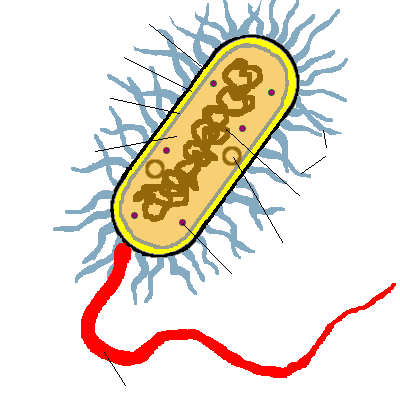
112. List the various structures of the bacterial cell, and describe their function.
113. Explain the laboratory technique Gram stain and explain why it is used.
114. Define the term genetic recombination as it applies to bacteria, and describe 3 ways that genetic recombination occurs in bacteria.
115. Explain how chemoautotrophs differ from photosynthetic autotrophs.
116. Explain how the terms bacteria, Eubacteria, and Archaebacteria, relate to one another.
117. Describe 3 types of movement among bacteria.
118. List the characteristics that are used to classify bacteria.
119. Explain how chemoautotrophs harvest energy from the environment.
120. Describe 2 ways bacteria cause disease.
121. Explain why antibiotic resistance among bacteria is increasing.
122. List one distinguishing characteristic of each of the three main groups of Archaebacteria.