Spongebob Safety Rules

 Sponge Bob Safety Rules
T. Trimpe 2003

The Bikini Bottom gang has been learning safety rules during science class. Read the paragraphs below to find the broken safety rules and number and underline each one. How many can you find? On the back of your sheet, write the number and the CORRECT safety procedure that should have been used.

SpongeBob, Patrick, and Gary were thrilled when Mr. Krabbs gave their teacher a chemistry set! Mr. Krabbs warned them to be careful and reminded them to follow the safety rules they had learned in science class. The teacher passed out the materials and provided each person with an experiment book. SpongeBob and Gary flipped through the book and decided to test the properties of a mystery substance. Since the teacher did not tell them to wear the safety goggles, they left them on the table.
SpongeBob lit the Bunsen burner, then reached across the flame to get a test tube from Gary . In the process, he knocked over a bottle of the mystery substance and a little bit splashed on Gary . SpongeBob poured some of the substance into a test tube and began to heat it. When it started to bubble he looked into the test tube to see what was happening and pointed it towards Gary so he could see. Gary thought it smelled weird so he took a deep whiff of it. He didn’t think it smelled poisonous and tasted a little bit of the substance.
They were worried about running out of time, so they left the test tube and materials on the table and moved to a different station to try another experiment. Patrick didn’t want to waste any time reading the directions, so he put on some safety goggles and picked a couple different substances. He tested them with vinegar (a weak acid) to see what would happen even though he didn’t have permission to experiment on his own. He noticed that one of the substances did not do anything, but the other one fizzed. He also mixed two substances together to see what would happen, but didn’t notice anything. He saw SpongeBob and Gary heating something in a test tube and decided to do that test. He ran over to that station and knocked over a couple bottles that SpongeBob had left open. After cleaning up the spills, he read the directions and found the materials he needed. The only test tube he could find had a small crack in it, but he decided to use it anyway. He lit the Bunsen burner and used tongs to hold the test tube over the flame. He forgot to move his notebook away from the flame and almost caught it on fire.

Before they could do another experiment, the bell rang and they rushed to put everything away. Since they didn’t have much time, Patrick didn’t clean out his test tube before putting it in the cabinet. SpongeBob noticed  that he had a small cut on his finger, but decided he didn’t have time to tell the teacher about it. Since they were late, they skipped washing their hands and hurried to the next class.

CLICK HERE FOR NOTEBOOK COPY

Sponges & Cnidarian

Sponges, Cnidarians, & Ctenophores

Phylum Porifera
Characteristics

  • Includes marine & freshwater sponges
  • Found in the kingdom Animalia & subkingdom Parazoa
  • Sessile as adults
  • Simplest of all animals

  • Contain specialized cells, but no tissue
  • Asymmetrical
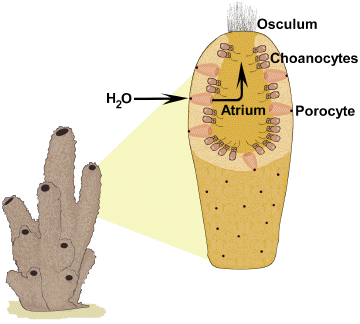
  • Bodies filled with holes or pores for water circulation
  • Marine sponges are larger & more colorful than freshwater sponges
  • Range in size from 2 centimeters to 2 meters
  • Osculum is single, large body opening at the top for water & wastes to leave
  • Spongocoel is the body cavity of sponges
  • Have only 2 cell layers (ectoderm & endoderm) separated by jellylike material
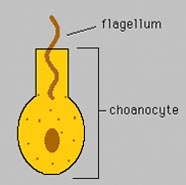
  • Flagellated cells called choanocytes or collar cells line their internal body cavity
  • Flagella of choanocytes beat & pull in water containing food which the collar traps


  • Spongin is a network of flexible, protein fibers making up the sponge’s skeleton
  • Spicules are tiny, hard particles shaped like spikes or stars in the  skeleton of some sponges
  • Spicules are made of calcium carbonate or silica

Feeding

  • Sponges are filter feeders that remove plankton (food) from the water that is brought in through pores lined with collar cells
  •  Flagella pull in bacteria, protozoans, & algae that sticks to collar of choanocytes where it is digested
  • Amebocytes are specialized cells in sponges that can roam to pick up food from choanocytes & distribute it to all other parts of the sponge
  • Amebocytes also transport carbon dioxide & wastes away from sponge cells
  • Excess water & food leaves through the excurrent osculum

Reproduction

  • Sponges can reproduce asexually by external buds that break off & form new sponges or stay attached to form sponge colonies
  • Gemmules are specialized, internal buds formed by sponges during cold or dry weather that can survive harsh conditions
  • Gemmules consist of a food-filled ball of amebocytes surrounded by a protective coat with spicules & released when adult sponge dies
  • Gemmules break open when conditions improve & the cells form new sponges

  • Sponge can also asexually regenerate missing parts or a new sponge from a small piece of sponge
  • Sponges are hermaphrodites (produce both eggs & sperm), but they exchange sperm & cross-fertilize eggs during sexual reproduction
  • Planula is the flagellated, free-swimming larva that forms from the zygote
  • Planula larva eventually settles to the bottom & attaches to develop into an adult, sessile sponge

Classes of Sponges

  • Calcarea are chalky sponges with calcium carbonate spicules
  • Hexactinella includes glass sponges & the Venus flower basket with silica spicules
  • Demospongiae include horny & bath sponges with only spongin or spongin & silica spicules
  • Sclerospongiae are coral sponges & have spongin & silica and calcium carbonate spicules

Phylum Cnidaria
Characteristics

  • Includes marine organisms such as jelllyfish, Portuguese man-of-war, coral, sea anemone, & sea fans
  • Hydra is a freshwater cnidarian

  • All carnivorous
  • Have 2 cell layers (epidermis -outer & gastrodermis-inner) with a hollow body called gastrovascular cavity
  • Contain a jelly-like layer between epidermis 7 gastrodermis  called mesoglea
  • Single opening (mouth/anus) to gastrovascular cavity where food & water enter & wastes leave; called two-way digestive system
  • Have tentacles around mouth to pull in water & capture food

  • Have a simple nerve net with to help with movement & senses
  • Sessile members include corals, sea anemones, & sea fans
  • Have radial symmetry as adults

  • Contain stinging cells called cnidocytes in their tentacles that contain coiled stingers called nematocysts that can shoot out & paralyze prey 

Body Forms

  • Have 2 basic body forms —polyp & medusa


MEDUSA

POLYP


  • Polyp forms are usually sessile with upright tentacles arranged around the mouth at the top and with a thin layer of mesoglea
  • Polyps are the asexual stage
  • Corals, hydra, & sea anemones exist in the polyp form as adults 


CORAL POLYPS

  • Medusa forms are usually free-swimming, bell-shaped animals with tentacles that hang down around the mouth and with a thick layer of mesoglea for support
  • Medusa are the sexual stage
  • Jellyfish & Portuguese man-of-war are medusa form as adults
  • Some cnidarians are dimorphic or go through both polyp & medusa stages in their life cycle

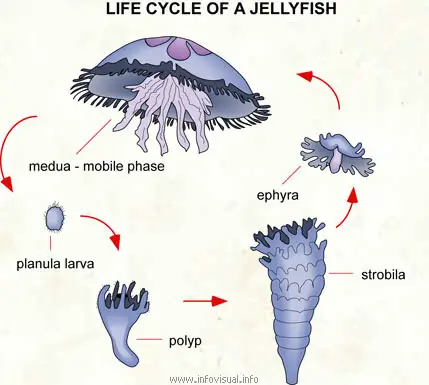
Life cycle of a jellyfish
JELLYFISH LIFE CYCLE

  • Some are solitary (Hydra) others are colonial (corals)
  • Three classes include Hydrozoa (hydra), Scyphozoa (jellyfish), & Anthozoa (sea anemones & corals)

Hydrozoa

  • Includes freshwater, sessile hydra (exists only as polyps) 
  • Portuguese man-of-war (exists as colony of polyps & medusa)
  • Group of cells called basal disk produces sticky secretion for attachment & can secrete gas bubbles to unattach & let hydra float
  • Hydra also move by somersaulting (tentacles bend over to bottom as basal disk pulls free)
  • Tentacles pull food into gastrovascular cavity where enzymes digest it
  • Reproduce asexually by budding during warm weather & sexually in the fall
  • Hermaphrodites that release sperm into water to fertilize eggs of another hydra


HYDRA

Scyphozoa

  • Includes bell-shaped jellyfish
  • Medusa stage is dominant in the life cycle
  • Tentacles may be meters in length & carry poisons that cause severe pain or death
  • Have both asexual polyps & sexual medusa stages in their life cycles
  • Adult medusa stage releases eggs & sperm into water
  • Fertilization produces ciliated planula larva that settles to the bottom, attaches, & forms tentacles 
  • New medusa bud off of reproductive polyps & form adult jellyfish

jellyfish life cycle photo
JELLYFISH

Anthozoa

  • Include corals in a limestone case & sea anemones
  • Called “flower animals”
  • All marine
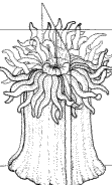
  • Sea anemone is a sessile, polyp-form that uses its tentacles to paralyze fish
  • Some anemones in the Pacific Ocean live symbiotically with the clownfish sharing food & protecting each other

#22A

  • Corals are small, colonial polyps living in limestone cases
  • Coral reefs form as polyps die & provide a home and protection for other marine animals
  • Reefs form in warm, shallow water & only the top layer has living polyps
  • Algae may live symbiotically with coral supplying them with oxygen

Phylum Ctenophora

Characteristics

  • All marine
  • Includes comb jellies

  • Have eight rows of fused cilia called “comb rows”
  • Largest animal to move by cilia
  • Move by beating cilia
  • Lack cnidocytes but have cells sticky cells called colloblasts that bind to prey
  • Colloblasts located on two ribbon-like tentacles
  • Have sensory structure called apical organ to detect direction in the water
  • Most are hermaphrodites (make eggs & sperm)
  • Produce light by bioluminescence
BACK


Square Roots


AP Biology Grading

Some major test grades will be determined by taking the square root of the student’s raw score (number of points correct). For example, if there are 50 questions on a test and each question counts 2 points each, a student who answers 35 questions correctly (70% of the total points possible or 70 points) will receive a score of √ 70 or 84%.

Table of Squares and Square Roots

Use this table to find the squares and square roots of numbers from 1 to 100.

You can also use this table to estimate the square roots of larger numbers.

  • For instance, if you want to find the square root of 2000, look in the middle column until you find the number that is closest to 2000. The number in the middle column that is closest to 2000 is 2,025.
  • Now look in at the number to the left of 2,025 to find its square root. The square root of 2,025 is 45.
  • Therefore, the approximate square root of 2,000 is 45.

To get a more exact number, you will have to use a calculator (44.721 is the more exact square root of 2,000).


Number Square Square root
1 1 1.000
2 4 1.414
3 9 1.732
4 16 2.000
5 25 2.236
6 36 2.449
7 49 2.646
8 64 2.828
9 81 3.000
10 100 3.162
11 121 3.317
12 144 3.464
13 169 3.606
14 196 3.742
15 225 3.873
16 256 4.000
17 289 4.123
18 324 4.243
19 361 4.359
20 400 4.472
21 441 4.583
22 484 4.690
23 529 4.796
24 576 4.899
25 625 5.000
26 676 5.099
27 729 5.196
28 784 5.292
29 841 5.385
30 900 5.477
31 961 5.568
32 1,024 5.657
33 1,089 5.745
34 1,156 5.831
35 1,225 5.916
36 1,296 6.000
37 1,369 6.083
38 1,444 6.164
39 1,521 6.245
40 1,600 6.325
41 1,681 6.403
42 1,764 6.481
43 1,849 6.557
44 1,936 6.633
45 2,025 6.708
46 2,116 6.782
47 2,209 6.856
48 2,304 6.928
49 2,401 7.000
50 2,500 7.071
51 2,601 7.141
52 2,704 7.211
53 2,809 7.280
54 2,916 7.348
55 3,025 7.416
56 3,136 7.483
57 3,249 7.550
58 3,364 7.616
59 3,481 7.681
60 3,600 7.746
61 3,721 7.810
62 3,844 7.874
63 3,969 7.937
64 4,096 8.000
65 4,225 8.062
66 4,356 8.124
67 4,489 8.185
68 4,624 8.246
69 4,761 8.307
70 4,900 8.367
71 5,041 8.426
72 5,184 8.485
73 5,329 8.544
74 5,476 8.602
75 5,625 8.660
76 5,776 8.718
77 5,929 8.775
78 6,084 8.832
79 6,241 8.888
80 6,400 8.944
81 6,561 9.000
82 6,724 9.055
83 6,889 9.110
84 7,056 9.165
85 7,225 9.220
86 7,396 9.274
87 7,569 9.327
88 7,744 9.381
89 7,921 9.434
90 8,100 9.487
91 8,281 9.539
92 8,464 9.592
93 8,649 9.644
94 8,836 9.695
95 9,025 9.747
96 9,216 9.798
97 9,409 9.849
98 9,604 9.899
99 9,801 9.950
100 10,000 10.000


NOTE: Square roots in this table are rounded to the nearest thousandth.


Squid Dissection

              Squid Dissection

Objectives:

As a result of this lesson, students will be able to:

  1. Locate and identify major external and internal features and organs of a squid.
  2. Understand and use basic dissection techniques and terms.
  3. Critically examine the functions of several squid features and organs.


Teaching Notes: This lab is a very thorough dissection of a squid and can be adapted to different grade levels. Teachers should try the lessons, considering which parts are most appropriate for their students and curriculum. The descriptions use complex dissection terminology. Be certain students understand the vocabulary of dissection prior to beginning the lab.

These lessons were tested with middle school students ages 11 to 13. They followed procedures and understood concepts well. The skills necessary to do all steps in the dissection are within the normal ability range of middle school students.


Materials:

  • squid*
  • scissors
  • toothpicks (for probes and pointers)
  • drawing paper
  • forceps
  • hand lens (5x recommended)
  • small cups (ketchup cups work well)
  • dissecting pan (or lunch trays)
  • paper towels
  • diagram of squid
  • wash bottle
  • microscope (optional)
  • dissecting scopes (optional)
  • slides (optional)
  • slide covers (optional)


*Look for squid at the local supermarket in the seafood and frozen foods sections. You may have to order it in advance. For areas that have them, you can also go to the local fish market or oriental food stores, or you can deal directly with fishermen.


Teaching Notes: Squid specimens tend to deteriorate rapidly. Keep all squid frozen until the morning before dissection. Thaw the squid in the refrigerator. If the entire dissection cannot be completed in one day, do the external activities while the specimens are still partly frozen, and the internal activities the next day after squid are thawed.

Squid may have tentacles or arms missing. Individual squid vary internally, and their relative maturity determines which organs are formed well enough to be seen clearly, and which have lost (or have yet to gain) their shape and coloration. Please advise students that they may not see everything shown in the enclosed diagram. Tissue shrinks and organs become misshapen quickly. To help maintain the freshness of the specimen, cover it with a wet paper towel as you work so it does not dry out so quickly.

Finally, this lesson is a tactile experience. You may want to explore this aspect through sensory activities, written descriptions, poetry, and/or artwork. Encourage students to experience the many textures found inside and outside the squid’s body. Moving fingertips along the suckers is suggested as well – the suckers do not scrape or hurt if you are gentle with them.


Procedure


  • Orientation:

Place the squid with the dorsal (back) side up in the dissecting pan. This means put the side with the funnel down and the fin side up. Make sure the tentacles and arms are towards you. Locate the head, eyes, beaks (mouth), arms (8), two longer feeding tentacles, fins, mantle, and skin. Use the hand lens to examine the suckers on the tentacles and arms as well as the spots on the skin, which are chromatophores.


Step 1A


What are the differences between arm and tentacle suckers? Where are the suckers located on the feeding tentacles as compared to the location of the suckers on the arms?


Step 1B


How do you account for the different locations of the suckers on the tentacles and the arms? What are chromatophores?


  1. The Mouth and Beaks: Locate the dark beaks in the center of the mouth.

    Step 2A


    Open and close the beaks, noting how the ventral beak overlaps the dorsal beak. How is this different from a parrot’s beak? Before you pull out the beaks, imagine what they will look like on the inside. With tweezers, remove the beaks and place beaks together with dark pointed parts opposite one another. Manipulate them (open and close) as if the squid were eating. What makes them work in this way?

    Step 2B Step 2B


    In order to remove the radula (a ribbon with rows of teeth on a tongue-like muscle) from inside the mouth, make small incisions in the edge of the mouth. With tweezers, locate the small, folded, plastic-like radula between beaks and remove it. It is usually very small, yellow or white in color. What is the radula’s function?   Store the radula and the beaks in water in a small cup if you are going to do a microscopic examination.
    Drawing of Squid Radula
  2. Funnel:
  3. Turn the body over, ventral side up, and locate the funnel (a deflated fleshy tube located at the base of the head). A squid swims by squirting water from the mantle through the funnel. The direction it swims depends on which way the funnel is aimed. Move the funnel and note its flexibility.

    Step 3


  4. External Anatomy:
  5. Orient the squid so that the tentacles are away from you, at the top of the dissection tray. Spread out the arms, tentacles, and fins. Draw and label the external parts of the squid: arms, tentacles (have suckers only at the tips), head, eyes, fins, mantle, funnel, tail, suckers, beaks (where each would be found on an intact squid) and mouth. If something cannot be seen, draw an arrow to show where it should be.  

    Step 4 Step 4


    If you have time, slice open an eyeball and locate the lens, pupil, retina, and iris (colored part of the eye). Look for the creamy white brain between the eyeballs. For assistance in identifying these parts, refer to the illustration below.

    Diagram of cephalopod eye


  6. Opening the Mantle:
  7. Keep the squid on its back (the side opposite the funnel). Using forceps, lift up the opening to the mantle behind the funnel (near the head) and separate the mantle from the internal organs. Close the forceps firmly so as to “pinch” the mantle flesh to keep it taut, cut along the ventral midline of the mantle, from its opening all the way to the tail. Be careful to keep the scissors lifted away from the internal organs so they are not damaged.  

    Step 5 Step 5


  8. Locating and Removing Reproductive Organs:
  9. Locate the gonad (reproductive organ) in the posterior end (refer to diagram for shape and location).

    Step 6A


    Upon opening female specimens, the large, firm, white nidamental glands are seen first. Males do not have nidamental glands. The glands lay on top of the other internal organs. These glands create the gelatinous matrix that envelops the eggs. In order to proceed further, carefully remove these glands. In females the eggs are jelly-like in a conical sac at the posterior end of the mantle. The male genital duct is a white, fluid-filled sac in the posterior end of the mantle. The sperm are stored in thin tubes in an elongated sac behind and along one gill.

    Step 6B


  10. Gills:
  11. Find the gills. These are the long, feather-shaped organs that are attached to the sides of the mantle and extend along the anterior half of the mantle. Identify the gill hearts, one on the posterior end of each gill (these are small, flat and white). Questions: Why are they white and our hearts are red or purple? The squid has a third heart (the systemic heart) that pumps blood to the rest of the body.

    Step 7


    Challenge: Why does it have separate hearts for the gills alone?
  12. Digestive Tract:

  13. Step 8A


    The long, silvery dark tube on the bottom of the liver (but appearing to be on top of the liver because of the squid’s inverted position) is the ink sac. Be careful not to break it open. Locate the stomach and caecum. These lie together as one white, silky-looking tube, like a deflated bladder and a coiled sack. The bunched up organs that look like human intestines are digestive ducts for the squid. If you are curious about the liver, wait to cut it open until the end of the dissection. It contains a lot of brown, oily liquid which may obscure other organs. If possible, open the stomach and examine its contents. Many squid will have bits of partially digested crustaceans (pink and white pieces), or tiny fish scales and bones.  

    Step 8B


  14. Removing the Ink Sac:
  15. Find and carefully remove the silvery-black ink sac that lies connected to the intestine. To do this, pinch the opening of the sac (near the back of the funnel) with forceps while gently pulling up and cutting the connective membrane along its length. After cutting about 1/3 to 1/2 of it, hold the sac with your fingers and pull the sac off the liver. Be careful not to puncture it. Squid ink stains clothing and skin. Place the sac in a small cup for later use with the gladius (pen).  

    Step 9 Step 9


  16. Removing the Gladius (Pen):
  17. The gladius is a long, clear feather-shaped structure used to support the mantle and for organ attachment. It and the cranium, or brain case, make up the “skeleton” of the squid. It feels like plastic and is made of tissue similar to a shrimp shell. There are two ways to remove it: from the tail or from inside the cut-open mantle. To remove it from inside the open mantle, grasp the head and organs firmly, and rotate them to the side with your left hand while holding on to one side of the mantle with your right hand and pulling away gently. Pulling the gladius out is like removing a splinter from your skin. You may need to cut away connective tissues that hold the gladius in place.

    Step 10A Step 10A


    The gladius is revealed, lying along the dorsal midline of the mantle.  

    Step 10B Step 10B


    Grab the forward end of the gladius and pull it carefully from its slot in the mantle. It may be helpful to have one person hold down the lower mantle while the other removes the gladius. To remove from the tail end, rotate the organs to one side, cutting connective tissues. Make sure the mantle is slit along the internal dorsal midline all the way to the tip of the tail. Pry out the tail end of the gladius and pull straight back, away from the body.

    Step 10C Step 10C


  18. Writing with the Gladius (Pen) and Squid Ink:

  19. Step 11A Step 11A


    Cut one end of the ink sac open and press it against the bottom of the cup with forceps or toothpick. You can also hold one end and push the ink out with your finger, as you would toothpaste from a tube. This will release the ink. Dip the pointed tip (the anterior end) of the gladius into the ink, filling the tip with the dark fluid. Then, using only the ink-filled tip of the gladius, write your name on your squid illustration or paper. If there is enough ink, create and write the name of your dissected squid under its picture. If the ink seems dry and pasty, add one drop of water at a time to create fluid ink. Though this is an unusual way to write, squid ink was actually used to write and draw in ancient times, and it is used today in some cultures. Unfortunately, it tends to fade over time (except from your clothes!).

    Step 11B


  20. Internal Anatomy:
  21. Draw, label, and identify the function of the following internal parts of the squid:
    • stomach
    • caecum
    • hearts (systemic and gill)
    • gills
    • reproductive organs
    • ink sac
    • liver (digestive gland)
    • gladius
    • brain
    • eyeball


  22. Microscope Slide Option:

    Step 12
    Step 12


    The following parts of the squid make excellent specimens for microscopic study:

    • eggs from the ovaries
    • suckers
    • nidamental glands
    • tips of arms and tentacles
    • spermatophores
    • connective membranes (thinly-sliced: mantle, fin, arm muscle)
    • radula
    • stomach contents
    • liver fluids
    • skin and chromatophores
    • portions of the eye
    • beak


    Teaching Note: Most of these are useful only for a dissecting microscope.

    Questions for further Investigation:

    • Identify the differences between the tentacles and the arms. Why are they different?
    • How are squid mouths and beaks like your jaw and teeth? How are they different?
    • How does the squid use the funnel and mantle for locomotion?
    • How does the squid obtain oxygen from the water?
    • How do squid reproduce?
    • Why are the chromatophores important to the squid?
    • What are the relatives of the squid?
    • What are the characteristics of cephalopods and of mollusks?
    • Why is it difficult to identify stomach contents?
    • What is the function of the fins?
    • What organ systems are the same or different from vertebrates?

    When finished, clean your area completely. Return all equipment and wash your hands. The squid odor will remain for a little while. Lemon juice will alleviate the odor if you find it offensive. To dispose of your specimen, wrap it in plastic or a zip-lock bag and throw it away. You may want to feed it to your cat, cut it up for fish bait, or even serve it as tonight’s calamari. Bon Appetite! Visit Clyde’s Kitchen on this website for tasty squid recipes!


Previous Lesson | Lesson List | Next Lesson
Site Contents | Opening Page | Home

Properties of Living Things


Properties of Living things


·        Early Views of life

o       Vitalism:

§        Life was generated by a objects acquisition of “Ethers” which would manifest animate it.

§        Led to idea of spontaneous generation

·        Flies came from dead animals

·        Mice came from Hay

§        Idea was challenged by scientist Francesco Redi in 1698.

·        Designed an experiment where 3 jars contained meat.

o       One Jar contained meat and had an open top which would allow the passage of “ethers” and flies. (maggots would appear on the meat)


o       The second jar was covered with an airtight lid allowing the passage of neither “ethers” or flies. (no maggots would appear on the meat)


o       The third was covered by a screen allowing passage of “ethers”, but not flies. (no maggots would appear on meat)

Setup 1              Setup 2           Setup 3


o       Since the third setup would theoretically allow the passage of “ethers”, but no maggots appeared, it was implied that flies were the source of the maggots.


·        Led to the theory of Biogenesis

o       All life comes from preexisting life


PROPERTIES of LIFE


1. Be made of Cells.

·        The Cell is the basic unit of life

·        Is self contained and possesses a barrier (membrane) which separates itself from the environment.

·        Two types of organisms.

·        Unicellular – One celled organism (Uni=1)

·        Multicellular – Many cells (Multi=”many”)


2. Living Things must Reproduce.

·        Must be able to create more of it’s own kind

·        Two types of reproduction:

·        Sexual – Two parent organisms combine genetic material to produce the offspring.

·        Asexual – When a single organism can divide or “bud” to create it’s offspring without another of it’s species.


3. Living things must Have DNA.

·        (Universal Genetic Code?)


4. Living things must Grow & Develop.

·        Growth refers to two processes.

·        Increase in the number of cells.

·        Increase in the size of cells.

·        Development refers to changes in the organism which occur through it’s life-span.

·        Includes cell differentiation.

·        Includes organ development

·        Includes aging & death.


5. Living things obtain & use energy.

·        Energy is used by all living things for growth, development & reproduction.

·        Life processes which result in “building” the organism ia known as Anabolism.

·        Life process where energy is extracted by “breaking-down” substances is called Catabolism.


6.  Living things must Respond (or react) to their environment in some way.

·        Something which causes an organism to react is known as a Stimulus (stimuli).

·        The ability of an organism to react is called Irritability.

·        Most responses are geared for maintaining Homeostasis.

·        Homeostasis is a process where an organism maintains a stable internal environment so life can continue.

·        Some examples include temperature, pH, and water content of the cell.


7. Must Maintain homeostasis.

·        Internal stable set of internal conditions allowing the chemical reactions of life to occur.