Virus PPT Questions

Viruses, Viroids, & Prions
ppt Questions

Living or Nonliving?

1. Why might some people consider viruses alive?


2. Can viruses be “killed”?

3. Can a virus maintain homeostasis like cells?

4. Are viruses cellular or noncellular?


5. Define virus.


6. Name the 2 main things that make up a virus.

Viral History

7. Who coined the term virus and what does it mean?

8. Explain how viruses were first discovered.


9. What discovery did Wendell Stanley make about viruses? What type of virus was he studying?


10. __________ is an example of a viral disease.

11. Who found the vaccine against this viral disease? What milder virus was used to make the vaccine?

12. What is meant by a virulent virus?

13. Smallpox has been ________________ in the world today. What does this mean?


14. How does the size of a virus compare with that of a cell?

15. What metric units are used to measure the size of viruses?

16. What technology had to be developed before viruses can be seen?

17. Give the size of these viruses.

     a. bacteriophage

     b. polio virus

     c. adenovirus

     d. Ebola virus

Viral Structure 

18. Are viruses made of cells? Are they living?

19. What covers the outside of a virus and what is it called?

20. What is in the core of a virus?

21. When & how can a virus reproduce?

22. What protective covering is around the capsid of some viruses?

23. What is the purpose of spikes and do all viruses have them?


24. Viruses only attack ___________ host cells.

25. Sketch and label the parts of a virus.


26. Describe the capsid of viruses.


27. What are capsomeres?

28. Are all viruses the same shape?

29. Outside of a host cell, viruses are ______________.

30. Do viruses have ribosomes like cells?

31. Do viruses have enzymes like cells?


32. Viruses use the _________ __________ and ____________ of its host cell to be able to ________________.

33. Does the HIV virus have spikes for attachment?

34. Besides smallpox and AIDS, name 6 other viral diseases.


35. Name a type of cancer thought to be caused by viruses.

36. What is the shape of each of these viruses:

     a. ebola?

     b. influenza?

37. Label the parts of these viruses.


Taxonomy of Viruses 

38. Family names for viruses end in what suffix?

39. Genus names for viruses end in ___________.

40.What is meant by a viral species?


41. ____________ names are used for different species of viruses.

42. How is the subspecies for a virus designated?

43. Give the family, genus, and species for the HIV and Herpes viruses.


44. What virus causes blisters that may appear around the mouth?

45. What virus is responsible for the common cold?

46. What virus causes warts?

47. Name 4 things used to identify viruses.

     a.

     b.

     c.

     d.

Bacteriophages

48. What is a bacteriophage?

49. Give 3 characteristics of T-phages.

     a.

     b.

     c.

50. What are the most commonly studied T-phages?

51. T-phages often attack what bacterial cell? Where is the host cell found?


52. How does a bacteriophage attach to its host cell?


53. What is the only part of the virus that actually enters the host cell?

54. What is the shape of the bacterial host cell that bacteriophages attack?

55. How many sides does the head or capsid of a bacteriophage have? 

56. T-bacteriophages have what nucleic acid at their core?

57. What are the head and tail fibers made of?

Retroviruses

58. What nucleic acid do retroviruses contain?

59. What enzyme do retroviruses contain that let them make DNA from RNA?

60. What 2 things do retroviruses inject into their host cells when they attack them?

61. Give an example of a retrovirus.

Viroids and Prions

62. What is a viroid? 

64. What is the host for viroids?

65. Viroids are responsible for causing what major problem in Europe?

66. Viroids resemble ____________ pieces of DNA that are cut out because they do not code for any proteins.

67. Prions are infectious pieces of _____________.

68. Describe how prions occur.


69. Do prions have a nucleic acid core?

70. What protein is responsible for most mammalian prion diseases?

71. What happens when prions get into the brain?


72. What does BSE stand for and what is the common name for this prion disease?


73. Explain the prion disease caused kuru.


Viral Replication

74. Viruses are host specific. What does this mean?


75. Do the viruses that attack most animals also attack most humans?

76. What is the envelope of viruses often made from? What is the function of an envelope?


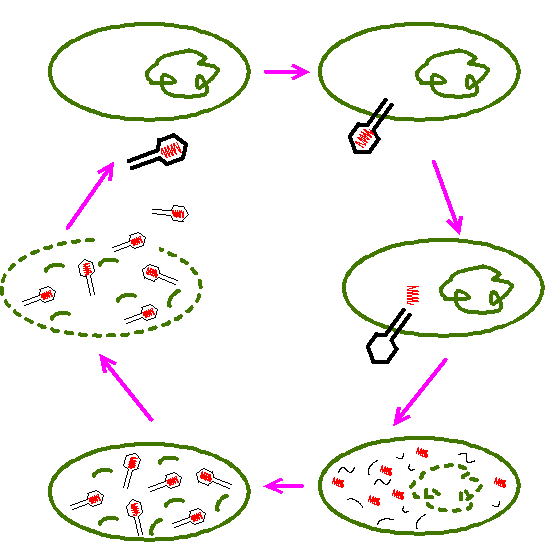
77. List the 5 steps of the Lytic cycle in viruses.

     (1)

     (2)

     (3)

     (4)

     (5)

78. What structures help a virus attach to a host cell?

79. What does the virus inject into its host?

80. What viral parts are made inside a cell? where do the raw materials come from?


81. What is meant by cell lyses?

82. Place these steps of the lytic cycle in order: maturation, penetration, release, biosynthesis, and attachment.


83. Label the stages of the lytic cycle. Also label the capsid, host cell, and DNA.
 

84. What are latent viruses?

85. How long can a latent virus remain inactive?

86. what activates latent viruses?

87. Give 2 examples of latent viruses.

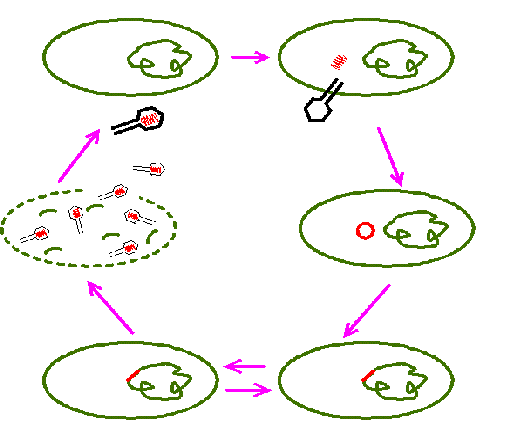
88. During the lysogenic cycle of a virus, what happens to the viral nucleic acid after it is injected into the host cell?


89. What is a prophage?


90. What causes the phage or viral DNA to start replicating?


91. Does the prophage start replicating right after it is injected into the host cell? Explain.


92. Viral DNA along with the host cell DNA is replicated during each ___________ ___________.

93. After a long period of time, __________ cells form that contain ________________.

94. Once a prophage cell is activated, what happens?


95. Once a prophage is active, the host cell is ______________ making the virus deadly or _______________.

96. Label the viral DNA, host DNA, prophage, bacteriophage, host cell, lytic cycle, and lysogenic cycle.
 

97. Give an example of a virus that remains dormant in the nervous system tissues for many years.

98. This virus may reappear later in life as a disease called ___________. Describe the disease.


99. ___________ infections also remain dormant in the nervous system.

100. How long does a herpes infection last?

101. Genital herpes is called Herpes ______________, while cold sores or fever blisters are known as Herpes ______________.

102. Viruses make us sick because they ___________ healthy host cells.

Treatment for Viral Disease

103. What is an attenuated virus?


104. How are viruses attenuated?

105. How are some viral vaccines made?


106. How does an attenuated virus help protect us from disease?


107. What proteins do our cells make to help protect us from viruses?

108. What is AZT?

109. How do protease inhibitors work to stop viruses?


Volume of Irregular Object Lab


Volume of an Irregular-shaped Object
 Introduction

The word mass is used to tell how much matter there is in something. Matter is anything you can touch physically. An electronic scale or triple beam balance can be used to tell the mass of an object. Volume is a measure of how much space an object occupies. When measuring the volume of a liquid, a graduated cylinder can be used.  Measurement is the collection of quantitative data (numbers). Measurements are not only numbers. They must always contain a unit of measurement. In the Metric System, the gram (g) is the basic unit of measurement for mass. The basic unit of measurement for the volume of liquids is the milliliter (ml). The density of an object can be determined by dividing the mass by the volume (D = M/V). From a density calculation, we may tell whether a substance will float or sink in another liquid. A less dense substance will float on one that is denser. An example is oil floating on water. Oil is less dense than the water.

For solids that have an irregular shape, the displacement method must be used to determine their volume. When using the displacement method, you must first measure the starting volume of the liquid. Then add the object and record the change in volume. This gives the volume of the irregularly-shaped object.

Hypothesis

The density of objects can be determined by a method known as water displacement.

Materials

Triple beam or electronic balance
100 ml graduated cylinder
3 irregularly shaped objects
calculator
pencil

Methods

  1. Obtain 3 irregularly shaped objects that will sink in water.
  2. Estimate the mass & volume of each object. Record this on table 1.
  3. Use a triple beam balance or electronic scale to determine the mass in grams of each object. Record this on table 1.
  4. Fill a graduated cylinder halfway with tap water.
  5. Measure & record the volume of the water in the graduated cylinder. READ THE MENISCUS!
  6. Place one of the objects into the graduated cylinder, and measure and record the new volume.
  7. Subtract the initial volume from the final volume. The difference is the volume of the object.
  8. Record the difference in data table 1.
  9. Repeat steps 4 – 8 for the other three objects.
  10. To determine the density of each object, divide the actual mass of each object by its volume (determined by water displacement).
  11. Record the densities in data table 1.

Results & Data

Data Table 1

Object Estimated Mass
(g)
Estimated Volume
(ml)
Actual Mass
(g)
Volume of H2O in graduated cylinder
(ml)
Volume of H2O and object in graduated cylinder
(ml)
Object’s Volume
(Subtract Column 5 from Column 6)
(ml)
Density
D=m/V
(Divide Column 4 by Column 7)
(g/ml)


Questions

  1. How did you determine the object’s:

a. mass?

b. Volume?

c. density?

  1. Objects will sink if they are denser than water. Explain why ships made of steel float instead of sinking since steel is denser than water.

Word Document

What is Ecology PPT Questions


What is Ecology?
By Susan Lundy


1.  Definition:

2.      It ________________ how living organism affect each other and the world they live in.
3.      ____________________ is the place a plant or animal lives in.
4.      ____________________ is an organism’s total way of life (its job)
5.      ____________________ factors are the nonliving parts of an organism’s environment.
6.      4 Examples of abiotic factors are:


7.      _____________________ factors are all the living organisms that inhabit an environment.

8.      Some things that organism’s rely on each other are _________________, ______________________, __________________ or _________________

9.      What are the levels of simple organization from simplest to most complex?

10.      _________________________ have organized the interactions an organism takes part in to different levels according to ________________

11.     Level 1 Organism:

12.     Level 2 Population:

13.     Level 3 Biological Community:

14.     Level 4 Ecosystem:

15.     Level 5 Biosphere:

16.      Where can you find life?


Where the Hippos Roam


Where the Hippos Roam
Holt, Rinehart, Winston

Introduction:

    Millions of years ago, ancestors of modern crocodiles lurked in the shallow waters of lakes and other bodies of water. They hunted fish and other animals, much as their descendants do today. If you could travel back in time to visit one of those lakes, you might see the ancestors of today’s hippos there as well. Antelopes might browse along the edges of the lake, and rodents of various sizes might scurry back and forth. When paleontologists examine the fossil of a prehistoric organism, they may discover clues about the organism’s life. They may also answer questions about the environment it lived in: Was the area hot or cold? Was it humid or dry? Then, by putting all of these clues together, the paleontologists may be able to learn a little more about how organisms and environments change over time. Unfortunately, studying a fossil site is no easy task! Often, a paleontologist may find a few teeth scattered over a very large area. In such cases, keeping track of where the fossils were found is very important. 

    In this activity, you will use the data from a fossil site to create a map of fossil locations at that site. Then you will make some conclusions about the past environment, or paleoenvironment, at that location. The table below shows the locations of fossils that were found spread out over 22,500 m2. A team of paleontologists decided that this site, which measured 150 m x 150 m, was too large to work on all at once. Therefore, they decided to create a grid of 10 m squares.

    Starting in the northwest corner, they labeled the squares with the letters A-O from west to east. Then the team numbered the squares 1-15 from north to south. In this way, each fossil could be labeled with a letter and a number, depending on where it was found. For instance, the label A1 would signify the 10 m x 10 m square in the northwest corner of the site. Similarly, the label O15 would indicate the square in the southeast corner of the site.

Activity:

Location of Fossils

Layer Hippos Rodents Crocodiles *Bovids
A B11,C6,D3, I15,J10,L7, M6 C14,F7,G13, I3,L13,O2
B F2,J3,K1,K2 B10,B11,F13 H2,I7,K2, N5,N7 G14
C B3,C10,D1, H8,M9,N4 A5,A6,E2, E4,E14,H7, H8,H12,K4, M1,N15

* Bovids are antelopes and other similar animals

Problem:

  1. Create a map of the fossil site. The scale should be 1 cm = 10 m. Label the grid of squares with letters and numbers.
  2. Using letters, show where the fossils were found. (Put an H in each square where a hippo tooth was found; use R to indicate a rodent tooth, use C to show a crocodile tooth, and B for a bovid tooth.
  3. Use a different color for each layer of sediment, and make a key to show which colors are which. (Example: Layer A – red, Layer B – blue, Layer C – green)
  4. Based on the distribution of fossils in level B, what part of this site might have been covered by water? Devise a way to indicate that part on you map. (Example: Lightly shade with a color)

Questions:

  1. Explain why you chose to shade part of your map as once covered in water. (What fossil clues helped you.)


  1. Describe how the environment at this site changed through time.


  1. One member of the team wished to look for fossils of dry-climate plants at this site. Which layer or layers do you think would be most likely to yield fossils of this kind? Explain your answer.


  1. When the paleontologists were analyzing these data, they proposed several hypotheses to explain the changing climate. One of them suggested that tectonic uplift had occurred, causing the area to gain elevation over time. A second paleontologist disagreed, stating that the area probably lost elevation over time. Whom do you agree with? Explain your answer .


Who Ate the Cheese


Who Ate the Cheese?!

Introduction:

DNA isolation from blood, hair, skin cells, or other genetic evidence left at the scene of a crime can be compared with the DNA of a criminal suspect to determine guilt or innocence. This is due to the fact that every person has a different sequence. Scientists use a small number of sequences of DNA that are known to vary among individuals, and analyze those to get a possibility of a match.  DNA is isolated, cut using restriction enzymes and sorted by size by gel electrophoresis. DNA is placed in a gel and an electrical charge is applied to the gel. The positive charge is at the top and the negative charge is at the bottom. Because DNA has a slightly negative charge, the pieces of DNA will be attracted to the bottom. The smaller pieces move more quickly towards the bottom than the larger pieces. The DNA can then be analyzed.

Objectives:

In this simulation you will examine crime scene evidence to determine who is responsible for eating the Queen’s special imported Lindbergher Cheese (yes, the stinky cheese). You will model the process of electrophoresis and DNA fingerprinting.

ROYAL GUARD INCIDENT REPORT

Incident Data

Incident Type: Theft Complaint Status Pending DNA results
Processed by: Chief Wiggam Other Officers: Officer Li Gase

Property

Property Code: Rare cheese Owner’s Name Queen Elizabeth
Name: Lindbergher Value: $12,000

Burglary Data

Method of Entry: Unknown, no evidence of force on doors or windows.

Narrative: The cheese was allegedly stolen from the Queen’s sitting room the night before the grand ball. The cheese was listed as a gift from the Manchurian diplomat. Officer Li Gase dusted for fingerprints and found none on the table or doors, the maid claimed that they had been wiped clean earlier. The wheel of cheese was on a platform in the sitting room, and half of it had been eaten. We took pictures of the half eaten cheese and sent it to the lab for further tests. Edna N. Zime, the lab technician said that saliva samples could be taken from the teeth imprints of the cheese that was left behind.

Suspect Data

Suspect Number: 1
Name: Princess Dubbah Elix
Description of Suspicion: The princess was seen entering the sitting room earlier in the evening. She is well known for her love of cheese.

Suspect Number 2
Name: Electra Foresis
Description of Suspicion: Electra was recently involved in a relationship with the Manchurian diplomat that sources say ended badly. Her motive may have been to sabotage the diplomat’s gift to the Queen.

Suspect Number 3
Name: Ada Nine
Description of Suspicion: Ada was the maid in charge of cleaning the sitting room. She had access to the cheese.

Suspect Number 4
Name: Gene Tics
Description of Suspicion: Gene is the leader of the local Cheese-Makers Guild, he may not have wished for Queen Elizabeth to have cheese from anywhere but his own guild.

Crime Lab Data

Crime Lab Investigator R. Renee Lab Technician Edna N. Zime
List of Evidence Received Plastic bag with cheese crumbs List of Procedures Used DNA extraction
Polymerase Chain Reaction
DNA restriction Analysis

Narrative: After receiving the package with the plastic bag marked Crime Scene, the DNA was extracted. Because the sample was so mall, the DNA was amplified using the polymerase chain reaction. We isolated the DNA from the four suspects and compared them to the crime scene DNA using DNA restriction analysis.

Results: See attached DNA Results

DNA Evidence Evaluation:

1. Turn your paper strips (DNA sequences) so that the side with the bases is facing you. The restriction enzyme cuts at every point it finds C C G G, always cutting between the C and the G. Label the back of the slips with the suspect number so that you don’t get them confused after cutting. Use scissors to cut the DNA sequence at the C C G G points.

2. Count the number of base pairs (bp) in each piece of DNA that you created. Record the base pair number on the back side of the DNA fragment.

3. Make an enlarged chart like the one shown. Your teacher will give you paper for this. Use a ruler to ensure that the lengths are uniform.

4. Tape your DNA fragments to the chart, using the base pair numbers as a guideline for fragment placement.

5. Compare the crime scene DNA to the suspects and indicate on your chart, which suspect is guilty of eating the cheese.


ANALYSIS:

1. On your chart, label the positive (+) and the negative (-) ends. Circle the suspect’s DNA who matches the DNA at the crime scene and write the name of the suspect.

2. For each of the following tasks performed in the activity, describe what they are actually simulating.

Cutting the DNA into fragments:


Taping the DNA onto the large paper:


3. For each word below, describe how it relates to DNA Fingerprinting:

Polymerase Chain Reaction:


Gel Electrophoresis:


Restriction Enzyme:


BACK