
| Probability Answers
|
 |
| Parents RR x rr | ||
| Offpring Rr | 1 x 1 = | 1 |
Answers to trihybrid probabilities:
RrYyGg x RrYyGg
a. 3/4 x 3/4 x 3/4 = 27/64
b. 1/4 x 1/4 x 1/4 = 1/64
c. 3/4 x 3/4 x 1/4 = 9/64
d. 3/4 x 1/4 x 1/4 = 3/64
| Probability Answers
|
|
| Parents RR x rr | ||
| Offpring Rr | 1 x 1 = | 1 |
Answers to trihybrid probabilities:
RrYyGg x RrYyGg
a. 3/4 x 3/4 x 3/4 = 27/64
b. 1/4 x 1/4 x 1/4 = 1/64
c. 3/4 x 3/4 x 1/4 = 9/64
d. 3/4 x 1/4 x 1/4 = 3/64
| Properties of Water |  |
Introduction:
Water’s chemical description is H2O. As the diagram to the left shows, that is one atom of oxygen bound to two atoms of hydrogen. The hydrogen atoms are “attached” to one side of the oxygen atom, resulting in a water molecule having a positive charge on the side where the hydrogen atoms are and a negative charge on the other side, where the oxygen atom is. This uneven distribution of charge is called polarity. Since opposite electrical charges attract, water molecules tend to attract each other, making water kind of “sticky.” As the right-side diagram shows, the side with the hydrogen atoms (positive charge) attracts the oxygen side (negative charge) of a different water molecule. (If the water molecule here looks familiar, remember that everyone’s favorite mouse is mostly water, too). This property of water is known as cohesion.
 All these water molecules attracting each other mean they tend to clump together. This is why water drops are, in fact, drops! If it wasn’t for some of Earth’s forces, such as gravity, a drop of water would be ball shaped — a perfect sphere. Even if it doesn’t form a perfect sphere on Earth, we should be happy water is sticky. Water is called the “universal solvent” because it dissolves more substances than any other liquid. This means that wherever water goes, either through the ground or through our bodies, it takes along valuable chemicals, minerals, and nutrients.
Water, the liquid commonly used for cleaning, has a property called surface tension. In the body of the water, each molecule is surrounded and attracted by other water molecules. However, at the surface, those molecules are surrounded by other water molecules only on the water side. A tension is created as the water molecules at the surface are pulled into the body of the water. This tension causes water to bead up on surfaces (glass, fabric), which slows wetting of the surface and inhibits the cleaning process. You can see surface tension at work by placing a drop of water onto a counter top. The drop will hold its shape and will not spread.
In the cleaning process, surface tension must be reduced so water can spread and wet surfaces. Chemicals that are able to do this effectively are called surface active agents, or surfactants. They are said to make water “wetter.” Surfactants perform other important functions in cleaning, such as loosening, emulsifying (dispersing in water) and holding soil in suspension until it can be rinsed away. Surfactants can also provide alkalinity, which is useful in removing acidic soils. 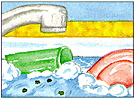
Pre-Lab Questions (Click here)
Materials:
Box of small paper clips, small plastic container, eyedropper, cup, stirring rod, water, liquid soap, plastic tray
Procedure (Part A) Cohesiveness of Water:
Procedure (Part B) Soap’s effect on Surface Tension:
Data:
Table 1
| Cohesiveness of Tapwater | ||
| Estimated Number of Paper Clips | Actual Number of paper Clips | Difference |
|
|
||
Table 2
| Cohesiveness of Soapy water | ||
| Estimated Number of Paper Clips | Actual Number of paper Clips | Difference |
|
|
||
Questions:
1. How did your estimated number compare to your actual number?
2. What happened to the surface of the water as more clips were added?
3. What property of water was shown in Part A?
4. How is this property of water used in nature?
5. Explain why water shows surface tension.
6. Explain why water is a polar molecule and include a diagram of several water molecules in a drop of water.
7. In order to clean a surface, what must happen to surface tension?
8. What is the job of a surfactant?
9. Name a surfactant used in Part B?
10. Using your data from Part B, explain what proof you gathered in Part B to support your answer to question 9.
 |
Protein Synthesis |
 Across 2. a series of three mRNA nucleotides that codes for an amino acid 3. coded for by DNA and made of amino acids 7. process of assembling amino acids into polypeptides in the ribosomes 9. RNA that copies DNA in the nucleus 10. use to translate mRNA transcripts into proteins 11. UGA, UAA, and UAG codons 12. RNA that carries amino acids to be linked together to make proteins 15. site of transcription Down 1. both DNA and RNA are these types of compounds 2. where ribosomes are found 4. series of three bases on tRNA that code for an amino acid 5. base on RNA that replaces thymine 6. holes in the nuclear membrane where mRNA leaves to move to the ribosome 8. methionine codon (AUG) 13. RNA that makes up ribosomes along with proteins 14. site of protein synthesis Across 2. a series of three mRNA nucleotides that codes for an amino acid 3. coded for by DNA and made of amino acids 7. process of assembling amino acids into polypeptides in the ribosomes 9. RNA that copies DNA in the nucleus 10. use to translate mRNA transcripts into proteins 11. UGA, UAA, and UAG codons 12. RNA that carries amino acids to be linked together to make proteins 15. site of transcription Down 1. both DNA and RNA are these types of compounds 2. where ribosomes are found 4. series of three bases on tRNA that code for an amino acid 5. base on RNA that replaces thymine 6. holes in the nuclear membrane where mRNA leaves to move to the ribosome 8. methionine codon (AUG) 13. RNA that makes up ribosomes along with proteins 14. site of protein synthesis
|
| Pterosaur Reconstruction |  |
Introduction:
A common sight during the Cretaceous period was the soaring through the air of a large fur-covered creature called the pterosaur. Pterosaur means flying lizard. Wings of some pterosaurs were longer than the wings of a small plane. This creature lived on cliffs at the edge of lagoons and would sail from its nest to catch prey. The bones of one pterosaur, Scaphognathus crassirostris, were discovered in 1826 by the German scientist, August Goldfuss. The fossilized bones were located in a limestone quarry and were unbroken. Scaphognathus crassirostris was approximately the size of a large bat with a broad jaw and short tail.
Objective:
Students will reconstruct the skeleton of S. crassirostris and draw conclusions about its method of movement, feeding habits, and other adaptations.
Materials:
Scissors, tape, construction paper, glue, metric ruler, pencil


Fossil Cast of S. crassirostris
Procedure:
Data:
Table 1
| Characteristics of S. crassirostris | |
| Wingspan (centimeters)? | |
| Jaw Shape? | |
| Teeth adapted for? | |
| Arms & hands adapted for? | |
| Number of bones in lower arm? | |
| Number of bones making up skull? | |
| Number of fingers? | |
| Finger adaptations? | |
Questions:

Flatworms – Observation of a Live Planarian

click here for background
You will receive a small petri dish with a flatworm inside it. The flatworm is the freshwater planarian, also known as Dugesia.
1. List 3 characteristics of flatworms.
2. What type of symmetry does this worm have?
3. Where do planarians live?
4. Observe your worm, using a microscope or hand lens. Sketch the planarian below. Label the eyespots. Label the anterior and posterior ends.
5. Measure your planarian. This operation is best performed by removing some of the water from the dish and waiting for the worm to stretch out. Measure the length of the worm in millimeters. (Always replace the water; you can use the dish lid to transfer water to and from the planarian environment.)
Length of Planarian _______mm
Write your length on the board and when all the lengths are down, determine the average planarian size.
Average ____________ mm
6. Observe the planarian for five minutes. Does the planarian seem active or passive? How does it move? Does it swim or creep? Where in the dish does it spend most of its time? Make a current in the water with a pipette. How does the planarian react? Fill out the table below.
| Description | |
| Movement | |
| Worm location | |
| Reaction to current |
7. Planarians actually display a “handedness” being right or left handed. You can discover whether your worm is right or left handed by flipping the planarian over on its dorsal (back) and seeing which way it recovers. If it rolls to the right, it is right handed, if it rolls to the left, it is left-handed. Do five trials to determine the handedness of your planarian.
Fill out the data table:
| Which way does it turn (left or right) | |
| Trial 1 | |
| Trial 2 | |
| Trial 3 | |
| Trial 4 | |
| Trial 5 |
Based on your data, is your planarian right or left handed? ____________
8. Design an experiment to test the planarians reaction to light and dark. You will have flashlights and the room will be darkened for this part of the lab. Describe your experiment.
Conduct your experiment to determine whether the planarian prefers light or dark. Construct a data table
Write your conclusions. Make sure you answer the question: Does the planarian prefer a light or dark environment and include your reasoning.
9. Drop a piece of food into the petri dish with the planarian. Observe the planarian’s reactions. It may take a few minutes. How does it eat the food? Where is its mouth? Use the space below to write your observations.
Reaction to food _______________________________________________________
How does it feed?
Where is the mouth located?
What is the name of the tube used for feeding in the planarian?
Planarian Reproduction –Make sure your planarian has finished eating entirely and its pharynx is withdrawn, if it gets too close to the end of the hour, ask your teacher for a different planarian
Planarians are hermaphrodites. Define hermaphrodite
Planarians can also reproduce by regeneration. Define regeneration.
Is this method of reproduction sexual or asexual?
Pour out some of the water, so that the planarian is mostly un-submerged. When it stretches out, use a razor blade to cut it cleanly in half. Replace the water and put the lid on it. Observe the two pieces of the planarian under the microscope.
| Movement (observations) | Sketch | |
| Anterior end |
|
|
| Posterior end |
Label the lid with your NAME and HOUR.
Make a prediction: How long do you think (in days) will it take for your planarian to completely regenerate?