| Probability Answers
|
 |
| Parents RR x rr | ||
| Offpring Rr | 1 x 1 = | 1 |
Answers to trihybrid probabilities:
RrYyGg x RrYyGg
a. 3/4 x 3/4 x 3/4 = 27/64
b. 1/4 x 1/4 x 1/4 = 1/64
c. 3/4 x 3/4 x 1/4 = 9/64
d. 3/4 x 1/4 x 1/4 = 3/64
| Probability Answers
|
|
| Parents RR x rr | ||
| Offpring Rr | 1 x 1 = | 1 |
Answers to trihybrid probabilities:
RrYyGg x RrYyGg
a. 3/4 x 3/4 x 3/4 = 27/64
b. 1/4 x 1/4 x 1/4 = 1/64
c. 3/4 x 3/4 x 1/4 = 9/64
d. 3/4 x 1/4 x 1/4 = 3/64
Flatworms – Observation of a Live Planarian

click here for background
You will receive a small petri dish with a flatworm inside it. The flatworm is the freshwater planarian, also known as Dugesia.
1. List 3 characteristics of flatworms.
2. What type of symmetry does this worm have?
3. Where do planarians live?
4. Observe your worm, using a microscope or hand lens. Sketch the planarian below. Label the eyespots. Label the anterior and posterior ends.
5. Measure your planarian. This operation is best performed by removing some of the water from the dish and waiting for the worm to stretch out. Measure the length of the worm in millimeters. (Always replace the water; you can use the dish lid to transfer water to and from the planarian environment.)
Length of Planarian _______mm
Write your length on the board and when all the lengths are down, determine the average planarian size.
Average ____________ mm
6. Observe the planarian for five minutes. Does the planarian seem active or passive? How does it move? Does it swim or creep? Where in the dish does it spend most of its time? Make a current in the water with a pipette. How does the planarian react? Fill out the table below.
| Description | |
| Movement | |
| Worm location | |
| Reaction to current |
7. Planarians actually display a “handedness” being right or left handed. You can discover whether your worm is right or left handed by flipping the planarian over on its dorsal (back) and seeing which way it recovers. If it rolls to the right, it is right handed, if it rolls to the left, it is left-handed. Do five trials to determine the handedness of your planarian.
Fill out the data table:
| Which way does it turn (left or right) | |
| Trial 1 | |
| Trial 2 | |
| Trial 3 | |
| Trial 4 | |
| Trial 5 |
Based on your data, is your planarian right or left handed? ____________
8. Design an experiment to test the planarians reaction to light and dark. You will have flashlights and the room will be darkened for this part of the lab. Describe your experiment.
Conduct your experiment to determine whether the planarian prefers light or dark. Construct a data table
Write your conclusions. Make sure you answer the question: Does the planarian prefer a light or dark environment and include your reasoning.
9. Drop a piece of food into the petri dish with the planarian. Observe the planarian’s reactions. It may take a few minutes. How does it eat the food? Where is its mouth? Use the space below to write your observations.
Reaction to food _______________________________________________________
How does it feed?
Where is the mouth located?
What is the name of the tube used for feeding in the planarian?
Planarian Reproduction –Make sure your planarian has finished eating entirely and its pharynx is withdrawn, if it gets too close to the end of the hour, ask your teacher for a different planarian
Planarians are hermaphrodites. Define hermaphrodite
Planarians can also reproduce by regeneration. Define regeneration.
Is this method of reproduction sexual or asexual?
Pour out some of the water, so that the planarian is mostly un-submerged. When it stretches out, use a razor blade to cut it cleanly in half. Replace the water and put the lid on it. Observe the two pieces of the planarian under the microscope.
| Movement (observations) | Sketch | |
| Anterior end |
|
|
| Posterior end |
Label the lid with your NAME and HOUR.
Make a prediction: How long do you think (in days) will it take for your planarian to completely regenerate?
| Potato Osmosis |
Introduction:
A shipwrecked sailor is stranded on a small desert island with no fresh water to drink. She knows she could last without food for up to a month, but if she didn’t have water to drink she would be dead within a week. Hoping to postpone the inevitable, her thirst drove her to drink the salty seawater. She was dead in two days. Why do you think drinking seawater killed the sailor faster than not drinking any water at all? Today we explore the cause of the sailor’s death. We’ll prepare solutions of salt water to represent the sea, and we’ll cut up slices of potato to represent the sailor. Potatoes are made of cells, as is the sailor!
Objective:
The concentration of solute in a solution will affect the movement of water across potato cell membranes.
Materials:
potato, corer, 3 plastic cups, marker, salt, sugar, distilled water, paper, pencil, electronic balance, clock with second hand or timer, metric ruler, small ziplock plastic bag, foil or plastic wrap
Procedure:
Day 1
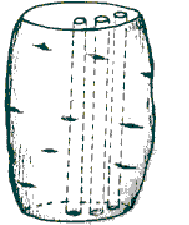
Day 2
Data:
| Results of Osmosis in Potato Cells | |||||||||
| Solution | Initial length cm (day1) |
Final length cm (day2) |
Change in length cm |
Initial Mass g (day1) |
Final Mass g (day2) |
Change in mass g |
Initial Turgidity (flaccid or crisp) |
Final Turgidity (flaccid or crisp) |
Tonicity of Solution (iso-, hypo-, or hpertonic) |
| Distilled water | |||||||||
| Salt Solution | |||||||||
| Sugar Solution | |||||||||
Results & Conclusions:
1. Did any of the potato cylinders change in their turgidity (flexibility), and if so, which ones changed?
2. Explain why the flexibility of the potato slices changed.
3. Define isotonic, hypotonic, & hypertonic solutions.
4. If potato slices changed in length or turgidity, what process was responsible for this?
5. Make a sketch of your potato cylinder in the distilled water and use arrows to show the direction of water movement across the potato cell membranes.
6. What type of solutions were the salt & sugar solutions. Explain how you know this.
7. Which solution served as the control for this experiment & why?
8. In which solutions was their a greater solute concentration outside of the cells?
9. In which direction did water move through these cell membranes?
10. In what type of solution do plant cells do best & why?
11. Using the information you’ve discovered from this experiment, explain why the sailor died that drank saltwater.
Constructing a Pedigree
Introduction
A pedigree is a special chart or family tree that uses a particular set of standardized symbols. Pedigrees are used to show the history of inherited traits through a family. In a pedigree, males are represented by squares and females by circles . An individual who exhibits the trait in question, for example, someone who suffers from hemophilia, is represented by a filled symbol or . A horizontal line between two symbols represents a mating . The offspring are connected to each other by a horizontal line above the symbols and to the parents by vertical lines. Roman numerals (I, II, III, etc.) symbolize generations. Arabic numerals (1,2,3, etc.) symbolize birth order within each generation. In this way, any individual within the pedigree can be identified by the combination of two numbers (i.e., individual II3).
Objective
Inherited traits can be traced through a family’s history by constructing a pedigree chart.
Materials
Large sheet of paper or poster board
Markers
Ruler
Protractor
Procedure
Part 1
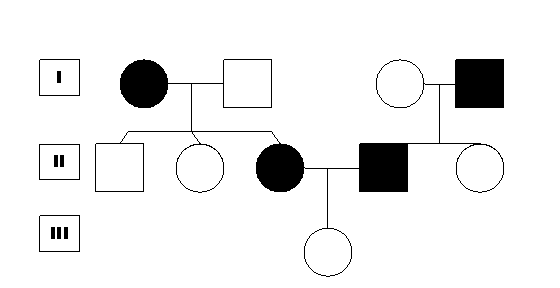
1. Examine Figure 1 that traces the ability to roll your tongue through three generations in a family. Remember: Blackened circles show the trait and circles are females and squares are male.
2. Determine which parents and which offspring would be able to roll their tongue.
FIGURE 1
Part 2
3. Read the Passage 1 about the Smith family and their inherited trait of dimples.
4. After reading the passage, construct a pedigree showing all family members in each generation that does and does NOT have dimples.
5. Once the pedigree is constructed, write the correct genotype by each person in the family.
Passage 1
Grandfather and Grandmother Smith smiled a lot and showed off their dimples each time. They had a son named John, who had dimples, and daughter named Julie, who did not. Julie died at an early age, but her brother John Smith met and married Mary Jones because she had the most beautiful dimples when she smiled. They had 5 children, 2 boys and 3 girls. Only one of their sons, Tom, had dimples, but both girls, Judy and Kay, had dimpled smiles. Their sister June lacked dimples. After college, Tom met and married Jane Kennedy who also had dimples. They had 3 children, all girls, who shared their parent’s dimpled smile. Tom’s sister Kay married a lawyer named James who seldom smiled and didn’t have dimples. Their only son Matthew was like his mother when he smiled. Judy never married. Tom’s sister, June, married a doctor and had 5 children. Three of the children were boys, Jay, Fred, and Mike. Mike and Fred had dimples like dad, but Jay’s smile was like his mom’s lacking dimples. One sister, Susan, had dimples, but the other, Katherine, didn’t.
Questions
1. What type of information does a pedigree contain?
2. How do you show the presence of a trait in a pedigree?
3. How do you denote males & females in a pedigree?
4. From your pedigree, is the presence of dimples a dominant or recessive trait?
5. How could examining a family pedigree be helpful to a couple wanting to have children?
| Perch Dissection |  |
Introduction:
The fish in the class Osteichthyes have bony skeletons. There are three groups of the bony fish — ray-finned fish, lobe-finned fish, and the lung fish. The perch is an example of a ray-finned fish. Its fins have spiny rays of cartilage &/or bone to support them. Fins help the perch to move quickly through the water and steer without rolling. The perch also has a streamline body shape that makes it well adapted for movement in the water. All ray-finned fish have a swim bladder that gives the fish buoyancy allowing them to sink or rise in the water. The swim bladder also regulates the concentration of gases in the blood of the fish. Perch have powerful jaws and strong teeth for catching and eating prey. Yellow perch are primarily bottom feeders with a slow deliberate bite. They eat almost anything, but prefer minnows, insect larvae, plankton, and worms. Perch move about in schools, often numbering in the hundreds.
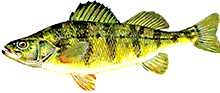
The scientific name for the yellow perch, most often used in dissection, is Perca flavescens (Perca means “dusky”; flavescens means “becoming gold colored”). The sides of the yellow perch are golden yellow to brassy green with six to eight dark vertical saddles and a white to yellow belly. Yellow perch have many small teeth, but no large canines. Yellow perch spawn from mid-April to early May by depositing their eggs over vegetation or the water bottom, with no care given. The eggs are laid in large gelatinous adhesive masses.

Materials:
Preserved perch, dissecting pan, scalpel, scissors, forceps, magnifying glass, dissecting pins, apron, gloves, eye cover, tape measure
Procedure (External Anatomy):
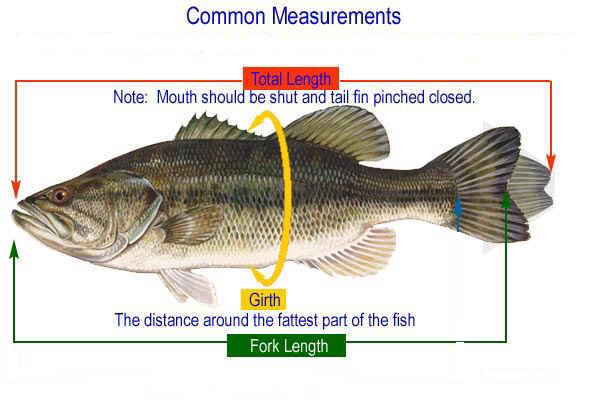
Table 1 – Fish Measurements (inches)
| Total Length | |
| Fork Length | |
| Girth |
Figure 1 – External Perch anatomy
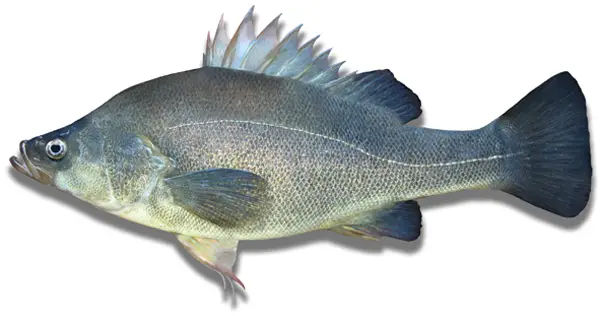
Figure 2 – Gill Structure
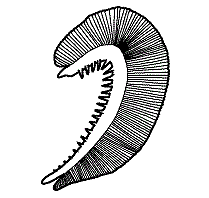
Table 2 – Fins
| Name of Fin | Spines (yes or no) |
Number of Fins | Location | Function |
|
|
||||
|
|
||||
|
|
||||
|
|
||||
|
|
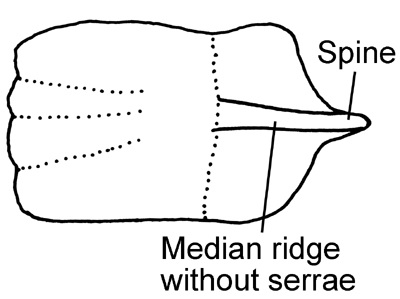
Figure 3 – Structure of a Scale
 |
Procedure (Internal Anatomy):
Figure 4 – Cut Lines for Internal dissection
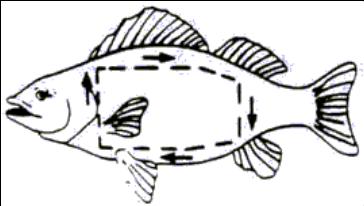
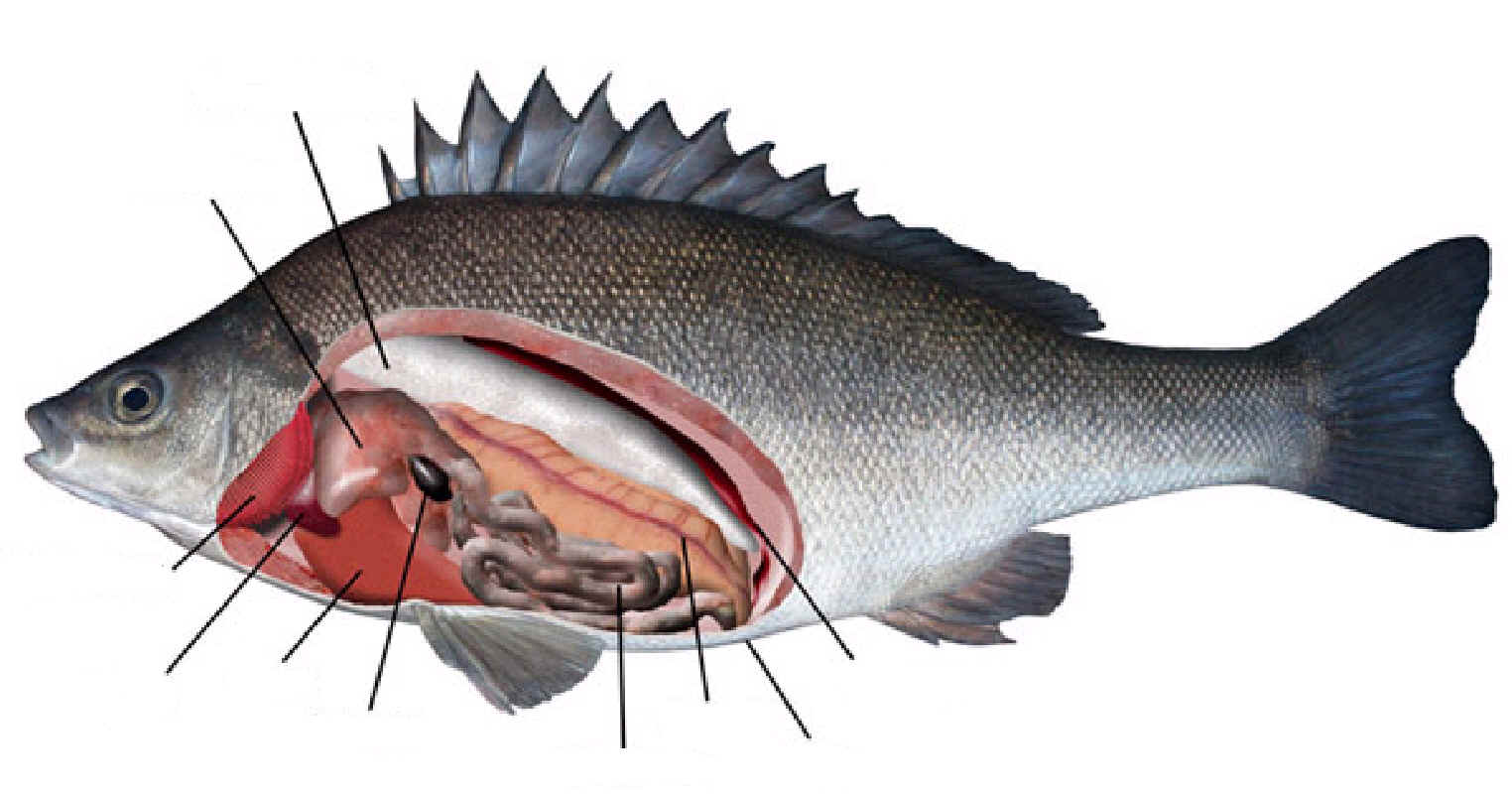
Figure 5 – Internal Perch Anatomy
Questions & Observations:
1. Are both jaws of the fish equally movable? Explain your answer.
2. Does the perch have eyelids?
3. How many gills are located on each side of the perch? What covering protects them?
4. What is the function of the gill rakers?
5. Explain how gas exchange occurs at the gills.
6. Which fin was the largest? What other difference do you notice in this fin when it was compared to the others?
7. What was the sex of your fish?
8. What is the function of the lateral line?
9. Describe how the scales are arranged on the trunk & tail of your fish.
10. Explain how the swim bladder controls buoyancy.