Codon Bingo


Codon Bingo

Introduction:

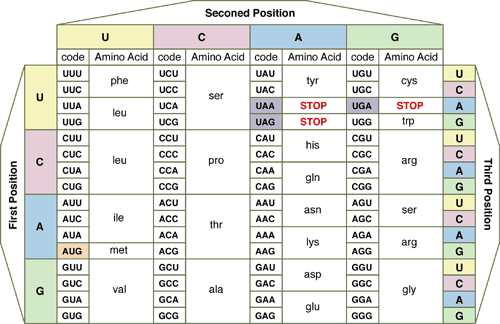
DNA is simply a storage form of information, like a recipe book.  In order to make useful proteins from this recipe, we must first transcribe the selected recipe from the DNA into messenger RNA (m-RNA) which then leaves the nucleus & goes to the ribosomes where it is “read” to link amino acids (building blocks of proteins). The code is “read” three bases at a time called a codon. The triplet code allows for a total of 4x4x4 or 64 different codons (groups of three RNA bases) –far more than needed to code for 20 amino acids. It was discovered that each amino acid is coded for by more than one codon. Codon Bingo is a simple exercise to learn how to use a codon table to translate mRNA into its associated amino acids.

Materials:  Bingo cards, pencil, codon table, beans or pennies

Procedure:

1. Pass out blank bingo cards.

2. Students should fill out each of the blanks with an amino acid from the codon chart.

3. Teacher will call out 3 bases (A, T, G, C)

4. Students find the amino acid that is associated with the codon and mark the square (use bingo chips, pennies, beans, or other miscellaneous items)


BIOLOGY BINGO


Crossword Puzzles

Crossword Puzzles

All Materials © Cmassengale


BACK

Current Science News


CURRENT SCIENCE NEWS SITES!


Chlorophyll Fluorescence


Chlorophyll Fluorescence

INTRODUCTION

When a pigment absorbs light, electrons of certain atoms in the pigment molecules are boosted to a higher energy level. The energy of an absorbed photon is converted to the potential energy of the electron that has been raised to an excited state. In most pigments, the excited electron drops back to its ground-state, or normal orbit, and releases the excess energy as heat. Some pigments, including chlorophyll, emit light as well as heat after absorbing photons.
In the chloroplast, these excited electrons jump from the chlorophyll molecule to a protein molecule in the thylakoid membrane, and are replaced by electrons from the splitting of water. The energy thus transferred, is used in carbohydrate production.
This release of light is called fluorescence. Chlorophyll will fluoresce in the red part of the spectrum, and also give off heat. In this lab, you will observe this fluorescence by separating the chlorophyll from the thylakoid membrane.

MATERIALS


Spinach leaves Flashlight or small lab light
Mortar and pestle Test tube
Acetone Filter paper
25-mL graduated cylinder Funnel
Ring stand or funnel rack Safety goggles

PROCEDURE

1. Grind the spinach leaves using a mortar and pestle.

2. Add acetone to the ground leaves, using enough acetone and spinach leaves to get between 10 and 15 mL of extract.

3. Set up your filtering apparatus, and using proper filtering technique, filter the extract to a test tube. NOTE: Use a small amount of acetone to wet the filter paper, to hold it into place, instead of water.

4. Shine a flashlight, or other similar light source, through the test tube and extract.

5. Observe the fluorescence of the chlorophyll at a 90 degree angle to the flashlight.