Crossword Puzzles
All Materials © Cmassengale
.gif)
Crossword Puzzles
All Materials © Cmassengale
.gif)
| CURRENT SCIENCE NEWS SITES! | ![]() |
Chromosomes & Inheritance
Section 12-1 Sex Determination
1. Geneticist Thomas Hunt Morgan conducted breeding experiments with what animal?
2. How many pairs of chromosomes are found in Drosophila.
3. Are the chromosomes in male & female fruit flies the same? Explain.
4. What did Morgan name the 2 chromosomes in the non-identical pair?
5. Describe the shape of the 2 chromosomes in the non-identical pair.
6. Morgan hypothesized that the non-identical pair were the _____________ chromosomes.
7. All other chromosomes except X and Y are called ______________________________.
8. What is the genotype for males? Females?
9. When male & female fruit flies are crossed, what percent of the offspring will be male? Female?
10. Because the X chromosome was much bigger than the Y chromosome, what did Morgan hypothesize?
11. Genes on the X chromosome are ____________________________ genes.
12. What is meant by sex linkage?
13. Did Morgan’s experiments prove or disprove the existence of sex-linked traits?
14. Name a trait that Morgan discovered was carried on the X chromosome in fruit flies.
15. Use a Punnett Square to show the results of crossing a red-eyed female (XRXR) with a white-eyed male XrY.
16. Use a Punnett Square to show the results of crossing a red-eyed female (XRXr) with a red-eyed male XRY.
17. What are linkage groups?
18. What 2 fruit fly traits did Morgan discover were linked?
19. What is the effect of crossing-over on genes?
20. Do genes that are close together or far apart get crossed over more often?
21. What is a chromosome map?
22. What scientist made a chromosome map of Drosophila?
23. How is one amp unit determined?
24. What is germ cell mutation & what is its effect?
25. What are somatic mutations, give an example, & can they be passed on to offspring?
26. What are lethal mutations?
27. What are chromosome mutations?
28. Name & describe 4 types of chromosome mutations.
29. What are gene mutations?
30. What are point mutations?
31. What are substitutions & give an example of a disease caused by this type of gene change?
32. What are frame shift mutations?
Section 12-2 Human Genetics
33. What is a pedigree?
34. Write the symbol that would appear on a pedigree for each of the following:
a. Male carrier?
b. Male with trait?
c. Female carrier?
d. Female with trait?
35. Name several single allele traits (both dominant & recessive).
36. Name 3 sex-linked traits.
37. What are polygenic traits and name four.
38. What influences the expression of a sex-influenced trait?
39. Name & describe 2 types of nondisjunction.
40. What causes Down syndrome?
41. When would genetic screening be useful?
42. What is amniocentesis?
43. What disease is genetically screened fro immediately after birth in the U.S.?
| Classification | ![]() |
Section 18-1 History of Taxonomy
1. Define taxonomy.
2. Who was first to classify organisms?
3. Explain Aristotle’s taxonomy of organisms.
4. Why are common names not good to use when classifying organisms? Give an example.
5. Describe Carolus Linnaeus’s system of classification.
6. Linnaeus used ____________________ or form & structure to classify organisms.
7. List Linnaeus’s levels of organization in order starting with the broadest classification level.
8. Name Linnaeus’s two kingdoms.
9. What is the difference between phylum & division? How are they alike?
10. What classification level contains only a single type of organism?
11. Give the taxonomy for a lion.
12. In Linnaeus’s naming system, ___________________ words are used as the name.
13. Explain Linnaeus’s 2-word naming system.
14. What is Linnaeus’s naming system called?
15. Write the scientific name for man.
16. The ___________ name is written first and must always be __________________.
17. The ____________ name is written second and should _____________ be capitalized.
18. Name 2 things a species name may do.
19. What are varieties?
20. What are subspecies?
21. Write a scientific name that includes a subspecies.
22. What do modern taxonomist use to classify organisms?
23. What is phylogeny?
Section 18-2 Modern Phylogenetic Taxonomy
24. Name 6 things used by modern taxonomists to classify organisms.
25. Classification of an organism should reflect its __________ or ___________ history.
26. What is systematics?
27. Name a tool used by systematic taxonomists.
28. What is a phylogenetic tree?
29. Draw a phylogenetic tree showing the possible relationships among animal phyla.
30. Do phylogenetic trees ever change? Explain.
31. What complex animal group is located at the top of your phylogenetic tree?
32. Do all organisms have complete fossil records? Explain.
33. Which structures show that organisms are more closely related, homologous or analogous?
34. Features similar in structure but with different functions are called _______________ structures.
35. Early patterns of similar ______________________ development show relationships.
36. The fertilized egg or _______________ divides by mitosis.
37. What is the blastula & make a sketch?
38. What is the blastopore, & what does it become?
39. The blastopore becomes the mouth in many animals except in ________ where it becomes their ______________.
40. What invertebrate group is most closely related to the vertebrates?
41. Taxonomists compare macromolecules such as ____________, ____________, & ____________ to show similarities among species.
42. If two organisms have similar banding patterns on their chromosomes then they are _______________ related.
43. What is used in cladistics to show evolutionary relationships?
44. What is a derived character & give an example?
45. Do shared derived characters show common ancestry?
46. What is a cladogram?
47. Sketch a cladogram for vertebrates.
Section 18-3 Modern Systems of Classification
48. The discovery of 2 broad types of bacteria led taxonomists to develop what type of classification system?
49. Name the 6 kingdoms & tell which are prokaryotes & which are eukaryotes.
50. Describe members of the kingdom Archaebacteria.
51. In what type of environment are Archaebacteria found?
52. Did Archaebacteria carry on photosynthesis?
53. What kingdom contains true bacteria?
54. Name 4 things Eubacteria do that affect your life.
55. Do all true bacteria use oxygen? Explain.
56. How do all bacteria reproduce?
57. Why are bacteria able to evolve so quickly? Give an example.
58. Most protists are ______ organisms, but some like the giant kelp are _________ without __________.
59. Since protists are eukaryotes, what special structures do they contain?
60. Some protists like ________________ feed on other organisms, while __________ have chloroplasts & make their own food.
61. Describe the characteristics of fungi.
62. How do fungi get food?
64. Multicellular plants are in the ____________________ kingdom.
65. Most plants are ________________ and make food energy by ________________.
66. Most plants live on ________________.
67. Name 4 examples of major plant groups.
68. Describe the characteristics of the animal kingdom.
69. Most animals have _______________ body organization.
70. Both plants & animals reproduce ________________.
71. Using information about __________ RNA, __________ developed the three _______ classification system.
72. Name the 3 domains.
73. Domain ___________ contains the same organisms as the kingdom Archaebacteria.
74. Domain ________________ contains the same organisms as kingdom Eubacteria.
75. What is included in domain Eukarya?
76. What characteristic do all members of the domain Eukarya have in common with each other
| Codon Bingo | ![]() |
Introduction:
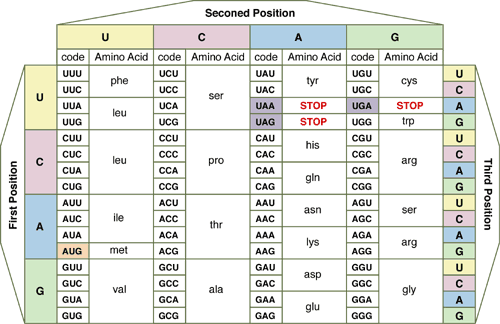
DNA is simply a storage form of information, like a recipe book. In order to make useful proteins from this recipe, we must first transcribe the selected recipe from the DNA into messenger RNA (m-RNA) which then leaves the nucleus & goes to the ribosomes where it is “read” to link amino acids (building blocks of proteins). The code is “read” three bases at a time called a codon. The triplet code allows for a total of 4x4x4 or 64 different codons (groups of three RNA bases) –far more than needed to code for 20 amino acids. It was discovered that each amino acid is coded for by more than one codon. Codon Bingo is a simple exercise to learn how to use a codon table to translate mRNA into its associated amino acids.
Materials: Bingo cards, pencil, codon table, beans or pennies
Procedure:
1. Pass out blank bingo cards.
2. Students should fill out each of the blanks with an amino acid from the codon chart.
3. Teacher will call out 3 bases (A, T, G, C)
4. Students find the amino acid that is associated with the codon and mark the square (use bingo chips, pennies, beans, or other miscellaneous items)

BIOLOGY BINGO