Alien Taxonomy Project


Alien Taxonomy


In the year 2525:

Humans, after hundreds of years of constant effort, have successfully polluted all bodies of water on Earth. As a result, almost all previously known species of plants, animals, and other life forms have become extinct. Through natural selection, genetic engineering, and selective breeding programs, a portion of the Earth has been successfully repopulated. The following organisms are all that remain:

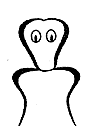
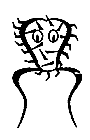
  1. Photosynthetic humanoids with green chlorophyll-containing hair (autotrophs)
  2. Chemosynthetic dolphin-like organisms who derive their energy for food production from the contaminants in the water (autotrophs)
  3. Aquatic humanoids who work on the dolphin’s aquaculture farms (heterotrophic)
  4. Aqua wheat, a heterotrophic crop grown by the dolphins that feeds on bacteria
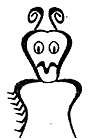
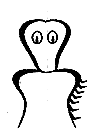
  5. Legless, photosynthetic humanoid space travelers with arm-like tentacles that visit the Earth every 6 weeks
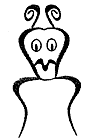
  6. Anaerobic humanoids designed for space living, but when on Earth for space training, they must wear deoxygenated space suits (heterotrophs)
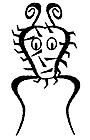
  7. Cockroach-like organisms that feed on humanoid and dolphin excrement (Decomposers)
  8. Heterotrophic giant squids that feed on humanoids & dolphins
  9. Green-skinned, photosynthetic rats
  10. Parasitic mosquitoes that feed on humanoids

Your Assignment:

As an alien taxonomist, it is your responsibility to classify these existing organisms.

  1. Create Latin-sounding Genus and species names for each organism. Remember that the species name should reflect a characteristic of the organism.
  2. Create a taxonomic scheme for each organism including a kingdom, phylum, and the genus and species name you created. Use only two kingdoms that you create. Be sure to also include the number of the organism with the scheme
  3. Illustrate your interpretation of each organism’s appearance including all the characteristics given to you.  All illustrations should be numbered and colored on a single sheet of unlined paper.
  4. Prepare a dichotomous key using the scientific names for these organisms so that your fellow aliens can also identify them when they come to Earth for summer vacations. 
  5. Make a cover sheet with your name, date, and period and paper clip your sheets together.


CLICK HERE FOR PRINTABLE COPY OF ACTIVITY & WORKSHEET

BACK


Amylase on Starch Lab


Enzyme Amylase Action on Starch

INTRODUCTION:

In this experiment you will observe the action of the enzyme amylase on starch. Amylase changes starch into a simpler form: the sugar maltose, which is soluble in water. Amylase is present in our saliva, and begins to act on the starch in our food while still in the mouth.
Exposure to heat or extreme pH (acid or base) will denature proteins. Enzymes, including amylase, are proteins. If denatured, an enzyme can no longer act as a catalyst for the reaction.
Benedict’s solution is a test reagent that reacts positively with simple reducing sugars like maltose, but will not react with starch. A positive test is observed as the formation of a brownish-red cuprous oxide precipitate. A weaker positive test will be yellow to orange.

MATERIALS:

Cornstarch
Distilled water
Saliva
Vinegar
Benedict’s qualitative solution
3 graduated cylinders (10mL)
250-ml beaker
Stirring rod
3 test tubes (16 x 125mm)
Test tube rack
Wax pencil
Water Bath

PRE-LAB:

Add 1g of cornstarch to a beaker containing 100ml of cold distilled water. While stirring frequently, heat the mixture just until it begins to boil. Allow to cool.

PROCEDURE:

1. Fill the 250-mL beaker about 3/4 full of water and place on the hot plate for a boiling water bath. Keep the water JUST AT BOILING.

2. Mark 3 test tubes A, B and C. “Spit” between 1 and 2 mL of saliva into each test tube.

3. Into tube A, add 2 mL of vinegar. Into tubes B and C, add 2 mL of distilled water. Thump the tubes to mix.

4. Place tube B into the boiling water bath for 5 minutes. After the five minutes, remove from the bath, and place back into the test tube rack.

5. Add 5 mL of the starch solution to each tube and thump to mix. Allow the tubes to sit for 10 minutes, occasionally thumping the tubes to mix.

6. Add 5 mL of Benedict’s solution to each tube and thump to mix. Place the tubes in the hot water bath. The reaction takes several minutes to begin.

OBSERVATIONS:

Tube A: Starch + saliva treated with vinegar (acid)

    • Was the test positive or negative? _______________________

What does this indicate?__________________________________________________

____________________________________________________________________

____________________________________________________________________

Tube B: Starch + saliva and water, treated in a boiling water bath

    • Was the test positive or negative? _______________________

What does this indicate?__________________________________________________

____________________________________________________________________

____________________________________________________________________

Tube C: Starch + saliva

    • Was the test positive or negative? _______________________

What does this indicate?__________________________________________________

____________________________________________________________________

____________________________________________________________________

QUESTIONS:

1. What is the function of an enzyme?


2. Where does a substrate attach to an enzyme?

3. If an enzyme is present in a reaction, less ________________ _________________ will be needed to get the reaction started.

4. What is a common suffix found at the end of most biological enzymes?

5. Most enzymes are macromolecules called ________________.

6. Define denaturation of proteins.


7. Name 3 things that can denature or unfold an enzyme.


8. In this lab, what weak acid denatured the protein?

9. What was the purpose of placing one test tube in a hot water bath?


10. What happens to enzymes in your body whenever you run fever?


Virus Worksheet


  Viruses Worksheet   

Structure of Viruses

1. Are viruses living or nonliving?

2. How can viruses be useful?


3. What odes a virologist do for a living?


4. Construct a Venn diagram comparing viruses and cells.


5. Explain how viruses were discovered and by whom.


6. Compare the size of viruses, bacteria, and eukaryotic cells.


7. What must be true for viruses to be able to replicate?


8. Name the two main parts of all viruses.


9. Discuss the hereditary material of viruses.


10. Compare & contrast capsids and envelopes of viruses.


11. Name 2 enveloped viruses that cause sexually transmitted disease.

12. What type of virus causes flu?

13. Where are glycoproteins found & what is there purpose?


14. What characteristics are used to group viruses?


15. How are these viruses grouped — retrovirus, adenovirus, and herpes virus?


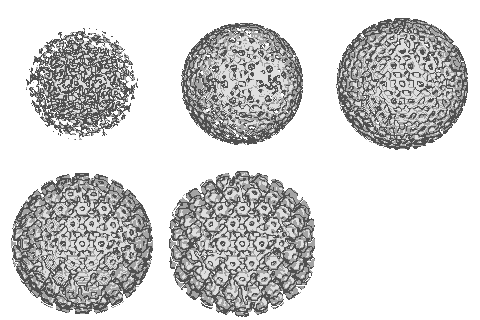
16. Compare & contrast helical & icosahedral viral shapes & diseases.


17. Explain how RNA viruses replicate.


18. Do viruses contain enzymes? Explain.


19. Compare 7 contrast viroids & prions by constructing a Venn diagram.


Viral Replication

20. Why are viruses considered to be obligate intracellular parasites?


21. What is the best known bacteriophage, and what virus does it attack?


22. Sketch & label a bacteriophage and tell the function of each labeled part.


23. Name the steps of the lytic cycle & tell what happens to the host cell & virus at each stage.


24. What are temperate phages and how do they affect a cell?


25. Name the steps of the lysogenic cycle & tell what happens to the host cell & virus at each stage.


26. How does a prophage form?


27.Name a sexually transmitted virus that uses the lysogenic cycle to attack host cells.

28. Why is the influenza virus so hard to combat?


Viruses & Human Disease

29. Name some of the most common viral disease that attack humans.


30. How are shingles & chickenpox alike? How are they different?


31.What two methods are used to control viral diseases?


32. What is the CDC and what is its job?


33.What eradication program did the World Health Organization undertake in 1967, and what were the results?


34. What virus do we vaccinate our pets against each year?

35. How does AZT work?


36. What drugs prevent viruses from making capsids?

37. Why is rain forest clearing dangerous to humans?


38. Some lysogenic viruses can trigger certain types of _________________.


BACK

Bacteria Virus Worksheet Bl


Bacteria Worksheet    


Bacterial Cell Evolution

1. Bacteria are microscopic _____________.

2. Fossils evidence shows bacteria are about __________ years old, while eukaryotes are about __________ years old.

3. Discuss where bacteria can be found.


4. Ribosomal differences have put bacteria into what two kingdoms? Which is the older group?


5. What is absent in the cell wall of Archaebacteria? Describe this substance.


6. Describe the environments in which you would find Archaebacteria.


7. Compare & contrast these tree groups of Archaebacteria — methanogens, extreme halophiles, and thermoacidophiles.


8. Most bacteria are found in what kingdom?

9. Name & describe the three shapes of Eubacteria.


10. Are Eubacteria aerobic or anaerobic? Explain.


11. Eubacteria may be heterotrophic or photosynthetic. Explain what this means & give an example of each type.


12. What type of staining is used to group Eubacteria?

13. Describe the appearance of gram-positive and gram-negative bacteria under a microscope.


14. Explain why Eubacteria do not all stain the same color during Gram staining.


15. Describe, in detail, cyanobacteria.


16. Cyanobacteria, also known as ______________ bacteria lack a membrane bound __________ & _____________.

17. How are heterocysts helpful to cyanobacteria?


18. What is eutrophication?


19. Explain the role of cyanobacteria in eutrophication.


20. What bacterium causes syphilis? Describe this bacteria.


21. Streptococci bacteria causing strep throat are in what group?

22. Why are actinomycete bacteria important?


23. Compare & contrast these three groups of Proteobacteria — enteric bacteria, chemoautotrophs, and nitrogen-fixing bacteria.


24.Name a genus of nitrogen-fixing bacteria found on the roots of soybeans in our area.


Characteristics of Bacteria

25. Name the three main parts of all bacteria.


26. Describe the cell wall of bacteria. How does this differ from a plant cell wall?


27. Compare & contrast the cell membrane of Eubacteria with that of other eukaryotes.


28.Are Gram positive or negative bacteria more protected against antibiotics & why?


29. Where does cell respiration take place in eukaryotes? in bacteria?

30. Describe how the cell membrane of photosynthetic bacteria are adapted for this process. Where does this process take place in plants?


31. Compare & contrast the cytoplasm of bacteria with that of eukaryotes.


32. Describe the DNA (hereditary material) found in bacteria. Make a sketch of what you think this would look like.


33. Where is the capsule of a bacteria, what is it made of, and give two ways it helps a bacterium?


34. Where is the glycoclayx of a bacteria, what is it made of, and how does it help a bacterium?


35. How do pili help the bacteria that have them?


36. How do Gram positive bacteria protect themselves against harsh environments?


37. Describe two methods of locomotion in bacteria.


38. Compare & contrast saprophytic and photoautotrophic bacterial nutrition.


39. Distinguish among these three bacteria & give an example of each — obligate anaerobes, facultative anaerobes, & obligate aerobes.


40. Compare & contrast these three methods of bacterial reproduction — transformation, conjugation, and transduction.


Bacteria and Humans

41. What does a pathologist do for a living?


42. Compare & contrast the two types of toxins bacteria produce.


43. Besides injuring the body by releasing toxins, how else do bacteria hurt the body?


44. Describe four antibiotics against bacteria.


45. Explain how antibiotic resistance occurs.


46. Name two  bacterial diseases carried by ticks.

47. name two bacterial diseases caused by eating contaminated food.

48. Name a sexually transmitted bacterial disease.

49. Name a bacterium that can cause disease whenever it gets into deep wounds.

50. Name a bacterium that is transmitted by coughing & infects the lungs.

51. Describe, in detail, how bacteria can be useful to humans.


BACK