Biology Study Guides
All Materials © Cmassengale
Biology Study Guides
All Materials © Cmassengale
| Safety & Equipment Study Guide | |||||||||||||||||||||||||||
Be able to recognize pictures of the following equipment:
Know the best solution for each of these safety problems:
|
|||||||||||||||||||||||||||
| What lizard is named for the spiny crest on its back? |
| What is the function of pits on the head of rattlesnakes? |
| What species of lizard is the only surviving member of its ancient group? |
| What is autotomy & what is its advantage? |
| Name the order for snakes. |
| Name several characteristics of all snakes. |
| Explain how retiles get air into their lungs. |
| Describe the skin of reptiles. |
| Give several ways that organisms reduce evaporation of water from their bodies. |
| What is the most widely accepted hypothesis for the extinction of dinosaurs? |
| Name some protective membranes found inside amniote eggs. |
| What retile adaptation allows them to live & reproduce on land? |
| What is the outermost membrane of the reptile egg? |
| Describe the heart chambers of all reptiles except alligators & crocodiles. |
| Name the 2 parts of a turtle’s shell and tell where each is located. |
| Are reptiles endotherms or ectotherms? Explain. |
| How do endotherms maintain their internal body temperature? |
| Describe the heart of endotherms. |
| Define oviparous. |
| Which group of reptiles care for their young after they hatch? |
| Which group of reptiles are the most ancient? |
| What characteristic found in other retiles is lacking in turtles & tortoises? |
| Describe the feeding habits of crocodiles. |
| Photosynthesis Review |  |
1. What is the term for the ability to perform work? ______________________.
2. Animals that Cannot make their own food are called ________________________.
3. Most organisms use an energy storage molecule called ____________________ _______________________ or simply (_______).
4. Light of different colors is different in ______________________ and _________________________.
5. During photosynthesis, a Reduction Reaction _________ ______________ to a molecule.
6. Oxidation is a process that makes a molecule __________________ electrons.
7. Disk-shaped structures with photosynthetic pigments are known as __________________.
8. The process by which autotrophs convert sunlight into energy is called ___________________________.
9. A molecule that can absorb certain light wavelengths and reflect others is a ________________________________.
10. What are the most common group of photosynthetic pigments in plants? ___________________________
11. Stroma are gel-like matrix (a solution) that surrounds the ________________________.
12. Photosynthesis occurs in two stages called:
A.______________________________________________
B.______________________________________________
13. Plants that use only the Calvin Cycle for photosynthesis are called ______________.
14. CAM Plants can survive in dry, hot deserts because they can fix carbon at ____________________________.
15. What substances do Autotrophs or producers use to make food?
A._____________________________________
B._____________________________________
C._____________________________________
16. The addition of an electron to an atom or a molecule is called _________________.
17. The loss of an electron to an atom or a molecule is called ____________________.
18. Organisms that CAN produce their own food are called ______________________.
19. An important waste product of photosynthesis is _______________________.
20. Photosynthesis occurs in what organelle of plants and algae? _________________________.
21. The Thylakoids are surrounded by a gel-like matrix (solution) called __________________.
22. An object that absorbs all colors appears _____________________.
23. What are the light collecting units of the Chloroplast? __________________.
24. Carbon fixing reactions occur in a pathway called the _____________________ _________________.
25. Chlorophyll reflects and transmits what color? _________________________.
26. An object that reflects all colors appears ____________________________.
27. Folded Thylakoids that resemble stacks of pancakes are called ________________________________.
28.The pigments that absorb violet, blue and red light. __________________________
29.The Enzyme that adds a phosphate group to ADP. _________ __________________ to form _________________.
30. What do we call the component colors of white light? ______________________ ___________________________
31. What clusters of pigments are called. ____________________________
32. A five-carbon carbohydrate in the Calvin cycle. _____________________________
33. A three-carbon molecule in the Calvin cycle.______________________________
34. A Series of linked chemical reactions is called a __________________________ ____________________________.
35. The pigments that absorb blue and green light are called ________________________.
36. The oxygen atoms in the oxygen gas produced in photosynthesis come from ________________________ __________________________.
37. Both C4 and C3 plants use the ____________________ _________________ for carbon fixation.
38. Where does the energy required for the Calvin cycle originate? From ______________ and __________________ produced by the ____________________ _____________________.
39. Protons are move into the thylakoid using energy from ___________________ in the __________________________ __________________________.
40. At the end of photosystem I transport chain, electrons combine with ______________ to form ______________________.
41. Carbon atoms are fixed into organic compounds in the _____________________ ______________________.
42. To produce the same amount of carbohydrate, C4 plants require less ___________________ ____________________ than C3 plants.
43. Where in the chloroplast do the light reactions occur? ________________________
44. Where in the chloroplast do the reactions of the Calvin cycle occur? ______________________________
45. What product of the light reactions of photosynthesis is released and does not participate further in photosynthesis? _________________________________
46.Which environmental factor will cause a rapid decline in the photosynthesis rate if the factor rises above a certain level? ___________________________________
47. Accessory pigments differ from chlorophyll a in that they are _______________ directly involved in the ___________________ _____________________ of photosynthesis.
48. What structure that is found in the thylakoid membrane is important to chemiosmosis? ___________
_____________________________.
49. _______________________________________________________ is the protein in the _____________________________________ membrane that adds a phosphate group to ADP.
50. Chemiosmosis relies on a(n) ____________________________________________________ of protons across the thylakoid membrane.
51. Write the chemical equation for photosynthesis.____________________________________
_____________________________________________________________________________
52. ATP synthase is a multifunctional protein. By allowing protons to cross the thylakoid membrane, it functions as a(n) _______________________________________________, and by catalyzing the synthesis of ATP it functions as a(n) ______________________________.
53. H+ represents an ion or in photosynthesis a(n) _____________________________________.
DIRECTIONS: Answer the questions below as completely and as thoroughly as possible. Answer the question in essay form (not outline form), using complete sentences. You may use diagrams to supplement your answers, but a diagram alone without appropriate discussion is inadequate.
1. Describe the internal structure and external structure of a chloroplast.
2. Explain what happens to the components of water molecules that are split during the light reactions of photosynthesis? (HINT: Name the three products that are produced when water molecules are split during the light reactions and explain what each product is used for.)
3. Explain the difference between the roles of photosystem I and photosystem II in photosynthesis?
4. Explain why the leaves of some plants look green during the summer then turn yellow, orange, red,
or brown during the fall?
5. What plant structures control the passage of water out of a plant and carbon dioxide into a plant? Explain
how they control the passage of water out of a plant and carbon dioxide into a plant.
6. What happens to the electrons that are lost by photosystem II? What happens to the electrons
that are lost by photosystem I?
7. Photosynthesis is said to be “Saturated” at a certain level of CO2. Explain what this means?
8. Explain how is ATP synthesized in photosynthesis? What is this process called?
9. What is the fate of most of the PGAL molecules in the third step of the Calvin cycle and Why is this important?
What happens to the remaining PGAL molecules? What organic compound can be made from PGAL?
10. Explain how CAM plants differ from C3 and C4 plants? How does this difference allow CAM
plants to exist in hot, dry conditions?
11. Define biochemical pathway and explain how the Calvin cycle is an example of a biochemical pathway.
In what part of the chloroplasts does the Calvin cycle take place?
12. Explain how the function of the chloroplasts is related to its structure.
13. What roles do water molecules play in photosynthesis?
14. Describe the structure and function of the thylakoids of a chloroplasts.
15. What role do accessory pigments play in photosynthesis?
| Protozoan Review |  |
1. Protists with animal-like characteristics are called ___________________________.
2. Protozoans are all ______________________ organisms.
3. One convent way to classify protozoans is based on the way they _______________.
4. _____________________ move by extending their ___________________. ______________________ propel themselves by ______________________. _____________________ move by hairlike ____________, and _________________________ do ___________ move by themselves at all.
5. Protozoans that move by extending lobes of cytoplasm are called _______________________________.
6. The lobes of cytoplasm that sarcodinians extend are called _____________________ which means “_____________ ________________”.
7. When conditions are unfavorable, many amoebas survive by becoming hard ______________. The ____________ can withstand drought, heat, or being eaten by other organisms.
8. Not all sarcodinians are soft “Naked”, some have hard shells or _______________ made of __________________________________ or _______________________. They are called ____________________________ and _______________________________.
9. Sarcodinians are protozoans that move by extending lobes of _________________________.
10. ________________________________ are protozoans that move by means of flagella.
11. Some zooflagellates are free-living ________________________ or ____________________ organisms; many can live inside other organisms in _____________________ relationship. Zooflagellates may have a ________________________ or _________________________________ relationships with other organisms.
12. Which zooflagellate parasite causes African Sleeping Sickness in humans? ____________________________. The disease is spread by the bite of the __________________ ___________________.
13. _________________________ are protozoans that have bodies covered with short hairlike projections called _________________. They beat like ___________ to propel these protists through the water.
14. The ____________________________ is a common freshwater ciliate.
15. Paramecium gathers food with its _____________. The ____________ sweeps food particles into the ______________ _________________, the Mouth _____________ opens into a ___________________ which pinches off around them to form a ____________________ ______________________. It ejects wastes through an opening called the ______________________ __________________________.
16. Water is constantly enters the Paramecium cell by _______________________. They would burst if they did not have a way to get rid of excess water. ______________________________ _____________________________ collect the excess water and pump it outside.
17. Like all ciliates, Paramecium has ______________ distinct kinds of nuclei, each with a different function. The ___________________________ controls ongoing functions of the cell and __________________________ reproduction. Ciliates reproduce _______________________ by cell division. The _____________________________ is involved in genetic exchange during ___________________________ reproduction.
18. When a Paramecium reproduces sexually, it exchanges genetic information by ________________________________________.
19. The protozoans that have NO structures for movement, and lives by being a parasite in animals are the ______________________________. They are ____________-__________________ ____________________ protozoans.
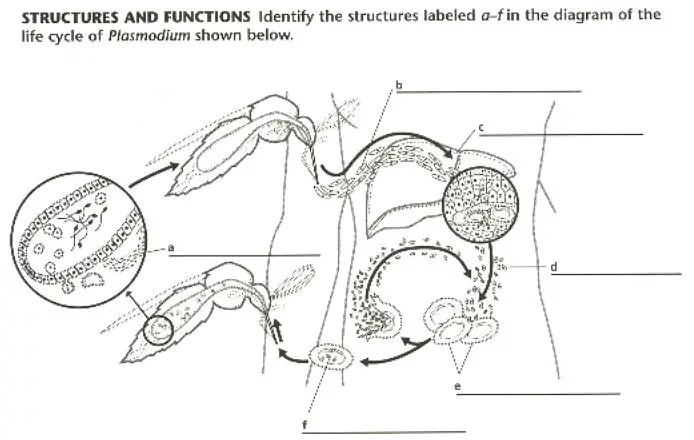
20. The protozoan that causes malaria is named ________________________ and is carried within _________________ ____________________.
21. Protozoans can grow and reproduce only in _____________ environments.
22. _____________________ is a collection of mostly microscopic organisms that float near the surface of the ocean and lakes.
23. Type of sarcodina that moves by pseudopodia is an _________________________.
24. The sporozoan that causes malaria is _______________________________.
25. The ciliophora that moves by cilia ________________________________.
26. Types of sarcodinians that are covered by a protective test are __________________________ and ______________________________.
27. The insect that transmits malaria to humans is the _____________________.
28. The sporozoan that is found in cats is ________________________ _____________________.
29. The zooflagellate that causes Chaga’s disease is ___________________________ _______________________.
30. The zooflagellate that is known to contaminate stream water in the U.S. is _______________________ __________________________.
31. ________________________ is a process of sexual reproduction in ciliates.
32. Protozoa are thought to have descended from ________________________ Eukaryotes.
33. Protozoan habitats are characterized by the presence of _______________________.
34. An adaptation to extreme environments is called ________________ _______________________________.
35. Sarcodines use their pseudopodia for ________________________________________, _____________________________________, and ________________________________.
36. Certain sarcodines affect Earth’s geology by having mineralized shells that form __________________________ _________________ after they die.
37. What do trypanosomiasis, Chaga’s disease, leishmaniasis, and giardiasis have in common? (Hint) They are all caused by __________________________________.
38. Pseudopodia are extensions of a sarcodine’s ____________________________.
39. In Paramecium, the macronucleus contains _______________________ _______________________ of _____________________.
40. What Two terms best describes members of the Kingdom Protista? (Hint) They are _________________________ – _______________ and ____________________________.
41. Most protists are made up of ______________________________ cell(s).
42. Most protists live in a ________________________________ environment.
43. Some protists undergo sexual reproduction only at times of environmental ________________________________.
44. Some protists have __________________________________ that contain light sensitive pigments.
45. Sleeping sickness is caused by a group of ____________________________ called trypanosomes.
46. _________________________________ has been used since the 1600s to relieve the symptoms of malaria.
47. Disease causing protists are transmitted mainly by insects and contaminated ______________________________.
DIRECTIONS: Answer the questions below as completely and as thoroughly as possible. Answer the question in essay form (not outline form), using complete sentences. You may use diagrams to supplement your answers, but a diagram alone without appropriate discussion is inadequate.
1. What kind of organisms are found in the kingdom Protista? What characteristics do they share?
2. Explain how parasitic zooflagellates infect their hosts. Give two examples.
3. Describe the life cycle of Plasmodium. What features typical of sporozoans does this life cycle exhibit.
4. Describe the four phyla of protozoa.
5. Would a motile or nonmotile protozoan be more likely to be free-living? Explain your answer.
6. Distinguish between the terms Protist and Protozoan.
7. What is conjugation? How is this process advantageous for ciliates, such as Paramecium?
8. Describe the process of ameboid movement and how it helps with the amoeba’s nutrition.
9. What are pseudopodia? What functions do they serve in sarcodines?
10. Describe Three means of locomotion among protozoa.
11. What is a cyst? Under what conditions might certain protozoa form cysts?
12. Explain how Conjugation in protozoa (Paramecium) differs from conjugation in bacteria?
13. Explain the role of protozoa in aquatic ecosystem food chains?
14. How have sarcodines built geological features of the environment?
15. What adaptive significance does the contractile vacuole have in fresh water sarcodine?
16. What Kinds of diseases can zooflagellates cause in humans?