Preap Biochemistry Study Guide


Biochemistry Review 


1. Molecules with a slightly negative end and a slightly positive end are called ___________________  _____________________________.

2. A monomer of protein is called an __________________  __________________.

3. An attractive force between like particles is called ___________________________.

4. Organic molecules that catalyze reactions in living systems are ______________________.

5. The compound found in living things that supplies the energy in one of its chemical bonds directly to cells is ______________________.

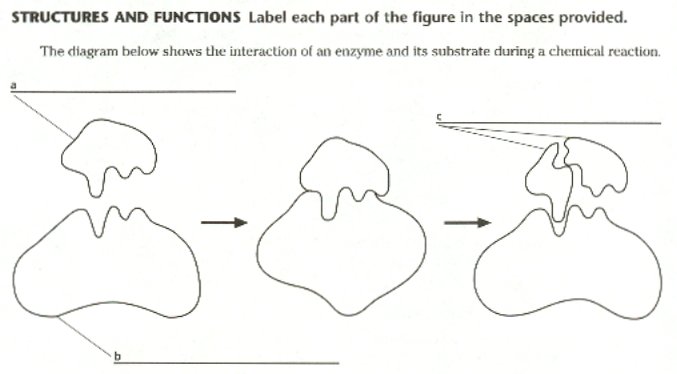
6. Enzymes lower activation energy by___________ to the ____________________ and ______________________ bonds within the ________________________.

7. The monomers that make up nucleic acids are called __________________________.

8. The type of attraction that holds two water molecules together is called __________________________  __________________________.

9. The sharing of three pairs of electrons is called a ___________________  _____________.

10.  The structural building block that determines the characteristics of a compound is called the _____________________________  _______________________.

11.  Large carbon compounds are built from smaller molecules called ______________________________.

12.  What is the type of reaction that forms large molecules from smaller ones? _________________________________  _____________________________.

13.  What type of reaction breaks large molecules into smaller ones? _______________________

14.  What is the by product of a condensation reaction? __________________________

15.  The attractive force between unlike particles is called ____________________________.

16.  A compound that is stored as glycogen in animals and as a starch in plants is ____________________________________.

17.  Lipids are good energy storage molecules because they have many _________________-___________________ bonds.

18.  What are the components of many lipids? ________________________  ______________________

19.  What is the monomer of many polysaccharides? ______________________________

20.  What kind of reaction allows amino acids to become linked together? ________________________________  _____________________________.

21.  Nucleic acids function primarily to carry __________________________  ____________________ and direct _____________________  ______________________.

22. Tends not to react with water, “Water Fearing”  ________________________________

23. Attracted to water molecules, “Water Loving” _________________________________

24. Water is called a ___________________________  ___________________________.
DIRECTIONS: Read Chapter 3, Biochemistry, and Answer the questions below as completely and as thoroughly as possible. Answer the question in essay form (not outline form), using complete sentences. You may use diagrams or pictures to supplement your answers, but a diagram or picture alone without appropriate discussion is inadequate.

1. Describe the structure of a water molecule, and explain how the electrical charge is distributed over the molecule.

2. Describe the structure of amino acids and proteins.

3. What are the structural differences between monosaccharides, disaccharides, and polysaccharides?

4. What is capillarity? Include defining Adhesion and Cohesion.

5. How does a condensation reaction differ from a hydrolysis reaction?

6. Give Three reasons why water is an effective solvent.

7. What is an organic compound?

8. What property allows carbon compounds to exist in a number of forms?

9. The presence of four electrons in the outermost energy level of a carbon atom enables
carbon atoms to form what THREE Things.

10. Living things contain many different proteins of vastly different shapes and functions.
What determines the shape and thus the function of a particular protein?

11. How does the structure of a phospholipid, linear molecules with a polar end and a
nonpolar end, relate to their function in the cell membrane?


Preap Genetics Study Guide

Genetics Review  

The two genes or alleles that combine to determine a trait would be the organism’s _______________.
Type AB blood, having two genes dominant for a trait, is an example of ________.
State Mendel’s law of segregation.
Rr x Rr is an example of what type of cross —– P1, F1, or F2?
If both alleles are the same in a genotype, is the genotype homozygous or heterozygous?
Which cross is a cross between two hybrids —– P1, F1, or F2?
__________ dominance results in the blending of genes in the hybrid. Give an example using flower color.
What is another term for a heterozygous genotype?
The _____________ is the physical feature such as round peas that results from a genotype.
How many traits are involved in a monohybrid cross?
What type of organism was used in the first genetic studies done by Gregor Mendel?
What is a karyotype?
The two genes for a trait represented by capital & lower case letters are called __________.
How many traits are involved in a dihybrid cross?
Which of Mendel’s laws states that the dominant gene in a pair will be expressed?
If both alleles are the same, is the genotype homozygous or heterozygous? Write an example.
Write an example of a hybrid or heterozygous genotype.
The genes for sex-linked traits are only carried on which chromosome?
Who is considered to be the “father of genetics”?
A second filial or F2 cross is also called a ____________ cross.
The failure of chromosomes to separate during meiosis (egg & sperm formation) is known as _________________.
A cross between two pure or homozygous organisms is called what type of cross —– P1, F1, or F2?
What genetic disorder results from a sex-linked trait that affects color vision?
The genetic disorder called _______________ is known as the “free bleeders” disease.
Having three 21st chromosomes causes the genetic disorder known as _________.
A person suffering from the genetic disorder called ______________ can not digest fats.
_____________________ disease is a genetic disorder where red blood cells carry less oxygen.
Work a P1 cross for plant height in peas.
Work an F1 cross for plant height in peas.


DIRECTIONS: Answer the questions below as completely and as thoroughly as possible. Answer the question in essay form (not outline form), using complete sentences. You may use diagrams or pictures to supplement your answers, but a diagram or picture alone without appropriate discussion is inadequate.

1. State the two laws of heredity that resulted from Mendel’s work.

2. What happens during meiosis that would allow genes located on the same chromosome to separate independently of one another?

3. List the steps in Mendel’s experiments on pea plants. Include the P generation, F1 generation, and F2 generation.

4. Write the equation for probability.

5. Distinguish between codominance and incomplete dominance. Give an example of each type of inheritance.

6. Define the terms, dominant and recessive.

7. Relate the events of meiosis to the law of segregation.

8. Explain the difference between a monohybrid cross and dihybrid cross. Give an example of each.

9. Explain how you would use a Punnett square to predict the probable outcome of a monohybrid cross. Draw a Punnett square to demonstrate your monohybrid cross.

10. Explain the terms genotype and phenotype.

11. Explain the terms homozygous and heterozygous.


BACK


Preap Biology Study Guides


PreAP Biology Chapter Reviews
All Materials © Cmassengale


Preap Cell Division Study Guide


Cell Cycle & Cell Division Review  

1. Chromosomes are Rod Shaped structures made of _________ and ___________.

2. State the cell theory.

3. The phases in the life of a cell are called the ______________  _____________.

4. The cell cycle consists of ________, __________, __________, & division.

5. ________________ is a series of ______________ in cell division during which the _____________________ of a cell divides into __________  __________ with ____________   _____________ material.

6. _________________ only occurs  in _________________________  cells.

7. The period of cell growth prior to division is _________________________.

8.   Interphase consist of what three phases and describe each:
a.

b.

c.

9. The period during which DNA is copied ______________________.

10. DNA replication in a cell results in _________________  ____________________.

11. Replication is the process of copying _______________  ____________________.

12. Cell division is the process by which one _________ produces __________ new identical _________  ___________.

13.  Cell division involves 2 Steps called __________________  _____________  ________________________.

The steps are:
a.

b.

14. Step 1 of cell division is called ___________, and step 2 is called ______________.

15. During __________the cytoplasm of the cell divides into _______ new cells called ___________  ___________.

16. The steps or phases of Mitosis are ___________,  ____________,  ____________, and ________________.

17.   _________ is the process by which a nucleus gives rise to ___________ _________  _____________.

18. In anaphase, the sister Chromatids __________________________________.

19. The cell is pinched into two and cytokinesis begins during ____________________.

20. The assembling of microtubules that make up the spindle fibers occurs during _____________.

21. During prophase the _________ and  ________  ____________ disappear.

22. The center of the cell is called the ___________  _______________.

23.   ________________ condenses into chromosomes of two _________________  ____________________, joined together by the _____________________ during __________________________.

24.  The production of offspring from one parent is called ________________________  ________________________.

25.  During mitosis, centrioles are present only in _________________________ cells.

26.  Most organisms are capable of combining ______________________ from two parents to produce ______________________.

27. The phase of mitosis during which chromosomes move to opposite poles is called ____________________________________.

28. When chromosomes of two parents combined to produce offspring, the process is known as _____________________  _____________________.

29. The chromosomes that combine during sexual reproduction are contained in special reproductive cells called _________________________.

30. In most organisms,  ________________ can be either _____________  or _________________.

31. Eggs are _______________ than sperm, but are ______________________.

32. Sperm have ______________________ that help them swim to the ___________.

33. Gametes are formed by _______________________, a type of nuclear division in which _____________________ number is ______________________ and is followed by ________________  ______________________.

34. In humans, specialized reproductive cells with _________  chromosomes, called ____________________ cells, undergo ________________ and ___________ ________________ to give rise to egg or sperm that have only _______ chromosomes,  ___________________ cells.

35. Any cell that contains two complete sets of chromosomes is called a _____________________  ______________.

36. A cell with only one complete set of chromosomes is called a ____________________ ______________.

37. When an egg and sperm join to produce a new individual, the process is called _________________________________.

38. The single cell that results from fertilization is called a ____________________.

39. Matching pairs of chromosomes in a diploid cell are called ___________________ _________________.

40. During ______________________, the cytoplasm of a cell and its organelles separate into two New ______________________  _____________.

41. Cytokinesis proceeds differently in animal and plant cells.  In animal cells, the cytoplasm divides when a _______________ called the ________________ _________________ forms through the middle of the parent cell.  In a plant cell, the material form a  ______________  ____________ and __________________ gather and fuse along the equator or middle of the cell.

42. The term cleavage furrow refers to _______________________________________
________________________________________________.

43. The exchange of genes between pairs of homologous chromosomes is called _____________________ – ___________________________ and Only occurs during __________________________________ of meiosis.

44. What equally divides chromatids between offspring cells _________________  ____________________.

45. The time between cell division is called ________________________________.

46. The division of a prokaryotic cell into two offspring cells is called _______________________  ____________________________.

47. What equally divides an animal cell into two offspring cells (daughter cells) ________________________  _______________________.

48. Each protein in an organisms DNA is coded for an individual __________________.

49. If an organism has 12 chromosomes in each body cell, how many chromosomes would you expect to find in the organism’s gametes? _________________

50. During which phase of meiosis do tetrads form? ___________________________

51. The division of the cytoplasm of a eukaryotic cell is called _________________________________.

52. What event occurs during synapsis? ______________________  __________  ___________________________  _______________________.

53. During mitosis and meiosis, kinetochore fibers are thought to move __________________________________.

54. Histones are proteins that _______________ in the _______________ of __________________ in eukaryotic cells.

55. Spermatogenesis results in _______________  _______________ cells.

56. Each offspring cell produced by binary fission contains an ____________________  __________________ of the original cell’s  __________________________.

57. Crossing-over results in genetic recombination by permitting the ________________________ of genetic material between ____________________ and _______________________ chromosomes.

58. Two of the 46 human chromosomes are called _______________  _________________________, all others (44) are called _________________________.

59. The production of eggs is called ____________________________.

60. What structure not found in animal cells forms along the midline of a dividing plant cell? _________________________  ____________________________.

Answer the Following questions in paragraph form:

1. What is Cytokinesis?  How is it different in plant and animal cells?

2. Explain the difference between Mitosis and Meiosis?

3. What is the Difference (Contrast) between Sex Chromosomes and Autosomes?

4. List 2 ways that meiosis differs from mitosis.

5. Compare the structure of a prokaryotic chromosome with that of eukaryotic chromosomes.

6. What are homologous chromosomes?

7. Explain the difference between a haploid cell and a diploid cell?

8. What is your diploid and haploid Number?

9. What is DNA? What are histones?

10. What is independent assortment, and how does it affect the genetic makeup of offspring cells?

11. What are chromatids and what holds two chromatids together?

12. Describe how you could determine if a dividing cell is a prokaryote or an eukaryote. What structures would you look for?

13. Compare the products of mitosis with those of meiosis II.

14.  Describe the events of binary fission and what kind of organisms would use this.

15. What is the cell cycle?

16. How do the products of spermatogenesis and oogenesis differ?

17.  What is interphase?  What makes up and occurs during each part of interphase?

18.  What is mitosis and in order, What are the four phases of mitosis?

19.  What are kinetochore fibers and polar fibers? What are their functions?

20. Explain crossing-over, What is it? When does it occur? Why is it Important?

21. In what type of cell, Eukaryote, Prokaryote, or Both, does mitosis occur?
__________________________________________.  EXPLAIN WHY?

22. Explain the difference between Mitosis and Cytokinesis.

23. What is the difference between asexual and sexual reproduction?  Which has evolutionary value?  Why?

Preap Cell Study Guide


Cell Structure & Function  Review   


1. The first Person to describe microscopic organisms and living cells was
________________________________.

2. The maximum size to which a cell may grow is limited mainly by the cell’s ___________________________  ____________________________.

3. Short, hair-like organelles that can move and may cover a unicellular organism or line the respiratory tract are called ______________________________________.

4. Some Ribosomes are free in the cytoplasm, while others line the membrane of the
_________________  __________________  __________________________.

5. Everything between the cell membrane and the nucleus, is the cell’s
____________________________________.

6. All cells, from all organisms, are surrounded by a _______________   _____________________.

7. Membranes are _______________________ and have the consistency of vegetable oil.

8. The organelle that stores DNA and synthesizes RNA _________________________.

9. The organelle that processes and packages substances produced by the cell ______________________  _________________________.

10. The ____________________________ is the control center of the cell.

11. The DNA in the form of a long strand is called ______________________________.

12. Cytoplasm consists of two main components:  ____________________________ and
______________________________.

13. The cell membrane functions like a ______________________, controlling what
__________________ and _______________________ the cell.

14. A lipid is a simple form of ________________________________.

15. There are many kinds of ______________________ in cell membranes; they help to move material into and out of the cell.

16. Scientist call the modern view of the cell membrane structure the
______________________________ ____________________ _________________.

17. The nucleus is surrounded by a double layer membrane called the
__________________________  _________________________________.

18. During cell division, _________________________ strands coil and condense into thick structures called _____________________________________.

19. The nucleoli make ___________________________. Which in turn build proteins.

20. Membranes are made mostly of ___________________  and  ______________________.

21. The _________________ is the smallest unit that can carry out all of the processes of life.  The basic unit of life.

22. The maximum size to which a cell may grow is limited mainly by the cell’s ___________________  ____________________.

23. The discovery of cells is linked most directly the development of the __________________________.

24. Organisms whose cells never contain a membrane bound nucleus are called _____________________________________.

24. Suspended in the cell’s cytosol are tiny ___________________________________.

25. Cell membranes consist of two phospholipid layers called a ___________________.

26. The chromosomes in the nucleus contain coded _____________________ that control all cellular activity.

27. When a cell prepares to reproduce the _______________________ disappears.

28. Cytosol is a jelylike mixture that consists mostly of _____________________.

29. The nucleus is one ______________________________.

30. In Eukaryotic cells, most organelles are surrounded by a _____________________.

31. Organisms whose cells always or usually contain a nucleus or nuclei are called
____________________________________.

32.  ________________________ are structures that carry out specific functions in the cell.

33. Most cells have a single ______________________; some cells have more than one.

34. Unicellular organisms such as bacteria and their relatives are ___________________________.

35. The Fluid Mosaic Model presents the modern view of a
__________________  ___________________________.

36. The “Blueprints” in a Cell that controls all its activity are the ___________________.

37. Where are poisons and waste detoxified in a cell? _________________________ _________________________________.

38. A cell synthesizes protein by using organelles called _______________________________.

39. The Mitochondria of a cell contain an inner membrane called _____________________________.

40. What are the membrane-bound sacs that package and secrete cell products?
___________________________ ___________________________.

41. Unlike animal cells, plant cells have ______________  ________________.

42. A Chloroplast can convert _________________, __________________________, and ____________________________ into ________________________.

43. What are Flagella? ___________________________________________________.

44. In animal cells, the Cytoskeleton maintains three-dimensional structure and helps the cell ___________________________.

45. The organelle that digest molecules, old organelles, and foreign substances in the cell   _______________________________________.

46. A pigment that absorbs energy in sunlight ________________________________.

47. The organelle that prepares proteins for export and synthesizes steroids is  ________________________  ________________________.

48. Ribosomes differ from most organelles because they have no ___________________________.

49. What type of cells would you expect to find large numbers of mitochondria?  _______________________  _________________.

50. The “Powerhouse” of the cell _______________________________.

51. Short, hairlike organelles that can move and may cover a unicellular organism or line the respiratory tract are called _______________________________.

52. The first cells on Earth were likely _______________________ that did __________ make their own _________________.

53. Microfilaments and microtubules function in cell _______________________ and ____________________________.

54. What is the correct order of structures in living things, from simplest to the most complex? ______________________, __________________________, ______________________________, ______________________________.

55. The is the organelle that transfers energy in ATP _______________________________.

56. What word means “Water Fearing”? ____________________________.

57.  What word means “Water Loving”? _____________________________.

58. What is cell specialization? Give an example.
59. Distinguish between the structure of rough ER and that of smooth ER.

60. Explain how ribosomes, endoplasmic reticulum, Golgi apparatus function together in protein synthesis.

61. Explain the difference between a tissue and an organ.

62.  Why is the cell membrane said to be selectively permeable?

63.  If a cell has a high energy requirement, would you expect it to have many or few mitochondria? Explain your answer.

64. Describe TWO differences between prokaryotic cells and eukaryotic cells.

65. How can you determine whether a unicellular organism is a prokaryote or a eukaryote?

66. Plant cells have cell walls, but animal cells do not. Why do you think that is so?

67. What are the THREE Parts of the Cell Theory?

68. Describe three differences between plant and animal cells.

69. Name the TWO different kinds of animal cells, and describe how their shape is related to their function.

70. What is the difference between chromatin and chromosomes?

71. What are the major roles of the nucleus, and what parts of the nucleus carry out these roles?

72. What is a colonial organism, and what does it have in common with multicellular organisms?