| Lab 5 Cell Respiration |  |
Introduction
Cellular respiration is a series of enzyme-mediated reactions that release the energy from carbohydrates. It begins in the cytosol with glycolysis and is completed within the mitochondria. Cellular Respiration can be summarized with the following equation:
C6H12O6 + 6O2 → 6CO2 + 6H2O + 686 kilocalories of energy/mole of glucose oxidized
Cellular respiration could be measured in several different ways, but in this experiment oxygen consumption is used. To do this, it uses a number of the physical laws of gases including the equation, PV = nRT, where P stands for pressure, V for volume, n for the number of molecules, R for the gas constant, and T for temperature. This law shows the many relationships between these factors and how they affect each other.
This experiment compares respiration rates in germinating and non-germinating peas. Germination is the growth processes of a seed. It requires a lot of energy to break the seed coat and as it continues to grow this energy need increases. Respiration is required to access this energy so as the seed germinates its respiration rates increase. Non-germinating seeds, however, are dormant and use very little respiration. Some respiration must occur in order for the seed to live.
Hypothesis
The rate of cellular respiration will be greater in germinating peas than in dry peas, and temperature will have a direct effect on this rate.
Materials
This lab required a room temperature bath and a 10°C bath, ice, a 100-mL graduated cylinder, 50 germinating peas, paper towels, 150 mL of water, dry peas, beads, six vials with attached stoppers and pipettes, absorbent cotton, 5-mL pipette, 15% KOH, non-absorbent cotton, masking tape, and a timer.
Methods
A room temperature bath and a 10°C bath were prepared. A 100-mL graduated cylinder was filled with 50 mL of water. Then, 25 germinating peas were added and the amount of displaced water was determined and recorded. The peas were then removed and placed on a paper towel until needed for Respirometer 1. The graduated cylinder was then refilled with 50 mL of water. 25 dry peas were added and beads were added until the volume equaled that of the germinating peas. The peas and beads were removed and placed on a paper towel for use in Respirometer 2. After refilling the graduated cylinder with 50 mL of water, beads were added until the volume again equaled that of the germinating peas. They were removed and placed in a paper towel for use in Respirometer 3.
The above procedures were repeated to prepare a second set of germinating peas, dry peas and beads, and beads for use in Respirometers 4, 5, and 6. The respirometers were prepared next by first placing a small wad of absorbent cotton in the bottom of each respirometer and saturating it with 15% KOH, being careful not to get any on the sides of the vial. Next, a piece of non-absorbent cotton was placed on top of the KOH-soaked cotton. The first set of germinating peas, peas and beads, and beads were added to Respirometers 1, 2, and 3. Then the second set was added to Respirometers 4, 5, and 6.
A masking tape sling was created for each of the water baths to hold the respirometers out of the water during equilibration. Respirometers 1, 2, and 3 were placed in the room-temperature bath, and Respirometers 4,5,and 6 were placed in the 10°C water bath. The respirometers were allowed to equilibrate for 10 minutes and then were immersed entirely in the water bath. They were checked for leaks and an initial reading was taken. Then additional readings were taken every 5 minutes for 20 minutes.
Results
| Temp
(°C) |
Time
(min) |
Beads Alone | Germinating Peas | Dry Peas and Beads | |||||
| Reading at time X | Diff. | Reading at time X | Diff. | Corrected Diff. | Reading at time X | Diff. | Corrected Diff. | ||
| 10° | Initial – 0 | 14.0 | 13.5 | 14.1 | |||||
| 0 to 5 | 14.1 | -0.1 | 13.4 | 0.1 | 0.2 | 14.4 | -0.3 | -0.2 | |
| 5 to 10 | 14.0 | 0.0 | 13.2 | 0.3 | 0.3 | 14.5 | -0.4 | -0.4 | |
| 10 to 15 | 14.1 | -0.1 | 12.8 | 0.7 | 0.8 | 14.6 | -0.5 | -0.4 | |
| 15 to 20 | 14.4 | -0.4 | 12.2 | 1.3 | 1.7 | 14.9 | -0.8 | -0.4 | |
| 25° | Initial – 0 | 14.8 | 14.0 | 15.0 | |||||
| 0 to 5 | 14.8 | 0.0 | 13.0 | 1.0 | 1.0 | 14.8 | 0.2 | 0.2 | |
| 5 to 10 | 14.7 | 0.1 | 12.2 | 1.8 | 1.7 | 14.6 | 0.4 | 0.3 | |
| 10 to 15 | 14.4 | 0.4 | 10.3 | 3.7 | 3.3 | 14.4 | 0.6 | 0.2 | |
| 15 to 20 | 14.3 | 0.5 | 9.8 | 4.2 | 3.7 | 14.3 | 0.7 | 0.2 | |

Condition |
Show Calculations Here | Rate in mL O2/minute |
| Germinating Peas/ 10°C | (1.0 – 0.2) / (9 – 5) | 0.20 |
| Germinating Peas/ 25°C | (2.4 – 1.0) / (7 – 5) | 0.70 |
| Dry Peas/ 10°C | (0.4 – 0.2) / (26 – 5) | 0.01 |
| Dry Peas/ 25°C | (-0.4 – -0.2) / (26 – 5) | -0.01 |
Questions:
1. In this activity, you are investigating both the effect of germination versus non-germination and warm versus cold temperature on respiration rate. Identify the hypothesis being tested in this activity.
The hypothesis being tested is that respiration in germinating peas occurs at a faster rate than that of non-germinating peas, and that temperature has a direct effect on these rates.
2. This activity uses a number of controls. Identify at least three of the controls and describe the purpose of each control.
One control in this experiment is that the dry peas and beads and the beads alone were made to have the same volume as the germinating peas, to make sure that the same amount of air was in each of the vials and displacement would be comparable. Another control was the respirometer with just beads. No respiration occurred in this respirometer so it could be used to correct any variances occurring in the surroundings. The amount of KOH used in each respirometer was controlled so that all the peas had an equal chance to perform cellular respiration.
4. Describe and explain the relationship between the amount of O2 consumed and time.
The amount of oxygen consumed increased over time as the cell continued cellular respiration.
6. Why is it necessary to correct the readings from the peas with the readings from the beads?
Uncontrollable aspects of the environment such as barometric pressure could cause a change in the water position without the occurrence of cellular respiration.
7. Explain the effect of germination (versus non-germinating) on pea seed respiration.
Germination increases the rate of respiration in pea seeds.
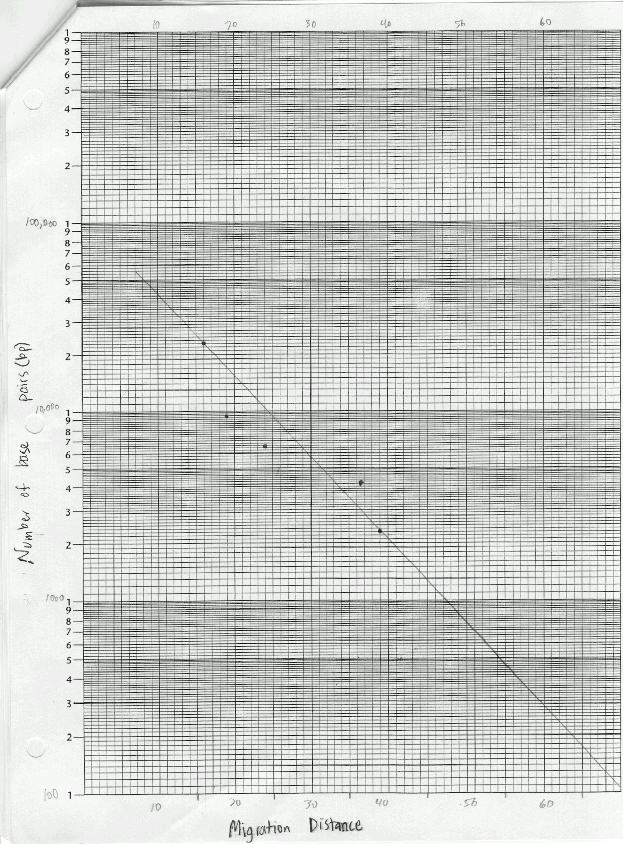
8. Below is a sample graph of possible data obtained for oxygen consumption by germinating peas up to about 8°C. Draw in predicted results through 45°C. Explain your prediction.

Oxygen Consumption will increase with temperature until the necessary enzymes become denatured.
9. What is the purpose of KOH in this experiment?
KOH combines with the CO2 and creates an insoluble precipitant.
10. Why did the vial have to be completely sealed around the stopper?
The vial had to be sealed so that when the volume of air in the vial decreased it would suction water into the pipette creating an observable change in the water position.
11. If you used the same experimental design to compare the rates of respiration of a 25g reptile and a 25g mammal, at 10°C, what results would you expect? Explain your reasoning.
The rate of respiration in the mammal would be greater than that of the reptile because the mammal keeps a constant body temperature while the body temperature of the reptile would be similar to that of its environment. Lower temperatures decrease the rate of cellular respiration.
12. If respiration in a small mammal were studied at both room temperature (21°C) and 10°C, what results would you predict? Explain your reasoning.
Respiration would be greater at 10°C because the animal would need more energy to sustain its normal body temperature.
13. Explain why water moved into the respirometers’ pipettes.
The volume of air in the vial was reduced when KOH combined with CO2 and water was then pulled in by the suction.
14. Design an experiment to examine the rates of cellular respiration in peas that have been germinating for 0, 24,48, and 72 hours. What results would you expect? Why?
Set up 5 respirometers containing beads, non-germinating peas, peas that have been germinating for 1 day, peas that have been germinating 2 days, and peas that have been germinating 4 days and measure the water displacement over 20 minutes. The peas that have been germinating the longest will have the highest rate of respiration and the lowest in the non-germinating peas.
Error Analysis:
Several errors could have occurred during this experiment. Some factors involved could have included inaccurate measurements of the water positions, variations in the water bath temperatures, possible leaks in the respirometers, and mathematical errors.
Discussion and Conclusion
This lab showed that cellular respiration rates are greater in germinating peas than in non-germinating peas. It also showed that respiration rates increase as temperature increases. The non-germinating peas showed very little oxygen consumption while the germinating peas had a high rate of oxygen consumption.