Tips and Advice on Growing Plants in Aquariums – What You Need to Know

We all know plants require sunlight, micro nutrients, macro nutrients and CO2 to grow healthy. However, very few know that there is an optimum amount for each to ensure a healthy growth for plants. If one is far less than the others, while growth may occur, it certainly wouldn’t be the healthiest way. Balance is the key here. If you’re planning to have plants in your aquarium to provide the best environment you can for your fishes, then you need to know more about this. Let’s break down these important factors:

Sunlight/Lighting

Light is an essential factor needed for chemical reactions to occur in plants without which, they wouldn’t be able to produce any food. The absence of light leads to the certain death for plants. To ensure the best possible growth for your plant, you need to know the correct spectrum of light that is required. Plants utilize light in the blue and red spectrum best for growth. However, as far as aesthetics are concerned, the full spectrum of light is what makes everything visually pop.

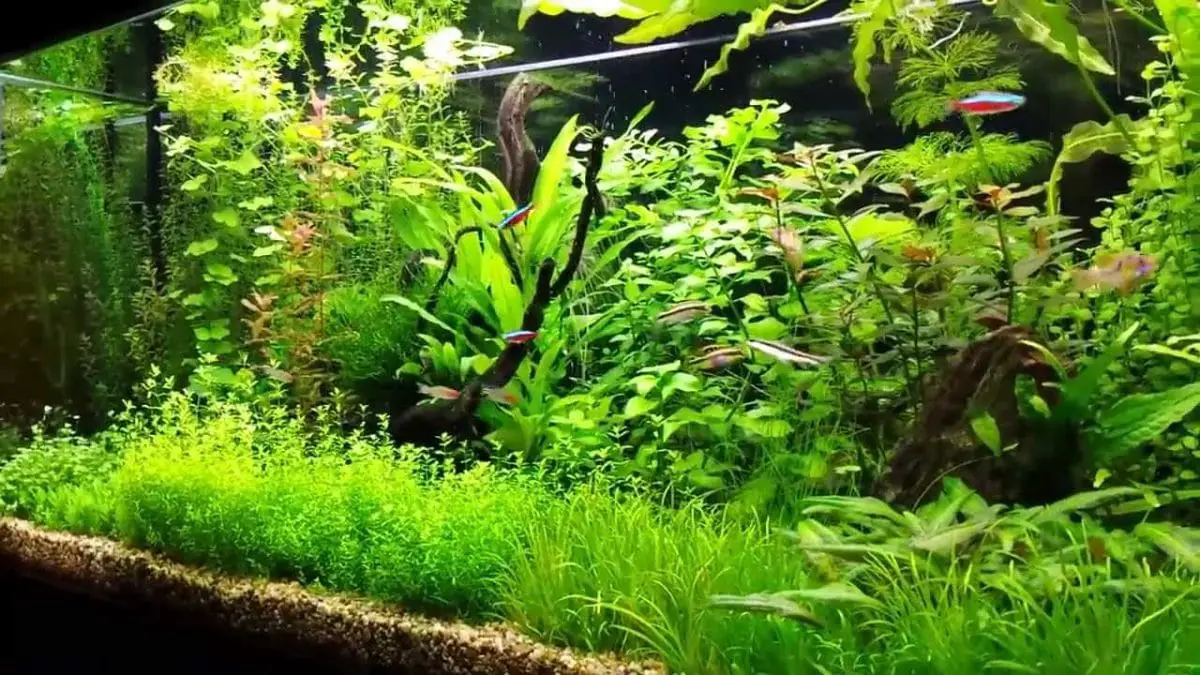
Plants Aquarium

While sunlight is optimal for plants on land, it might not be the best for plants in aquariums. While the full spectrum of sunlight may make your aquarium look good, most purists or hobbyists see it as having many disadvantages. The amount of light would either be too weak for the plants or short. It can also be very bad for fishes and plants alike if there are significant fluctuations in the light. Algae growth is yet another bad consequence of incorrect amount of light in aquariums. Considering all these facts, it is far more efficient and effective to use artificial lights for aquariums.

Full spectrum fluorescent light is one of the best ways to light up your aquarium. The amount of light required for optimum plant growth differs according to the density of plants in the aquarium. If the aquarium is sparely planted, then about 1.5w of light per every gallon of water is the recommended amount. If however, your aquarium is densely planted, then 3w to 5w per gallon would be optimum. In both cases, 10 to 12 hours of light supply is essential for encouraging and allowing healthy and efficient plant growth.

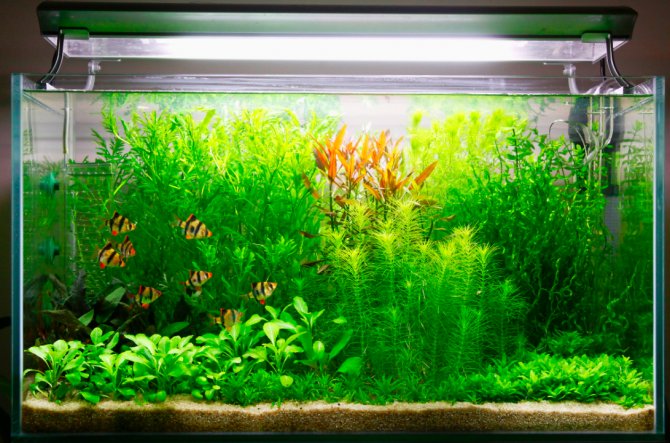
Aquarium

Carbon Dioxide

Co2 is another essential element required for plants to create food. During the process of photosynthesis, co2 is transformed into carbohydrate and used for plant growth. Aquariums that don’t have a good co2 source have about 1-3ppm of the gas but most plants flourish when there is about 10-20 ppm of co2 in the water. Co2 supplementation is very important for having an effective planted aquarium.

There are two different types of co2 setups for aquariums namely, a co2 tank and the DIY co2 reactor. The co2 tank is quite simple to use and it’s better for large aquariums, although it will get expensive in the long run. The DIY co2 reactor is made for smaller aquariums by combining yeast, sugar and water.

Macro Nutrients

Plants also require various nutrients in large amounts for their growth like Nitrogen, Potassium and Phosphorus.Excessive amounts of these nutrients will result in an undesirable growth of algae in the tank. So when providing nutrients to plants in your aquarium, remember moderation is the key. These elements also exist organically. For instance, Nitrogen is easily available and present in the form of ammonium from fish waste. Ammonium is actually very good for the plants because it actually takes less energy to use. Potassium and phosphorous on the other hand can be provided from external sources like fish food. Certain fertilizers also contain potassium and they can be added in small quantities.

Macro nutrients should be supplemented if your aquarium is densely planted or if you are growing medium and hard category plants since they require more nutrients.

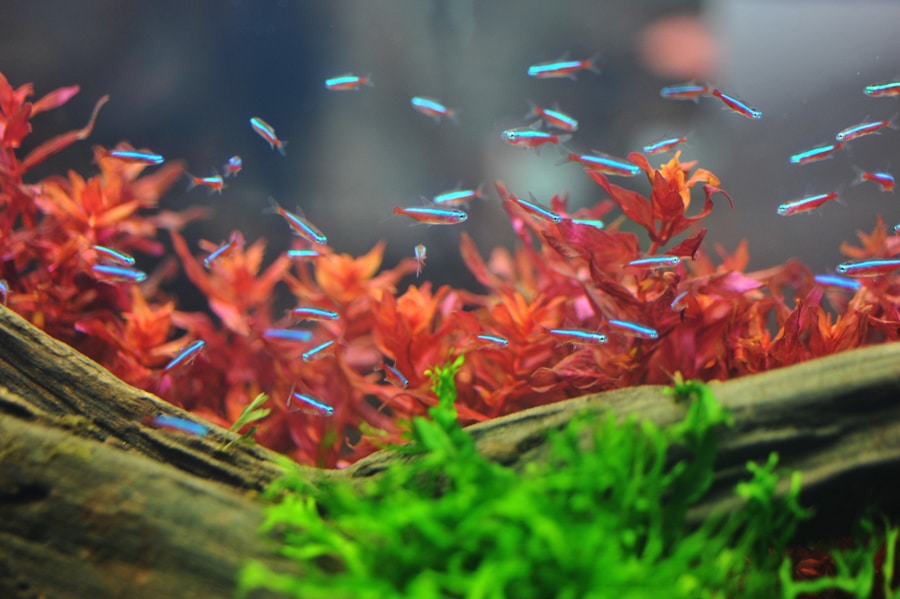
neon tetra

Micro Nutrients

M nutrients like iron, copper, zinc, sulphur, calcium and magnesium are some of the other essential ingredients needed. While iron is usually present in tap water, it usually gets oxidized to the limit where it becomes unusable for plants. One way to prevent it from happening is to use chelated iron mixtures which prevents the iron from oxidizing. The amount of iron in the water should be less than 0.2 ppm. Calcium and magnesium can also be found in tap water but it’s usually not enough so they should be added externally in small amounts. One very important thing to remember as far as micro nutrients are concerned is that they should be added only in very small amounts. Too much if it can lead to high toxicity in the water which will be very detrimental to the plant’s growth in the aquarium.

The final point in setting up an effective planted aquarium is to change water each week. This will not only remove extra fish waste but also get rid of any unwanted nutrients. Doing so will not only promote better growth but it also suppress algae growth. By informing yourself of key factors such as these, you will have no problem in maintaining a healthy environment for your fishes and plants.

Flat and Roundworms Study Guide

%CODE1%

Javascript not enabled

Name: 

Flat and Roundworms Quiz


Multiple Choice
Identify the choice that best completes the statement or answers the question.
 1.
Planarians can reproduce asexually by
a.
fission.
c.
producing polyps.
b.
forming larvae.
d.
exchanging both sperm and eggs.
 2.
Which of the following is not found in flatworms?
a.
an anterior end
c.
bilateral symmetry
b.
a circulatory system
d.
a nervous system
 3.
Flatworms have no need for circulatory and respiratory systems because
a.
the digestive system performs these functions.
b.
their cells are close to the animal’s exterior surface.
c.
the spherical body shape allows diffusion of materials into tissues.
d.
the coelom is bathed in blood and oxygen.
 4.
Schistosomiasis is a disease caused by a
a.
roundworm.
c.
cestode.
b.
trematode.
d.
planarian.
 5.
turbellarians : free-living ::
a.
planaria : parasitic
c.
cestodes : free-living
b.
tapeworms : free-living
d.
flukes : parasitic
 6.
Which of the following statements about tapeworms is false?
a.
They can infect a person who eats undercooked food.
b.
They belong to the genus Schistosoma.
c.
They can grow to be large in human intestines.
d.
They do not have a digestive system.
 7.
To which phylum do roundworms belong?
a.
Annelida
c.
Platyhelminthes
b.
Nematoda
d.
Arthropoda
 8.
Roundworms have a fluid-filled cavity called a
a.
coelom.
c.
digestive system.
b.
pseudocoelom.
d.
None of the above
 9.
Roundworms have a digestive tract with ____ opening(s).
a.
three
c.
one
b.
two
d.
no
 10.
All of the following groups of invertebrates are coelomates except
a.
annelids.
c.
mollusks.
b.
echinoderms.
d.
nematodes.
 11.
A roundworm’s digestive tract can be considered an advancement over a gastrovascular cavity because
a.
food moves through it in only one direction.
b.
different parts of the tract can carry out different functions.
c.
undigested wastes do not have to leave through the same opening where food is taken in.
d.
All of the above
 12.
The nematode Ascaris lumbricoides infects humans, spending most of its adult life inside the intestines of its host. To be infected, a person must
a.
consume the nematode’s eggs.
b.
walk barefoot on infested soil.
c.
sit on an infested toilet seat.
d.
All of the above
 13.
A type of roundworm that lives a parasitic life is
a.
Ascaris.
c.
Trichinella.
b.
Enterobius.
d.
All of the above
 14.
A rotifer uses ____ to collect excess water in order to remove the water from the body.
a.
diffusion
b.
kidneys
c.
flame cells and excretory tubules
d.
a mastax
 15.
Which of the following statements is not true?
a.
Most tapeworms are hermaphrodites.
b.
Planarians reproduce both sexually and asexually.
c.
Some rotifers reproduce by parthenogenesis.
d.
Because they are all parasitic, roundworms reproduce asexually.
 16.
Tapeworms absorb food from the host through their
a.
scolex.
c.
suckers.
b.
tegument.
d.
None of the above
 17.
Humans can avoid trichinosis by
a.
avoiding undercooked meat.
b.
avoiding public restrooms.
c.
wearing shoes outdoors.
d.
washing their hands frequently.
 18.
Which of the following has a cloaca?
a.
a fluke
c.
a rotifer
b.
a nematode
d.
a tapeworm
 19.
Parasitic flatworms
a.
probably evolved from free-living organisms.
b.
gave rise to free-living flatworms.
c.
have a gut with two openings.
d.
are found mostly in the class Turbellaria.
 20.
Which of the following is not true about the planarian nervous system?
a.
It includes a ladderlike arrangement of nerves.
b.
It provides the ability to sense light intensity.
c.
It includes one ventral nerve cord.
d.
It provides the ability to learn.
 

Completion
Complete each statement.
 21.
A schistosome is a member of the phylum ____________________.

 22.
The ability of some animals, such as flatworms, to regrow lost parts of their bodies is called ____________________.

 23.
Flatworms take up oxygen and release carbon dioxide by the process of ____________________, which occurs across the body surface of the animals.

 24.
The ____________________ is a protective cellular covering of the bodies of endoparasitic flukes that prevents them from being digested by their hosts.

 25.
____________________ are rectangular body sections of tapeworms.

 26.
Roundworms are members of the phylum ____________________.

 27.
Roundworms take in food through the mouth and eliminate wastes through an opening at the other end of the digestive tract called the ____________________.

 28.
Organisms that feed by using cilia to sweep food into their mouths are called ____________________.

 29.
____________________ are the simplest animals with bilateral symmetry.

 30.
Concentration of sense organs at the anterior end can be observed in flatworms and is called ____________________.

 31.
A planarian takes in food through the ____________________.

 32.
The ____________________ is a noncellular layer that protects a roundworm.

 33.
Being infected with ____________________ worms can cause a condition known as elephantiasis.


Essay
 34.
A planarian cannot eat when food is already in its gut. Why? Write your answer in the space below.


Check Your Work     Start Over

Taxonomy Study Guide

%CODE1%

Javascript not enabled

Name: 

Taxonomy Quiz


Modified True/False
Indicate whether the statement is true or false.  If false, change the identified word or phrase to make the statement true.
 1.
Scientists use taxonomy to determine the evolutionary history of organisms. _________________________


 2.
Taxonomy provides consistent ways to name organisms. _________________________


 3.
Scientific names of organisms consist of two English terms. _________________________


 4.
Two different organisms cannot have the same scientific name. _________________________


 5.
Genus is the basic biological unit in the Linnaean system of classification. _________________________


 6.
A genus is a taxonomic category that contains several families. _________________________


 7.
Under the Linnaean system of classification, organisms are grouped on the basis of similarities in structure. _________________________


 8.
Linnaeus devised eight levels of classification categories for living things. _________________________


 9.
The least inclusive group to which an organism can be assigned is its kingdom. _________________________


 10.
Kingdoms are subgroups of phyla. _________________________


 11.
A species is a larger taxonomic group than a genus. _________________________


 12.
Bird wings and insect wings are examples of analogous structures. _________________________


 13.
Organisms that have similar traits but evolved independently are the result of convergent evolution. _________________________


 14.
Cladistics is used to determine the sequence in which different groups of organisms evolved. _________________________


 15.
In modern systematics, studies of the changes in the skeletons of vertebrates have helped researchers to estimate the time at which each species began to evolve. _________________________


 16.
Comparing the sequence of DNA bases in the genes of several organisms is used to determine the order in which the organisms evolved. _________________________


 17.
All organisms in the kingdom Animalia are multicellular heterotrophs whose cells lack cell walls. _________________________


 18.
Archaea are eukaryotes that are characterized by several unique biochemical characteristics. _________________________


 19.
Traditionally, bacteria have been classified on the basis of their shape, cell wall composition, and metabolism. _________________________


 20.
Most organisms in the kingdoms Plantae and Animalia are multicellular. _________________________


Multiple Choice
Identify the choice that best completes the statement or answers the question.
 21.
Taxonomy is
a.
the study of life.
b.
the science of naming and classifying organisms.
c.
the evolutionary history of a species.
d.
the sequence in which different groups evolved.
 22.
An advantage of our scientific naming system is that
a.
common names mean the same in all countries.
b.
Latin names are easy to pronounce.
c.
biologists can communicate regardless of their native languages.
d.
organisms all have the same scientific name.
 23.
All scientific names of organisms must be
a.
unique and have two Latin words.
b.
general and use the species name.
c.
different and repeat the phylum name.
d.
similar and include the common name.
 24.
Linnaeus’s two-word system for naming organisms is called
a.
taxonomic evolution.
c.
Greek polynomials.
b.
Genus species.
d.
binomial nomenclature.
 25.
In the Linnaean system of classification, the level that identifies one unique organism is the
a.
kingdom.
c.
genus.
b.
family.
d.
species.
 26.
The largest division that a group of organisms can belong to is a
a.
domain.
c.
genus.
b.
class.
d.
kingdom.
 27.
Placement in each level of classification is based on
a.
specific characteristics.
c.
shared characteristics.
b.
general characteristics.
d.
different characteristics.
 28.
Similar genera are grouped into a(n)
a.
phylum.
c.
family.
b.
class.
d.
order.
 29.
Analogous structures
a.
have a common size in organisms.
b.
perform the same function in organisms.
c.
have the same structure in organisms.
d.
evolve from a common ancestor.
 30.
Traditional systematics emphasizes the importance of
a.
derived characteristics.
c.
similar characteristics.
b.
unique characteristics.
d.
compared characteristics.
 31.
Similar features that evolve through convergent evolution are called
a.
analogous characters.
c.
environmental characters.
b.
homologous characters.
d.
genetic characters.
 32.
Convergent evolution produces analogous characters in different species as the result of
a.
similar environments.
c.
sharing a common ancestor.
b.
different environments.
d.
shared derived characters.
 33.
A phylogenetic tree differs from a cladogram in that a phylogenetic tree
a.
hypothesizes the time at which each group of organisms evolved.
b.
also indicates the new characteristics that evolved with each group of organisms
c.
only illustrates hypothesized relationships among groups of organisms.
d.
predicts the next group of organisms that is expected to evolve.
 34.
Studies of fossils of dinosaurs and birds show that
a.
feathers may not be an important difference between dinosaurs and birds.
b.
dinosaurs can be considered to be modern descendents of birds.
c.
the anatomies of the dinosaurs and birds are unrelated.
d.
dinosaurs and birds share many analogous characters.
 35.
A model used by biologists to represent evolutionary history among species is called a
a.
phylogram.
c.
histogram.
b.
cladogram.
d.
parallelogram.
 36.
Derived characters are traits
a.
that are shared by all species.
b.
that originated in a common ancestor.
c.
found in closely related species.
d.
found in distantly related species.
 37.
During Linnaeus’ time, scientists divided all living organisms into
a.
five phyla.
c.
three domains.
b.
four families.
d.
two kingdoms.
 38.
Sponges are animals that were once classified as
a.
bacteria.
c.
plants.
b.
fungi.
d.
protists.
 39.
Which of the following characteristics was used to reclassify sponges?
a.
body type
c.
cell walls
b.
cell type
d.
nutrition
 40.
The kingdoms Eubacteria and Archaebacteria were once grouped in a kingdom called
a.
Protista.
c.
Monera.
b.
Animalia.
d.
Plantae.
 41.
Four of the kingdoms include eukaryotes and the other two include
a.
plants.
c.
animals.
b.
fungi.
d.
prokaryotes.
 42.
Which of the following is not a characteristic used to differentiate kingdoms?
a.
cell type
c.
nutrition
b.
root system
d.
body type
 43.
Protista is an example of a
a.
kingdom.
c.
genus.
b.
class.
d.
species.
 44.
Which two kingdoms contain both unicellular and multicellular organisms?
a.
Archaea and Animalia
c.
Animalia and Fungi
b.
Protists and Bacteria
d.
Protista and Fungi
 45.
One difference between plants and animals is that plants are
a.
prokaryotic and animals are eukaryotic.
b.
eukaryotic and animals are prokaryotic.
c.
autotrophs and animals are heterotrophs.
d.
heterotrophs and animals are autotrophs.
 

Completion
Complete each statement.
 46.
The current system used for naming organisms was developed by ____________________.

 47.
The two-word system for naming organisms is called _________________________.

 48.
The scientific name of an organism gives biologists a common way of ____________________ regardless of their native languages.

 49.
All names assigned to organisms under the Linnaean system are in the ____________________ language.

 50.
The unique two-word name for a species is its ____________________ name.

 51.
All living things are grouped into one of three ____________________.

 52.
There are ____________________ levels of classification in the modern classification system.

 53.
A kingdom contains many ____________________.

 54.
Classes with similar characteristics are assigned to a(n) ____________________.

 55.
Each level of classification is based on ____________________ shared by all the organisms it contains.

 56.
Homo habilis, Homo erectus, and Homo sapiens all belong to the same ____________________.

 57.
Traditionally, scientists have used differences in appearance and ____________________ to classify organisms.

 58.
Unlike cladistics, traditional systematics places more ____________________ on some traits than on others.

 59.
Analogous structures are found in ____________________ taxa as a result of similar environmental conditions.

 60.
The type of evolution that results in similar characteristics found in different organisms as the result of selection within similar environments is called ____________________ evolution.

 61.
The evolutionary history of a species is called its ____________________.

 62.
Shared derived characters are found in organisms that once shared a(n) ____________________ ancestor.

 63.
A method of analysis that reconstructs phylogenies by inferring relationships based on shared characteristics is called ____________________.

 64.
A model developed by systematists that uses shared derived characters to show the evolutionary history of different organisms is called a(n) ____________________.

 65.
Cladistics is used to determine the ____________________ in which different groups of organisms evolved.

 66.
Animals that appear early on a cladogram do not share as many of the same ____________________ traits as the animals that appear later on the cladogram.

 67.
Modern systematic biologists use the ____________________ rate of DNA mutations like a “molecular clock.”

 68.
Bacteria have strong exterior cell walls made of ____________________.

 69.
An organism made of many cells that are permanently associated and that coordinate their activities is called a(n) ____________________ organism.

 70.
Eukaryotes that are not fungi, plants, or animals are called ____________________.


Check Your Work     Start Over

Quiz Homeostasis

%CODE1%

Javascript not enabled

Name: 

Homeostasis


True/False
Indicate whether the sentence or statement is true or false.
1.
Diffusion is an active process that requires a cell to expend a great deal of energy.
2.
During diffusion, molecules diffuse from a region where their concentration is low to a region where their concentration is higher until they are evenly dispersed.
3.
A cell placed in a strong salt solution would probably burst because of an increase in osmotic pressure.
4.
When the concentration of solutes outside the cell is equal to the concentration of solutes inside the cell, the cell solution is isotonic relative to its environment.
5.
Diffusion occurs only in living systems.
6.
The transport of specific particles through a membrane by carrier proteins is known as facilitated diffusion.
7.
Ion channels are usually able to transport only one type of ion.
8.
Facilitated diffusion moves molecules and ions in one direction only, while active transport moves them in two directions.
9.
In active transport, energy is required to move a substance across a cell membrane.
10.
Both the sodium-potassium pump and the proton pump require energy to move particles across the cell membrane.
11.
The sodium-potassium pump moves sodium and potassium ions against the concentration gradient.
12.
Exocytosis helps the cell rid itself of wastes.
13.
During the process of exocytosis, the cell membrane extends to engulf substances that are too big to pass through the cell membrane.
 

Completion
Complete each sentence or statement.
14.
Active transport systems are a form of cell transport that requires energy from molecules of ____________________.

15.
____________________ allows a cell to stockpile substances in far greater concentrations than they occur outside the cell.

16.
The transport of food into cells involves the action of the sodium-potassium pump and ____________________ channels.

      quiz_homeostasis_files/i0190000.jpg
                  A                                    B
17.
Refer to the illustration above. The process shown in figure “B” is called ____________________.

18.
Refer to the illustration above. Cells often trap extracellular particles and fluid. This is shown in figure ____________________.

19.
The process in which an amoeba engulfs its prey and takes it in is known as ____________________.


Check Your Work     Reset