

| Summer Assignments #1Choose a book or a movie by Robin Cook to read or view. Dr Robin Cook is considered to be the master of the medical thriller! Sometimes his books are classified as science fiction and sometimes as horror. He does an enormous amount of research so all of his books contain good, exciting biology. After reading the book (preferably) or viewing the video, write a 3-4 page paper giving a summary and a critique of the book or video . Be sure to emphasis the biological aspect and write in third person. #2 Contact a research scientist or field biologist in our area and conduct an interview about their current research. Using your interview notes, write a newspaper article about this scientist. Include a picture of the scientist with your article for bonus points! The two assignments will each count as a test grade and are due the first week of school.
|
Taxonomy
All Materials © Cmassengale
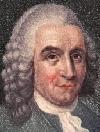
Carolus Linnaeus
Taxonomy – study of classifying organisms
Reasons to Classify:
Early Taxonomy:
Taxonomic categories:

Basis for Modern taxonomy:

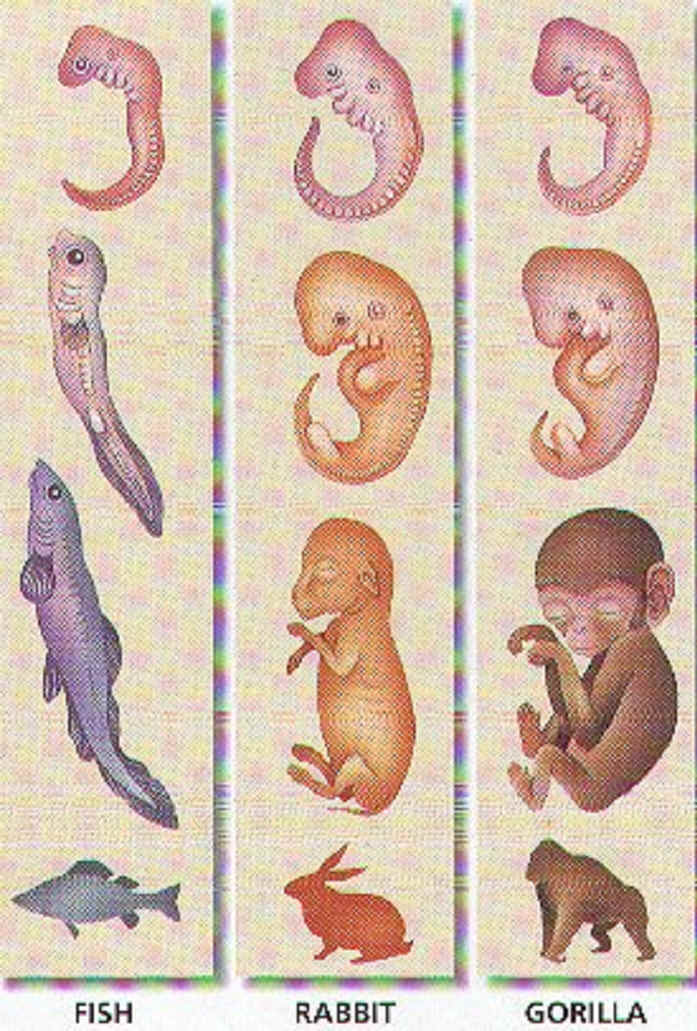
Modern Taxonomic System:
Phylogeny (evolutionary history):


Three Domain System:

Taxonomy
ppt Questions
Classification
1. How many known species are there?
2. What percent of all organisms that have ever lived is this?
3. Are all organisms on Earth today identified?
4. Define classification.
5. What is another term for classification?
6. What do you call scientists that study classification?
7. Classifying organisms makes naming organisms more _____________ and _____________.
8. Classifying prevents ____________ or inaccurate naming.
9. Give two examples of misnomers and explain why they aren’t correct.
10. What language is used for scientific naming?
11. Sometimes, scientific names may be ___________ instead of Latin.
12. Why don’t scientists around the world just use more simple, common names for organisms?
13.What language is universally used by scientists for naming?
14. Who was the first taxonomist and what two groups did he place organism in?
15. How did Aristotle subdivide his two groups?
16. Who was first to use Latin for scientific naming?
17. What was the problem with Ray’s names?
18. What 18th century taxonomist developed the naming system still used today?
19. How did Linnaeus group his organisms?
20. Who is the “father of taxonomy”?
Binomial Nomenclature
21. What is Linnaeus’s naming system called?
22. Explain binomial nomenclature.
23. Besides Latin, what other language is sometimes used for scientific names?
24. How do scientific names appear in print?
25. What must be done to a scientific name when you are writing it?
26. Give an example of a common and scientific name for an animal.
27. Where can you find the rules for naming organisms?
28. All scientific names must be approved by ________________ ___________ ______________.
29. Why do naming congresses have to approve names?
Taxonomic Groups
30. What is a taxon?
31. What is plural for taxon?
32.There is a ______________ of groups that goes from the broadest grouping to the most _____________ grouping.
33. Name the 8 taxon in order from broadest to most specific.
34. What is the NEWEST and BROADEST taxon?
35. Instead of the taxon phylum, what other taxon is used for plants at this level?
36. What is the most specific taxon?
37. Write the sentence used to help remember the 8 most important taxonomic levels.
38. Complete the following taxonomic table:
| Classification for Humans | |
| Taxonomic Level | Taxon |
| Domain | |
| Kingdom | |
| Phylum | |
| Class | |
| Order | |
| Family | |
| Genus | |
| Species | |
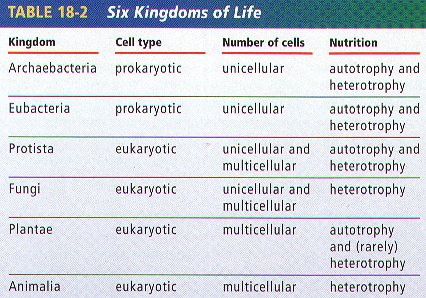
Domains of Organisms
39. How many domains are there?
40. Name the 3 Domains.
41. What are the main characteristics of Archaea and Eubacteria?
42. What are the main characteristics of the Domain Eukarya?
43. What Domain of organisms probably evolved first?
44. Where do Archaea live? Give some examples.
45.Name an Archaean.
46. Where are eubacteria found?
47. Some bacteria cause ______________ but many act as decomposers & are important to the ______________.
48. Some members of eubacteria live in the __________ of animals.
Kingdoms
49. The Domain Eukarya is divided into how many kingdoms?
50. List the 4 kingdoms of Eukarya and tell what organisms are in each group.
51. Which 2 kingdoms contain all multicellular members?
52. List the main characteristics of the Kingdom Protista.
53. Microscopic organisms found in pond water are most likely in the kingdom _______________.
54. All members of the Kingdom Fungi are _____________ except for unicellular ____________.
55. What type of heterotrophic organism are fungi?
56. Explain what it means to be an absorptive heterotrophic.
57. The cell walls of fungi are made of ______________.
58. Members of the kingdom Plantae are all ________________ and _____________.
59. What do plants use as their energy to make food?
60. Name the food making process of plants.
61. Plant cell walls are made of _______________.
62. Members of the Kingdom Animalia contain all of the multicellular _____________ on Earth.
63. Animals are ______________ heterotrophs that feed on __________ or other __________.
64. Define ingestive heterotroph.
65. Complete the following table for characteristics of each kingdom:
| Kingdom | Organization | Type of Nutrition | Examples |
| Protista | |||
| Fungi | |||
| Plantae | |||
| Animalia |
66. A Genera may contain a number of different ___________.
67. What Genera is an exception to this?
68. Which Kingdom has the largest number of different kinds of organisms?
69. What two groups are in the plant kingdom?
Basis for Modern Taxonomy
70. List three examples of things used as a basis for modern taxonomy.
a.
b.
c.
71. What are homologous structures?
72. What is an embryo?
73. At the molecular level, similarities in ___________, __________, or the __________ __________ sequence of proteins can be a basis for grouping organisms together.
74. Give an example of homologous structures show similarities among organisms in the same taxon.
75. Name 5 organisms that have similar embryonic development. To what taxon do these organisms belong?
76. What is a cladogram?
77. Using the following cladogram, name the organisms that share 4 of the 5 characteristics.

78. What characteristic(s) do the grouper and lamprey share?
79. What characteristic is found in all the animals EXCEPT the lancelet?
80. What is a dichotomous key?
81. When using a dichotomous key, you should make sure you ___________ both characteristics and either ____________ the organism OR go to ____________ set of characteristics.
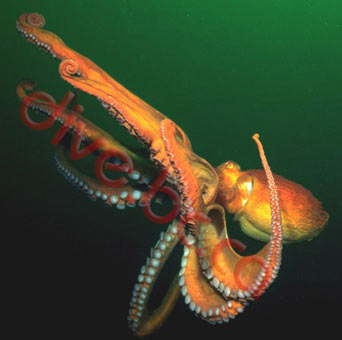
82. Use the following dichotomous key to identify the picture of each organism.
|
1a Tentacles present – Go to 2
1b Tentacles absent – Go to 6
2a Eight Tentacles – Octopus
2b More than 8 tentacles – 3
3a Tentacles hang down – go to 4
3b Tentacles upright–Sea Anemone
4a Balloon-shaped body–Jellyfish
4b Body NOT balloon-shaped – 5
|
 |
 |
 |
Transpiration

Introduction:
The amount of water needed daily by plants for the growth and maintenance of tissues is small in comparison to the amount that is lost through the process of transpiration and guttation. If this water is not replaced, the plant will wilt and may die. The transport up from the roots in the xylem is governed by differences in water potential ( the potential energy of water molecules). These differences account for water movement from cell to cell and over long distances in the plant. Gravity, pressure, and solute concentration all contribute to water potential and water always moves from an area of high water potential to an area of low water potential. The movement itself is facilitated by osmosis, root pressure, and adhesion and cohesion of water molecules.
The overall process: Minerals actively transported into the root accumulate in the xylem, increase solute concentration and decrease water potential. Water moves in by osmosis. As water enters the xylem, it forces fluid up the xylem due to hydrostatic root pressure. But this pressure can only move fluid a short distance. The most significant force moving the water and dissolved minerals in the xylem is upward pull as a result of transpiration, which creates a negative tension. The “pull” on the water from transpiration is increased as a result of cohesion and adhesion of water molecules.
The details: Transpiration begins with evaporation of water through the stomates (stomata), small openings in the leaf surface which open into air spaces that surround the mesophyll cells of the leaf. The moist air in these spaces has a higher water potential than the outside air, and water tends to evaporate from the leaf surface. The moisture in the air spaces is replaced by water from the adjacent mesophyll cells, lowering their water potential. Water will then move into the mesophyll cells by osmosis from surrounding cells with the higher water potentials including the xylem. As each water molecule moves into a mesophyll cell, it exerts a pull on the column of water molecules existing in the xylem all the way from the leaves to the roots. This transpirational pull is caused by (1) the cohesion of water molecules to one another due to hydrogen bond formation, (2) by adhesion of water molecules to the walls of the xylem cells which aids in offsetting the downward pull of gravity. The upward transpirational pull on the fluid in the xylem causes a tension (negative pressure) to form in the xylem, pulling the xylem walls inward. The tension also contributes to the lowering of the water potential in the xylem. This decrease in water potential, transmitted all the way from the leaf to the roots, causes water to move inward from the soil, across the cortex of the root, and into the xylem. Evaporation through the open stomates is a major route of water loss in the plant. However, the stomates must open to allow the entry of CO2 used in photosynthesis. Therefore, a balance must be maintained between the gain of CO2 and the loss of water by regulating the opening and closing of stomates on the leaf surface. Many environmental conditions influence the opening and closing of the stomates and also affect the rate of transpiration. Temperature, light intensity, air currents, and humidity are some of these factors. Different plants also vary in the rate of transpiration and in the regulation of stomatal opening.
Exercise 9A Transpiration
In this lab, you will measure transpiration under various laboratory conditions using a potometer. Four suggested plant species are Coleus, Oleander, Zebrina, and two week old bean seedlings.
Materials:
0.1 mL pipette, plant cutting, ring stand, clamps, clear plastic tubing, petroleum jelly, fan, lamp, spray bottle, and plastic bag.
Procedures:
Each lab group will expose one plant to one treatment.
1. Place the tip of a 0.1 mL pipette into a 16 -inch piece of clear plastic tubing.
2. Submerge the tubing and the pipette in a shallow tray of water. Draw water through the tubing until all the air bubbles are eliminated.
3. Carefully cut your plant stem under water. This step is very important, because no air bubbles must be introduced into the xylem.
4. While your plant and tubing are submerged, insert the freshly cut stem into the open end of the tubing.
5. Bend the tubing upward into a “U” and use the clamp on a ring stand to hold both the pipette and the tubing.

6. If necessary use petroleum jelly to make an airtight seal surrounding the stem after it has been inserted into the tube. Do not put petroleum jelly on the end of the stem.
7. Let the potometer equilibrate for 10 minutes before recording the time zero reading.
8. Expose the plant in the tubing to one of the following treatments( you will be assigned a treatment by your teacher):
a). Room conditions.
b). Floodlight (over head projector light).
c). Fan ( place at least 1 meter from the plant, on low speed, creating a gentle breeze).
d). Mist ( mist leaves with water and cover with a transparent plastic bag; leave the bottom of the bag open).
9. Read the level of water in the pipette at the beginning of your experiment(time zero) and record your finding in Table 9.1.
10. Continue to record the water level in the pipette every 3 minutes for 30 minutes and record the data in Table 9.1.
Table 9.1: Potometer Readings
| Time (min) | Beginning (0) | v3ss | fff6ff | 9 | 12 | 15 | 18 | 21 | 24 | 27 | 30 |
| Reading (mL) | 4nnnnnnn | 4nnnnnn | nnnn4 |
11. At the end of your experiment, cut the leaves off the plant and mass them. Remember to blot off all excess water before massing.
Mass of leaves ______________ grams.
Calculation of Leaf Surface Area
The total surface area of all the leaves can be calculated by using one of the following procedures.
__________________ = Leaf Surface Area (m2)
Leaf Trace Method:
After arranging all the cut-off leaves on the grid below, trace the edge pattern directly on to the grid. Count all of the grids that are completely within the tracing and estimate the number of grids that lie partially within the tracing. The grid has been constructed so that a square of four blocks equals 1 cm2. The total surface area can then be calculated by didvding the total number of blocks covered by 4. Record the value above.
Grid 9.1

Leaf Mass Method:
12. Water lost per square meter: To calculate the water loss per square meter of leaf surface, divide the water loss at each reading (Table 9.1) by the leaf surface area you calculated.
Table 9.2: Individual Water Loss in mL /m2
| Time Intervals ( minutes) | ||||||||||
| s | 0-3 | 3-6 | 6-9 | 9-12 | 12-15 | 15-18 | 18-21 | 21-24 | 24-27 | 27-30 |
| Water Loss (mL) | ||||||||||
| Water loss per m2 | ||||||||||
13. Record the averages of the class data for each treatment in Table 9.3.
Table 9.3: Class Average Cumulative Water Loss in mL /m2
| Time ( minutes) | |||||||||||
| Treatment | 0 | 3 | 6 | 9 | 12 | 15 | 18 | 21 | 24 | 27 | 30 |
| Room | 0 | ||||||||||
| Light | 0 | ||||||||||
| Fan | 0 | ||||||||||
| Mist | 0 | ||||||||||
14. For each treatment, graph the average of the class data for each time interval. You may need to convert data to scientific notation. All numbers must be reported to the same power of ten for graphing purposes.
Graph Title________________________________________
Graph 9.1
Analysis of Results:
1. Calculate the average rate of water loss per minute for each of the treatments:
Room: ______________________________________________________________________
Fan: _______________________________________________________________________
Light: _______________________________________________________________________
Mist: _______________________________________________________________________
2. Explain why each of the conditions causes an increase or decrease in transpiration compared to the control.
| Conditions | Effect | Reasons |
| Room | ||
| Fan | ||
| Light | ||
| Mist |
3. How did each condition affect the gradient of water potential from stem to leaf in the experimental plant?
_______________________________________________________________________
_______________________________________________________________________
_______________________________________________________________________
_______________________________________________________________________
4. What is the advantage to a plant of closed stomata when water is in short supply? What are the disadvantages?
_______________________________________________________________________
_______________________________________________________________________
_______________________________________________________________________
_______________________________________________________________________
5. Describe several adaptations that enable plants to reduce water loss from their leaves. Include both structural and physiological adaptations.
_______________________________________________________________________
_______________________________________________________________________
_______________________________________________________________________
_______________________________________________________________________
6. Why did you need to calculate leaf surface area in tabulating your results?
________________________________________________________________________
________________________________________________________________________
________________________________________________________________________
________________________________________________________________________
