Biology Quizzes


Practice Quizzes     biology quiz

Use the following online quizzes to review each topic covered in Biology. Some topics have two biology tests each, so try them both!
When you get all answers correct, email me your page along with your name and class period.

All Materials © Cmassengale

Biology Test

Introduction to Biology   Photosynthesis Flat & Round Worms
Worms (harder)
Introduction to Biology (harder)

Introduction to Biology (hardest)

Photosynthesis & Cell Respiration Annelids
Mollusks & Annelids (harder)
Chemistry

Chemistry (Harder)

Cellular Respiration
Mollusks
Biochemistry Cell Reproduction Arthropods
Biochemistry (harder)

Biochemistry (hardest)

DNA
Nucleic Acids (harder)
Insects
Cells Protein Synthesis
Protein Synthesis (hardest)
Echinoderms
Cells (a little harder) Evolution Introduction to Animals
Cells (hardest)

Cells (I’m ready for the test!)

Evolution (harder) Fish
Diffusion Taxonomy
Taxonomy (harder)
Taxonomy (hardest)
Amphibians
Homeostasis & Transport
Cell Membrane & Transport (hardest)
   Bacteria
Bacteria (harder)
Reptiles
Cell Reproduction Protists
Protists (harder)
      Birds        
Meiosis Viruses
Viruses (harder)
Mammals
Genetics Mosses & Ferns
Introduction to Plants
Ecology
Genetics (harder)
Genetics (hardest)
Seed Plants
Seed Plants (harder)
Ecology (harder)
Safety Sponges & Cnidarians
Sponges & Cnidarians (harder)
Graphing

qz bacteria

Random Sampling

Random Sampling

Introduction

Scientists cannot possibly count every organism in a population. One way to estimate the size of a population is to collect data by taking random samples. If you survey every person or a whole set of units in a population you are taking a census. However, this method is often impracticable; as it’s often very costly in terms of time and money. For example, a survey that asks complicated questions may need to use trained interviewers to ensure questions are understood. This may be too expensive if every person in the population is to be included.

Sometimes taking a census can be impossible. For example, a car manufacturer might want to test the strength of cars being produced. Obviously, each car could not be crash tested to determine its strength!
To overcome these problems, samples are taken from populations, and estimates made about the total population based on information derived from the sample. A sample must be large enough to give a good representation of the population, but small enough to be manageable. Data obtained by random sampling can be compared to data obtained by actual counts. By comparing data from random sampling to the actual count, you can compute the percentage error to determine the accuracy of the random sampling.

Objective
The size of a population can be determined using the random sampling method.

Materials
Pencil
Scissors
Sheet of paper
2 envelopes

Procedure

  1. Tear a sheet of paper into 20 slips, each approximately 4cm x 4 cm.
  2. Number 10 of the slips from 1 to 10 and put them in an envelope.
  3. Label the remaining 10 slips from A through J and put them in a second envelope.
  4. Use the grid below for you random and actual counts. The grid represents a meadow measuring 10 meters on each side. Each grid segment is 1m x 1m. Each black circle represents one sunflower plant.
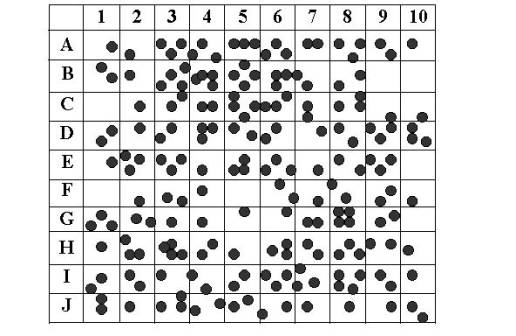
  1. Randomly remove one slip from each envelope. Write down the number-letter combination and find the grid segment that matches the combination. Count the number of sunflower plants in that grid segment. Record this number on Data table 1.  Return each slip to its appropriate envelop.
  2. Repeat step 5 until you have data for 10 different grid segments (and the table is filled out). These 10 grid segments represent a sample. Gathering data from a randomly selected sample of a larger area is called sampling.
  3. Find the total number of sunflower plants for the 10 segment sample. This is an estimation based on a formula. Add all the grid segment sunflowers together and divide by ten to get an AVERAGE number of sunflower plants per grid segment. Record this number in the table.    Multiple the average number of sunflower plants by 100 (this is the total number of grid segments) to find the total number of plants in the meadow based on your sample. Record this number in Data Table 1.
  4. Now count all the sunflower plants actually shown in the meadow.  Record this number in Data Table 2.  Divide this figure by 100 to calculate the average number of sunflower plants per each grid.

Data Table 1 


Random Sampling Data

Grid Segment
(number-letter)
Number of
Sunflowers
Total Number of
Sunflowers
Average per grid
(divide total by 10)
Total number of plants in meadow
(multiply average by 100)


Data Table 2


Actual Data

Total number of Sunflowers
(count by hand)
Average number of Sunflowers
(divide total by 10)
Per grid


Questions

1. Compare the total number you got for sunflowers from the SAMPLING to the ACTUAL count.  How close are they?


2. Why was the paper-slip method used to select the grid segments?


3. Why do biologists use Sampling?   Why can’t they just go into the forest and count all the sunflower plants?


4. Population Sampling is usually more effective when the population has an even dispersion pattern. Clumped dispersion patterns are the least effective.  Explain why this would be the case.


5. Describe how you would use Sampling to determine the population of dandelions in your yard.


6. In a forest that measures 5 miles by 5 miles, a sample was taken to count the number of silver maple trees in the forest. The number of trees counted in the grid is shown below. The grids where the survey was taken were chosen randomly. Determine how many silver maple trees are in this forest using the random sampling technique. Show your work!


 

7
3
5
11 9


Reptile


Reptiles All Materials © Cmassengale  


Evolution of  Reptiles:

  • Reptiles were 1st vertebrates to make a complete transition to life on land (more food & space)
  • Arose from ancestral reptile group called cotylosaurs (small, lizard like reptile)
  • Cotylosaurs adapted to other environments in Permian period
    1. Pterosaurs – flying reptiles
    2. Ichthyosaurs & plesiosaurs – marine reptiles
    3. Thecodonts – small, land reptiles that walked on back legs
  • Mesozoic Era called “age of reptiles”

  • Dinosaurs dominated life on land for 160 million years
  • Brachiosaurs were largest dinosaurs
  • Herbivores included Brontosaurus & Diplodocus, while Tyrannosaurus were carnivores
  • Dinosaurs became extinct at end of Cretaceous period 
  • Mass extinction of many animal species possibly due to impact of huge asteroid with earth; Asteroid Impact Theory
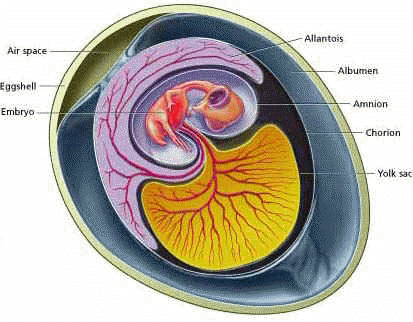
  • Amniote (shelled) egg allowed reptiles to live & reproduce on land

Amniote Egg:

  • Egg had protective membranes & porous shell enclosing the embryo
  • Has  4 specialized membranes — amnion, yolk sac, allantois, & chorion
  • Amnion is a thin membrane surrounding a salty fluid in which the embryo “floats”
  • Yolk sac encloses the yolk or protein-rich food supply for embryo
  • Allantois stores nitrogenous wastes made by embryo until egg hatches
  • Chorion lines the inside of the shell & regulates oxygen & carbon dioxide exchange
  • Shell leathery & waterproof
  • Internal fertilization occurs in female before shell is formed

Section 1 Review

Terrestrial Adaptations:

  • Dry, watertight skin covered by scales made of a protein called keratin to prevent desiccation (water loss)
  • Toes with claws to dig & climb
  • Geckos have toes modified into suction cups to aid climbing
  • Snakes use scales & well developed muscular & skeletal systems to move
  • Lungs for respiration
  • Double circulation of blood through heart to increase oxygen to cells
  • Partial separation in ventricle to separate oxygenated & deoxygenated blood
  • Ectothermic – body temperature controlled by environment
  • May bask or lie in sun to raise body temperature or seek shade to lower body temperature; known as thermoregulation
  • Water conserved as nitrogen wastes excreted in dry, paste like form of uric acid crystals

Section 2 Review

Modern Reptiles:

  • Only 4 living orders remain
  • Found worldwide except in coldest ecosystems
  • Orders include —– Rhyncocephalia (tuatara lizard), Chelonia (turtles & tortoises), Squamata (lizards & snakes), & Crocodilia (alligators, caimans, and crocodiles)

Rhyncocephalia:

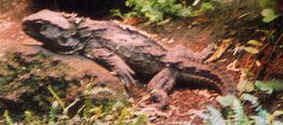
  • Only one living species, Spenodon punctatus, (tuatara lizard)
  • Live on islands off the coast of New Zealand

Tuatara
Tuatara

  • Spiny crest running down back
  • Grows up to 60 cm in length
  • Has 3rd eye on top of head (parietal eye) that acts as a thermostat
  • Most active when temperatures are low (nocturnal)
  • Often burrow during the day
  • Feed on insects, worms, & small animals at night

Chelonia:

  • Includes turtles and tortoises
  • Aquatic, but lay eggs on land
  • Body covered with shell composed of hard plates & tough, leathery skin
  • Carapace or dorsal surface of shell fused with vertebrae & ribs
  • Plastron is ventral shell surface
  • Shape of shell modified for habitat
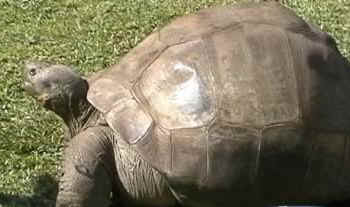
  • Dome shaped shell helps to retract head & limbs in tortoises
CLICK TO RETURN
Galapagos Tortoise
  • Water-dwelling turtles have streamline, disk shaped shell to rapidly move in water

spotted turtle photograph
Spotted Turtle

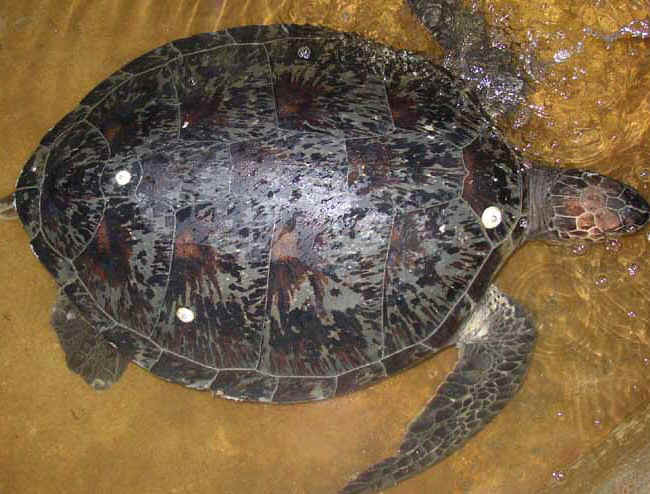
  • Forelimbs of marine turtles modified into flippers

Green Turtle found on Guernsey 1/2003 (Photograph © by Richard Lord, Guernsey)
Marine Turtle

  • River & sea turtles migrate to breeding areas where they hatched to lay their eggs on land

Crocodilia:

  • Includes crocodiles, alligators, caimans, & gavials
  • Direct descendants of Archosaurs
  • Carnivorous (wait for prey to come near & then aggressively attack)
  • Eyes located on top of head so they can see when submerged
  • Nostrils on top of snout to breathe in water
  • Valve in back of mouth prevents water from entering airway when feeding underwater
  • No parental care of young in most species except Nile crocodile that carry young in their jaws & guards nest
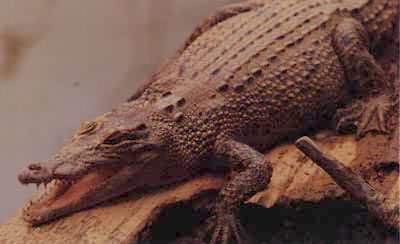
  • Crocodiles are tropical or subtropical, usually nocturnal, reptiles found in Africa, Asia, South America, & southern Florida

Australian photographs - crocodile
Australian Crocodile

  • Alligators are found in China & the southern United States


American Alligator

  • Caimans are native to Central America & resemble alligators


Black Caiman

  • Gavials, living only in India & Burma, are fish eating reptiles with very slender, long snouts


Gavial

Squamata:

  • Includes snakes & lizards
  • Snakes probably evolved from lizards during the Cretaceous period
  • Snakes have 100-400 vertebrae each with a pair of ribs & attached muscles for movement
  • Interaction of bone, muscles, & skin of snakes allows them 3 ways to move — lateral, rectilinear, & side winding
  • Lateral undulations:
    1. Most common
    2. Head moves side to side causing wave of muscular contractions
    3. Snake uses sides of its body to push off of ground
    4. Snake moves forward in S-shaped path
  • Rectilinear Movements:
    1. Muscular force applied to belly & not sides of snake
    2. Scutes or scales on belly catch on rough surfaces
    3. Body relaxes & then moves forward slowly
  • Sidewinding:
    1. Used by some desert snakes
    2. Sideways movement of body
    3. Head vigorously flung from side to side
    4. Whiplike motion moves body along
  • Do not hear or see well but locate prey using forked tongue that gathers chemical scents
  • Swallow prey whole:
    1. Jaws unhinge for mouth to stretch
    2. Small teeth used to hold prey in mouth
    3. Windpipe thrust into throat while swallowing so snake can swallow & breathe
    4. Swallowing may take several hours
    5. Saliva begins digestion during swallowing
  • Constrictors wrap body around prey & squeeze them to death (boas, pythons, etc.)
  • Snakes may inject venom or poison:
    1. Hemotoxin – poisonous proteins attacking red blood cells (water moccasin & rattlesnake)
    2. Neurotoxin – poison that works on nervous system affecting heart rate & breathing (copperhead)
  • Venomous snakes with 3 types of fangs — rear-fanged, front-fanged, & hinge- fanged snakes
  • Rear-fanged snakes bite prey & use grooved back teeth to guide venom into puncture (boomslang)
  • Front-fanged snakes inject poison through 2 small front fangs that act like a hypodermic needle (cobra)


Spitting Cobra

  • Hinged- fang snakes have hinged fangs in roof of mouth that swing forward to inject poison (rattlesnake, water moccasin, copperhead)


Crotalus viridis viridis, Prairie Rattlesnake Stock Photograph
Rattlesnake Water Moccasin


  • Often camouflaged for defense
  • May use signals such as cobra expanding its hood, rattlesnake shaking its rattle, or hissing for defense
  • Most snakes locate females by scent
  • Internal fertilization with no parental care
  • May be oviparous (eggs hatch outside body) or ovoviviparous (eggs held inside body until hatch)
  • Lizards:
    1. Four limbs
    2. Includes iguanas, geckos, skinks, chameleons, etc.
    3. Rely on speed, agility, & camouflage to catch prey
    4. Feed on insects & small worms
    5. Some, such as anole & chameleon, can change colors for protection
    6. May use active displays such as squirting blood, hissing, or inflating bodies
    7. Some show autotomy (breaking off tail to escape predators)
    8. Two poisonous U.S. species include Gila Monster & Beaded Lizard

Gila Monster
Gila Monster

  • Komodo dragon of Indonesia is largest lizard reaching 3 meters in length

Section 3 Review


BACK


Reptile Study Guide BI

Reptile Study Guide

What lizard is named for the spiny crest on its back?
What is the function of pits on the  head of rattlesnakes?
What species of lizard is the only surviving member of its ancient group?
What is autotomy & what is its advantage?
Name the order for snakes.
Name several characteristics of all snakes.
Explain how retiles get air into their lungs.
Describe the skin of reptiles.
Give several ways that organisms reduce evaporation of water from their bodies.
What is the most widely accepted hypothesis for the extinction of dinosaurs?
Name some protective membranes found inside amniote eggs.
What retile adaptation allows them to live & reproduce on land?
What is the outermost membrane of the reptile egg?
Describe the heart chambers of all reptiles except alligators & crocodiles.
Name the 2 parts of a turtle’s shell and tell where each is located.
Are reptiles endotherms or ectotherms? Explain.
How do endotherms maintain their internal body temperature?
Describe the heart of endotherms.
Define oviparous.
Which group of reptiles care for their young after they hatch?
Which group of reptiles are the most ancient?
What characteristic found in other retiles is lacking in turtles & tortoises?
Describe the feeding habits of crocodiles.
BACK