![]() |
Photosynthesis |
Word Bank:
|
|||||||||||||||||||||||||||||||||||
![]() |
Photosynthesis |
Word Bank:
|
|||||||||||||||||||||||||||||||||||
| Algae and Fungal-like Protists | ![]() |
Characteristics:
Structure:
Classification
· Algae are classified into 7 phyla, based on color, type of chlorophyll, form of food-storage substance, and cell wall composition.
Reproduction
· Many species of algae reproduce sexually and asexually
· Sexual reproduction in algae is often triggered by environmental stress
· During asexual reproduction, the algae first absorbs its flagellum, then the haploid cell divides mitotically up to three times, and from two to eight haploid flagellated cells called zoospores develop within the parent cell, lastly, the asexual reproductive cells break out of the parent cell, disperse, and eventually grow to full size.
· Sexual reproduction begins by haploid cells dividing mitotically to produce either “plus” or “minus” gametes.
· A plus gamete and a minus gamete come into contact with one another and shed their cell walls, then they fuse and form a diploid zygote, which develops a thick protective wall; this resting stage of a zygote is called a zygospore.
· A zygospore can withstand bad environmental conditions; during the bad environmental condition, the thick wall opens and the living zoospore emerges.
Reproduction in Multicellular Algae
· The male unicellular gametangium, called an antheridium, produces sperm and the female unicellular gametangium, called an oogonium, produces an egg.
· The antheridium releases sperm into the surrounding water, where they swim to the female egg and enter through small spores.
· After fertilization, the resulting zygote is released from the female egg and forms a thick-walled, resting spore; the diploid undergoes meiosis, forming zoospores that are released into the water; the zoospore settles and divides to form a rootlike holdfast, and the others divide and form a new filament.
· The leaflike algae Ulva has a sexual reproductive cycle that is characterized by a pattern called alternation of generations; a life cycle that exhibits alternation of generations has two distinct multicellular phases- a haploid, gamete-producing phase called a gametophyte and a diploid, spore-producing phase called a sporophyte.
· The adult sporophyte has reproductive cells called sporangia, which produce haploid zoospore by meiosis.
Algal-Like Protists
Phylum Chlorophyta
· The phylum Chlorophyta contains more than 7,000 identified species of organisms called green algae and members of this phylum have an amazing number of forms and reproductive methods and their body structures range from single cells and colonial forms to multicellular filaments and sheets.
Phylum Phaeophyta
· The phylum Phaeophyta contains 1,500 species of organisms called brown algae; brown algae is mostly marine and plantlike organisms called seaweed’s and kelps, they are common along rocky coasts where ocean water is cool.
· The brown algae contain chlorophylls a and c and a large amount of pigment called fucoxanthin, which give the algae its brown color.
· The food brown algae produces are stored as laminarin, a carbohydrate with glucose units that are linked differently than those in starch.
· All brown algae are multicellular; the largest brown alga is the Macrocystis.
· The thallus is anchored to the ocean bottom by a rootlike holdfast; the stemlike portion of the alga is called the stipe and the leaflike region, modified to capture sunlight for photosynthesis is called the blade.
· The cell walls of the Macrocystis contain alginate, an alginic acid that is used in cosmetics and various drugs, as food, and as a stabilizer in most ice creams.
Phylum Rhodophyta
· The phylum Rhodophyta contains 4,000 species of organisms called red algae.
· Red algae contain chlorophyll a and pigments called phycobilins, which play an important role in absorbing light for photosynthesis.
· Phycobilins can absorb the wavelengths of light that penetrate deep into the water; they make it possible for red algae to live in depths where alga pigments cannot survive.
· Certain species of red algae have cell walls that are coated with a sticky substance called carageenan, which is a polysaccharide.
· Agar, which is used as a gel-forming base for culturing microbes, is also extracted from the cell wall of red algae.
Bacillariophyta
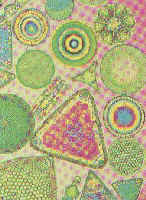
· The phylum Bacillariophyta contains 11,500 species of organisms called diatoms.
· Diatoms are abundant in both freshwater and marine environments; the cell wall, called shells, of the diatoms contains two pieces that fit together like a box; each half is called a valve.
· Centric diatoms have circular or triangular shells and are most abundant in marine environments.
· Pennate diatoms have rectangular shells and are most abundant in freshwater ponds and lakes; some pennate diatoms by secreting threads that attach to the surface of the water.
· Diatoms are an abundant component of phytoplankton and are important producers in freshwater and marine food webs, along with being an essential source of nutrients for microscopic heterotrophs, and they release an abundance of oxygen.
· When diatoms die their shells sink and accumulate in large numbers, forming a layer of material called diatomaceous earth.
Phylum Dinoflagellata
· The phylum Dinoflagellata contains 1,100 species of organisms called dinoflagellates.
· Dinoflagellates are small, usually unicellular organisms, photosynthetic, but a few are colorless and heterotrophic, and they are the major producers of organic matter in marine environments.
· Photosynthetic dinoflagellates usually have a yellowish green to brown color due to large amounts of pigments called carotenoids and chlorophylls a and c.
· Some species of dinoflagellates, such as Noctiluca, can produce bioluminescence, a display of sparkling light often seen in the ocean water at night.
· When other species produce toxins and red pigments that explode, a resulting phenomenon is the red tide.
Phylum Chrysophyta
· The phylum Chrysophyta contains about 850 species of organisms called golden algae, which live in freshwater, but few are found in marine environments.
· Most of the species placed in this phylum are some shade of yellow or brown due to the presence of large amounts of carotenoids.
· Golden algae store much of their surplus energy as oil and are important in the formation of petroleum deposits.
Phylum Euglenophyta
· The phylum Euglenophyta contains 1,000 species of flagellated unicellular algae called euglenoids.
· Euglenoids show both plantlike and animal-like characteristics; they are plantlike in that they have chlorophyll and are photosynthetic and they are animal-like in that they lack a cell wall and are highly motile.
· Euglena is abundant in freshwater, especially in water polluted by excess nutrients.
· Euglena lacks a cell wall and therefore is able to change its shape as it swims about.
Fungal-like Protists
Slime Molds
· Slime molds spend half their life in a mobile, amoeba-like feeding form, engulfing organic matter and bacteria, like protozoa.
· Slime molds produce funguslike reproductive structures, which is why they were once classified as fungi.
· Slime molds are typically found growing on damp soil, rotting logs, decaying leaves, or other decomposing organic matter in moist areas.
· During reproduction, slime molds produce a spore-bearing structure called a fruiting body.
Phylum Acrasiomycota
· The phylum Acrasiomycota comprises about 65 species of cellular slime molds.
· Cellular slime molds live as individual haploid cells that move about like amoebas; each cell moves as an independent organism, creeping over rotting logs and soil or swimming in fresh water, ingesting bacteria and other food.
· A pseudoplasmodium is a coordinated colony of individual cells that resembles a slug, and it leaves a slimy trail as it crawls over decaying logs, leaves, and twigs.
· Eventually a pseudoplasmodium will settle and form a fruiting body where spore will develop, then once the fruiting body breaks open, and the wind disperses the spores to new locations.
Phylum Myxomycota
· 450 species of plasmodial slime molds compose the phylum Myxomycota.
· During the feeding stage of its life cycle, a plasmodial slime mold is a mass of cytoplasm called a plasmodium, and it may be as large as several square meters.
· Each plasmodium is multinucleate or it contains thousands of nuclei.
· The spores of a plasmodium are resistant to adverse conditions; in favorable conditions, they crack open and give rise to haploid reproductive cells.
Water Molds
· A water mold is a funguslike organism composed of branched filaments of cells.
· Water molds are aquatic and are commonly found in bodies of freshwater.
Phylum Oomycota
· The phylum Oomycota includes a number of organisms that are pathogenic to plants.
· Blight is a disease of plants characterized by quickly developing decay and discoloring leaves, stems, and flowers.
· Water molds reproduce asexually and sexually.
· During asexual reproduction, they produce motile, flagellated reproductive zoospores, which accumulate to form a matlike mass.
· During sexual reproduction, the cells of the water mold develops egg-containing and sperm-containing structures, then tubes grow between the two types of structures letting the sperm cells to fertilize haploid egg cells to form diploid zygotes.
Phylum Chytridiomycota
· It is approximately 750 protists species in the phylum Chytridiomycota.
· The chytrids are primarily aquatic protists characterized by gametes and zoospores with a single, posterior flagellum.
NAME/PERIOD:
If you type answers onto this page, they won’t be saved so be sure to PRINT this page! Answer sheet to download.
Exploring Protists

Domain Eukarya; Kingdom Protista

There are many types of protists, but organisms in this kingdom only have a few things in common:
| They are eukaryotes – organisms that have cells with a nucleus and membrane-bound organelles. | They typically live in aquatic or moist environments. | Most protists are unicellular (made of only one cell) but they may live in colonies. | But there are some protists are are multicellular (containing more than one cell) |
![]() |
![]() |
![]() ![]() |
![]() |
1. Are protists prokaryotes or eukaryotes?
2. What is a eukaryote?
3. What type of environment would you typically find protists living?
4. Are all protists unicellular? yes or no
5. What are unicellular protists that live together in clusters called?
Obtaining Food / Nutrition / Energy
Protists have a few different methods of obtaining nutrition (food):
6. How do the heterotroph protists obtain their food?
7. How do the autotroph protists get their food? Name the process.
8. What is an example of a protist that can do both autotrophic and heterotrophic methods of obtaining food?
9. What is an example of a protist that absorbs their food?
10. What is an example of a protist that makes their own food?
Classifying Protists
Protists are classified by how they obtain food. Protists are organized into three main groups:
11. How are protists classified?
Animal – Like Protists – Protozoa

Animal – like protists are often called Protozoa. Scientists classify them by the way they move around.
12. What are the animal-like protists often called?
13. How do they obtain their food / energy?
14. How are they classified?
15. Go to http://blog.microscopeworld.com/2012/04/amoeba-under-microscope.html and DRAW and LABEL an amoeba.
Methods of Protozoa movement:
| Cilia | small hair-like projections all around the organism |
| Flagella | long, thin, whip-like structure |
| Pseudopodia | “false feet” – temporary extensions of a cell’s cytoplasm that help them move around and change their shapes to absorb their food |
| Parasites | move along with the host they invaded |
16. What is the method of movement that uses a long, whip-like tail?
17. What is the method of movement that uses “false feet”?
18. What are cilia?
19. Go to http://www.eastcentral.edu/common/depts/bi/protistans.php and DRAW and LABEL the paramecium.

Types of Protozoa:
| Phylum Sarcodina | Phylum Ciliophora | Phylum Zoomastingina | Phylum Sporozoa |
| Common Name – Sarcodines | Common Name – Ciliates | Common Name – Zooflagellates | Common Name – Sporozoan |
| Move by using Pseudopodia | Move by using Cilia | Move by using Flagella | Adults do not move |
Example: Amebas ![]() |
Example: Paramecium ![]() |
Example: Trypanosoma (causes African Sleeping Sickness) ![]() |
Example: Plasmodium (causes Malaria)![]() |
20. What is an example of a protozoa that uses a flagella for movement?
21. What type of protist phylum uses cilia?
Plant/Algal – Like Protists
![]()
Plant/Algal-like protists are eukaryotes that are similar to plants. Scientists classify these protists by the color of their pigments.
| Green Algae | Brown Algae | Red Algae | Diatoms | Dinoflagellates | Golden Algae | Euglena |
![]() |
![]() |
![]() |
![]() |
![]() |
![]() |
|
22. What are plant/algal-like protists similar to?
23. How are they classified?
24. How do they obtain food/energy? autotroph or heterotroph?
25. What do they do for the environment?
26. Why are they not plants?
27. Why are diatoms and dinoflagellates so important? (Use the web to research this question)
28. Giant kelp are called what?
29. Red algae produce what substance used as a culture media in lab? (Use the web to research this question)
Fungal – Like Protists

Fungal-like protists are multicellular eukaryotes that are absorptive heterotrophs.
30. Are fungal-like protists unicellular OR multicellular?
31. How do they obtain their food?
32. What is the job of the fungal-like protists?
33. Give two examples of a fungal-like protist.
Protists – Review
Click on the box you choose for the correct answer for each question.
34. Protists are
|
35. Animal-like protists are often called
|
||||||||||||||||
36. Animal-like protists are classified by
|
37. Plant/Algal-like protists are
|
||||||||||||||||
38. Plant/Algal-like protists are classified by
|
39. Fungal-like protists help the environment by
|
||||||||||||||||
| Protozoa Animal like Protists All Materials © Cmassengale |
![]() |
Characteristics:

Reproduction:
Adaptations:

Classification:
| Phylum | Common Name | Locomotion | Type of Nutrition | Examples |
| Sarcodina | sarcodines | pseudopodia | heterotrophic; some parasitic |
Amoeba Radiolaria Naegleria |
| Ciliophora | ciliates | cilia | heterotrophic; some parasitic |
Paramecium Tetrahymena Balantidium |
| Zoomastigina | zooflagellates | flagella | heterotrophic; some parasitic |
Trypanosoma Leishmania Giardia Trichonympha |
| Sporozoa | sporozoans | (None in Adults) | heterotrophic; some parasitic |
Plasmodium Toxoplasma |
Protozoan Evolution:
Phylum Sarcodina:


Phylum Ciliophora:

Stentor:

Vorticella:

Paramecium caudatum:


Phylum Zoomastigina:


Phylum Sporozoa:


| Pterosaur Reconstruction | ![]() |
Introduction:
A common sight during the Cretaceous period was the soaring through the air of a large fur-covered creature called the pterosaur. Pterosaur means flying lizard. Wings of some pterosaurs were longer than the wings of a small plane. This creature lived on cliffs at the edge of lagoons and would sail from its nest to catch prey. The bones of one pterosaur, Scaphognathus crassirostris, were discovered in 1826 by the German scientist, August Goldfuss. The fossilized bones were located in a limestone quarry and were unbroken. Scaphognathus crassirostris was approximately the size of a large bat with a broad jaw and short tail.
Objective:
Students will reconstruct the skeleton of S. crassirostris and draw conclusions about its method of movement, feeding habits, and other adaptations.
Materials:
Scissors, tape, construction paper, glue, metric ruler, pencil

Fossil Cast of S. crassirostris
Procedure:
Data:
Table 1
| Characteristics of S. crassirostris | |
| Wingspan (centimeters)? | |
| Jaw Shape? | |
| Teeth adapted for? | |
| Arms & hands adapted for? | |
| Number of bones in lower arm? | |
| Number of bones making up skull? | |
| Number of fingers? | |
| Finger adaptations? | |
Questions: