Line Graph Quiz

%CODE1% Line Graphs Quiz

Click on the radio buttons in front of the correct answers to the questions.

Line Graph of Temperatures

1. This graph shows the temperatures during the period of a

Week Month Year

2. The temperatures in the beginning of the week were rising or falling?

Rising Falling

3. There was the least amount of change between days

6 and 7

5 and 6

1 and two

4. If freezing is 32 degrees, which day was above freezing?

Day 1

Day 2

Day 4

5. When was the greatest drop in temperatures between?

Days 1 and 2

Days 3 and 4

Days 4 and 5


Bar Graph Animated title

BAR GRAPHS

When you have finished this page, try the Bar Graphs Quiz.

Bar graphs are an excellent way to show results that are one time, that aren’t continuous – especially samplings such as surveys, inventories, etc. Below is a typical survey asking students about their favorite after school activity. Notice that in this graph each column is labeled – it is also possible to label the category to the left of the bar.

In this case, the numbers for each category are across the bottom of the chart.

A bar chart is marked off with a series of lines called grid lines. These lines typically mark off a numerical point in the series of numbers on the axis or line. In this case, each grid line going up and down marks a multiple of 20 as the graph is divided such.More gridlines can make it easier to be exact with the amounts being shown on the bar graph, but too many can make it confusing.

Notice that for data that does not fall evenly on a multiple of 20, the bar is in between two grid lines.

Bar graphs are useful to get an overall idea of trends in responses – which categories get many versus few responses.


Favorite Student After School Activity

Activity Number
Visit W/Friends 175
Talk on Phone 168
Play Sports 120
Earn Money 120
Use Computers 65
Bar Graph


BAR GRAPH QUIZ

Click on the radio buttons in front of the correct answers to the questions about the graph.

Bar Graph

1. In the bar graph above, students favorite activity is

Using the computer

Visiting with friends

Earning money

2. According to the bar graph which is the least favorite after school activity?

Using on the computer

Visiting with friends

Earning money

3. Which two activities are favored by an equal number of students?

Playing sports and earning money

Using the computer and earning money

Talking on the phone and playing sports.

4. How many students said they their favorite after school activity is playing sports?

100 120 140

5. Based on this survey would you say more students like to be around people or be alone after school?

Be alone Be around people


Circle Pie Graph Title CIRCLE/PIE GRAPHS

When you have finished this page, try the Circle/Pie Graphs Quiz.

Circle or pie graphs are particularly good illustrations when considering how many parts of a whole are inception. In the table below both the number of hours in a whole day devoted to certain activities is listed as well as the percent of time for each of these activities. The pie chart is then divided very much as a baker’s pie would be into slices that represent the proportional amounts of time spent on each activity.

To the right of the pie chart is a legend that tells which color stands for which category. In addition, the percents are also near the pie slice that stands for that particular amount of time spent.

Percent of Hours of a Day Spent on Activities

ACTIVITY HOURS PERCENT OF DAY
Sleep 6 25
School 6 25
Job 4 17
Entertainment 4 17
Meals 2 8
Homework 2 8


Pie Graph of Day's Activities

Circle/Pie Graph Quiz

Click on the radio buttons in front of the correct answers to the questions.

Chart of Day's Activities

1. A part of a circle/pie graph that explains the colors that represent each part or slice of the graph is a

legend grid axis

2. These two activities took up half of the time of the day.

Entertainment and school

Meals and school

Sleep and school

3. These two activities took up the least amount of time.

Sleep and school

Meals and homework

Sleep and job

4. Which of these took up one fourth of the day?

Entertainment

Sleep

Homework

5. What percent of the day does homework take up?

2 8 25

6. Which of these takes up the same amount of time as meals and entertainment together?

Job

School

Homework


Cell Quiz

%CODE1%


Cells!
1. The door to your house is like the ___ of a cell membrane?
phospholipid bilayer
gated channel
receptor protein
recognition protein
2. The phospholipid bilayer of the cell membrane is like a(n):
screen door
plate glass window
hot water heater
oven

3. Facilitated diffusion ____ require energy and uses the help of ______
does, transport proteins
does, cytoplasm
does not, transport proteins
does not, sodium pumps

4. A semi permeable membrane is stretched across a chamber filled with water. The membrane is only permeable to water. 60 mg of salt is added to the left side of the chamber. Which of the following will happen?
water will move toward the right side
salt will move toward the right side
water will move toward the left side
salt will move toward the left side

5. The lipid bilayer keeps the inside of the cell membrane:
bipolar
protein saturated
dry
wet

6. Which of the following could be found in BOTH the nucleus and the cytoplasm
nucleolus
ribosomes
RNA
both RNA & ribosomes

7. Amino acid chains built by the ribosomes then move to the:
golgi apparatus
lysosome
endoplasmic reticulum
mitochondria

8. Which of the following structures has a 9 + 2 arrangement?
flagella
ribosome
mitochondria
golgi apparatus

9. The centriole is most like the:
lysosome
flagella
mitochondria
chromatin

10. Which of the following is composed of a large and a small subunit?
golgi apparatus
endoplasmic reticulum
mitochondria
ribosome

11. A cell that is missing lysosomes would have difficulty doing what?
digesting food
storing energy
packaging proteins
moving cytoplasm

12. Which of the following cell parts is described as a “fluid mosaic”?
chloroplast
vacuole
cell membrane
endoplasmic reticulum

13. Some cells take in large molecules through the process of:
protein synthesis
endocytosis
cytoplasmic streaming
ATP

14. Which of the following organelles would NOT be found in a plant cell?
chloroplast
DNA
food vacuole
cell membrane

Score =
Correct answers:


BACK

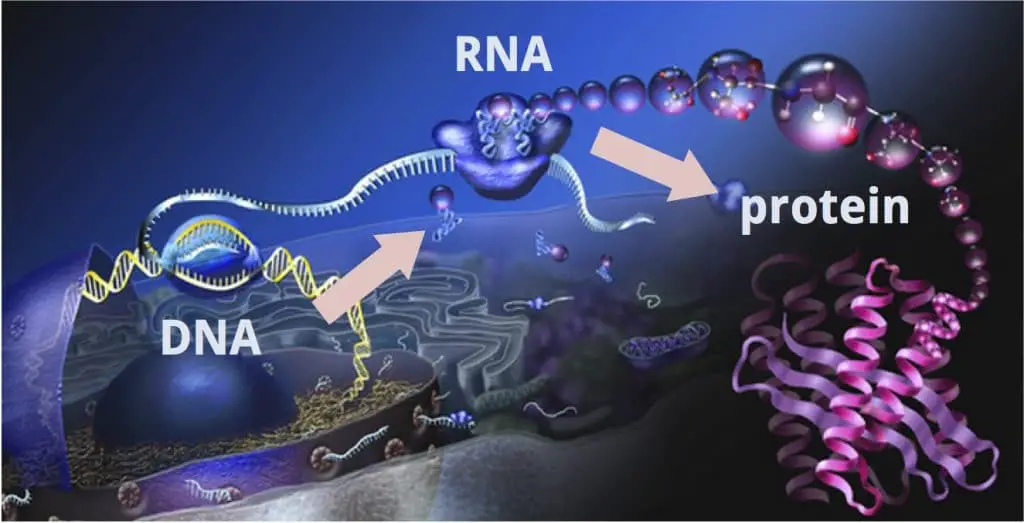
DNA QUIZ

%CODE1%

DNA QUIZ

1. Name this structure.
deoxynucleic acid
deoxyribonucleic acid
denatured ribonucleic acid
deoxoribonuclear acid2. The process by which RNA is made from DNA:
synthesis
translation
transcription
replication

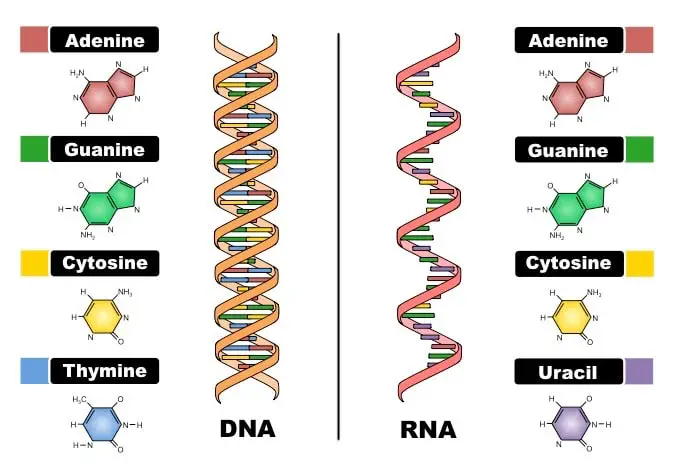
3. Adenine always pairs with:
thymine
cytosine
guanine
ribose

4. The “rungs” of the DNA ladder are made of:
phosphates and hydrogen
glucose and sugars
sugars and phosphates
base pairs

5. The DNA molecule is held together by:
magnetism
glucose
glue
hydrogen bonds

6. The process by which DNA makes a copy of itself is called:
synthesis
replication
transcription
translation

7. A gene is:
a segment of DNA that codes for a protein
a set of homologous chromosomes
a molecule within DNA
a type of pants

8. The twisted ladder shape of DNA is called a:
hydrogen twist
deoxyribose flip
double helix
double membrane

9. The sugar found in DNA is:
equal
deoxyribose
ribose
glucose

10. Which of the following takes the genetic code to the cytoplasm:
DNA
deoxyribose
tRNA
mRNA

11. The three nucleotide sequence on RNA is called a:
tRNA
codon
triplet
gene

12. Three nucleotides code for:
1 amino acid
3 amino acids
1 protein
3 proteins

13. RNA differs from DNA in that:
it has a different kind of sugar
it is single stranded
it has uracil
all of these

14. DNA is called the “blueprint of life” because:
it is like a fingerprint
it has a blue color
it contains the plans for building an organism
it can relay messages to other molecules

15. The two men who established the structure of DNA were:


Frederick and Alvers
Watson and Crick
Berkely and Fry
Darwin and Lamarke

Score =
Correct answers:

Mitosis Quiz

%CODE1%


Mitosis


cell

  1. What phase is this cell in?

prophase
metaphase
anaphase
telopase

  2. During which phase do chromosomes become visible?

telophase
anaphase
prophase
interphase

cell

3. Which phase is this cell in?

prophase
telophase
metaphase
interphase

4. A cell with 10 chromosomes undergoes mitosis and cell division. How many daughter cells are produced and what number of chromosomes do they have?
2 daughter cells, 5 chromosomes each
1 daughter cell, 10 chromosomes each
4 daughter cells, 20 chromosomes each
2 daughter cells, 10 chromosomes each

5. During which phase does the spindle form?
prophase
interphase
metaphase
anaphase

cell

6. Which phase is the cell in?
prophase
telophase
interphase
metaphase

7. The process where the cytoplasm divides and forms two new cells is called:
mitosis
cytokinesis
karyotype
spindle formation

cell

8. What phase is the cell in?
anaphase
interphase
telophase
prophase

9. Cytokinesis begins in:
interphase
metaphase
telophase
prophase


10. What is depicted in the illustration?
mitosis of an animal cell
cytokinesis of an animal cell
mitosis of a plant cell
cytokinesis of a plant cell

Decimals, Fractions and Percentages

%CODE1%


Decimals, Fractions and Percentages

Decimals, Fractions and Percentages are just different ways of showing the same value:

A Half can be written…
As a fraction:
1/2
As a decimal:
0.5
As a percentage:
50%


A Quarter can be written…
As a fraction:
1/4
As a decimal:
0.25
As a percentage:
25%

Here, have a play with it yourself:

Example Values

Here is a table of commonly occuring values shown in Percent, Decimal and Fraction form:

Percent Decimal Fraction
1% 0.01 1/100
5% 0.05 1/20
10% 0.1 1/10
12½% 0.125 1/8
20% 0.2 1/5
25% 0.25 1/4
331/3% 0.333… 1/3
50% 0.5 1/2
75% 0.75 3/4
80% 0.8 4/5
90% 0.9 9/10
99% 0.99 99/100
100% 1
125% 1.25 5/4
150% 1.5 3/2
200% 2


Conversions


From Percent to Decimal

To convert from percent to decimal: divide by 100, and remove the “%” sign.

The easiest way to divide by 100 is to move the decimal point 2 places to the left. So:

From Percent To Decimal
move the decimal point 2 places to the left, and remove the “%” sign.


From Decimal to Percent

To convert from decimal to percent: multiply by 100, and add a “%” sign.

The easiest way to multiply by 100 is to move the decimal point 2 places to the right. So:

From Decimal To Percent
move the decimal point 2 places to the right, and add the “%” sign.


From Fraction to Decimal

The easiest way to convert a fraction to a decimal is to divide the top number by the bottom number (divide the numerator by the denominator in mathematical language)

Example: Convert 2/5 to a decimal

Divide 2 by 5: 2 ÷ 5 = 0.4

Answer: 2/5 = 0.4


From Decimal to Fraction

To convert a decimal to a fraction needs a little more work.

Example: To convert 0.75 to a fraction

Steps Example
First, write down the decimal “over” the number 1 0.75 / 1
Then multiply top and bottom by 10 for every number after the decimal point (10 for 1 number, 100 for 2 numbers, etc) 0.75 × 100 / 1 × 100
(This makes it a correctly formed fraction) = 75 / 100
Then Simplify the fraction 3 / 4


From Fraction to Percentage

The easiest way to convert a fraction to a percentage is to divide the top number by the bottom number. then multiply the result by 100, and add the “%” sign.

Example: Convert 3/8 to a percentage

First divide 3 by 8: 3 ÷ 8 = 0.375,
Then multiply by 100: 0.375 x 100 = 37.5
Add the “%” sign: 37.5%

Answer: 3/8 = 37.5%


From Percentage to Fraction

To convert a percentage to a fraction, first convert to a decimal (divide by 100), then use the steps for converting decimal to fractions (like above).

Example: To convert 80% to a fraction

Steps Example
Convert 80% to a decimal (=80/100): 0.8
Write down the decimal “over” the number 1 0.8 / 1
Then multiply top and bottom by 10 for every number after the decimal point (10 for 1 number, 100 for 2 numbers, etc) 0.8 × 10 / 1 × 10
(This makes it a correctly formed fraction) = 8 / 10
Then Simplify the fraction 4 / 5

Search :: Index :: About :: Contact :: Contribute :: Cite This Page :: Privacy

Copyright © 2011 MathsIsFun.com