Volume of Irregular Object Sample Lab 1


Volume of an Irregular Object


Introduction

Everything is made of matter, and matter has both chemical and physical properties. Physical properties of matter are observable and include mass, volume, and density. Mass is the amount of matter in an object and can be found by using an electronic balance or scale. Volume is the amount of space an object occupies and can be determined by measuring the amount of water that a submerged object displaces. The formula for determining density is:

Density = Mass of the object / Volume of the object

Hypothesis

Determining the volume of an irregularly shaped object can help determine its density.

Materials

The materials used in this lab included a rubber stopper, small rock, shell, 100 ml graduated cylinder, electronic balance, water, paper, and pencil.

Methods

Obtain three, irregularly shaped objects — a rubber stopper, a shell, and a rock. Estimate the volume and mass of each object and record this in the data table. Use an electronic balance to mass each object and record the masses in the data table. Fill a graduated cylinder approximately half way with water and record this initial volume. Place one of the objects into the graduated cylinder and record the final volume. Subtract the initial volume of the water from the final volume of water to find the volume of the water the object displaced. Record this as the object’s volume in the data table. Remove the first object and repeat this process of determining volume for the other two objects. Determine each object’s density by dividing their mass by their volume. Record each density in the data table.

Results


Data Table
Object estimated mass (g) estimated volume (ml) actual mass (g) initial volume of water (ml) final volume of water (ml) volume of object (ml) density (g/ml)
Rubber stopper 19.3 10 9.3 50 56 6 1.55
Shell 6.0 2 3.3 50 51.5 1.5 2.2
Rock 10.0 5 9.3 50 55 5 1.86


Discussion and Conclusion

Objects that are irregular in shape can have their volume determined by measuring the amount of water that they displaced when submerged in a known amount of water. The increase in volume from the initial water level to the final water level is the volume of the object. Once the volume is determined and the actual mass measured then the object’s density can also be determined. The formula for finding density is the mass of the object divided by the volume of the object. For example, since the rock had a mass of 9.3 grams and a volume of 5 ml, the density of the rock was determined to be 1.86 grams/ millimeters.

BACK


Electricity Elementary


   ELECTRICITY


Standards:

  • PS.7.4.2   Classify electrical conductors and electrical insulators
  • PS.7.4.3   Construct simple circuits from circuit diagrams

Notes:

  • What is Electricity? – Just the basics about electricity
  • Circuits Can Be Electrifying! – All types of circuits covered — open, closed, series, and parallel
  • Static Electricity and Dryer Sheets! – Covers that problem of static cling in your clothes
  • Electricity and Magnetism –  Tells students how these two are related
  • Conductors and Insulators – What will and what won’t conduct an electric current and why

Interactive Activities:

Smart Board Activities:

Labs:

  • Complete the Circuit Game! — Elementary students will love this activity by competing with each other for the most steady hand!  They’ll learn something about open and closed circuits too!!


Great Links:


BI Sample 2 Lab Volume of Object


Volume of an Irregular Object


Introduction


Everything is made of matter. Matter has physical and chemical properties. Physical properties are observable, such as mass, volume, and density. Mass is a fundamental property of an object generally regarded as equivalent to the amount of matter in the object. Volume is the amount of space it takes up. Density is the thickness of it the formula for density is D=M/V. The purpose of this experiment was to find the mass, volume, and density of three different objects.


Hypothesis


Determining the volume of an irregularly shaped object can help in determining density.


Materials


The materials used included a rubber stopper, a rock, a shell, a 100mL graduated cylinder, water, electronic balance, paper, and pencil.


Methods:


Obtain rubber a stopper, a shell, and a rock. Estimate and record the mass and volume of the three objects. Weigh and record each object. Take the graduated cylinder and fill halfway with water and record the volume. Add one object and record the new volume. Subtract initial volume from final, and record. Repeat with the other three objects.


Results:


Object Estimated mass (g) Estimated volume (ml) Actual mass (g) Volume of H2O (ml) Volume of object + H2O (ml) Object’s Volume (ml) Density D=m/v

(g/ml)

Rubber Stopper 8g 65ml 8.3g 50ml 56ml 6ml 1.38g/ml
Shell 2g 55ml 3.1g 50ml 53ml 3ml 1g/ml
Rock 4g 60ml 7.8g 50ml 54ml 4ml 1.95g/ml

1. How did you determine the object’s:

a. Mass? Weighed it on a electronic balance


b. Volume? Put it in the water and measured the volume then subtracted the volume of the water before the object.

c. Density? Divided mass into volume

2. How did your estimates of mass and volume compare to the actual mass and volume of each object?

Our estimates of mass were close to the actual mass. Our estimates of volume were off not close to the actual volume at all.

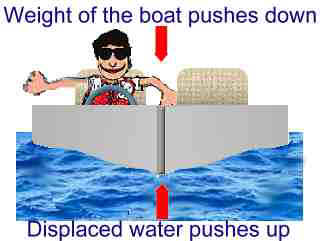
3. Objects will sink if they are denser than water. Explain why ships made of steel float instead of sinking since steel is denser than water.

Because the ship has a hallow cavity with trapped air in it.


Error Analysis:


The volume of the water might not have been measured correctly.


Discussion and Conclusion:


The volume of the rubber stopper, rock and shell were determined by submerging them in a graduating cylinder containing water. The original water level in the cylinder was subtracted from the final water level to get the volume (ml) of each object. The actual mass (g) of each object was obtained by placing each on an electronic balance. Density could then be determined by dividing the mass of each object by its volume. The data showed the rock to have the greatest density at 1.95 g/ml with the rubber stopper 1.38 g/ml and the shell 1 g/ml being less dense.

BACK