Pzsol Photosynthesis


Photosynthesis

Answer Key:


All organisms use energy to carry out their life functions. Some organisms obtain this energy from sunlight. The process by which this energy transfer takes place is called photosynthesis. Photosynthesis involves a biochemical pathway in which the product of one reaction is consumed in the next reaction. Autotrophs are organisms that carry on photosynthesis and includes plants and other organisms containing the green pigment chlorophyll. Autotrophs use carbon dioxide and water to make oxygen and the simple sugar glucose. The pigment chlorophyll absorbs light energy from the sun during the light reactions. Accessory pigments also in the chloroplast absorb other wavelengths of light that chlorophyll does not absorb. These accessory pigments are responsible for other colors we see in plants such as red, orange, and yellow. Chloroplasts are surrounded by a double membrane. Inside chloroplasts is a system of membranes arranged as stacks of flattened sacs called granum. Each sac in the stack is called a thylakoid. The thylakoids are surrounded by a solution called the stroma. The dark reactions of photosynthesis take place in the stroma. Most chloroplasts are found in the leaves of plants. The underside of a leaf contains openings called stomata where gases such as oxygen and carbon dioxide enter and leave. These openings or stomata are closed during the hottest times of the day by cells called guard cells.

Pzsol Viruses


Viruses

Answer Key:


1) virus
2) virology
3) stanley
4) mosaic
5) crystallization
6) metabolism
7) antiviral
8) nonliving
9) capsid
10) glycoprotein
11) genome
12) transcriptase
13) envelope
14) spikes
15) nanometer
16) replicate
17) protein
18) nucleic
19) hiv
20) immunodeficiency
21) icosahedron
22) helix
23) host
24) adenovirus
25) retrovirus
26) viroid
27) prion
28) intracellular
29) bacteriophage
30) escherichia
31) collar
32) tail
33) lytic
34) virulent
35) assembly
36) lysis
37) attachment
38) lysogenic
39) temperate
40) prophage
41) injection
42) inactivated
43) attenuated
44) smallpox
45) measles
46) influenza
47) jungles


Reptile


Reptiles All Materials © Cmassengale  


Evolution of  Reptiles:

  • Reptiles were 1st vertebrates to make a complete transition to life on land (more food & space)
  • Arose from ancestral reptile group called cotylosaurs (small, lizard like reptile)
  • Cotylosaurs adapted to other environments in Permian period
    1. Pterosaurs – flying reptiles
    2. Ichthyosaurs & plesiosaurs – marine reptiles
    3. Thecodonts – small, land reptiles that walked on back legs
  • Mesozoic Era called “age of reptiles”

  • Dinosaurs dominated life on land for 160 million years
  • Brachiosaurs were largest dinosaurs
  • Herbivores included Brontosaurus & Diplodocus, while Tyrannosaurus were carnivores
  • Dinosaurs became extinct at end of Cretaceous period 
  • Mass extinction of many animal species possibly due to impact of huge asteroid with earth; Asteroid Impact Theory
  • Amniote (shelled) egg allowed reptiles to live & reproduce on land

Amniote Egg:

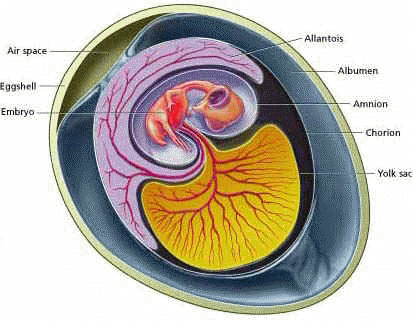
  • Egg had protective membranes & porous shell enclosing the embryo
  • Has  4 specialized membranes — amnion, yolk sac, allantois, & chorion
  • Amnion is a thin membrane surrounding a salty fluid in which the embryo “floats”
  • Yolk sac encloses the yolk or protein-rich food supply for embryo
  • Allantois stores nitrogenous wastes made by embryo until egg hatches
  • Chorion lines the inside of the shell & regulates oxygen & carbon dioxide exchange
  • Shell leathery & waterproof
  • Internal fertilization occurs in female before shell is formed

Section 1 Review

Terrestrial Adaptations:

  • Dry, watertight skin covered by scales made of a protein called keratin to prevent desiccation (water loss)
  • Toes with claws to dig & climb
  • Geckos have toes modified into suction cups to aid climbing
  • Snakes use scales & well developed muscular & skeletal systems to move
  • Lungs for respiration
  • Double circulation of blood through heart to increase oxygen to cells
  • Partial separation in ventricle to separate oxygenated & deoxygenated blood
  • Ectothermic – body temperature controlled by environment
  • May bask or lie in sun to raise body temperature or seek shade to lower body temperature; known as thermoregulation
  • Water conserved as nitrogen wastes excreted in dry, paste like form of uric acid crystals

Section 2 Review

Modern Reptiles:

  • Only 4 living orders remain
  • Found worldwide except in coldest ecosystems
  • Orders include —– Rhyncocephalia (tuatara lizard), Chelonia (turtles & tortoises), Squamata (lizards & snakes), & Crocodilia (alligators, caimans, and crocodiles)

Rhyncocephalia:

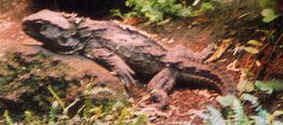
  • Only one living species, Spenodon punctatus, (tuatara lizard)
  • Live on islands off the coast of New Zealand

Tuatara
Tuatara

  • Spiny crest running down back
  • Grows up to 60 cm in length
  • Has 3rd eye on top of head (parietal eye) that acts as a thermostat
  • Most active when temperatures are low (nocturnal)
  • Often burrow during the day
  • Feed on insects, worms, & small animals at night

Chelonia:

  • Includes turtles and tortoises
  • Aquatic, but lay eggs on land
  • Body covered with shell composed of hard plates & tough, leathery skin
  • Carapace or dorsal surface of shell fused with vertebrae & ribs
  • Plastron is ventral shell surface
  • Shape of shell modified for habitat
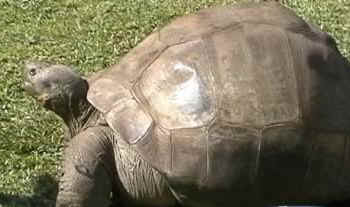
  • Dome shaped shell helps to retract head & limbs in tortoises
CLICK TO RETURN
Galapagos Tortoise
  • Water-dwelling turtles have streamline, disk shaped shell to rapidly move in water

spotted turtle photograph
Spotted Turtle

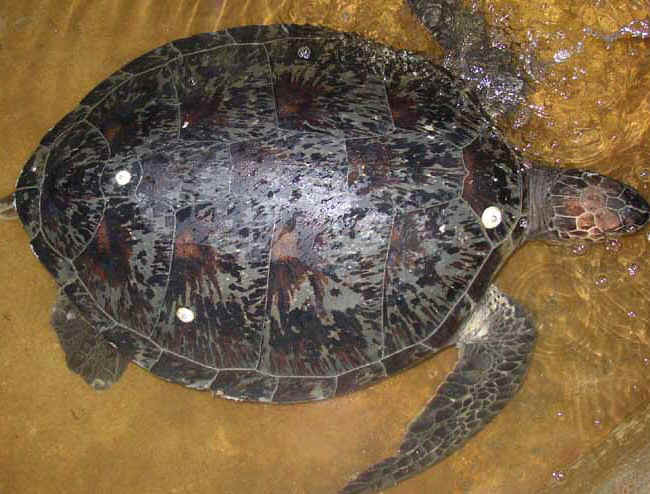
  • Forelimbs of marine turtles modified into flippers

Green Turtle found on Guernsey 1/2003 (Photograph © by Richard Lord, Guernsey)
Marine Turtle

  • River & sea turtles migrate to breeding areas where they hatched to lay their eggs on land

Crocodilia:

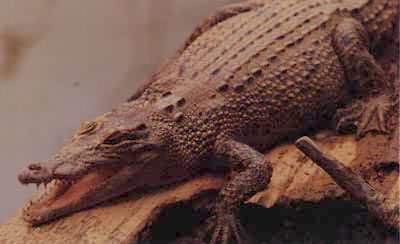
  • Includes crocodiles, alligators, caimans, & gavials
  • Direct descendants of Archosaurs
  • Carnivorous (wait for prey to come near & then aggressively attack)
  • Eyes located on top of head so they can see when submerged
  • Nostrils on top of snout to breathe in water
  • Valve in back of mouth prevents water from entering airway when feeding underwater
  • No parental care of young in most species except Nile crocodile that carry young in their jaws & guards nest
  • Crocodiles are tropical or subtropical, usually nocturnal, reptiles found in Africa, Asia, South America, & southern Florida

Australian photographs - crocodile
Australian Crocodile

  • Alligators are found in China & the southern United States


American Alligator

  • Caimans are native to Central America & resemble alligators


Black Caiman

  • Gavials, living only in India & Burma, are fish eating reptiles with very slender, long snouts


Gavial

Squamata:

  • Includes snakes & lizards
  • Snakes probably evolved from lizards during the Cretaceous period
  • Snakes have 100-400 vertebrae each with a pair of ribs & attached muscles for movement
  • Interaction of bone, muscles, & skin of snakes allows them 3 ways to move — lateral, rectilinear, & side winding
  • Lateral undulations:
    1. Most common
    2. Head moves side to side causing wave of muscular contractions
    3. Snake uses sides of its body to push off of ground
    4. Snake moves forward in S-shaped path
  • Rectilinear Movements:
    1. Muscular force applied to belly & not sides of snake
    2. Scutes or scales on belly catch on rough surfaces
    3. Body relaxes & then moves forward slowly
  • Sidewinding:
    1. Used by some desert snakes
    2. Sideways movement of body
    3. Head vigorously flung from side to side
    4. Whiplike motion moves body along
  • Do not hear or see well but locate prey using forked tongue that gathers chemical scents
  • Swallow prey whole:
    1. Jaws unhinge for mouth to stretch
    2. Small teeth used to hold prey in mouth
    3. Windpipe thrust into throat while swallowing so snake can swallow & breathe
    4. Swallowing may take several hours
    5. Saliva begins digestion during swallowing
  • Constrictors wrap body around prey & squeeze them to death (boas, pythons, etc.)
  • Snakes may inject venom or poison:
    1. Hemotoxin – poisonous proteins attacking red blood cells (water moccasin & rattlesnake)
    2. Neurotoxin – poison that works on nervous system affecting heart rate & breathing (copperhead)
  • Venomous snakes with 3 types of fangs — rear-fanged, front-fanged, & hinge- fanged snakes
  • Rear-fanged snakes bite prey & use grooved back teeth to guide venom into puncture (boomslang)
  • Front-fanged snakes inject poison through 2 small front fangs that act like a hypodermic needle (cobra)


Spitting Cobra

  • Hinged- fang snakes have hinged fangs in roof of mouth that swing forward to inject poison (rattlesnake, water moccasin, copperhead)


Crotalus viridis viridis, Prairie Rattlesnake Stock Photograph
Rattlesnake Water Moccasin


  • Often camouflaged for defense
  • May use signals such as cobra expanding its hood, rattlesnake shaking its rattle, or hissing for defense
  • Most snakes locate females by scent
  • Internal fertilization with no parental care
  • May be oviparous (eggs hatch outside body) or ovoviviparous (eggs held inside body until hatch)
  • Lizards:
    1. Four limbs
    2. Includes iguanas, geckos, skinks, chameleons, etc.
    3. Rely on speed, agility, & camouflage to catch prey
    4. Feed on insects & small worms
    5. Some, such as anole & chameleon, can change colors for protection
    6. May use active displays such as squirting blood, hissing, or inflating bodies
    7. Some show autotomy (breaking off tail to escape predators)
    8. Two poisonous U.S. species include Gila Monster & Beaded Lizard

Gila Monster
Gila Monster

  • Komodo dragon of Indonesia is largest lizard reaching 3 meters in length

Section 3 Review


BACK


Pzsol Worms


Worms
Answer Key:
 

1)platyhelminthes phylum of flatworms
2)three number of body layers in worms
3)bilateral symmetry f flatworms
4)dorsal upper body surface of worms
5)ventral lower body surface of worms
6)ectoderm outermost cell layer of worms
7)mesoderm middle cell layer of worms
8)endoderm innermost cell layer of worms
9)acoelomate solid body in flatworms
10)coelom body cavity
11)gastrovascular gut with a single opening in flatworms
12)absorption how flatworms exchanges gases with their environment
13)anterior head or front end of a flatworm
14)cephalization anterior end with sensory structures concentrated there
15)parasite worms that live on or inside the body of their host
16)turbellaria class of flatworms containing the freshwater planarian
17)pharynx extendable feeding tube on the underside of planarians
18)mucus secreted by planarians to glide across
19)flame excretory cells in worms that filter wastes
20)ganglia clusters of nerve cells in worms
21)hermaphrodites worms that make both eggs & sperm
22)trematoda class of flatworms containing flukes
23)suckers found on the ends of flukes to attach to hosts
24)tegument tough outer covering on flukes
25)cestoda class containing tapeworms
26)scolex anterior end of a tapeworm with hooks & suckers
27)proglottids reproductive sections of a tapeworm’s body
28)nematoda phylum for roundworms
29)taper shape of both ends of a roundworms body
30)cuticle protective noncellular layer of roundworms
31)ascaris roundworm found in pig & horse intestines
32)hookworms intestinal parasitic roundworm with cutting plates in it’s mouth
33)trichinosis disease that result from eating infected undercooked pork
34)pinworms most common parasitic roundworm of children in the U.S.
35)rotifera phylum of worms with a crown of cilia surrounding the mouth
36)mastax muscular organ of rotifers to break down food
37)pseudocoelomates rotifers & nematodes are examples


Quiz Bacteria

Name: 

Bacteria


True/False
Indicate whether the sentence or statement is true or false.
1.
Gram-negative bacteria have a thick layer of peptidoglycan that stains purple.
2.
Bacteria lack nuclei and therefore also lack genetic material.
3.
Bacterial cells have membrane-bound organelles and chromosomes.
4.
Bacterial cells are usually much larger than eukaryotic cells.
5.
Bacteria are incapable of movement themselves; they can only get to new locations by growing toward them or by forming endospores and being carried in air or water.
6.
Some bacteria cannot survive in the presence of oxygen.
7.
When bacteria undergo nonreproductive genetic recombination, their bacterial chromosome is altered.
8.
Certain antibiotics have become ineffective against certain strains of bacteria. These bacteria have developed a resistance, which may be passed on from one generation of bacteria to the next.
9.
The photoautotrophic bacteria are the only bacteria that are indirectly beneficial to humans.
 

Completion
Complete each sentence or statement.
10.
Spiral bacteria are called ____________________.

11.
Spherical bacteria are called ____________________.

12.
Rod-shaped bacteria are called ____________________.

13.
The procedure used to distinguish between two types of bacterial cell wall structures is called ____________________.

14.
Protective structures that some bacteria may form under harsh conditions are ____________________.

15.
The cell walls of Gram-negative eubacteria are composed of a combination of polysaccharide and polypeptide called ____________________.

16.
Bacteria that obtain their energy by removing electrons from inorganic molecules, rather than obtaining energy from the sun, are called ____________________ bacteria.

17.
In general, organisms that obtain their energy from sunlight are called ____________________.

18.
Bacteria that are heterotrophic and feed on dead organic matter are called ____________________.

19.
A(n) ____________________ is a substance that can be obtained from bacteria or fungi and can be used as a drug to fight pathogenic bacteria.

20.
Many bacteria are ____________________ and play an important role in recycling carbon, nitrogen, and other elements, while other bacteria are ____________________ and assemble organic compounds from carbon dioxide, nitrogen, and other elements.


Check Your Work     Reset