Caught Red-Handed


Caught Red-Handed  


Introduction:

Bacteria are everywhere. They have evolved the ability to inhabit almost every surface on the planet; however, they are invisible to the naked eye due to their small size. Bacteria have been found living in the deepest part of the ocean, in volcanic vents, in boiling hot springs, and even deep in polar ice caps. Many species of bacteria live inside of other organisms in a harmless commensalistic way such as the intestinal bacteria, Escherichia coli. Bacteria can reproduce at very rapid rates whenever conditions are favorable, as often as every 20 minutes doubling in number. The bacterial population is kept in check by the natural defenses of the host, such as the immune system and proper washing habits. When these natural defenses fail, bacteria can quickly become a problem. Some bacteria produce poisons or toxins that can be life-threatening if the bacterial population isn’t controlled by our natural defenses.

The United States Centers for Disease Control (CDC) states that the best way to prevent bacterial spread and infection is through the use of proper sanitary techniques. Perhaps the most critical step in this prevention is the use of proper hand washing. When improperly washed, your hands are one of the most easily colonized areas of your body and many of our behaviors involve the use of our hands.  Proper hand washing requires the use of water as hot as you can stand, soap, and lots of rubbing. The soap and water serve to destroy bacteria, and the rubbing helps slough off dead skin cells along with lots of bacteria.

Objective:

Students will examine:

  1. The spread of bacteria through surface contact
  2. Surface washing techniques to reduce the spread of bacteria

Materials (Part A):

Black light, Glo-Germ powder, lotion or Glo-Germ oil, hand soap, water, paper towels, pencil, lab sheet

Procedure (Part A):

  1. Choose one student in the lab group and have them spread a SMALL AMOUNT of Glo-Germ powder or lotion evenly over the entire surface of their hands. Be sure to include hard to clean areas such as around & under the fingernail.
  2. Have another student use the Black light to check your hands for the fluorescent “germs”.
  3. Estimate the percentage of your hand that you have covered with Glo-Germ powder and record this percentage in your data table 1 under time “0”.
  4. Wash your hands for 10 seconds and then recheck your hands with Black light and record the percentage of “germs” remaining.
  5. Repeat step 5 for washing times of 30 seconds, 60 seconds, and 120 seconds.
  6. Return Glo-Germ powder, lotion, or oil to lab cart. 

Data Table 1


Time of Wash in Seconds Percent of Hand Covered with “germs”
0 (initial observation)
10
30
60
120


Materials (Part B):

Tennis ball, “play” money, stuffed toy, pencil, lab sheet

Procedure (Part B):

  1. Choose a different member of your lab group and use the Black light to check their hands for the presence of germs.  IF they are “infected”, have them thoroughly wash their hands to remove the “germs”.
  2. Record the percentage of their hand that is covered with “germs”.
  3. Pick up the basket from the lab cart with your materials for part B.
  4. Handle the tennis ball for at least 20 to 30 seconds.
  5. After handling the tennis ball, have your hands rechecked with the Black light for “germs”.
  6. Record this percentage in data table 2.
  7. Return to your lab table and handle each of the other items ONE AT A TIME, checking for “germs after EACH item and recording this percentage in table 2.
  8. Return the black light and basket with handled items to the lab cart.

Data Table 2


Name of Item Percent Coverage
Initial Hand Coverage
Tennis Ball
“Play” money
Toy


Questions:

  1. If almost every surface we touch is inhabited by bacteria, why don’t bacterial infections occur more often?
  2. Name 3 ways you  might prevent the spread of bacteria each day.
  3. Name several bacterial diseases.
  4. Name and describe the 3 shapes of bacteria.
  5. Are all bacteria harmful? Explain your answer.
  6. What effect, if any, did increased washing time have on the percentage of “germ” coverage on your hands?
  7. Name 3 areas of your home that are most susceptible to bacterial contamination. Explain steps you could take in each of these areas to prevent the spread of bacteria to other places in your home.

Optional:

Create a graph based on the data from table 1.

Title _____________________________


Build a Bug


Build-a-Bug


Introduction:

Most adult insects have the following characteristics:

    1. A body divided into three parts (head, thorax and abdomen)
    2. Three pairs of legs
    3. Usually one pair of antennae and a pair of compound eyes (a few exceptions to these characteristics are found)
    4. Usually two pairs of wings (absent in many insects such as lice, fleas, ants; flies have one pair of wings)

There are approximately 30 orders of insects. Choose one of the insects from these orders.

INSECT ORDERS

Click on the link to learn more about the characteristics of that order. There are links to specific insects on each page.  Visit the Field Guide Index to see a listing of all insects featured in the Field Guide.

Objective:

Students will build biologically correct insects in order to learn insect structure and adaptations.

Materials:

Any non-food item such as cardboard, egg cartons, clay, wire, felt, Styrofoam, pipe cleaners, nylon stockings, pipe cleaners, paint, glue, string, etc.

Guidelines:

  1. Your model must be an INSECT (i.e. no spiders, mites, ticks, centipedes, or millipedes, please). Note: Your insect does not have to live in the United States.
  2. Your model must be between 6-12 inches long, and sturdy.
  3. Be accurate when building your model (appropriate proportions, true color and form, etc.).
  4. The more detail your model has, the better.
  5. A written description must accompany your model and include:
  • The common name of the insect
  • The name of the order to which it belongs
  • A brief description of the insect’s habitat
  • Where the insect is located geographically
  • At least 2 interesting, and unique facts about the insect you have modeled (i.e. “it has 6 legs and 3 body segments” doesn’t count)
  • Your name and address on model description

Examples of Models:


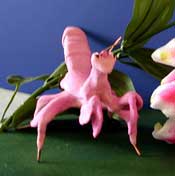
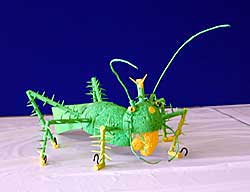
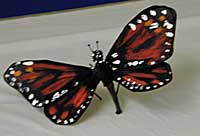
Spiny Katydid Monarch
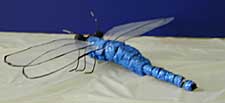
Dragonfly Damselfly Luna Moth
Walking Stick Grasshopper Yellow jacket
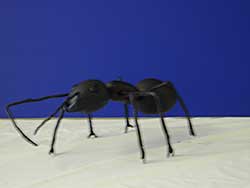
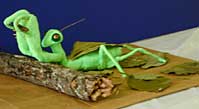
Atlas Moth Carpenter ant Praying Mantid


Bullfrog Skeletal Reconstruction


Bullfrog Skeleton Reconstruction


Introduction:

The skeleton of the frog consists chiefly of bony and cartilaginous elements.  The functions of a skeleton include providing support for the body,  protection of delicate internal organs and attachment surfaces for muscles.  In vertebrates, the axial skeleton consists of the skull, vertebral column, sternum (breast bone) and ribs (which are not present in amphibians).  The vertebral column of frogs is made up of 10 vertebrae, the first of which (called the atlas) articulates with the base of the skull.  The atlas is the only cervical vertebra in the frog.  The next seven vertebrae are abdominal vertebrae, which is the large sacrum with two strong transverse processes that join with the ileum.  The last vertebra is the long and highly modified urostyle.  Note:  Most vertebrates have a tail supported by caudal vertebrate, but frogs and toads are atypical in that they lack any tail and are therefore called anurans (“tail less amphibians”).


Lab_9b-17a  

1. Skull
2. Axis Cervical vertebrae)
3. Abdominal vertebrae
4. Cervical Vertebrae
5. Urostyle
6. Scapula
7. Ilium
8. Ischium
9. Humerus
10. Radio-ulna
11. Carpals
12. Metacarpals
13. Phalanges
14. Femur


The appendicular skeleton includes the limbs and the pectoral and pelvic girdles that support them.  In most vertebrates the forelimbs consist of three major bones — the humerus, radius and ulna, along with the smaller bones of the hand (carpals, metacarpals and phalanges).  Note that in the frog the radius and ulna have become fused into a single bone, the radio-ulna.  Likewise, the hindlimbs consist of three major bones — the femur, tibia and fibula, along with the smaller bones that make up the feet (tarsals, metatarsals and phalanges). Once again, in frogs and toads the tibia and fibula have become fused into a single bone, the tibio-fibula.  The pectoral girdle consists of four pairs of bones (the suprascapula, scapula, coracoid, and clavicle).  The last three pairs are connected to the sternum.  In frogs, the pelvic girdle, which supports the hindlimbs, is formed by the fusion of the ilium, ischium and non-ossified pubis.  Each femur fits into a socket on the pelvic girdle called an acetabulum.  Note that the pelvic girdle and limb structure are well adapted for giving a powerful, synchronous thrust of both hind limbs in swimming and jumping

Objective:

By reassembling an amphibian skeleton, students will learn the bones and modifications of a vertebrate.

Materials:

Dermestid beetles, small aquarium with air-vented lid,  dermestid bedding, food, & water supply, freeze-dried bullfrogs, tweezers, small container with lid for bones, 20% H2O2, thin piece of wood, paints, and glue.

Procedure:

  1. Place the freeze dried frog into a small aquarium of dermestid beetles.
  2. Leave the frog skeleton in the aquarium for several days to several weeks until all flesh has been stripped from the skeleton.
  3. Carefully remove all bones from the aquarium and use forceps to carefully pull away any flesh that remains..
  4. Rinse the bones in running water thoroughly.
  5. Bleach the bone in 20% hydrogen peroxide solution until the bones appear white.
  6. Dry the bones and articulate them. (use the above diagram to help in the arrangement of the bones.)
  7. Bones should be mounted on a thin piece of wood.
  8. You may be creative and place your frog in a scene of your choosing — playing football or basketball, swimming in a pond, practicing ballet, etc.

Examples: