Ap Lab 1 Sample 5


Osmosis & Diffusion – Lab 1 

Introduction:

All molecules have kinetic energy and are constantly in motion.  This motion causes the molecules to bump into each other and move in different directions.  The result is diffusion.  Diffusion is the random movement of molecules from an area of high concentration to an area of low concentration. This will continue until dynamic equilibrium is reached; no net movement will occur.  Osmosis is a special kind of diffusion.  It is the diffusion of water through a selectively permeable membrane. A selectively permeable membrane means that the membrane will only allow certain molecules through such as water, small solutes, oxygen, carbon dioxide, and glucose, because no additional ATP is required. The membrane will not let ions, nonpolar molecules, or large molecules through because extra ATP is needed for them to travel across the membrane.  Active transport is how molecules (such as ions) move against the concentration gradient.  Additional ATP is required to perform this process.

Water will travel from an area of high water potential to an area of low water potential.  Water potential is the measure of free energy of water in a certain solution.  It is measured by using the Greek letter psi (ψ).  The formula for figuring water potential is:

ψ          =             ψp             +           ψs

Water Potential   =   Pressure Potential   +  Solute Potential

Water potential is affected by 2 different factors.  They are the addition of a solute and the pressure potential.  If a solute is added to the water, then the water potential is lowered.  If more pressure is placed on the water, then the potential is raised. The addition of a solute and water potential are inversely proportional.  Pressure being placed onto the water and the potential of the water are directly proportional.

Solutions can have three relationships with each other; isotonic, hypertonic, or hypotonic.  When the solutions have the same concentration of solutes, they are isotonic.  There is no net change in the amount of water on each side of the membrane.  If the solutions differ in their solute concentrations, the solution that has the most solute is hypertonic to the other solution.  The solution with the smaller amount of solute is hypotonic to the other solution. The net movement of water will be from the hypertonic solution to the hypotonic solution. Net movement will occur until dynamic equilibrium is reached, then there will be no net movement of water.

Hypothesis:

In this lab, osmosis and diffusion will occur between the solutions of different concentration until dynamic equilibrium is reached and there is no net movement of water.

Materials:

Exercise 1A:

The materials used include a 30cm piece of 2.5cm dialysis tubing, string, scissors, 15mL of 15% glucose/1% starch solution, 250mL beaker, distilled water, and 4mL of Lugol’s solution (Iodine Potassium-Iodine or IKI).

Exercise 1B:

This exercise required six 30cm strips of presoaked dialysis tuning, six 250mL cups or beakers, string, scissors, a balance, and 25mL of  these solutions: distilled water, 0.2M sucrose, 0.4M sucrose, 0.6M sucrose, 0.8M sucrose, and 1.0M sucrose.

Exercise 1C:

The materials that were required include 100mL of these solutions: distilled water, 0.2M sucrose, 0.4M sucrose, 0.6M sucrose, 0.8M sucrose, and 1.0M sucrose, six 250mL beakers or cups, a potato, a cork borer, a balance, paper towel, and plastic wrap.

Exercise 1D:

The materials used include a calculator, and a pencil.

Procedure:

Exercise 1A:

Soak the dialysis tubing in water.  Tie off one end of the tubing to form a bag.  Open the bag and place the glucose/starch solution in it.  Tie off the other end of the bag, leaving enough room for expansion of the contents in the bag.  Record the color of the solution in Table 1.1.  Next, test the glucose/starch solution for the presence of glucose.  Record the results in Table 1.1.  Fill a 250mL beaker or cup with 2/3 full with distilled water.  Add 4mL of Lugol’s solution to the distilled water and record the color of the solution in Table 1.1.  Test the solution for glucose and record the results in Table 1.1.  Immerse the bag in the beaker of solution.  Allow the beaker and bag to stand for approximately 30 minutes or until you see a distinct color change in the bag and the beaker.  Record the final color of the solution in the bag, and the solution in the beaker, in Table 1.1.  Test the liquid in the beaker and in the bag for the presence of glucose.  Record the results in Table 1.1.

Exercise 1B:

Obtain the six strips of presoaked dialysis tubing and create a bag out of each one by tying off one end.  Pour 25mL of the 6 solutions into separate bags. Tie off the other end of the 6 bags.  Rinse each bag gently with distilled water and blot dry.  Determine the mass of each bag and record it in Table 1.2.  Immerse each bag in one beaker filled will distilled water and label the beaker to indicate the molarity of the solution in the bag.  Let the setups stand for 30 minutes.  Remove the bags from the water.  Carefully blot them dry and determine their masses.  Record them in Table 1.2.  Obtain the other lab groups data to complete Table 1.3.

Exercise 1C:

Pour 100mL of the solutions into a labeled 250mL beaker.  Use a cork borer to cut potato cylinders.  You need 4 cylinders for each cup.  Determine the mass of the 4 cylinders together and record the amount in Table 1.4.  Place the cylinders into the beaker of sucrose solution.  Cover the beaker with plastic wrap to prevent evaporation.  Let it stand overnight.  Remove the cores from the beaker and blot them gently on a paper towel and determine their total mass.  Record the results in Table 1.4.  Calculate the percentage change.  Do this for the individual and class data.  Graph the class average percentage change in mass.

Exercise 1D:

Determine the solute, pressure, and water potential of the sucrose solution.  Then, graph the information that is given about the zucchini cores.

Results:

Exercise 1A:

 Table 1.1


Initial Contents Initial Color Final Color Initial Presence of Glucose Final Presence of Glucose
Bag 15% glucose & 1% starch Cloudy White Purple Yes Yes
Beaker Water & IKI Brown Orange No Yes


  1. Which substances are entering the bag and which are leaving the bag? What evidence supports the answer?  Distilled water and IKI are  leaving and entering.  Glucose is able to leave the bag.
  2. Explain the results that were obtained.  Include the concentration differences and membrane pore size in the discussion.  Glucose and small molecules were able to move through the pores.  Water and IKI moved from high to low concentration.
  3. How could this experiment be modified so that quantitative data could be collected to show that water diffused into the dialysis bag?  You could mass the bag before and after it was placed into the solution.
  4. Based on your observations, rank the following by relative size, beginning with the smallest: glucose molecules, water molecules, IKI molecules, membrane pores, and starch molecules.  Water molecules, IKI molecules, Glucose molecules, Membrane pores, and Starch molecules
  5. What results would you expect if the experiment started with a glucose and IKI solution inside the bag and only starch and water outside?  The glucose and IKI would move out of the bag and turn the starch and water solution purple/blue.  The starch couldn’t move inside the bag because its molecules are too big to pass through the membrane of the tubing.

Exercise 1B:


Table 1.2: Dialysis Bag Results: Individual Data


Contents in dialysis bag Initial mass (g) Final mass (g) Mass difference (g) % Change in mass
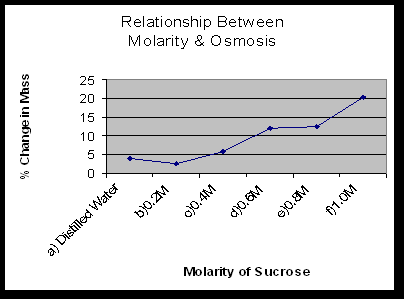
Distilled Water 24.7 23.7 1 4.1
0.2M 26.7 27.4 .7 2.62
0.4M 27.4 29 1.6 5.84
0.6M 25.9 29 3.1 12
0.8M 29 32.6 3.6 12.41
1.0M 28 33.7 5.7 20.4


Table 1.3: Dialysis Bag Results: Class Data


Group 1

Group 2

Group 3

Total Class Average
Distilled Water 4.1% .7% 1.6% 6.4% 2.13%
0.2M 2.62% 6.4% 4.1% 13.12% 4.37%
0.4M 5.84% 9.9% 9.5% 25.24% 8.41%
0.6M 12% 13.4% 9.3% 34.37% 11.57%
0.8M 12.41% 14.6% 15.2% 42.21% 14.07%
1.0M 20.4% 19.7% 15.9% 56% 18.67%


  1. Explain the relationship between the change in mass and the molarity of sucrose within the dialysis bags.  The solute is hypertonic and water will move into the bag.  As the molarity increases the water moves into the bag.
  2. Predict what would happen to the mass of each bag in this experiment if all the bags were placed in a 0.4M sucrose solution instead of distilled water.  Explain.  With the 0.2M bag, the water would move out.  With the 0.4M bag, there will be no net movement of water because the solutions reach dynamic equilibrium.  With the 0.6M-1M bags, the water would move into the bag.
  3. Why did you calculate the percent change in mass rather than simply using the change in mass?  This was calculated because each group began with different initial masses and we would have different data.  All the groups needed consistent data.
  4. A dialysis bag is filled with distilled water and then places in a sucrose solution.  The bag’s initial mass is 20g and its final mass is 18g.  Calculate the percent change of mass, showing your calculations.  ((18-20)/20) x 100 = 10%
  5. The sucrose solution in the beaker would have been hypotonic to the distilled water in the bag.

Exercise 1C


Table 1.4: Potato Core: Individual Data


Contents of Beaker Initial Mass (g) Final Mass (g) Difference in Mass % Change in Mass
Distilled Water 2.8 3.7 .9 32.14
0.2M 2.9 3.1 .2 7
0.4M 2.5 2.2 .3 12
0.6M 2.3 1.9 .4 17.39
0.8M 2.5 1.9 .6 24
1.0M 2.3 1.8 .5 21.74


Table 1.5: Potato Core: Class Data


Group 1 Group 2 Total Class Average
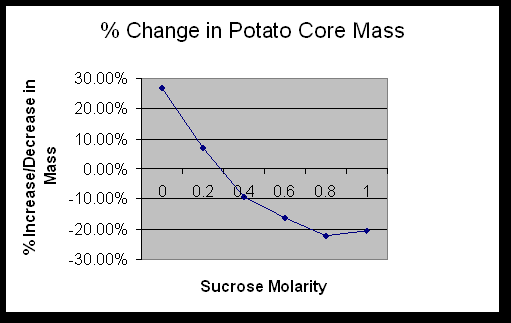
Distilled Water 32.14% 21.1% 53.24% 26.62%
0.2M 7% 6.7% 13.7% 6.85%
0.4M -12% -6.5% -18.5% -9.25%
0.6M -17.39% -15.2% -32.59% -16.30%
0.8M -24% -20% -44% -22%
1.0M -21.74% -19% -40.74% -20.37%


Determine the molar concentration of the potato core.  0.3M

Exercise 1D
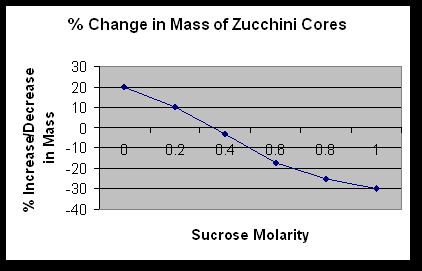


What is the molar concentration of the zucchini cores? .35M


  1. If a potato core is allowed to dehydrate by sitting in the open air, would the water potential of the potato cells decrease or increase? Why?  It would decrease because the water would leave the cells and cause the water potential to go down.
  2. If a plant cell has a lower water potential than its surrounding environment and if pressure is equal to zero, is the cell hypertonic or hypotonic to its environment? Will the cell gain water or lose water?  It is hypotonic and it will gain water.
  3. The beaker is open to the atmosphere.  What is the pressure potential of the system?  The pressure potential is zero.
  4. Where is the greatest water potential?  In the dialysis bag.
  5. Water will diffuse out of the bag. Why? It is because the water moves from and area of high water potential to an area of lower water potential.
  6. What effect does adding solute have on the solute potential component of that solution? Why?  It makes is more negative.
  7. Consider what would happen to a red blood cell placed in distilled water: a) Which would have the higher concentration of water molecules?  Distilled Water  b) Which would have the higher water potential?  Distilled Water  c)  What would happen to the red blood cell? Why?  It would lyce, because it would take on too much water.

Error Analysis:

Possible errors that could have affected the results of the lab include incorrectly mixing the solutions, ineffectively tying the dialysis tubing, inaccurately measuring , and inaccurately calculating.

Conclusion:

            During Exercise 1A the data that was collected help determine which molecules can and can not move across a cell membrane. Obviously, because of the color change in the bag, the IKI was able to move across the membrane.  It is small enough to fit through the pores in the selectively permeable membrane, along with water.  Starch was too large to move across the membrane. Glucose, as the Benedict’s test proves, was able to move freely along with the water and IKI solution.

In Exercise 1B, it was proven that water moves faster across the cell membrane than sucrose.  The water moved to help reach dynamic equilibrium between the 2 solutions.  The sucrose molecules are too big to move across the membrane as fast as water can.

The data in Exercise 1C showed that the potatoes contained sucrose.  The sucrose in the potato raised the solute potential, which lowered the water potential.  The beaker of distilled water had a high water potential.  Water moves down the concentration gradient, causing the potato cores to take on water.

Exercise 1D helped better understand the lab with simple algebra equations.  It proved that the data that was collected was correct through mathematics.


AP Unit Cell Cycle Division


OPENERS NOTES POWERPOINTS WORKSHEETS & INTERACTIVES LABS TEST PREP GREAT LINKS


PREVIOUS CHAPTER NEXT CHAPTER


OPENERS:

Right Click on Topic & choose “SAVE AS” to Show any of these 5 minute class openers!

CELL CYCLE & MITOSIS

MEIOSIS

TOP  

NOTES:


TOP  

POWERPOINTS:


TOP  

WORKSHEETS & INTERACTIVES:


TOP  

LABS:


TOP  

TEST PREP:


TOP  

GREAT LINKS:

  • Cell Division: Binary Fission and Mitosis This site, from the University of Arizona, is an illustrated lecture place on mitosis and cell division. It contains many diagrams that may help you understand all the process of cell division.
  • Studying Cells  Introduce yourself to the cell as the fundamental unit of life and the scientific method.
  • The Cell Cycle & Mitosis  Understand the events that occur in the cell cycle and the process of mitosis that divides the duplicated genetic material creating two identical daughter cells.
  • Mitosis Animation Although the diagrams here are somewhat rough, they do a good job of showing the essential features of mitosis. Just remember that the figures show the nucleus, not the entire cell!
  • Meiosis Understand the events that occur in process of meiosis that takes place to produce our gametes.
  • Prokaryotes, Eukaryotes, & Viruses Learn about the cells that make up all living systems, their organelles, and the differences between living cells and viruses.
  • The Cytoskeleton Learn that the cytoskeleton acts both a muscle and a skeleton, and is responsible for cell movement, cytokinesis, and the organization of the organelles within the cell.
  • Online Onion Root Tips Estimate the amount of time cell spent in each mitotic phase in this animated cyber-version of the chapter’s lab investigation. After completing this activity, identifying the phases of mitosis will be a snap.
  • Spindle Microtubules These amazing pictures show microtubule organization at interphase and during several stages of mitosis. (The microtubules are stained green, and the DNA is stained blue.)
  • Cytokinesis Movie This site shows a very nice cytokinesis of a mouse cell growing in a dish.
  • Amphibian Embryology This site provides a good overview of how mitosis takes a fertilized egg and produces an animal from it

TOP  


AP Sample 6 Lab 5 – Cellular Respiration


Lab 6 Cellular Respiration


Introduction


Cellular respiration is the release of energy from organic compounds by metabolic chemical oxidation in the mitochondria within each cell. Enzyme mediated reactions are required. The equation for cellular respiration is:

C6H12O6 + 6 O2 à 6 CO2 + 6 H2O + 686 kilocalories of energy/mole of glucose oxidized

Several different measures can be taken from this equation. The consumption of oxygen, which will tell you how many moles of oxygen are consumed during cellular respiration. That is what was measured in this lab. The production of CO2 can also be measured. And of course the release of energy can be measured. Cellular respiration is a catabolic pathway and the mitochondria houses most of the metabolic equipment for cellular respiration. It will break down glucose in what we call an exergonic reaction. Like previously said, the consumption of oxygen molecules will be measured in a gas form. One must know the physical laws of gases when working with them. The laws are summarized by the following equation.

PV=Nrt

Where:

P stands for the pressure of the gas

V is the volume of the gas

n is the number of molecules of gas

R is the gas constant (fixed value)

T is the temperature of the gas ( in K° )

The CO2 produced during cellular respiration will be removed by potassium hydroxide (KOH) and will form a solid potassium carbonate (K2CO3) when the following reaction occurs: CO2 + 2 KOH à K2CO3+ H2O

Since the CO2 is removed, the change in the volume of gas in the respirometer will be directly related to the amount of oxygen consumed. If the water temp and volume stay constant then the water will move toward the region of lower pressure. During respiration, oxygen will be consumed and its volume will be reduced because the CO2 is being converted to a solid. The net result is a decrease in gas volume in the tube and a decrease in pressure of the tube. The vial with beads will detect any atmospheric changes.

Hypothesis

Several different things will affect the rate of O2 consumption. The non germinating peas will have a lower rate than the germinating peas and the coldness of the water will slow the rates.

Materials

The materials used for this lab were: a 100 mL graduated cylinder, 6vials,germinating peas, dry peas, glass beads, 2 water baths, absorbent cotton and non-absorbent cotton, weights, KOH, water, stoppers, pipettes, rubber bands, masking tape, glue, thermometer, ice, a pencil, and paper.

Methods

Set up a 25° C and a 10° C water bath. Ice may be used to obtain 10° C.

Respirometer 1:Obtain a 100 mL graduated cylinder and fill it with 50 mL of H2O.

Drop in 25 germinating peas. Determine the amount of water displaced. Pea volume =11 mL. Take peas out and place on paper towel.

Respirometer 2: refill cylinder with 50 mL of H2O. Drop 25 dry peas into the cylinder. Add glass beads to obtain the same volume that you got in respirometer 1. Remove peas and beads to a paper towel.

Respirometer 3: Add 50 mL of water to the cylinder. Put only beads in to get an equivalent volume to the first 2 respirometers. Put on paper towel when finished. Repeat respirometer 1 steps for respirometer 4. And 2 for 5. And 3 for 6. Listen to your teacher on how and where to set up the respirometers. Now fill your vials with the required items shown in the table and in figure 5.1. Seal the vials after your items have been put in to stop any gas or water leaks. Place a weighted collar onto the bottom of your vials so they will stay submerged in the water baths. During equilibration use masking tape attached to each side of the water baths to hold the respirometers out of water for 7 minutes. Vials 1-3 should be in the 25° C water bath and vials 4-6 should be in the 10° C water bath. Finally submerge totally the respirometers and let them equilibrate for 3 more minutes. Read the water line where the oxygen is and record in intervals of 5 minutes all the way up to 25 minutes. Record in table 5.1.


Results

Table 5.1: Measurement of O2 Consumption by Soaked and Dry Pea Seeds at Room Temperature and 10° C Using Volumetric Methods


Beads Alone

Germinating Peas

Dry Peas and Beads

Reading at time X Diff. Reading at time X Diff. Corrected Diff. Reading at time X Diff. Corrected Diff.
Initial-0 1.35 1.62 1.32
0-5 1.33 .02 1.20 .42 .4 1.32 .0 .02
5-10 1.33 .02 1.12 .50 .48 1.3 .02 .0
10-15 1.32 .03 1.02 .60 .57 1.29 .03 .0
15-20 1.32 .03 .92 .7 .67 1.3 .02 .01
 

Initial-0

1.48 1.37 1.46
 

0-5

1.48 .0 1.15 .22 .22 1.45 .01 .01
 

5-10

1.45 .03 .98 .39 .36 1.44 .02 .01
 

10-15

1.43 .05 .84 .53 .48 1.43 .03 .02
 

15-20

1.41 .07 .70 .67 .6 1.41 .05 .02


In this activity, you are investigating both the effects of germination versus non-germination and warm temperature versus cold temperature on respiration rate. Identify the hypothesis being tested on this activity.
The nongerminating peas will have a slower rate of respiration than the germinating peas and the coldness of the water will slow down the rate as it gets colder.


This activity uses a number of controls. Identify at least three of the controls, and describe the purpose of each.
The three controls are the beads in one vial controlling the barometric pressure, the KOH keeps equality in the consumption of CO2, and the time intervals give each vial the same amount of time so the results will not be affected.

Describe and explain the relationship between the amount of oxygen consumed and time.
The relationship was pretty constant, there may have been a gradual rising in O2 consumption.

5.


Condition


Calculations


Rate in mL O2/ minute


Germinating Peas/ 10 oC


(1.62-.92)

20

.035
 

Germinating Peas/ 20 oC


(1.37-.7)

20

.0335
 

Dry Peas/ 10 oC


(1.32-1.30)

20

.001
 

Dry Peas/ 20 oC

(1.46-1.41)

20

.0025


Why is it necessary to correct the readings from the peas with the readings from the beads?
The beads were just a control, experiencing no gas change.


Explain the effects of germination (versus non-germination) on pea seed respiration.
The germinating seeds had a higher metabolic rate and therefore consumed more oxygen than the nongerminating.

Above is a sample graph of possible data obtained for oxygen consumption by germinating peas up to about 8 oC. Draw in predicted results through 45 oC. Explain your prediction.
Once the temperature gets above about 30 degrees C, the enzymes will denature and that will be the end of respiration.


What is the purpose of KOH in this experiment?
The KOH will take the CO2 and turn it to a precipitant at the bottom of the vial and it will have no affect on the O2 readings.


Why did the vial have to be completely sealed under the stopper?
The vial had to be sealed or gas would leak out and water could leak in and affect the results.


If you used the same experimental design to compare the rates of respiration of a 35g mammal at 10 oC, what results would you expect? Explain your reasoning.
Respiration would be higher in the mammal because they are warm-blooded.


If respiration in a small mammal were studied at both room temperature (21 oC) and 10 oC, what results would you predict? Explain your reasoning.
The rate of respiration would be higher in the 21-degree bath because the mammal would perform better when its body was more comfortable.


Explain why water moved into the respirometer pipettes.
The water moved in the vial because it was fully submerged in water but it came to a stop when it met the oxygen coming out of the vial.

14. Design an experiment to examine the rates of cellular respiration in peas that have been germinating for 0, 24, 48, and 72 hours. What results would you expect? Why?
You could put peas in vials each from a time interval above. You would have a vial with just started germinating peas, one with 24 hour germinating peas, another with 48 hour peas, and the last with 72 hour peas. Place them in a room temp water bath. Take readings at intervals of 5 min up to 20 min. The 72-hour peas should have more O2 consumption because they will use more oxygen because they have been germinating the longest. The just started germinating peas would use the least O2 because they haven’t been germinating vary long. The other two will be in the middle of the “just started peas” and the “72 hour peas”.


Error Analysis


Many errors could have been made in this lab. There could have been miscalculations when trying to equal the pea volumes. The stoppers might not have been sealed and gas could have been lost from the vials affecting the results with vengeance. The water temperatures had to be maintained precisely or the results would not be what they should be. There was also a lot of math in this lab when figuring results and many numbers could have been affected by this poor math.


Disussion and Conclusion

This lab showed many things about thew rates of cellular respiration. This lab showed that germinating peas consume more O2 than nongerminating peas. The colder temperature also slowed the rate of oxygen consumption. The oxygen could be clearly seen because of the following reaction

CO2+2KOH à K2O3 +H2O

This reaction gets rid of the CO2 so that it would not affect the readings of oxygen. It is absorbed by KOH to give you a precipitant K2CO3 + H2O. I conclude that the rate of O2 consumption is directly proportional to the respiration rate in that when the rate increases the gas consumption increases. When the gas consumption is low then the rate is low. Organisms go through cellular respiration more proficiently when the body of the organism is comfortable with its outside temp and environment. This lab showed many things affecting the rate of cellular respiration.

BACK


AP Lab 1 Osmosis Sample 3


Diffusion and Osmosis


Introduction:

Atoms and molecules are constantly in motion. This kinetic energy causes the molecules to bump into each other and move in different directions. This motion is the fuel for diffusion. Diffusion is the random movement of molecules from an area of higher concentration to an area of lower concentration. This will occur until the two areas reach a dynamic equilibrium. When this dynamic equilibrium is reached the concentration of molecules will be approximately equal and there will be no net movement of molecules after this point. The molecules will still be in motion but the concentrations will remain the same.

Osmosis is a special kind of diffusion in which water moves through a selectively permeable membrane. A selectively permeable membrane allows diffusion for only certain solutes (the substance being dissolved) and water, the most common solvent (a dissolving substance). The most common selectively permeable membrane is the cell membrane. Water moves from an area of high water potential to an area of low water potential. Water potential is the measure of free energy of water in a solution and is represented by the symbol ψ (psi). Water potential is affected by two physical factors: the addition of a solute (ψs) and pressure potential (ψp). The addition of solutes to a concentration will lower the water potential of that solute, causing water to move into the area. Water movement is directly proportional to the pressure potential. Water potential can be determined by the equation:

ψ = ψp + ψs

Pure water has a water potential of zero. The addition of solutes will cause the water potential value to be negative, while an increase in pressure potential will cause a more positive water potential value.

There are three relationships that can occur between two solutions. When two solutions have equal solute concentrations, they are isotonic and no net movement of solute occurs. There is also no net movement of water. If the two solutions differ in solute concentrations, they will either be hypertonic or hypotonic. The hypertonic solution has a lower concentration of solute. Water will move out of a hypertonic solution, while solute will move in, (moving up the concentration gradient-similar to water potential). This depends on the selective qualities of the membrane. Pertaining to cells, this will cause the cell to shrivel or become flaccid. The hypotonic solution has a higher concentration of solute, and therefore has less water. This solution will gain water, while losing solute. This movement between the hypotonic and hypertonic solutions will continue until the point of dynamic equilibrium is reached. A hypertonic cell may also undergo plasmolysis. Plasmolysis is the shrinking of the cytoplasm in a plant cell in response to the diffusion of water out of the cell. When a cell is hypotonic it may lyse. In plant cells, it creates turgor pressure against the cell walls keeping the plant from becoming wilted.

Besides osmosis and diffusion, molecules and ions can be moved by active transport. This process includes the use of ATP to drive molecules in or out of a cell. Active transport is generally used to move molecules against a concentration gradient, from an area of low concentration to an area of higher concentration of molecules.


Hypothesis:

In this experiment, diffusion and osmosis will occur until dynamic equilibrium is reached. This experiment is done in a theoretical condition with no other variables affecting the movement of the solute except water potential.


Materials:


Exercise 1A

This exercise requires a 30 cm of 2.5 cm dialysis tubing, 250 ml beaker, distilled water, 2 dialysis tubing clamps, 15 ml of 15% glucose/1% starch solution, 4 pieces of glucose tape, 4 ml of Lugol’s solution (Iodine Potassium-Iodide or IKI), and clock or timer.

Exercise 1B

This experiment requires six strips of 30 cm dialysis tubing, 250 ml beaker, 12 dialysis tubing clamps, distilled water six cups, scale, timer or clock, paper towels, and about 25 ml of each of these solutions: distilled water, .2 M glucose, .4 M glucose, .6 M glucose, .8 glucose, and 1.0 M glucose.

Exercise 1C

This experiment requires a large potato, potato corer (about 3 cm long), 250 ml beaker, paper towel, scale, six cups, knife, and about 100 ml of each of these solutions: distilled water, .2 M glucose, .4 M glucose, .6 M glucose, .8 glucose, and 1.0 M glucose.

Exercise 1D

This experiment requires a calculator, paper, pencil, and graphing paper.

Exercise 1E

This experiment requires onion skin, dye, microscope, slide, cover slip, salt water (15%), and tap water.


Methods:


Exercise 1A

First, soak the dialysis tubing in distilled water for 24 hours. Remove the tubing and tie off one end using the clamp (twist tubing end about 7 times and fold end on self, slide into the clamp). Next, open the other end of the tubing (rubbing end between fingers) and fill it with the glucose/starch solution. Use the glucose tape and record the color change of the tape and the color of the bag. Tie of the end with the tubing clamp (leave empty space, but no air). Fill the beaker with distilled water and add the 4-ml’s of Lugol’s solution, record the color change. Use glucose tap to test for any glucose in the water (record). Set the dialysis tubing in the beaker and let it sit for about 30 minutes. Remove the bag and record the change in water and bag color. Use the last two pieces of glucose tape to measure the glucose in the water and bag and record results.

Exercise 1B

First, soak the dialysis tubing for about 24 hours. Tie off one end of each tube with the clamps. Next, fill each tube with a different solution (distilled water, .2 M glucose, .4 M glucose, .6 M glucose, .8 glucose, and 1.0 M glucose) and tie off the end (leave empty space, but no air). Weigh each tube separately and record the masses. Soak the tubes in separate cups filled with distilled water for about 30 minutes. Remove the tubing, blot dry, reweigh, and record the mass.

Exercise 1C

First, slice the potato into to 3-cm discs. Use the potato corer and core out 24 cores (don’t get any). Weigh 4 cores together and record the mass. Fill each cup with a different solution (distilled water, .2 M glucose, .4 M glucose, .6 M glucose, .8 glucose, and 1.0 M glucose). In each cup put 4 potato cores and let it sit over night. Take out the cores and blot them dry. Record the change in mass. Calculate the information and compare.

Exercise 1D

First, determine the solute potential of the glucose solution, the pressure potential, and the water potential. Then, graph the information given about the zucchini cores.

Exercise 1E

First, prepare a wet mount slide of dyed onion skin. Observe under a light microscope and sketch what the cells. Add a few drops of the salt solution, observe, and sketch the change.


Results:


Exercise 1A


Table 1    Change of Color of Dialysis Tubing and Beaker


Solution Color


Presence of Glucose (Glucose Tape)


Initial


Final


Initial


Final


Dialysis Bag

15% Glucose/1% Starch Clearish White Indigo Dark brown Mahogany
 

Beaker

Water + IKI Amber Amber Yellow teal Tan-green


Which substance(s) are entering the bag and which are leaving the bag? What experimental evidence supports your answer?


Glucose is leaving the bag slowly; this is shown buy using the glucose tape in the beaker. Iodine is entering the dialysis bag; this is shown by the change of color in the bag. Water enters the bag; the bag becoming fatter, which shows this.


Explain the results you obtained. Include the concentration differences and membrane pore size in your discussion.


The substances moved and out of the bag, according to the gradient. Some were small substances and moved in and out of the bag quickly and easily. The larger substances, like starch and glucose, were slow or didn’t enter or leave the bag at all.


Quantitative data uses numbers to measure observed changes. How could this experiment be modified so that quantitative data could be collected to show that water diffused into the dialysis bag?


The mass of the bag could be recorded before and after soaking.


Based on your observations, rank the following by relative size, beginning with the smallest: glucose molecules, water, IKI, membrane pores, and starch molecules.


Water→ IKI→ Glucose Molecules→ Membrane Pores→ Starch Molecules


What results would you expect if the experiment started with a glucose and IKI solution inside the bag and only starch and water outside? Why?

The IKI would have left the bag and changed the color of the solution in the beaker. Eventually dynamic equilibrium would be reached and there will be no net movement.

Exercise 1B


Table 2    Dialysis Bag Results: Individual Data


Contents of Dialysis Bag


Initial Mass

(g)


Final Mass

(g)


Mass Difference (g)


Percent Change in Mass*


a) Distilled Water

24.0 24.2 0.2 .83%
 

b) 0.2 M

26.2 26.7 0.5 1.9%
 

c) 0.4 M

26.4 27.0 0.6 2.2%
 

d) 0.6 M

27.9 31.2 3.3 11.8%
 

e) 0.8 M

28.4 31.9 3.5 12.3%
 

f) 1.0 M

29.6 34.6 5.0 16.9%


* To Calculate: Percent Change in Mass = Final Mass – Initial Mass

Initial Mass * 100


Table 3

Dialysis Bag results: Class Data


Solution


Group 1


Group 2


Group 3


Average


a) Distilled Water

.77% 1.53% .83% 1.04%
 

b) 0.2 M

1.86% 5.30% 1.9% 3.02%
 

c) 0.4 M

2.4% 2.22% 2.2% 2.27%
 

d) 0.6 M

12.54% 9.75% 11.8% 11.36%
 

e) 0.8 M

13.07% 9.64% 12.3% 11.67%
 

f) 1.0 M

16.55% 18.98% 16.9% 17.48%
 

Team Members

Tripp & Stephanie Hudgens & Kris Elizabeth & Julie  

7.81%


Graph 1

Percent Change in Mass of Dialysis Tubing in Glucose Solutions of Different Molarity

Explain the relationship between the change in mass and the molarity of sucrose within the dialysis bags.


They are directly proportional. The percent change of mass goes up as the molarity of the sugar goes up.


Predict what would happen to the mass of each bag in this experiment if all the bags were placed in a 0.4 M sucrose solution instead of distilled water. Explain your response.


There will be no net movement when 0.4 M is in the dialysis bag. When the concentration is above 0.4, the bag will lose water. When the concentration is below 0.4, the bag will gain water.


Why did you calculate the percent change in mass rather than simply using the change in mass?


The volumes of the solutions were not exactly the same.


A dialysis bag is filled with distilled water and then placed in a sucrose solution. The bag’s initial mass is 20g, and its final mass is 18g. Calculate the percent change of mass, showing your calculations in the space below.


Percent Change in Mass = Final Mass – Initial Mass    X  100 = 18-20 x 100 = 10%

Initial Mass                               20


The sucrose solution in the beaker would have been hypertonic to the distilled water in the bag.


Exercise 1C


Table 4     Potato Core: Individual Data


Contents of Beaker


Initial Mass (g)


Final Mass (g)


Mass Difference (g)


% Change in Mass


a) Distilled Water

1.8 21. .3 16.7
 

b) 0.2 M

1.5 1.7 .2 13.3
 

c) 0.4 M

1.5 1.8 .3 20
 

d) 0.6 M

1.6 1.3 .3 -18.75
 

e) 0.8 M

1.4 1.1 .3 -21.4
 

f) 1.0 M

1.6 1.3 .3 -18.75


Table 5     Potato Core Results: Class Data


Contents

Group 1  

Group 2


Total


Class Average


Distilled Water

16.7% 28.5% 45.2% 22.6%
 

0.2 M Sucrose

13.3% 21.4% 34.7% 17.35%
 

0.4 M Sucrose

20.0% 14.28% 34.28% 17.14%
 

0.6 M Sucrose

-18.75% -20.0% -38.75% -19.38%
 

0.8 M Sucrose

-21.4% -26.66% -48.06% -24.03%
 

1.0 M Sucrose

-18.75% -21.42% -40.17% -20.09%


Graph 2

Percent Change in Mass of Potato Cores at Different Molarities of Glucose


Exercise 1D


If a potato is allowed to dehydrate by sitting in the open air, would the water potential of the potato cells decrease or increase? Why?


The water potential of the cells will decrease, the osmotic potential will decrease, and the solute will increase. This occurs because the cells have become dehydrated.


If a plant cell has a lower water potential than its surrounding environment, and if pressure is equal to zero, is the cell hypertonic or hypotonic to its environment? Will the cell gain water or lose water? Explain your response.


The environment is hypotonic, so it will gain water. This is because it has less water than the surrounding environment.


In figure 1.5, the beaker is open to the atmosphere. What is the pressure potential of the system?


The pressure potential is zero.


In figure 1.5, where is the greatest water potential?


The dialysis bag.


Water will diffuse out of the bag. Why?


The water will diffuse out because there is higher water potential inside the bag.


Zucchini cores placed in sucrose solutions at 27° C resulted in the following percent changes after 23 hours:

% Change in Mass Sucrose Molarity

20% Distilled Water

10% 0.2 M

-3% 0.4 M

-17% 0.6 M

-25% 0.8 M

-30% 1.0 M

Graph 3

Percent Change in Mass of Zucchini Cores of Sucrose Solutions of Different Molarity

b) What is the molar concentration of solutes with in the zucchini in cells?

About .36 M


Refer to the procedure for calculating water potential from experimental data.

Calculate solute potential (ψs) of the sucrose solution in which the mass of the zucchini cores doesn’t change. Show work.


ψs =-iCRT
ψs =-(1)(0.35)(0.0831)(295)
ψs =-8.580075

ψ =0+ ψs
ψ =0+(-8.580075)
ψ =-8.580075


Calculate the water potential (ψ) of the solutes within the zucchini cores. Show work here.


ψ = ψs + ψp

-8.580075 = ψs + 0

-8.580075 = ψs


What effect does adding solute have on the solute potential component of that solution? Why?


Adding more solute will increase the solute potential and decrease water potential by making it more negative.


Consider what would happen to a red blood cell placed in distilled water:
a) Which would have the higher concentration of water molecules?


Distilled Water

b) Which would have the higher water potential?


Distilled Water

c) What would happen to the red blood cell? Why?

The red blood cells would pull in water and lyse.


Exercise 1E


Prepare a wet mount of a small piece of epidermis of an onion. Observe under 100x magnification. Sketch and describe the appearance of the onion cells.


Describe the appearance of the onion cells after the NaCl was added.


The plasma membrane shriveled from the cell wall, causing plasmolysis.


Remove the cover slip and flood the onion with fresh water. Observe and describe what happened.


The onion cells absorbed water and increasing in turgor pressure.


What is plasmolysis?


Plasmolysis is the shrinking of the cytoplasm of a plant cell in response to diffusion of water out or the cell and into a hypertonic solution surrounding the cell.


Why did the onion cell plasmolyze?


The environment became hypertonic to the cell and the water left the cell running with its concentration gradient because of the salt. With all the water leaving the cell, it shrank, leaving behind its cell wall.


In the winter, grass often dies near roads that have been salted to remove ice. What causes this to happen?


The salt causes the plant cells to plasmolyze.


Error Analysis:

Exercise 1A

Error that could have occurred in this experiment is that some of the glucose/starch solution could leaked into the beaker before the dialysis bag was inserted, but after the glucose test.
Exercise 1B

Error that could have occurred in this experiment is that the sugar could mot have been mixed completely with the water or some sugar could have been lost during the mixing. Another mistake could be that the bags were not bloated dry well enough.
Exercise 1C

Error that could have occurred in this experiment is that the sugar could mot have been mixed completely with the water or some sugar could have been lost during the mixing. Another mistake could be that the potato cores were not bloated dry well enough. Also the measuring of the liquids’ volumes may not have been accurate.
Exercise 1D

Errors that could have been made in this exercise could be that the numbers were put in the calculator wrong.
Exercise 1E

Error that could have been made in this exercise could have been that the onion skin could have dried out before the salt water was added, thus affecting the results.


Discussion and Conclusion:


Exercise 1A

In this experiment, the ability of substances to move across a selectively permeable membrane was viewed. A glucose/starch solution was put in the dialysis bag. The glucose molecules leaked out of the bag (learned from before and after test with glucose tape). Using IKI to test for starch, the change in color for the bag only shows that the starch molecules were too large to escape out of the dialysis bag, but the IKI molecule were small enough to enter the bag.

Exercise 1B

In this experiment, the study of hypotonic and hypertonic solution was tested. When the bags were placed in a hypotonic solution, they gained water. This could be viewed by massing the bags before and after the soaking.

Exercise 1C

In this experiment, potato cores were proven to have some sugar in them. When placed in low or no sugar environments, they gained water. When placed in high sugar environments, the cores lost water.

Exercise 1D

In this experiment, all these conclusion made in previous experiments were reinforced with scientific equations.

Exercise 1E

In this experiment, the turgor pressure of a plant cell’s plasma membrane was observed. The plasma membrane gives the cell shape and form. When salt is added, the cytoplasm loses water and causes the plasma membrane to shrink. This causes the plant to wilt.

Concentration gradient and water potential affected all aspects of this experiment. Water potential is used by many scientists to study the effects of different substance on plants, for good or bad. Pressure potential and solute potential are the two main components. Water moves to different areas based on water potential. Water will move from high water potential to low or low water potential to high. This change is called a gradient. Ψs = -iCRT is the formula used for solute potential. Water potential and solute potential are inversely proportional. When water potential goes up, solute potential is low. All these factors affected the results of these experiments.

Plant and animal cells react differently to different environment. A hypertonic solution will cause an animal cell to shrink in size. A hypotonic solution for an animal cell will cause it to lyse. Isotonic solutions are ideal for animal cells. Plant cell’s plasma membrane shrinks if in a hypertonic solution, causing the cell wall to loose shape or plasmolyze. While an isotonic solution is good, it doesn’t provide quite enough support for the cell wall. Hypotonic solutions are the best for plant cells. The plasma membrane presses against the inside of the cell wall giving it a lot of support. Without this pressure, turgor pressure, the plant will wilt and die. These experiments enable us to better understand living things, including our own bodies, and be able to take care of them.

BACK


AP Lab 5 Sample 7


Cellular Respiration

Blake Lockwood

Introduction:


The human body has to have energy in order to perform the functions that allow life. This energy comes from the process of cellular respiration. Cellular respiration releases energy that the body can use in the form of ATP from carbohydrates by using oxygen. Cellular respiration is not just one singular reaction, it is a metabolic pathway made up of several reactions that are enzyme mediated. This process begins with glycolysis in the cytosol of the cell. In glycolysis, glucose is split into two three-carbon compounds called pyruvate, producing a small amount of ATP The final two steps of cellular respiration occur in the mitochondria. These final two steps are the electron transport system and the Krebs Cycle. The overall equation for cellular respiration is

C6H12O6 + 6O2 -> 6CO2 + 6H2O + 686 kilocalories of energy per mole of glucose oxidized.

There are three ways to measure the rate of cellular respiration. These three ways are by measuring the consumption of oxygen gas, by measuring the production of carbon dioxide, or by measuring the release of energy during cellular respiration. In order to measure the gases, the general gas law must be understood. The general gas law state: PV=nRT where P is the pressure of the gas, V is the volume of the gas, n is the number of molecules of gas, R is the gas constant, and T is the temperature of the gas (in K). The gas law also shows concepts about gases. If temperature and pressure are kept constant, then the volume of the gas is directly proportional to the number of molecules of the gas. If the temperature and volume remain constant, then the pressure of the gas changes in direct proportion to the number of molecules of gas present. If the number of gas molecules and the temperature remain constant, then the pressure is inversely proportional to the volume. If the temperature changes and the number of gas molecules is kept constant, then either pressure of volume will change in direct proportion to the temperature.

In this experiment, the rate of cellular respiration will be measured by measuring the oxygen gas consumption by using a respirometer in water. This experiment measures the consumption of oxygen by germinating and non-germinating at room temperature and at ice water temperature. The carbon dioxide produced in cellular respiration will be removed by potassium hydroxide (KOH). As a result of the carbon dioxide being removed, the change in the volume of gas in the respirometer will be directly related to the amount of oxygen consumed. The respirometer with glass beads alone will show any changes in volume due to atmospheric pressure changes or temperature changes.


Hypothesis:


The germinating peas will have a higher rate of respiration, than the beads and non-germinating peas.


Materials:


This lab requires two thermometers, two water baths, beads, germinating and non-germinating peas, beads, six vials, twelve pipettes, 100 mL graduated cylinder, scotch tape, tap water, ice, KOH, absorbent and non-absorbent cotton, six washers, six rubber stoppers, scotch tape, and a one mL dropper.


Methods:


Start the experiment by setting up two water baths, one at room temperature and the other at 10 degrees Celsius. Then, find the volume of twenty-five germinating peas. Next, put 50 mL of water in a graduated cylinder and put twenty-five non-germinating peas in it. Then, add beads until the volume is the same as twenty-five germinating peas. Next, pour our the peas and beads, refill the graduated cylinder with 50 mL of water, and add only beads until the volume is the same as the twenty-five germinating peas. Repeat these steps for another set of peas and beads. Also, put together the six respirometers by gluing a pipette to a stopper and taping another pipette to the pipette for all six respirometers. Then, put two absorbent cotton balls, several drops of KOH, and half of a piece of non-absorbent cotton into all six vials. Next, add the peas and beads to the appropriate respirometers. Place one set of respirometers into the room temperature water bath and the other set in the ice water bath. Elevate the respirometers by setting the pipettes onto masking tape and allow them to equilibrate for five minutes. Next, lower the respirometers into the water baths and take reading at 0, 5, 10, 15, and 20 minutes. Record the results in the table.


Results:


Table:


Beads Alone Germinating Peas

Dry Peas and Beads

Reading at time X Diff. Reading at time X Diff. Corrected Diff.


Reading at time X Diff. Corrected Diff.
Initial 13.2 12.7 12.9
0 to 5 11.0 2.2 10.5 2.2 0.0 11.1 1.8 -0.4
5 to 10 10 3.2 9.0 3.7 0.5 10.0 2.8 -0.3
10 to 15 9.2 4.0 8.0 4.7 0.7 9.4 3.5 -0.5
15 to 20 9.1 4.0 7.5 5.1 1.2 9.3 3.6 -0.4
Initial 14.0 13.5 14.0
0 to 5 13.3 0.7 12.1 1.4 0.7 13.6 0.4 -0.3
5 to 10 12.9 1.1 11.0 2.5 1.4 13.2 0.8 -0.3
10 to 15 12.6 1.4 10.0 3.5 2.1 12.9 1.1 -0.3
15 to 20 12.2 01.8 9.0 4.5 2.7 12.5 1.5 -0.3


Questions

1. In this activity, you are investigating both the effect of germination versus non-germination and warm temperature versus cold temperature on respiration rate. Identify the hypothesis being tested in this activity. Increasing the temperature could increase the oxygen consumption. Germinating peas have a higher respiration rate than non-germinating.


2. This activity uses a number of controls. Identify at least three of the controls, and describe the purpose of each control. One control was the respirometer with only beads in it because it didn’t use respiration. Another control was that the water temperatures were constant. The final control was that there was the same amount of KOH in each vial.


3. Graph the results from the corrected difference column for the germinating peas and dry peas at both room temperature and at 10 degrees Celsius. On graph paper.


4. Describe and explain the relationship between the amount of oxygen gas consumed and time. The oxygen gas consumed increased fairly constantly in respect to time.


5. From the slope of the four lines on the graph, determine the rate of oxygen gas consumption of germinating and dry peas during the experiments at room temperature and at 10 degrees Celsius. Recall that rate = _y over _x.


Condition Show Calculations Here Rate in mL oxygen gas/minute
Germinating Peas/10°C (1.2-0.7)/5 0.1
Germinating Peas/ Room Temperature (2.7-2.1)/5 0.12
Dry Peas/10°C (-.4-0)/5 -0.08
Dry Peas/Room Temperature (-.3-(-.3))/5 0


6. Why is it necessary to correct the readings from the peas with the readings from the beads? The gas changes in the beads were only due to pressure and temperature, and not gas consumption, so the beads act as a control.


7. Explain the effect of germination (versus non-germination) on pea seed respiration. Germinating peas consumed more oxygen than non-germinating.


8. Below is a sample graph of possible data obtained for oxygen consumption by germinating peas up to about 8 degrees Celsius. Draw in predicted results through 45 degree Celsius. Explain your predictions.


The amount of oxygen consumed will steadily increase until the temperature reaches a point at which the enzymes become denatured.


9. What is the purpose of KOH in this experiment? The purpose of the KOH was to remove the effect of carbon dioxide from the readings.


10. Why did the vial have to be completely sealed around the stopper? The vial had to be completely sealed so that gases couldn’t escape and water couldn’t leak into the respirometer.


11. If you used the same experimental design to compare the rates of respiration of a 25 g. reptile and a 25 g. mammal, at 10 degrees Celsius, what results would you expect? Explain your reasoning. The reptile would use less oxygen because it is cold-blooded and wouldn’t be as active at a colder temperature as the mammal would.


12. If respiration in a small mammal were studied at both room temperature (21°C) and 10°C, what results would you predict? Explain your reasoning. The respiration of the small mammal would be higher at 10 degrees Celsius because it would need more energy to keep its normal body temperature.


13. Explain why water moved into the respirometers’ pipettes. Water moved into the respirometer’s pipettes because pressure decreased when the amount of oxygen was decreased.


14. Design an experiment to examine the rates of cellular respiration in peas that have been germinating for 0, 24, 48, and 72 hours. What results would you expect? Why?


Set up five respirometers containing beads, non-germinating peas, peas that have germinated for one day, peas that have germinated for two days, and peas that have germinated for three days. Measure the water readings in intervals of five minutes for twenty minutes. The peas that have been germinating for three days will have the highest rate of respiration and the beads will have the lowest rate of respiration.


15. According to your graph, what happens to the rate of oxygen consumed by germinating peas over time? What does this indicate to you? The rate of oxygen consumption is fairly constant.


16. How did the KOH affect the water movement in the respirometer? It allows more water into the pipette.


17. Which of the two pea types, germinating or non-germinating, consumes the most oxygen? Why? Germinating peas consume more oxygen because they are growing and are more active than non-germinating peas.


18. What was the effect of temperature on pea respiration? Warmer temperatures allow for the peas to respire at a faster rate.


19. During aerobic respiration, glucose is broken down to form several end products. Which end products contain the carbon atoms from glucose? The hydrogen atoms from glucose? The oxygen atoms from glucose? The energy stored in the glucose molecules? Carbon dioxide contains the carbon, water contains the hydrogen, both carbon dioxide and water contain the oxygen, and ATP contains the energy.


20. What is fermentation? What are the two types of fermentation? What organisms use fermentation? Fermentation is a catabolic process that makes a limited amount of ATP from glucose without an electron transport chain and that produces an end-product such as ethyl alcohol or lactic acid. The two types of fermentation are alcoholic and lactic acid fermentation. Plants use alcoholic while animals use lactic acid.


21. Draw a Venn diagram showing how respiration and fermentation are similar and how they differ.


22. What are the three pathways involved in the complete breakdown of glucose to carbon dioxide and water? What reaction is needed to join two of these pathways? What are the substrates and products of this reaction and where does it take place? The three pathways are glycolysis, the electron transport chain, and the Krebs Cycle. The reaction of the pyruvate joining with CoA enzyme and NAD to produce acetyl CoA, NADH, and carbon dioxide. The acetyl CoA goes to the Krebs Cycle and NADH to the electron transport chain in the mitochondria.

23. Write the letter of the pathway that best fits each of the following processes.

Pathway

a. Glycolysis

b. Krebs Cycle

c. Electron Transport System

Process

1. Carbon dioxide is given off b.

2. Water is formed c.

3. PGAL a.

4. NADH becomes NAD+ c.

5. Oxidative phosphorylation c.

6. Cytochrome carriers c.

7. Pyruvate a.

8. FAD becomes FADH2 b.

24. Calculate the energy yield of glycolysis and cellular respiration per glucose molecule. Distinguish between substrate-level phosphorylation and oxidative phosphorylation. Where does the energy for oxidative phosphorylation come from? 36 ATPs are formed per glucose moelcule. Four of the ATPs are formed from substrate level and 32 from oxidative.


Substrate

Oxidative Total
Glycolysis 2 4 6
Transition 0 6 6
Krebs 2 22 24
Total 4 32 36


Error Analysis:

Some of the errors that could have occurred during the experiment were water leaking into the respirometers, gas escaping the respirometers, water temperature in the bath changing, and mathematical mistakes.

Discussion and Conclusion:

This lab showed that germinating peas consumed more oxygen at a faster rate than the non-germinating peas and the beads did. The non-germinating peas and the beads didn’t consume hardly any oxygen at all. It also showed that the respiration rate of germinating peas was faster than the respiration rate of non-germinating peas. Finally, this experiment showed that respiration rates increase as the temperature increases. This shows that temperature and respiration rates are directly proportional to each other.