Category: Chemistry of Organisms
Properties of Water
| Properties of Water | ![]() |
Introduction:
Water’s chemical description is H2O. As the diagram to the left shows, that is one atom of oxygen bound to two atoms of hydrogen. The hydrogen atoms are “attached” to one side of the oxygen atom, resulting in a water molecule having a positive charge on the side where the hydrogen atoms are and a negative charge on the other side, where the oxygen atom is. This uneven distribution of charge is called polarity. Since opposite electrical charges attract, water molecules tend to attract each other, making water kind of “sticky.” As the right-side diagram shows, the side with the hydrogen atoms (positive charge) attracts the oxygen side (negative charge) of a different water molecule. (If the water molecule here looks familiar, remember that everyone’s favorite mouse is mostly water, too). This property of water is known as cohesion.
All these water molecules attracting each other mean they tend to clump together. This is why water drops are, in fact, drops! If it wasn’t for some of Earth’s forces, such as gravity, a drop of water would be ball shaped — a perfect sphere. Even if it doesn’t form a perfect sphere on Earth, we should be happy water is sticky. Water is called the “universal solvent” because it dissolves more substances than any other liquid. This means that wherever water goes, either through the ground or through our bodies, it takes along valuable chemicals, minerals, and nutrients.
Water, the liquid commonly used for cleaning, has a property called surface tension. In the body of the water, each molecule is surrounded and attracted by other water molecules. However, at the surface, those molecules are surrounded by other water molecules only on the water side. A tension is created as the water molecules at the surface are pulled into the body of the water. This tension causes water to bead up on surfaces (glass, fabric), which slows wetting of the surface and inhibits the cleaning process. You can see surface tension at work by placing a drop of water onto a counter top. The drop will hold its shape and will not spread.
In the cleaning process, surface tension must be reduced so water can spread and wet surfaces. Chemicals that are able to do this effectively are called surface active agents, or surfactants. They are said to make water “wetter.” Surfactants perform other important functions in cleaning, such as loosening, emulsifying (dispersing in water) and holding soil in suspension until it can be rinsed away. Surfactants can also provide alkalinity, which is useful in removing acidic soils.
Pre-Lab Questions (Click here)
Materials:
Box of small paper clips, small plastic container, eyedropper, cup, stirring rod, water, liquid soap, plastic tray
Procedure (Part A) Cohesiveness of Water:
- Estimate how many paper clips will fit into a completely full cup of water. Record this number in data table 1.
- Place your small container on a tray to contain any water that may spill.
- Fill a plastic cup with tap water.
- Pour tap water from your cup into your small container.
- Continue to add water by eyedropper until the top surface appears rounded.
- Slowly add paper clips one at a time to the cup keeping count of all paper clips that you add.
- Stop adding paper clips to the container whenever water spills from the top.
- Record your paper clip count. Compare the actual number of paper clips to the estimated number.
Procedure (Part B) Soap’s effect on Surface Tension:
- Again estimate how many paper clips will fit into a completely full cup of soapy water. Record this number in data table 2.
- Place your small container on a tray to contain any water that may spill.
- Fill a plastic cup with tap water.
- Add several drops of liquid soap & use a stirring rod to mix.
- Pour soapy water from your cup into your small container.
- Continue to add soapy water by eyedropper until the top surface appears rounded.
- Slowly add paper clips one at a time to the cup keeping count of all paper clips that you add.
- Stop adding paper clips to the container whenever water spills from the top.
- Record your paper clip count. Compare the actual number of paper clips to the estimated number.
Data:
Table 1
| Cohesiveness of Tapwater | ||
| Estimated Number of Paper Clips | Actual Number of paper Clips | Difference |
|
|
||
Table 2
| Cohesiveness of Soapy water | ||
| Estimated Number of Paper Clips | Actual Number of paper Clips | Difference |
|
|
||
Questions:
1. How did your estimated number compare to your actual number?
2. What happened to the surface of the water as more clips were added?
3. What property of water was shown in Part A?
4. How is this property of water used in nature?
5. Explain why water shows surface tension.
6. Explain why water is a polar molecule and include a diagram of several water molecules in a drop of water.
7. In order to clean a surface, what must happen to surface tension?
8. What is the job of a surfactant?
9. Name a surfactant used in Part B?
10. Using your data from Part B, explain what proof you gathered in Part B to support your answer to question 9.
pH in Living Systems
| pH and Living Systems | ![]() |
Introduction:
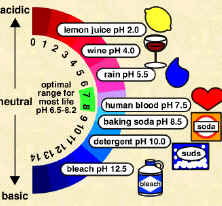
Scientists use something called the pH scale to measure how acidic or basic a liquid is. The scale goes from 0 to 14. Distilled water is neutral and has a pH of 7. Acids are found between 0 and 7. Bases are from 7 to 14. Most of the liquids you find every day have a pH near 7. They are either a little below or a little above that mark. When you start looking at the pH of chemicals, the numbers go to the extremes. Substances with the highest pH (strong bases) and the lowest pH (strong acids) are very dangerous chemicals. Molecules that make up or are produced by living organisms usually only function within a narrow pH range (near neutral) and a narrow temperature range (body temperature). Many biological solutions, such as blood, have a pH near neutral.
The biological molecule used in this lab is a protein found in milk. Proteins are used to build cells and do most of the cell’s work. They also act as enzymes. For proteins to work, they must maintain their globular shape. Changing the shape of a protein denatures and the protein will no longer work.
Materials:
Small squares of wide-range pH paper, pH color chart, paper towels, 4 dropper bottles, ammonia, lemon juice, skim milk, distilled water, forceps, 50 ml beakers, small squares of narrow-range pH paper, 2 stirring rods
Procedure (part A): Testing the pH of Substances
- Line up 4 squares of wide-range pH paper about 1 cm apart on a paper towel.
- Put one drop of distilled water on the pH square.
- Compare the color of the pH paper to the color chart and record the pH in data table 1.
- Repeat this procedure for the ammonia, lemon juice, and skim milk.
Questions (Part A): Determining the pH of Solutions
- Which substance was the most acidic?
- Which substance was the most basic?
- Did any of the substances have a pH close to neutral? Name them.
Procedure (part B): Showing the Effect of pH on a Biological Molecule (Milk Proteins)
- Place 100 drops of skim milk in a 50 ml beaker.
- Pick up a piece of narrow-range pH paper with forceps.
- Touch the pH paper to the milk and remove it.
- Compare the color of the pH paper to the pH color chart.
- Record the initial pH in data table 2.
- Add a drop of lemon juice to the milk in the cup & stir with a stirring rod. Keep track of how many drops you add to the milk!
- Measure and record the pH of the solution with the narrow-range pH paper.
- Repeat step 7 until you notice an obvious change in the appearance of the milk. record this final pH and appearance of the milk in your data table.
- Repeat steps 1-8 using a clean 50 ml beaker and fresh milk, and substitute ammonia for the lemon juice.
- Add drops of ammonia to the milk until the change in pH of the milk is equal to the change in pH you measured in step 8. Be sure to keep track of the number of drops added. HINT: If the pH changed by 2 units with the lemon juice, then add ammonia until you also get 2 pH units of change!
Data:
Table 1
| Substance Tested | pH | Acid | Base | Neutral |
Table 2
| Substance Tested | Substance used to Produce Change | Starting pH of Milk | Final pH of Milk | Original Appearance of Milk | Final Appearance of Milk | Total Number of drops added to Produce the change |
| 100 drops Skim Milk | Lemon Juice | |||||
| 100 drops Skim Milk | Ammonia |
Questions:
1. Which substance tested from table 1 was the most acidic?
2. Which substance was most basic?
3. Did any substance from table 1 have a neutral, or near neutral pH? If so, which substance was neutral?
4. Why did you use narrow-range pH paper to measure the milk’s change in pH?
5. Describe the change in appearance of the milk as more lemon juice was added. Explain why this change occurred.
6. How much did the pH of milk change when lemon juice was added?
7. Why do you think lemon juice “curdled” (precipitated out the proteins) from the milk?
8. Did you get the same change when ammonia was used? Why or why not?
Examples of Organic Models
Effect of Detergent on Gelatin
| “How Good Is Your Enzymatic Detergent? |
Introduction:
In nature there are enzymes called proteases that “digest” or degrade proteins. Some of these enzymes have been genetically engineered and added to our laundry detergents in the hope that they will “digest” the protein off of our clothing. Do they work? Do they assist in cleaning? In this experiment you can compare different detergents and their ability to “digest” protein.
What is gelatin? Gelatin consists of protein chains that are easily digested into their amino acid components. Gelatin is prepared from collagen, a protein found in animal tendons and skin and taken out during the meat rendering process. Boiling collagen reduces the weight by about one-third and separates the protein strands by breaking bonds. When the boiled collagen is cooled, it does not revert back to collagen but sets to a gel we know as gelatin.
Purpose :
To test the effectiveness of laundry detergent brands (and their enzymes) to digest protein (in the form of gelatin)
Hypothesis: ____________ will decompose more gelatin in millimeters than ______________.
Materials:
Gelatin in 4 test tubes Wax Pencil/ Permanent marker
3 detergent brands
Distilled water
Test tube rack
Parafilm®
Ruler
Procedure:
Day 1
1. Pour 5 ml of melted gelatin into 4 test tubes. Let the gelatin solidify.
2. Make 10% solutions of the five non-liquid detergents selected for testing. (Mix 10 g of detergent in 90 mL of distilled water). Label the solutions carefully and note whether enzymes are listed as a component of each.
3. Mark the top level of the gelatin with a permanent marker. Add 15 drops of each detergent solution to the top surface of the hardened gelatin in a test
tube. To one tube add 15 drops of distilled water. Label carefully.
Day 2
4. After 24 hours examine the test tubes. Notice that the gelatin has been liquefied in some tubes. Use a ruler to measure the depth of the liquefication. Measure from the mark where the hardened gelatin started down to where it is still hard. Measure to the nearest mm. Record.
Day 3
5. Measure the depth of liquefication again after 48 hours.
Data 1 data table, 1 graph (time vs. mm. liquefied)
| Enzymes listed? | Liquefied After 24 hours (mm.) | Liquefied After 48 hours (mm.) | |
| Distilled Water | |||
| Detergent 1 ? | |||
| Detergent 2 ? | |||
| Detergent 3 ? |

Conclusion:
1. What is the job of enzymes?
2. Why do laundry detergents often contain enzymes?
3. Why was gelatin used in this lab?
4. How is gelatin made?
5. Name each of the laundry detergents you used and describe the effect each one had on the gelatin.
6. Did any of the laundry detergents contain enzymes? If so, which one(s)?
7. Was your original hypothesis correct? Explain.