| Chromosomes Linkage Genes on the same chromosome are linked. Example: Unlinked GenesG = gray body g = black (ebony) body
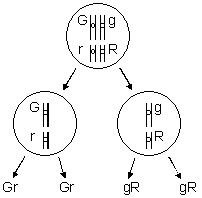
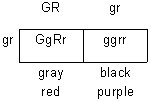
R = red eyes r = purple eyes The diagrams below show that the locus for body color (G or g) is on a different chromosome than the locus for eye color (R or r). These two loci will assort independently to produce either GR and gr gametes or Gr and gR gametes.
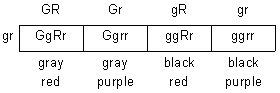
cross: GgRr X ggrr gametes: GR, Gr, gR, gr X gr
Ratio expected: 1:1:1:1 Example: Linked GenesSuppose G and R are linked as shown below. If the body color and eye color loci are on the same chromosome, they will not assort independently unless crossing-over occurs frequently.
In this case, GgRr can produce only two kinds of gametes: GR and gr. GgRr X ggrr gametes: GR, gr X gr
If G and R are linked, then whenever you have a G, you have an R. Any gray, purple offspring (G-rr) would result from crossing over because a Gr gamete is needed. Suppose out of 100 offspring, you got 46 gray, red, 46 black purple, 4 gray purple and 4 black red. Eight percent of the offspring resulted from crossing over. These offspring are recombinant. Crossing over is more likely to occur between genes that are far apart. The farther apart genes are, the greater the probability that crossing over will occur between them. In the example above, we had 8% crossing over. The percent of recombination (crossing over) can beused as a measure of how far apart genes are. 1% crossing over = 1 map unit. ExampleG = gray body g = black (ebony) body
R = red eyes r = purple eyes Suppose that G and R are linked (on the same chromosome) in a particular individual and g and r are also linked P1 GgRr X ggrr If there is no crossing-over, possible gametes for the first parent are GR and gr. If there is crossing-over, possible gametes are gR and Gr. the following results were obtained:
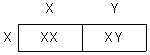
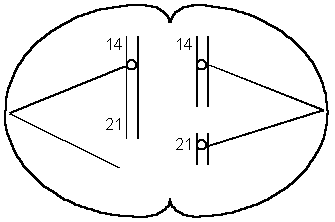
How far apart are the G and R loci? Humans have 23 pairs of chromosomes (46 total) chromosomes. Two of these are called sex chromosomes, the other 44 are called autosomes. There are two kinds of sex chromosomes, called the X chromosome and the Y chromosome. The X chromosome is larger and contains many genes. The Y chromosome is much smaller and contains very few genes. Normally, human females have two X chromosomes (XX) and males have one X and one Y chromosome (XY). Occasionally, an accident happens in which a person is born with too many or too few sex chromosomes. In these cases, the person will be male if they inherit a Y chromosome and female if they do not. Examples of four different possibilities that produce males are shown below. The last three are abnormal. XY Examples of four different possibilities that produce females are shown below. Normal females are XX. X The cross below shows that normal females produce eggs that have one X chromosome. Half of the sperm produced by normal males have an X chromosome and the other half have a Y chromosome. XX x XY ¯
This analysis shows that half of the offspring are expected to be male, half are expected to be female.
Chromosomal Determination of SexMales
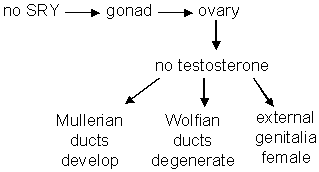
The Y chromosome contains a gene called SRY (for sex-determining region of Y).
Females
Testicular Feminization
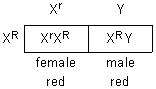
The body cells of people with testicular feminization are insensitive to testosterone and therefore develop the female phenotype even though they have a Y chromosome. It has an X-linked recessive mode of inheritance. GuevodocesGuevodoces refers to a condition in which the male phenotype develops after puberty. It is due to delayed testosterone production. X-Linkage Morgan (Columbia U): P1 red-eyed X white-eyed ¯ F1 all red-eyed F2 3:1 (red:white) but all white were male explanation: These genes are found on the X chromosome but not on the Y chromosome. An XrY male will therefore have red eyes. Details of this cross are below.
gametes: XR (female) and Xr, Y (male)
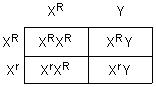
The offspring produced from the above cross are crossed with each other (below): F1 XRXr X XRY ¯ gametes: XR and Xr (from female); XR and Y (from male) F2:
Notice that there are three possible genotypes for females and two possible genotypes for males.
X-Linked InheritanceMales inherit their X chromosome from their mother. Their Y chromosome comes from their father. A male, therefore, cannot pass an X-linked trait to his sons. Males inherit all of their X-linked traits from their mother. If a male inherits an X-linked recessive trait, it will be expressed because males do not have a homologous X chromosome. Females can be carriers of X-linked traits without expressing them because they might carry the dominant allele on the other X chromosome. For example, the following genotype will have a dominant phenotype: XAXa. Although females have twice as many X-linked genes, the amount of protein produced by these genes is the same in females as it is in males.
Reduced protein production (called dosage compensation) occurs as a result of inactivating one X chromosome by coiling and condensing it. When condensed, it cannot be transcribed, that is, it cannot be used to produce mRNA. Condensed X chromosomes, called Barr bodies, are visible using ordinary light microscope techniques. The table below shows the number of Barr bodies in normal cells and in the cells of people with an abnormal number of X chromosomes. Normal males do not have Barr bodies because they only have one X chromosome.
In summary, one X chromosome remains active, the others are inactivated by forming Barr bodies.
Inactivation
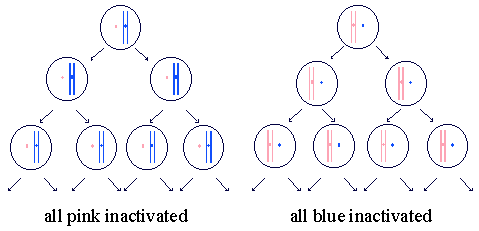
Inactivation occurs early in embryonic development (12-16 days). In females, each cell normally contains two X chromosomes. The X chromosome that is inactivated is determined randomly.
Once inactivation occurs, all daughter cells of a particular cell have the same X chromosome inactivated. All of the “pink” chromosomes in the drawing below (left side of diagram) have been inactivated. All future cells produced by this cell will have the pink chromosome inactivated. In the diagram on the right, all of the blue chromosomes have been inactivated. All future generations of this cell will have the blue chromosome inactivated.
Females are therefore mosaics with respect to the X chromosome. Patches of body cells will have the maternally inherited X chromosome inactivated and other patches will have the paternally inherited one inactivated.
Example of Mosaicism: Calico Cats
A calico cat has patches of orange and patches of black X = orange X1 = black MALES: XY = orange X1Y = black FEMALES: XX = orange X1 X1 = black X X1 = orange or black patches All cells descended from an X1 cell (X is inactive) are orange-yellow. All cells descended from an X cell (X1 is inactive) are black.
Human Example – Anhydrotic Dysplasia
Anhydrotic dysplasia is a disease that results in the absence of sweat glands. It is inherited as an X-linked recessive disease. Let X = normal sweat glands and X’ = absence of sweat glands. Normal males are XY. Affected males are X’Y and do not have sweat glands. Normal females are XX, heterozygous females are XX’ and have patches of skin with sweat glands and patches of skin without sweat glands. Females that are X’X’ do not have sweat glands.
Other Information
Should heterozygous females for colorblindness be able to see color? Suppose: X = color vision x = colorblind
The Retina of a heterozygous (Xx) female will have some cells with the “X” inactivated and other cells with the “x” inactivated. A heterozygous carrier of red-green colorblindness has some colorblind cells in her retina. The non-colorblind cells enable her to see color. Turner’s syndrome is an abnormality in females where there is only one X chromosome; the other is missing. These people have abnormalities that will be discussed in the next chapter. Why aren’t Turners syndrome females normal? Evidence indicates that some genes in the Barr body remain active. Their DNA is uncoiled and extends from the Barr body. If the Barr bodies of a normal female were missing, she would exhibit Turners Syndrome.
|
||||||||||||||||||||||||||||||||||||||
| Home General Biology 1 General Biology 2 Human Biology Anatomy and Physiology |
 Charles Robert Darwin |
Darwin and Evolution |
History of Evolution:
C. Late Eighteenth Century Contributions
1.
a. George Cuvier (1769-1832), a distinguished French vertebrate zoologist, was the first to use
comparative anatomy to develop a system of classifying animals.
b. He founded the science of paleontology, the study of fossils, and suggested that a single fossil bone
was all he needed to deduce the entire anatomy of an animal.
c. .
d. Cuvier was also a staunch advocate of special creation and fixity of species; this presented him with
a serious problem when geological evidence of a particular region showed a succession of life forms
in the earth’s strata.
e. Catastrophism is the term applied to Cuvier’s explanation of fossil history, the belief held by Cuvier
that catastrophic extinctions occurred, after which repopulation of surviving species took place,
giving an appearance of change through time.
2. Lamarck’s Theory of Evolution
a. Lamarck (1744-1829) was first to state that descent with modification occurs and that organisms
become adapted to their environments.
b. Lamarck was an invertebrate zoologist and held ideas different from Cuvier.
c. Unfortunately, he saw the drive for perfection as inherent in all living things.
d. Inheritance of acquired characteristics was the Lamarckian belief that organisms become adapted to
their environment during their lifetime and pass on these adaptations to their offspring.
e. He believed the increasing complexity of life forms in strata is the result of a natural tendency toward
perfection inherent in all living things.
f. Experiments fail to uphold Lamarck’s inheritance of acquired characteristics; molecular mechanism of
inheritance show phenotypic changes do not result in genetic changes that can be passed on.
18.2. Darwin’s Theory of Evolution
A. Darwin’s Background
1. His nature was too sensitive to pursue medicine; he attended divinity school at Cambridge.
2. He attended biology and geology lectures and was tutored by the Reverend John Henslow.
3. Henslow arranged his trip on the HMS Beagle; Darwin was an observant student of nature.
B. Geology and Fossils
1. His study of geology and fossils caused him to concur with Lyell that the observed massive geological
changes were caused by slow, continuous processes.
a. In his book Principles of Geology, Charles Lyell presented arguments to support a theory of geological
change proposed by James Hutton.
b. In contrast to catastrophists, Hutton proposed that the earth was subject to slow but continuous
geological processes (e.g., erosion and uplifting) that occur at a uniform rate.
c. Darwin took Lyell’s book on the voyage of the HMS Beagle.
2. Fossil Evidence
a. The Argentina coast had raised beaches; he witnessed earthquakes raising the earth several feet.
b. Marine shells occurred far inland and at great heights in the Andes.
c. Fossils of huge sloths and armadillo-like animals suggested modern forms were descended from
extinct forms with change over time.
C. Biogeography
1. Biogeography is the study of the geographic distribution of life forms on earth.
2. Darwin’s comparison of the animals of South America and the Galapagos Islands caused him to conclude
that adaptation to the environment can cause diversification, including origin of new species.
3. Patagonian hares replaced rabbits in the South American grasslands.
4. The greater rhea found in the north was replaced by the lesser rhea in the south.
5. The Galapagos Islands
a. These volcanic islands off the South American coast had fewer types of organisms.
b. Island species varied from the mainland species, and from island-to-island.
c. Each island had a variation of tortoise; long and short necked tortoises correlated with different vegetation.
d. Darwin’s Finches
1) Finches on the Galapagos Islands resembled a mainland finch but there were more types.
2) Galapagos finch species varied by nesting site, beak size, and eating habits.
3) One unusual finch used a twig or thorn to pry out insects, a job normally done by a woodpecker.
4) The finches posed questions to Darwin: did they descend from one mainland ancestor, did islands
allow isolated populations to evolve independently, and could present-day species have resulted
from changes occurring in each isolated population?
D. Natural Selection and Adaptation
1. Darwin decided adaptations develop over time; he sought a mechanism by which adaptations might arise.
2. Natural selection was proposed by both Alfred Russel Wallace and Darwin as a driving mechanism of
evolution caused by environmental selection of organisms most fit to reproduce, resulting in adaptation.
3. Because the environment is always changing, there is no perfectly-adapted organism.
4. Preconditions for natural selection
a. The members of a population have random but heritable variations.
b. In a population, many more individuals are produced each generation than an environment can support.
c. Some individuals have adaptive characteristics that enable them to survive and reproduce better.
5. Consequences of natural selection
a. An increasing proportion of individuals in succeeding generations have the adaptive characteristics.
b. The result of natural selection is a population adapted to its local environment.
6. Natural selection can only utilize variations that are randomly provided; therefore, there is no directedness
or anticipation of future needs.
7. Extinction occurs when previous adaptations are no longer suitable to a changed environment.
E. Organisms Have Variations
1. In contrast to the previous world-view, variations are highly significant.
2. Darwin suspected, but did not have today’s evidence, that variation is completely random.
3. New variations are as likely to be harmful as helpful.
4. Variations that make adaptation possible are those that are passed on generation to generation.
5. Darwin could not state the cause of variations because genetics was not yet established.
F. Organisms Struggle to Exist
1. Darwin and Wallace both read an essay by Thomas Malthus, a clergyman and socio-economist.
2. Malthus proposed that human populations outgrow resources and death and famine were inevitable.
3. Darwin applied this to all organisms; resources were not sufficient for all members to survive.
4. Therefore, there is a constant struggle for existence; only certain members survive and reproduce.
G. Organisms Differ in Fitness
1. Organisms whose traits enable them to reproduce to a greater degree have a greater fitness.
a. Fitness is a measure of an organism’s reproductive success.
b. Black western diamondback rattlesnakes are more likely to survive on lava flows; lighter-colored
rattlesnakes are more likely to survive on desert soil.
2. Darwin noted that humans carry out artificial selection.
a. Early humans likely selected wolf variants; consequently, desirable traits increase in frequency in
subsequent generations and produced the varieties of domestic dogs.
b. Many crop plant varieties can be traced to a single ancestor.
c. In nature, interactions with the environment determine which members reproduce more.
d. Evolution by artificial or natural selection occurs when more fit organisms reproduce and leave more
offspring that the less fit.
H. Organisms Become Adapted
1. An adaptation is a trait that helps an organism be more suited to its environment.
2. Unrelated organisms living in the same environment often display similar characteristics.
3. Because of differential reproduction, adaptive traits increase in each succeeding generation.
I. On Origin of Species by Darwin
1. After the HMS Beagle returned to England in 1836, Darwin waited over 20 years to publish.
2. He used the time to test his hypothesis that life forms arose by descent from a common ancestor and
that natural selection is a mechanism by which species can change and new species arise.
3. Darwin was forced to publish Origin of Species after reading a similar hypothesis by Alfred Russel Wallace.
18.3. Evidence for Evolution
A. Common Descent Adapted
1. The hypothesis of common descent is supported by many lines of evidence.
2. The more varied the evidence, the more certain it becomes.
3. Darwin synthesized much of the current data but biochemical research was yet to come.
B. Fossils Evidence
1. The fossil record is the history of life recorded by remains from the past.
2. Fossils are at least 10,000 years old and include skeletons, shells, seeds, insects trapped in amber,
and imprints of leaves.
3. The fossil record traces history of life and allows us to study history of particular organisms.
4. Fossil evidence supports the common descent hypothesis; fossils can be linked over time because they
reveal a similarity in form, despite observed changes.
5. Transitional forms reveal links between groups.
a. Caudipteryx is between dinosaurs and birds.
1) This Chinese fossil shows some dinosaurs had feathers on arms, tail and probably body.
2) Advantages during running and escape gave rise to birds once lift-off occurred.
b. Eustheopteron is an amphibious fish.
c. Seymouria is a reptile-like amphibian.
d. Therapsids were mammal-like reptiles.
6. The fossil record allows us to trace the history of the modern-day horse Equus.
a. Earliest fossils show an ancestral Hyracotherium the size of a dog, with cusped low-crowned molars,
four toes on each front foot, three on each hind foot — all adaptations for forest living.
b. When forests were replaced by grasslands, the intermediates were selected for durable grinding teeth,
speed, etc. with an increase in size and decrease in toes.
c. Living organisms resemble most recent fossils in the line of descent; underlying similarities allow us
to trace a line of descent over time.
C. Biogeographical Evidence
1. Biogeography studies the distribution of plants and animals worldwide.
2. Distribution of organisms is explained by related forms of evolving in one locale and spreading to
other accessible areas.
a. Darwin observed South America had no rabbits; he concluded rabbits originated elsewhere.
b. Biogeography explains the many finch species on the Galapagos Islands but not the mainland.
3. Physical factors, such as the location of continents, determine where a population can spread.
a. Cacti are restricted to North American deserts and euphorbia grow in African deserts.
b. Marsupials arose when South America, Antarctica, and Australia were joined; Australia separated
before placental mammals arose, so only marsupials diversified in Australia.
D. Anatomical Evidence
1. Organisms have anatomical similarities when they are closely related because of common descent.
a. Homologous structures in different organisms are inherited from a common ancestor.
b. Analogous structures are inherited from a unique ancestors and have come to resemble each other
because they serve a similar function.
c. Vertebrate forelimbs contain the same sets of bones organized in similar ways, despite their dissimilar functions.
2. Vestigial Structures are remains of a structure that was functional in some ancestor but is no longer
functional in the organism in question.
a. Most birds have well-developed wings; some bird species have reduced wings and do not fly.
b. Humans have a tailbone but no tail.
c. Presence of vestigial structures is explained by the common descent hypothesis; these are traces of
an organism’s evolutionary history.
3. Embryological development reveals a unity of plan.
a. During development, all vertebrates have a post-anal tail and paired pharyngeal pouches.
1) In fishes and amphibian larvae, the pouches become gills.
2) In humans, first pair of pouches becomes a cavity of middle ear and auditory tube; second pair
becomes tonsil, while third and fourth pairs become thymus and parathyroid glands.
3) Above features are explained if fishes are ancestral to other vertebrate groups.
E. Biochemical Evidence
1. Almost all living organisms use the same basic biochemical molecules, e.g., DNA, ATP, and many
identical or nearly identical enzymes.
2. Organisms utilize the same DNA triplet code and the same 20 amino acids in their proteins.
3. Many organisms share same introns and types of repeats, which is remarkable since there is no obvious
functional reason why these components need to be so similar.
4. This is substantiated by analysis of degree of similarity in amino acids for cytochrome c among organisms.
5. These similarities can be explained by descent from a common ancestor.
6. Life’s vast diversity has come about by only a slight difference in the same genes.
F. Because it is supported by so many lines of evidence, evolution is no longer considered a hypothesis.
1. Evolution is one of the great unifying theories of biology.
2. In science, theory is reserved for those conceptual schemes that are supported by a large number of
observations or a large amount of experimental evidence and have not been found lacking.
evolution–process of change through time
Evolution includes the change in characteristics of populations through generations.
Thus, existing life forms have evolved from earlier life forms.
Evolutionary theory is a unifying principle for the biological sciences.
It provides an explanation for the differences in structure, function, and behavior
among life forms.
Through radioactive dating with uranium, geologists
estimate the age of the earth at about 4.6 billion years. (It is assumed that the earth
is at least as old as the oldest rocks and minerals composing its crust.)
fossils: direct or indirect remains of organisms preserved in media such as sedimentary rock, amber, ice, or tar
Fossils have been found that indicate organisms existed well over 3 billion years ago. These organisms were simple, single-celled organisms.
Law of Superposition: the higher up you go in an undisturbed rock stratum, the
younger the rock layers become
** Upper, undisturbed strata generally contain fossils of more complex organisms,
whereas, the lower strata contain fossils of simpler life forms.
(Tendency toward increasing complexity over time.)
** When comparing fossils in undisturbed strata, fossils can be found in
upper strata which, although different from fossils in lower strata, resemble
those fossils. This suggests links between modern forms and older forms, as
well as divergent pathways from common ancestors.
adaptations–changes in organisms which make them better suited to their environment
Gene mutations can be caused by such agents as radiation and chemicals. When they occur in sex cells, the mutations can be passed on to the offspring; if they occur in other cells, they can be passed on to body cells only. The experiences an organism has during its lifetime can affect its offspring only if the genes in its own sex cells are changed by the experience.
biological adaptation — changes in structures, behaviors, or physiology that enhance survival and reproductive success in a particular environment
Theory of Natural Selection
Darwin–(1859) Book–“On Origin of Species”
–stated his theory of Natural Selection
— Natural selection and its evolutionary consequences provide a scientific explanation of the fossil record of ancient life-forms, as well as the molecular and structural similarities observed among the diverse species of living organisms.
(Theory of Natural Selection)
1. Overproduction — Within a population more offspring are born than can possibly survive.
2. Competition — since the number of individuals in a population tends to remain constant from generation to generation, a struggle for survival is suggested
3. Survival of the Fittest — The individuals who survive are the ones best adapted to exist in their environment due to the possession of variations that maximize their fitness.
4. Reproduction — Variations assist or hinder individuals in their struggle for survival.
The best adapted individuals survive and reproduce, passing on the favorable variations to their offspring.
5. Speciation — as time and generations continue, adaptations are perpetuated in individuals and new species may evolve from a common ancestor.
adaptive variations–those variations which assist an organisms survival
(Weaknesses of Darwin’s Theory)
1. Darwin didn’t explain how variations arose.
2. He did not distinguish between hereditary and environmental variations.
3. Darwin believed that both environmental and hereditary variations were inherited.
Some Sources of Variation in Modern Natural Selection Theory
1. The genetic basis for variation within a species is provided by mutations and sexual reproduction. (crossing over and recombination)
2. Mutations are spontaneous and provide the raw material for evolution.
(Modern Natural Selection Theory)
1.) All species of the potential to increase in numbers.
2.) There is a finite amount of resources for any species. Species tend to make too many
organisms for these resources.
3.) Species will show genetic variability due to mutation, crossing over, and
genetic recombination (during fertilization) of genes.
4.) The scarce finite resources of the environment will select those offspring better able to survive and leave offspring.
Variation within a species increases the likelihood that at least some members of the species will survive under changed environmental conditions.
** Traits which are beneficial to the survival of an organism in a particular environment tend to be retained and passed on, and therefore, increase in frequency within a population.
** Traits which have a low survival value to organisms tend to diminish in
frequency from generation to generation.
** If environmental conditions change, traits that were formerly associated with a
low survival value may, in a changed environment, have greater survival value and
increase accordingly.
(Examples of Evolution in Modern Times)
1. Peppered moth — light colored vs. dark colored (industrialization influence) Manchester, England
2. Insect resistance to insecticides. (Resistance is not in response to the insecticide. The insecticide acts as a selecting agent.)
3. Bacterial resistance to antibiotics.
** Evolutionary factors operate on population — but not on individual organisms.
speciation: formation of two or more different species from one original population
Evolution does not necessarily mean long term progress is going to go in a certain direction. Evolutionary changes often appear to be like the growth of a bush: Some branches survive from the beginning with little or no change, many die out altogether, and others branch out repeatedly, sometimes giving rise to more complex organisms.

Note the divergence of the various groups from a common ancestor and the fact that some branches became extinct.
Extinction of a species occurs when the environment changes and the adaptive characteristics of a species are insufficient to allow its survival. Fossils indicate that many organisms that lived long ago are extinct. Extinction of a species is common; most of the species that have lived on earth no longer exist.
The SPECIES is the most fundamental unit of classification.
The purpose of biological classification is to show how organisms are related. Organisms are branched into hierarchies or groups based on structural similarities and evolutionary relationships.
Small differences between parents and offspring can accumulate in successive generations so that descendants become very different from their ancestors.
** The degree of kinship between organisms or species can be estimated from the similarity of their
DNA sequences; this similarity often closely matches organisms’ or species’ classification based on anatomical similarities.
Origin of Life
1.) 3 to 4 billion years ago — it is thought the first primitive single-celled life appeared on earth
2.) These original unicellular organisms added of carbon dioxide to the environment.
3.) Some autotrophs evolved a means of using the carbon dioxide added to do photosynthesis
4.) Autotrophic activity added free oxygen to the atmosphere. Some autotrophs
and heterotrophs evolved mechanisms by which they used this oxygen to
derive their energy. (aerobic respiration)
5.) About a billion years ago, increasingly complex multicellular organisms began to evolve.
** The great diversity of organisms is the result of billions of years of evolution that has filled available niches with life-forms.
| Name:
|
|
True/False
Indicate whether the sentence or statement is true or false.
|
||||||||||
| 1. |
Freshwater habitats are independent of terrestrial habitats.
|
|||||||||
| 2. |
An ecosystem consists of biotic and abiotic factors.
|
|||||||||
| 3. |
Clearing a forest would reduce the amount of energy available to the consumers.
|
|||||||||
| 4. |
While an understanding of the interactions between organisms and their environment was very important to early hunter and gatherer humans, it is even more important today because humans are having significant effects on the environment.
|
|||||||||
| 5. |
Cutting down trees in a forest alters the habitat of the organisms living in the forest.
|
|||||||||
| 6. |
An organism’s niche includes its habitat.
|
|||||||||
|
Multiple Choice
Identify the letter of the choice that best completes the statement or answers the question.
|
||||||||||
| 7. |
Abiotic factors affect an ecosystem by all of these except the
|
|||||||||
| 8. |
The most important single factor affecting the biosphere is
|
|||||||||
| 9. |
Which of the following is the smallest ecological unit?
|
|||||||||
| 10. |
Collectively, physical factors such as light, temperature, and moisture that affect an organism’s life and survival are called the
|
|||||||||
| 11. |
The rate of photosynthesis carried on by plants living in a body of water depends upon the
|
|||||||||
| 12. |
Which of the following would not be included in a description of an organism’s niche?
|
|||||||||
| 13. |
Ecology is the study of the interaction of living organisms
|
|||||||||
| 14. |
The destruction of the ozone layer may be responsible for an increase in
|
|||||||||
| 15. |
Ozone in the atmosphere
|
|||||||||
| 16. |
Ecological models are useful for
|
|||||||||
| 17. |
The physical location of an ecosystem in which a given species lives is called a
|
|||||||||
| 18. |
Which of the following is not an adaptation for avoiding unfavorable conditions?
|
|||||||||
| 19. |
Which of the following would not be included in a description of an organism’s niche?
|
|||||||||
  |
|
Name:
|
|
True/False
Indicate whether the sentence or statement is true or false.
|
||||||||||
| 1. |
The law of segregation states that two or more pairs of alleles separate independently of one
another during gamete formation.
|
|||||||||
| 2. |
Cells that contain a single set of chromosomes are said to be haploid (N).
|
|||||||||
| 3. |
Crosses involving a study of one gene are called monohybrid crosses.
|
|||||||||
| 4. |
A dominant allele masks the effect of a recessive allele.
|
|||||||||
| 5. |
Mendel concluded that the patterns of inheritance are determined entirely by the environment.
|
|||||||||
| 6. |
A Punnett square represents the phenotype of an organism.
|
|||||||||
| 7. |
The physical appearance of an individual organism, as determined by the genes it has inherited from its parents, is called its genotype.
|
|||||||||
| 8. |
Individuals must exhibit a trait in order for it to appear in their offspring.
|
|||||||||
| 9. |
In codominance, two alleles are expressed at the same time.
|
|||||||||
|
Multiple Choice
Identify the letter of the choice that best completes the statement or answers the question.
|
||||||||||
| 10. |
In fruit flies, the gene for long wings, L, is dominant to the gene for short wings, l. A heterozygous long wing male and a short wing female produce many offspring. The possible genotype(s) among the long-winged offspring is (are)
|
|||||||||
| 11. |
In drosophila, curled wing is recessive to straight wing. If a homozygous straight-winged fly is mated with a curled-wing fly, how many different phenotypes will be produced?
|
|||||||||
| 12. |
If an organism has two identical alleles for a trait, it is
|
|||||||||
| 13. |
Alleles for the same trait separate during
|
|||||||||
| 14. |
The inheritance of genes that determine one trait (hair color) is not affected by the inheritance of genes that control another trait (tongue rolling). Which of Mendel’s rules apply to the above statement?
|
|||||||||
| 15. |
In fruit flies, the gene for straight wings, C, is dominant to the gene for curly wings, c. Two flies, when bred, produced 98 straight-winged and 102 curly-winged offspring. What was the genotype of the curly-winged offspring?
|
|||||||||
| 16. |
All homozygous individuals have:
|
|||||||||
| 17. |
If a family has three daughters, the probability that the next child will be a girl is
|
|||||||||
| 18. |
Mendel explained the reappearance of recessive traits in the F2 generation in his principle of
|
|||||||||
| 19. |
If any offspring from a test cross show a recessive phenotype, the parent with the unknown genotype is
|
|||||||||
| 20. |
A homozygous black rabbit is mated with a heterozygous rabbit. If black is dominant over white, they should produce:
|
|||||||||
| 21. |
Mendel’s finding that the inheritance of one trait had no effect on the inheritance of another became known as the
|
|||||||||
| 22. |
The phenotype of an organism
|
|||||||||
| 23. |
In humans the ability to taste PTC paper is dominant to non-tasting and hair color shows incomplete dominance (Dark hair x blond hair => brown hair). A brown haired man who cannot taste PTC paper marries a woman with brown hair and who can taste PTC paper. Their first child had brown hair and could not taste PTC paper. What are the chances that their next child will be a brown taster?
|
|||||||||
| 24. |
Two long-furred cats were mated and produced 25 percent short-furred cats. The parents were probably:
|
|||||||||
| 25. |
When certain types of black roosters are crossed with white hens, speckled chickens result. These chickens, which have a mixture of black and white feathers, show
|
|||||||||
| 26. |
codominance : both traits are displayed::
|
|||||||||
| 27. |
A Punnett square is used to determine the
|
|||||||||
| 28. |
If a family has four sons, the probability that the next child will be a boy is
|
|||||||||
| 29. |
Suppose that on Mars green creatures are dominant over red creatures and that 3-eyes are recessive to 4-eyes. Assume that inheritance of traits on Mars occurs the same way as on Earth. A cross between 2 GgEe Martians would result in what fraction of the offspring being red-3-eyed Martians?
|
|||||||||
| 30. |
The fact that a man and woman, both of whom have wavy hair, could have children with curly hair, wavy hair, or straight hair is best explained by the phenomenon called
|
|||||||||
| 31. |
A Punnett square does not show the
|
|||||||||
| 32. |
The “father” of genetics was
|
|||||||||
| 33. |
What is the probability that the offspring of a homozygous dominant individual and a homozygous recessive individual will exhibit the dominant phenotype?
|
|||||||||
| 34. |
Which of the following is the designation for Mendel’s original pure strains of plants?
|
|||||||||
| 35. |
F2 : F1 ::
|
|||||||||
| 36. |
The passing of traits from parents to offspring is called
|
|||||||||
| 37. |
homozygous : heterozygous ::
|
|||||||||
| 38. |
The phenotype of an organism
|
|||||||||
| 39. |
If an individual has two recessive alleles for the same trait, the individual is said to be
|
|||||||||
| 40. |
Tallness (T) is dominant to shortness (t) in pea plants. Which of the following represents a genotype of a pea plant that is heterozygous for tallness?
|
|||||||||
| 41. |
How many different phenotypes can be produced by a pair of codominant alleles?
|
|||||||||
 |
||||||||||
| 42. |
Refer to the illustration above. The genotype represented by the cell labeled “2” is
|
|||||||||
|
In rabbits, black fur (B) is dominant to brown fur (b). Consider the following cross between two rabbits.
 |
||||||||||
| 43. |
Refer to the illustration above. Both of the parents in the cross are
|
|||||||||
| 44. |
Refer to the illustration above. The genotypic ratio of the F1 generation would be
|
|||||||||
| 45. |
In pea plants, yellow seeds are dominant over green seeds. What would be the expected genotype ratio in a cross between a plant with green seeds and a plant that is heterozygous for seed color?
|
|||||||||
| |
|