Campbell Problem 8

Molecular Genetics Problem 8
8. Imagine that a geneticist has identified two disorders that appear to be caused by the same chromosomal defect and are affected by genomic imprinting: blindness and numbness of the limbs. A blind woman (whose mother suffered from numbness) has four children, two of whom, a son and daughter, have inherited the chromosomal defect. If this defect works like Prader-Willi and Angelman syndromes, what disorders do this son and daughter display? What disorders would be seen in their sons and daughters?

In Prader-Willi and Angelman syndromes the type of symptom exhibited in the offspring depends upon which parent contributes the defective chromosome.

In this case children receiving a defective chromosome from the father will suffer from numbness and children receiving a defective chromosome from the mother will be blind.

The pedigree below helps to sort out how the imprinting works.


BACK 

Campbell Problem 9

Molecular Genetics Problem 9
9. What pattern of inheritance would lead a geneticist to suspect that an inherited disorder of cell metabolism is due to a defective mitochondrial gene?


The disorder would always be inherited from the mother because the mother’s mitochondrial gene is the only one that survives when the zygote is formed. The gamete from the mother contains all the information. The head of the father’s sperm is the only part that survives during fertilization. The tail of the sperm containing the male’s mitochondria (an their genes) is lost when the zygote begins development. Thus it is only from the mother that the disorder can be inherited.


Do Brain Cells Run Out of Gas?
Within each cell reside hundreds of tiny gas stations known as mitochondria. These essential organelles generate a large share of the fuel, a molecule called ATP, that cells use to power their biological machinery. There’s a suspicion, admittedly controversial, that problems with these energy-supplying mitochondria contribute to the progression of age-related neurodegenerative illnesses such as Alzheimer’s, Parkinson’s, and Huntington’s diseases, says Douglas C. Wallace of Emory University School of Medicine in Atlanta. In 1993, Wallace and his colleagues reported on comparisons of the mitochondrial DNA of Alzheimer’s patients and that of people without Alzheimer’s, who served as controls. This genetic material, which contains all the instructions necessary for mitochondria to function and replicate, is independent of the DNA found in a cell’s nucleus. Wallace’s group discovered that a particular mutation in mitochondrial DNA showed up in more than 5 percent of Alzheimer’s patients but in less than 1 percent of a random group of people with-out the disease. Studies on animals support the importance of mitochondria in brain disorders. When investigators destroy mitochondria or inhibit the activity of enzymes crucial to mitochondrial function in rats or mice, the rodents develop behavioral or physical attributes of Alzheimer’s, Huntington’s, and Parkinson’s diseases. &emdash; J. Travis

Science News: Aug. 5 • Vol. 148, No. 6


BACK 

Biomes of the World Solution

Biomes of the World Solution
T + + + C D A R + R L + T + + + S + + E I E B E + A + U + + + + E S + M T T I + D E N + + + + E R U E A O + O I M D H + + R + S O W R + I + T O R E R T + N + H F C O + B R I A R E + O + S + + N A V + E B C B C C + E + + + + I R I T + + I U + R S A V A N N A N N + + V D F E N I R A M + + R I M + O O G R A S S L A N D + A V O R R S U O U D I C E D G + + O E P + + + + + + + + I + + + + R + + + + + + + + A + + + + + + E + + + + + + T + + + + + + + + (Over,Down,Direction) ABIOTIC(7,1,SE) BIOME(12,7,N) BIOTIC(10,6,NW) CARNIVORE(7,6,SE) CONSUMER(1,8,NE) DECIDUOUS(9,12,W) DESERT(6,1,SW) FRESHWATER(1,10,NE) GRASSLAND(1,11,E) HERBIVORE(14,4,S) INTERTIDAL(11,10,N) MARINE(7,10,W) OMNIVORE(13,11,NW) PRODUCER(15,12,N) RAINFOREST(10,10,NW) SAVANNA(3,9,E) TAIGA(7,15,NE) TUNDRA(13,1,S)


Biotechnology Notes Bi


DNA Technology
All Materials © Cmassengale

Introduction:

  • Biotechnology refers to technology used to manipulate DNA
  • The procedures are often referred to as genetic engineering
  • DNA is the genetic material of all living organisms
  • All organisms use the same genetic code
  • Genes from one kind of organism can be transcribed and translated when put into another kind of organism
  • For example, human and other genes are routinely put into bacteria in order to synthesize products for medical treatment and commercial use
  • Human insulin, human growth hormone, and vaccines are produced by bacteria
  • Recombinant DNA refers to DNA from two different source
  • Individuals that receive genes from other species are transgenic

Viruses & their Structure:

  • Viruses contain genetic material but are not living
  • Host cells are required for their reproduction
  • Viruses are composed of an inner nucleic acid core (genetic material) and an outer protein coat (capsid)
  • Viruses that infect animals have an outer envelope (membrane) that is derived from the cell membrane of the host cell may surround the capsid
  • The genetic material in some viruses is DNA; in others it is RNA


Viral Reproduction:

  • When viral genetic material enters a cell, it is replicated, transcribed (mRNA is produced) and translated (proteins are produced from the mRNA) by the host cell
  • By this process, the host cell uses the genetic instructions in the virus to make more viruses

Viral DNA ® mRNA ® protein

  • If the viral genetic material is RNA, a DNA copy must first be made before transcription and translation can occur
  • The DNA copy of the viral RNA is called cDNA.

viral RNA ® cDNA ® mRNA ® protein

Bacteriophages:

  • Bacteriophages are viruses that infect bacteria
  • Not surrounded by a membrane as the animal-infecting viruses
  • Virus attaches to the bacteria cell, a viral enzyme digests away a part of the wall, and its viral DNA enters the host cell
  • Inside the host cell, the viral DNA is transcribed, translated, and replicated
  • Translation produces protein coats and the enzymes needed in the construction of new virus particles
  • Viral DNA is replicated
  • The protein coats and DNA are assembled into new viral particles
  • The host cell wall to ruptures releasing the newly formed viruses

  • Upon entering the cell, the viral DNA may instead, become integrated into the bacterial DNA
  • It is replicated along with the host DNA when the host reproduces
  • Eventually, it will become transcribed and translated

Retroviruses:

  • Contain RNA & the enzyme reverse transcriptase
  • Reverse transcriptase can make a DNA copy of the viral RNA
  • The new DNA produced from the RNA template is called cDNA
  • DNA synthesis follows the production of cDNA to produce a double-helix
  • cDNA then becomes incorporated into the host DNA (called a prophage)
  • The new viruses escape the host cell by budding
  • The AIDS virus (HIV) is an example of a retrovirus


Vectors

  • Vectors are used to transfer genes into a host cell
  • Plasmids & viruses are the most commonly used vectors
  • A vector must be capable of self-replicating inside a cell
  • Viruses are the vectors of choice for animal cells
  • Marker genes can be used to determine if the gene has been taken up

Plasmids:

  • Small rings of DNA in bacterial cells
  • Used to transfer genes to other organisms
  • Host bacterium takes up the plasmid, which includes the foreign gene
  • When bacteria reproduce, plasmids with the new gene are also reproduced 
  • This clones (copies) the gene each time the bacteria reproduces

Viruses:

  • Can accept larger amounts of DNA than plasmids
  • Once the virus enters the host cell, it also reproduces the foreign gene it carries
  • The copied gene is “cloned”


Restriction enzymes:

  • Restriction enzymes were discovered in bacteria
  • Bacteria use them as a defense mechanism to cut up the DNA of viruses or other bacteria
  • Hundreds of different restriction enzymes have been isolated
  • Each restriction enzyme or RE cuts DNA at a specific base sequence
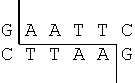
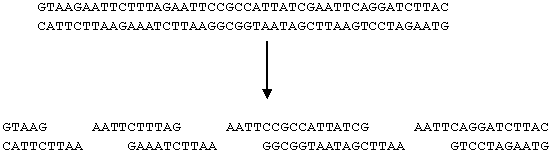
  • For example, EcoRI always cuts DNA at GAATTC as indicated below

  • The sequence GAATTC appears three times in the DNA strand below. As a result, the strand is cut into four pieces

  • Other restriction enzymes cut at different sites, some examples are listed below


Enzyme Cutting Site
Bam HI GGATCC
Hae III GGCC
Pst I CTGCAG
Hind I GANTC


Sticky Ends & Recombinant DNA:

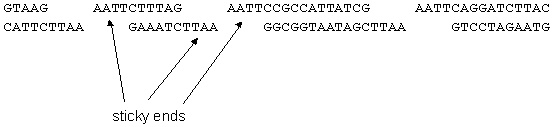
  • Fragments of DNA that has been cut with restriction enzymes have unpaired nucleotides at the ends called sticky ends

  • Sticky ends have complimentary bases, so they could rejoin
  • If the vector and the gene to be cloned are both cut with the same restriction enzyme, they will both have complimentary sticky ends
  • After cutting, the 2 DNA samples are mixed
  • Fragments with complementary sticky ends join together forming recombinant DNA (contains gene from vector & the gene to be cloned)
  • Enzyme DNA ligase seals the fragments together
  • Bacteria such as Escherichia coli are capable of taking up DNA from their environment
  • This process is called transformation
  • CaCl2 and a procedure called heat shock are used to make E. coli cells more permeable so that they take up the modified plasmids more readily

Genomic Libraries:

  • A genome is all of the genes in a particular organism
  • Bacteria or virus vectors can be used to store fragments of the DNA from another species
  • The DNA is cut up into fragments, and the different fragments are inserted into bacteria or viruses
  • The collection of bacteria or viruses is called a genomic library

Polymerase Chain Reaction (PCR):

  • Used to make many copies of small pieces of DNA
  • Procedure requires primers, DNA polymerase, and nucleotides
  • Primers are short chains of about 20 nucleotides that are complimentary to a region in the DNA to be amplified
  • DNA polymerase cannot continue the process unless it has already been started by primers
  • Nucleotides are needed because DNA is composed of nucleotide “building blocks”

  • The DNA is heated to approximately 95o C to separate the two strands of the double helix

  • After the strands are separated, the DNA is cooled to about 50o C, and the primers attach
  • The temperature is raised to approximately 70o C so the polymerase will attach to & copy the strand

  • The DNA replication process repeats itself as the solution is then heated and cooled at regular intervals


DNA Fingerprinting (RFLP Analysis):

  • In RFLP analysis, the DNA of an organism is cut up into fragments using restriction enzymes producing a large number of short fragments of DNA
  • Because no two individuals have identical DNA, no two individuals will have the same length fragments
  • Gel electrophoresis is a technique used to separate the DNA fragments according to their size
  • The fragments are placed in wells on a sheet of gelatin, and an electric current is applied to the sheet
  • DNA is negatively charged and will move in an electric field toward the positive pole

  • The smallest fragments will move the fastest because they are able to move through the pores in the gelatin faster
  • Bands will be produced on the gelatin where the fragments accumulate
  • Shortest fragments will accumulate near one end of the gelatin (furthest from the wells), and the longer, slower-moving ones will remain near the other end
  • DNA bands must be stained to make them visible


Gene Products & Uses of Genetic Engineering:

  • E. coli is used to produce proteins such as insulin by genetic engineering because it is easily grown
  • To recover the product, E. coli must be lysed or the gene must be linked to a gene that produces a naturally secreted protein
  • Yeasts can be genetically engineered and are likely to secrete the gene product continuously
  • Mammalian cells can be engineered to produce proteins such as hormones for medical use
  • Plant cells take up a plasmid from Agrobacterium
  • Plant cells can be engineered and used to produce plants with new properties such as Roundup Ready soybeans
  • Pseudomonas bacteria has been engineered to produce Bacillus thuringiensis or BT
  • BT bacteria make a toxin against insects, thus producing a natural insecticide   (example – B.T. cotton)
  • Animal viruses can be engineered to carry a gene for a pathogen’s surface protein so the virus can be used as a vaccine 
  • Genetic engineering techniques are being used to map the human genome through the Human Genome Project
  • Could provide tools for diagnosis and possible repair of genetic disease
  • Recombinant DNA techniques can be used for genetic fingerprinting
  • Gene therapy can be used to cure genetic diseases by replacing the defective or missing gene
  • Bovine growth hormone (BGH) increases milk production in cows by about 10%

Safety and Ethical Issues:

  • Harmful organisms may be accidentally produced
  • Organisms that are intended to be released in the environment may be engineered with genes that will eventually kill them
  • There is little legislation on the use of genetic screening and information produced by screening
  • The technology is increasing the ability to diagnose genetic diseases pre-natally, adding new complexity to the abortion controversy
  • Ethical questions have been raised over whether we should modify the genes of humans
  • Genetic screening and gene therapy are expensive and may be unavailable to the poor
  • Biological weapons could be created using biotechnology

Ap Unit 6 Heredity Study Guide


Unit 5    Molecular Genetics  Study Guide 


ü     Be able to describe & explain the experiments of the following scientists:
Frederick Griffith
Erwin Chargraff
Alfred Hershey
Martha Chase
Watson & Crick
Meselson & Stahl
Beadle & Tatum
“Dolly” experiment

ü     Know how DNA replicates including steps & the enzymes involved, energy required, nucleotides, leading & lagging strands, proofreading

ü     Be able to describe the ultrastructure of each component of the DNA & RNA molecules

ü     Know the steps of transcription, enzymes involved, etc

ü     Know the steps of translation, enzymes involved, etc.

ü     Be able to describe the structure & function of free and bound ribosomes

ü     Know the processing steps of newly made mRNA

ü     Know the types of mutations and their effects

ü     Know viral structure, reproduction, host recognition, viral genome, etc

ü     Be able to describe the prokaryotic genome, mechanisms for genetic recombination, & defenses against phages

ü     Differentiate between hetero- & euchromatin

ü     Know the function and use of restriction enzymes

ü     Be able to describe genomic differentiation

BACK