Fruitfly Lab


Report by Josh Jackson


BACK

Gene Expression


Gene Expression [18,787 bytes]


Section 11-1     Control of Gene Expression


1. Cells use ______________________ to build hundreds of different________________each with a unique ____________________________.

2. Are all proteins used by a cell at any one time? If not, how do cells control this?

3. Define gene expression.

4. When are proteins produced?

5. What is the genome?

6. What are the 2 steps of gene expression?

7. What 2 scientists determined how genes are expressed in prokaryotes?

8. What gene & in what organism did Jacob & Monod make their discoveries about gene expression?

9. Name the 3 regulatory elements on the DNA of the E. coli bacterium and tell the function of each.

10. What is an operon & what 3 things is it made up of?

11. What name did Jacob & Monod give their gene & why?

12. If lactose is not present, what attaches to the operator?

13. Define repressor protein and give its function.

14. Define repression.

15. What occurs if lactose is present in the E. coli in lactose metabolism?

16. What is an inducer?

17. What is an inducer for E. coli in lactose metabolism?

18. How does the genome of eukaryotes compare with that of prokaryotes?

19. Are operons found in eukaryotes?

20. Each eukaryotic cell contains a ___________________ set of genes, but only some genes

are ______________________ at a given time.

21. What controls much of the gene expression in eukaryotes?

22. What is euchromatin?

23. Some sections of chromatin always remain coiled preventing what process?

24. Name & define the 2 kinds of segments found behind the promoter in eukaryotes.

25. Where do the processes of transcription & translation take place in prokaryotes?

26. Where do these processes take place in eukaryotes?

27. Are introns and/or exons transcribed?

28. What is pre-mRNA and how is mRNA formed from this?


Section 11-2     Gene Expression and Development


29. Multicellular, sexually reproducing organisms begin life as a _____________________with all cells containing the same _______________________.

30. Genes may be turned ______________ and _____________as various ___________________ are needed by the cells.

31. What is cell differentiation?

32. Define morphogenesis.

33. What genes determine what anatomical structures an organism will develop during morphogenesis?

34. What is a tumor and what are the 2 main types?

35. Define benign tumor.

36. Are benign tumors dangerous? Explain.

37. What treatment do doctors use with benign tumors?

38. Define malignant tumor.

39. Malignant tumors are commonly known as ____________________________.

40. What is metastasis & what happens to the body when this occurs?

41. How are malignant tumors categorized?

42. Name & describe 4 types of malignant tumors.

43. Lung cancer & breast cancer are what type of tumors?

44. When do normal cells stop dividing? Do cancer cells respond the same way? Explain.

45. What trait of cancer cells facilitates the spread of cancer cells in the body?

46. What is a carcinogen & give 5 examples?

47. What causes most lung cancer?

48. What is the effect of mutagens on cells?

49. What are oncogenes?

50. Certain ____________________ can cause cancer in plants & animals.

BACK


Genetic Notes Bi


Mendelian Genetics 


Mendel 1862 Mendel 1868 Mendel 1880
1862 1868 1880


Genetic Terminology:

  • Trait – any characteristic that can be passed from parent to offspring
  • Heredity – passing of traits from parent to offspring
  • Genetics – study of heredity
  • Alleles – two forms of a gene (dominant & recessive)
  • Dominant – stronger of two genes expressed in the hybrid; represented by a capital letter (R)
  • Recessive – gene that shows up less often in a cross; represented by a lower case letter (r)
  • Genotype – gene combination for a trait (e.g. RR, Rr, rr)
  • Phenotype – the physical feature resulting from a genotype (e.g. tall, short)
  • Homozygous genotype – gene combination involving 2 dominant or 2 recessive genes (e.g. RR or Rr); also called pure 
  • Heterozygous genotype – gene combination of one dominant & one recessive allele    (e.g. Rr); also called hybrid
  • Monohybrid cross – cross involving a single trait
  • Dihybrid cross – cross involving two traits
  • Punnett Square – used to solve genetics problems

Blending Concept of Inheritance:

  • Accepted before Mendel’s experiments
  • Theory stated that offspring would have traits intermediate between those of its parents such as red & white flowers producing pink
  • The appearance of red or white flowers again was consider instability in genetic material
  • Blending theory was of no help to Charles Darwin’s theory of evolution 
  • Blending theory did not account for variation and could not explain species diversity
  • Particulate theory of Inheritance, proposed by Mendel, accounted for variation in a population generation after generation
  • Mendel’s work was unrecognized until 1900

Gregor Mendel:

  • Austrian monk
  • Studied science & math at the University of Vienna
  • Formulated the laws of heredity in the early 1860’s
  • Did a statistical study of  traits in garden peas over an eight year period


drawing of a flower cross-section showing both male and female sexual structures


Why peas, Pisum sativum?

  • Can be grown in a small area
  • Produce lots of offspring
  • Produce pure plants when allowed to self-pollinate several generations
  • Can be artificially cross-pollinate

Picture of Pisum sativum
GARDEN PEA

Mendel’s Experiments:

  • Mendel studied simple traits from 22 varieties of  pea plants (seed color & shape, pod color & shape, etc.)
  • Mendel traced the inheritance of individual traits & kept careful records of numbers of offspring
  • He used his math principles of probability to interpret results
  • Mendel studied pea traits, each of which had a dominant & a recessive form (alleles)
  • The dominant (shows up most often) gene or allele is represented with a capital letter, & the recessive gene with a lower case of that same letter (e.g. B, b)
  • Mendel’s traits included:

         a. Seed shape —  Round (R) or Wrinkled (r)
            b. Seed Color —- Yellow (Y) or  Green (y)
            c. Pod Shape — Smooth (S) or wrinkled (s)
            d. Pod Color —  Green (G) or Yellow (g)
            e. Seed Coat Color —  Gray (G) or White (g)
            f. Flower position — Axial (A) or Terminal (a)
            g. Plant Height — Tall (T) or Short (t)
            h. Flower color — Purple (P) or white (p)


  •  Mendel produced pure strains by allowing the plants to self-pollinate for several generations
  • These strains were called the Parental generation or P1 strain
  • Mendel cross-pollinated two strains and tracked each trait through two
    generations (e.g. TT  x  tt )


                  Trait – plant height

                  Alleles – T tall, t short

    P1 cross    TT  x  tt

    genotype      —    Tt
    t t phenotype    —    Tall
    T Tt Tt genotypic ratio –all alike
    T Tt Tt phenotypic ratio- all alike


  • The offspring of this cross were all hybrids showing only the dominant trait & were called the First Filial or F1 generation
  • Mendel then crossed two of his F1 plants and tracked their traits; known as an F1 cross


              Trait – plant height

              Alleles – T tall, t short

F1 cross    Tt  x  Tt

genotype      —    TT, Tt, tt
T t phenotype    —    Tall & short
T TT Tt genotypic ratio —1:2:1
t Tt tt phenotypic ratio- 3:1


  • When 2 hybrids were crossed, 75% (3/4) of the offspring showed the dominant trait & 25% (1/4) showed the recessive trait; always a 3:1 ratio
  • The offspring of this cross were called the F2 generation
  • Mendel then crossed a pure & a hybrid from his F2 generation; known as an F2 or test cross


Trait   –  Plant Height
Alleles – T  tall, t  short

F2 cross       TT  x Tt

F2 cross       tt  x Tt

T t T t
T TT Tt t Tt tt
T TT Tt t Tt tt
          genotype – TT, Tt           genotype – tt, Tt
          phenotype  –  Tall           phenotype  –  Tall & short
          genotypic ratio  – 1:1           genotypic ratio  – 1:1
          phenotypic ratio – all alike           phenotypic ratio – 1:1


  • 50% (1/2) of the offspring in a test cross showed the same genotype of one parent & the other 50% showed the genotype of the other parent; always a 1:1 ratio

Problems: Work the P1, F1, and both F2 crosses for all of the other pea plant traits & be sure to include genotypes, phenotypes, genotypic & phenotypic ratios.

  • Mendel also crossed plants that differed in two characteristics (Dihybrid Crosses)
    such as seed shape & seed color
  • In the P1 cross, RRYY  x  rryy, all of the F1 offspring showed only the dominant form for both traits; all hybrids, RrYy


Traits:      Seed Shape & Seed Color

Alleles:     R round                Y yellow
r wrinkled             y green

 P1 Cross:     RRYY          x     r r yy  


ry Genotype:      RrYy
RY RrYy
Phenotype:      Round yellow seed
Genotypic ratio:      All alike
Phenotypic ratio:      All Alike


  • When Mendel crossed 2 hybrid plants (F1 cross), he got the following results


Traits:       Seed Shape & Seed Color

Alleles:     R round                Y yellow
r wrinkled             y green

     F1 Cross:     RrYy           x     RrYy                   
RY Ry rY ry
RY
RRYY

RRYy

RrYY

RrYy
Ry
RRYy

RRyy

RrYy

Rryy
rY
RrYY

RrYy

r rYY

r rYy
ry
RrYy

Rryy

r rYy

r ryy


Genotypes Genotypic Ratios Phenotypes Phenotypic Ratios
RRYY 1 Round yellow seed
9
RRYy 2
RrYY 2
RrYy 4
RRyy 1 Round green seed
3
Rryy 2
r rYY 1 Wrinkled yellow seed
3
r rYy 2
r ryy 1 Wrinkled green seed
1


Problems: Choose two other pea plant traits and work the P1 and F1 dihybrid crosses. Be sure to show the trait, alleles, genotypes, phenotypes, and all ratios. 

Results of Mendel’s Experiments:

  • Inheritable factors or genes are responsible for all heritable characteristics
  • Phenotype is based on Genotype
  • Each trait is based on two genes, one from the mother and the other from the father
  • True-breeding individuals are homozygous ( both alleles) are the same
  • Law of Dominance states that when different alleles for a characteristic are inherited (heterozygous), the trait of only one (the dominant one) will be expressed. The recessive trait’s phenotype only appears in true-breeding (homozygous) individuals


Trait: Pod Color
Genotypes: Phenotype:
GG Green Pod
Gg Green Pod
gg Yellow Pod


  • Law of Segregation states that each genetic trait is produced by a pair of alleles which separate (segregate) during reproduction


Rr
R r


  • Law of Independent Assortment states that each factor (gene) is distributed (assorted) randomly and independently of one another in the formation of gametes


RrYy

RY Ry rY ry


Other Patterns of Inheritance:

  • Incomplete dominance occurs in the heterozygous or hybrid genotype where the 2 alleles blend to give a different phenotype
  • Flower color in snapdragons shows incomplete dominance whenever a red flower is crossed with a white flower to produce pink flowers

  • In some populations, multiple alleles (3 or more) may determine a trait such as in ABO Blood type
  • Alleles A & B are dominant, while O is recessive


Genotype Phenotype
IOIO Type O
IAIO Type A
IAIA Type A
IBIO Type B
IBIB Type B
IAIB Type AB


  • Polygenic inheritance occurs whenever many variations in the resulting phenotypes such as in hair, skin, & eye color
  • The expression of a gene is also influenced by environmental factors (example: seasonal change in fur color)


Evolution & Phylogeny AP Study Guide


Unit 6  Evolution & Phylogeny Study Guide
  • Be able to give an example of an idea that Charles Darwin borrowed from Thomas Malthus
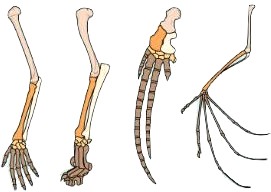
  • Know some anatomical structures that would be homologous to the wing of a bat
  • Know what important information was unavailable to Darwin in the mid-nineteenth century when he formulated his theory of evolution
  • Know the name of Darwin’s 1859 publication
  • Be able to explain all parts of the Darwin-Wallace theory of natural selection
  • Be able to explain how phylogenetic relationships are determined for closely related species
  • Be able to differentiate between analogous & homolgous structures
  • Know the requirements for the maintenance of  Hardy-Weinberg equilibrium
  • Be able to use the Hardy-Weinberg equation to determine allele frequencies and genotypic frequencies
  • Be able to describe and give an example of a cline
  • Be able to explain the bottleneck effect
  • Know what process creates new alleles and serves to balance natural selection
  • Be able to explain & give an example of genetic drift
  • Know what is meant by the “gene pool”
  • Know the major divisions of geologic time
  • Be able to give several examples of fossil types
  • Be able to explain binomial nomenclature
  • Be able to list in order the major taxonomic categories
  • Know what individuals in a population would most often carry copies of harmful recessive alleles
  • Be able to explain & give an example of hybrid sterility
  • Be able to explain & give an example of ecological isolation of species
  • Know what polyploidy is & how it can cause rapid speciation
  • Know the effect of mitosis & meiosis on allelic frequencies in nature
  • Be able to explain the effect on alleles when new members move into a population
  • Know the difference in prezygotic & postzygotic barriers
  • Be able to name & and give examples of prezygotic and postzygotic barriers
  • Be able to explain & give examples of mechanical and behavioral isolation
  • Know the difference between sympatric isolation and allopatric isolation
  • Be able to explain why such a great diversity of life exists on the Hawaiian & Galapagos Islands
  • Be able to tell the difference between anagenesis & cladogenesis
  • Know what taxonomic level can exist as a discrete unit in nature
  • Know what taxonomic unit would show the most genetic variation
  • Be able to explain & give an example of adaptive radiation
  • Be able to determine the age of a fossil using the half-life of carbon-14
  • Know what major evolutionary episode occurred closely with the formation of Pangaea
  • Be able to explain phylogeny
  • Know the significance of the asteroid hypothesis
  • Be able to explain & give examples of divergent & convergent evolution


Evolution Answers


Evolution Answers
    1. In biological terms, what is a species? a group of organisms that are similar in form and structure
      a group of organisms that can interbreed
      a group of organisms that share common features
      a group of organisms that have live in the same habitat
    2. What is the Scala Naturae? an idea proposed by Darwin that suggests that all organisms share a common ancestor
      an idea proposed by Plato that suggests organisms are all evolving toward an ideal form
      an idea proposed by Aristotle that suggests that all organisms fit into an orderly scheme
      an idea proposed by Wallace that suggests that organisms change over time
    3. Creationism is not accepted as a valid scientific theory because: it violates the scientific principle of natural causality
      it doesn’t offer a model to explain the diversity of life on earth
      it cannot be disproven
      all of these

birds

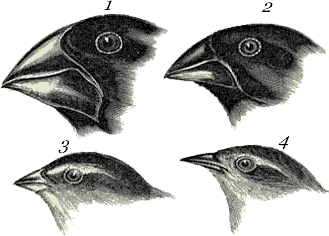
    1. The picture of the finches is used to illustrate: phylogeny of finches
      change over time
      specialization of beaks for different diets
      natural selection
    2. Which of the following was not an observation made by Darwin on his voyages: penguins use wings to paddle instead of fly
      snakes have rudimentary hind limbs
      the earth is very old
      islands had species that did not exist on the mainland

bones

    1. The image illustrates: vestigial structures
      homologous structures
      the fossil record
      natural selection
    2. Which of the following is an example of artificial selection: a panda’s thumb
      the breeding of dogs
      the galapagos finches
      a giraffe’s neck
    3. According to the theory of evolution by natural selection, which of the following is true: random mating is necessary for evolution to occur
      variation does not exist between members of the same species
      populations will change to better fit their environment
      individuals will adapt to their environment
    4. Which of the following are assumptions made with regards to the Theory of Evolution by Natural selection organisms compete with each other to survive
      variations exist among organisms
      not all organisms that are born survive to reproduce
      all of these

whale

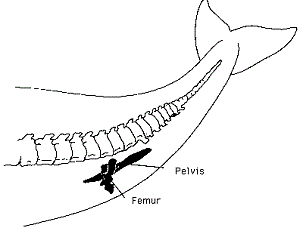
    1. The image illustrates which of the following: artificial selection
      acquired characteristics
      homologous structures
      vestigial structures
    2. A panda’s thumb is considered an evolutionary contrivance because: it is assembled from wrist bones, and imperfect
      it is perfectly structured to grab leaves
      it is an structure that has no use
      none of these
    3. Which of the following outcomes would you predict for a population of bacteria exposed to a new antibiotic. over many generations, the bacteria would become resistant to the antibiotic
      over a few generations, the bacteria would evolve into Archaebacteria
      over a few generations, the bacteria would become extinct
      over many generations, the bacteria would become more susceptible to the antibiotic
    4. Which of the following is an example of convergent evolution: whales and sharks have similar body designs
      bees and hummingbirds have similar body designs
      bats and birds have similar body designs
      all of these
    5. Why is evolution called the “unifying theory of biology” because it explains the diversity of life on the planet
      because it serves as a model to predict how organisms will change
      it serves as a model to interpret relationships between organisms on the planet
      all of these

moths

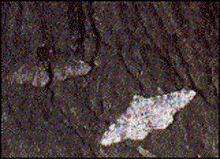
  1. The image illustrates how peppered moths are related to other moths
    how peppered moths adapted to a changing environment
    how peppered moths became extinct
    how peppered moths became two species