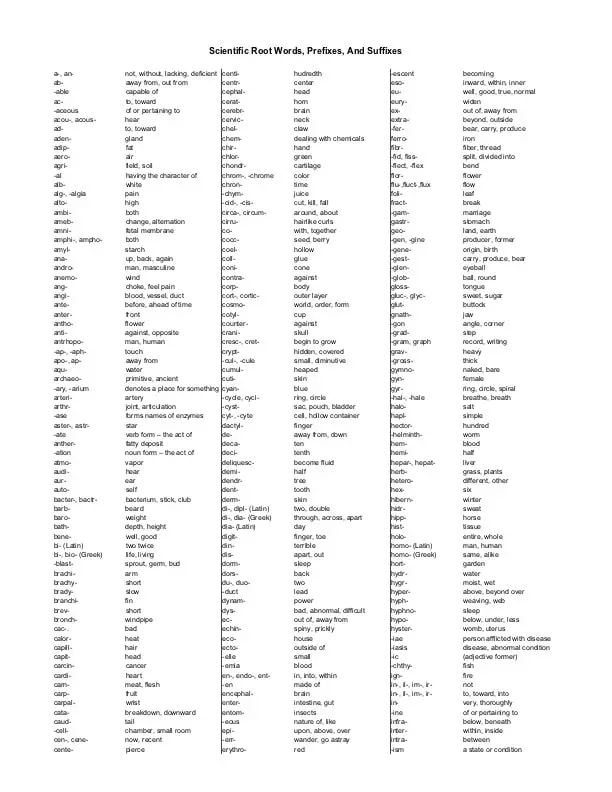
Click to download Scientific Root Words, Prefixes & Suffixes
If you’re studying for a science test, one of the best ways to help remember the material is by setting to music! That’s right; cell raps can help you remember the names of the organelles located in each cell, as well as their functions.
We’ve rounded up our top seven picks for cell raps that we think you’re going to love.
5 out of 5 stars
As YouTuber CrappyTeacher (Emily Crapnell) explains in her cell rap video, she created this video to help her sixth-grade science students learn the different parts of a cell. At over 5.7 million views, it seems that this cell rap has caught on with more than just Crapnell’s students! We can’t blame people for watching it; it’s catching and makes science–dare we say it?–fun!
“Today’s the day,” the rap begins; “let’s talk about the building blocks of life–cells that make us.”
The cell rap chorus covers some of the most vital parts of cellular biology. It explains that cells are made of organelles, and mentions cytoplasm, the nucleus (“controllin’ everything”), the membrane, the vacuole (“we can float around for hours”), and chloroplasts by name.
The next chorus explains that there are two different types of cells–animal and plant cells, while the final three stanzas are devoted to explaining in more details with each part of the cell does. “The cell membrane is the border patrol,” raps CrappyTeacher, and then later, “The mitochondria’s something every cell needs, breaking down the food and releasin’ energy.”
Over second thousand people have taken the time to comment on this cell rap. Many mention how they heard it years ago and still remember it, speaking to the catchy lyrics and the arresting beat. While designed for sixth-graders, the content is sophisticated enough that even college students report finding it helpful!
We also feel like it’s one of the best mixes of catchy lyrics and useful information, managing to find a good balance between repetition and new information. Plus, it provides a great video with very helpful images which will further solidify the information in your mind. For these reasons, we’ve given it five stars!
The rap can be viewed here or may be purchased.
5 out of 5 stars
The Cell Song, created and sung by Glenn Wolkenfeld, isn’t a cell rap–but it is a fantastic way to use the power of song to help commit the parts of a cell to memory! And with over two million views, we’re not the only people who think so.
The song is a folksy, bluesy tune where the singer asks what happens when he goes into a cell. “Who drives this bus,” sings Wolkenfeld, and then he “found myself talking to the boss, the nucleus.”
Wolkenfeld does two things in this song; he gets deeper into the molecular biology involved in the parts of a cell, and he offers a karaoke version.
Unlike some of the other cell raps available, The Cell Song explains that chromosomes stores genetic information, the ribosomes make proteins, and the lysosome use enzymes to dissolve, and centrioles organize chromosomes into spindles.
Wolkenfeld also uses The Cell Song to explain how rigid cell walls allow plants to grow extremely tall, and the purpose of green in the plant cell. “I went into a plant cell, ‘why’s it so green?’” sings the artist. “‘Cause I make food from sunlight,’” answers a green chloroplast.
The video is filled with helpful drawings and diagrams to further illustrate each concept. Wolkenfeld, as we mentioned already, also offers a karaoke version, which is the same version, but instead of Wolkenfeld singing, the lyrics are on the screen.
The Cell Song, like Cells Cells by CrappyTeacher, also gets five stars thanks to its ability to combine great video content with helpful, relevant information about cells.
You can find The Cell Song here, and the karaoke version here.
5 out of 5 stars
The Parts of a Cell Song is a cell rap created by an organization called Jam Campus. It’s one of many Jam Campus creations; in fact, the YouTube channel creates educational videos on everything history to science to mathematics.
With over 54,000 views, The Parts of a Cell Song is catchy and well-loved. What we especially love, in addition to the self-made music, is the high quality illustrated video! Any time you can marry great visual images with catchy lyrics, you increase the likelihood of you remembering the information.
The Parts of a Cell Song gets right down to business, stating in its first line, “here’s what each cell contains, outer layer is the cell membrane.” The lyrics point out where cells get their energy (mitochondria), and what ribosomes do (help with protein synthesis).
We also appreciate this lyric, which helps to sum up the parts of a cell, something most cell raps don’t do:
Cell membrane, mitochondria, lysosomes and the ribosomesCytoplasm, nucleus, E.R. and Golgi body, and the nucleolus
We especially appreciate how accurate the presented information is here (many cell raps mistakenly identify ribosomes as making proteins; however, they simply help in the assembly of polypeptides, chains of amino acids, which are the building blocks of protein), which is a big part of why this song gets five out of five stars.
4 out of 5 stars
Mr. Simons and his fifth grade have teamed up to create another great cell rap, available on YouTube. This cell rap has approximately 468,000 views, and we understand why–out of all the cell raps we’re sharing today, this one is probably the most likely to get stuck in your head!
Every song has to decide how to balance repetition with new information; as you’ll see later, some of the cell rap songs we’ve rounded up choose to focus on including as much data as possible. This rap, however, from Jake Simons, focuses on repetition.
In fact, we feel it focuses a little too much on repetition (we downgraded it to four stars), but it’s still a great rap that will help cement many of the things you’re learning about cell biology into your memory.
This five-minute rap features the cytoplasm, the nucleus, the membrane, the vacuoles, and the mitochondria of the cell. Here’s an example of a lyric:
“Just like us, the cell has energy. The mitochondria takes the food and puts it where it needs to be.”
Here’s another line from the cell rap, this one memorably explaining how the cell membrane works:
“There’s a thing called a membrane that holds it all in place so none of us will ever complain.”
Is this the cell rap to turn to if you need to memorize complicated material? Probably not; but it is a great option for younger students or people who need just the basic parts of a cell!
4 out of 5 stars
The Cell Song was written and recorded by Dr. Keith Smolinski as part of a doctoral study to research how music can help students learn complex science concepts. In addition to The Cell Song, which features the parts of a cell, there are another nine songs sold in an album called Biorhythms: The Music of Life Science.
Songs in Biorhythms cover everything from cellular division, to the digestive tract, to the ecosystem. The song we’re featuring, The Cell Song, isn’t a cell rap, but it is well-performed, catchy, and interesting to listen to!
While the accompanying video doesn’t include images (that’s why it only has four stars and not five), it does utilize the lyrics on screen. In just two minutes and nineteen seconds, Dr. Smolinski manages to cover everything from the nucleus to the cell membranes.
In The Cell Song, listeners learn that the nucleus contains the genetic code, the mitochondria are the power plants of the cell, and the vacuoles store food and water. We also learn that the ribosomes make proteins, the Golgi bodies pack and ship the proteins, and the endoplasmic reticulum carries them.
Plus, the song teaches that lysosomes are janitors, cytoplasm is gel-like, and cell membranes help regulate what comes in and out of the cell.
In the notes section of this video, Dr. Smolinski also explains that additional teacher’s resources are available on his website, including a Teacher’s Guide for The Cell Song. All of Dr. Smolinski’s resources are based on the National and State of Connecticut Science Standards, so you can be sure you’re getting accurate and helpful information.
4 out of 5 stars
ParrMr, a YouTube creator, has garnered over one hundred thousand subscribers thanks to her (or his!) ability to put science lyrics to popular songs. If you cringe over cells raps or want music you’re already familiar with, you can find videos on everything from Pangaea to the atmosphere to the planets.
ParrMr’s songs are set to hits like Forget You by Cee Lo Green, Toothbrush by D’NCE, and Jealous by Nick Jonas. The one we’re featuring here, with four out of five stars, is Organelles Song, set to Counting Stars by OneRepublic.
The music is easy to remember if you’re already familiar with the song–our one complaint, however, is that the lyrics have very little repetition. This has the upside of packing a ton of information into the four-plus minute song, but if you’re trying to make sure the material sticks, this might be a downside.
“Look inside a cell,” sings ParrMr, who created this song for his or her sixth-grade students, “and you will see…organelles have jobs, yeah, organelles have…jobs.”
The next lines focus on how plant cell walls and cell membranes protect the line like a fence, letting the right things in and out. ParrMr covers vacuoles, lysosomes, the nucleus, chromatin, DNA, and ribosomes.
The final stanza explains proteins and their relationships to the endoplasmic reticulum, Golgi bodies, and cytoplasm. Mitochondria and chloroplasts are also mentioned.
Organelles Song by ParrMr has racked up over 700,000 views, and for a good reason–we give this cells video four out of five stars!
3 out of 5 stars
Another much-loved option (four hundred thousand views!) by ParrMr, also for a sixth-grade classroom, this is another song about cells set to hit music. This one, called Cells Song, is set to Sail by AWOLNATION.
In it, ParrMr sings about cell membranes, cytoplasm, organelles, mitochondria, endoplasmic reticulum, ribosomes, and Golgi bodies.
“Cells cells cells cells cells,” he sings, before starting another chorus about vacuoles, the nucleus, and lysosomes.
Here is the final stanza:
Capturing Sun’s energyChloroplasts in plants and treesAnd cell walls giving box-like shape, rigid
If you’re a fan of pop or dance music or are simply looking for a non-rap alternative to cell raps, this is a great option. It’s short on useful information, but what is included is presented appealingly, and will be likely to stick!
Thanks to these seven awesome cell raps, we have a feeling you’re going to ace your next quiz or test. We’d say good luck, but we don’t think you’ll need it!
%CODE1%
| Biochemistry Quiz |  |
|
|
|
||
%CODE1%
 |
Mitosis
|