Introduction to Biology

%CODE1%

Introduction to Biology

    1. Name:

Course:

E-mail address:

  1. Biology is the study of Minerals Organisms Weather Energy
  2. All organisms possess DNA because DNA creates energy for cells DNA allows sensitivity to environmental stimuli

    DNA contains information for growth & development

    DNA helps capture energy from the sun

  3. Hoeostasis means a slow change over a long period of time Keeping things the same or in balance

    Producing enzymes for metabolism

    Responding to environmental stimuli

Introduction to Biology Quiz 2

%CODE1%

Name: 

Introduction to Biology


True/False
Indicate whether the sentence or statement is true or false.
1.
Only multicellular organisms use energy for growth and maintenance.
2.
Scientific investigations always follow a series of rigidly defined steps.
3.
Communicating scientific information may result in the development of new hypotheses.
4.
All living things are composed of cells.
5.
In a carefully planned experiment, the variable being studied is omitted from the experimental group.
6.
Scientific understanding is based on observations.
7.
Reproduction is essential for the survival of individual organisms.
8.
The processes of observing, measuring, and organizing data generally lead to the formulation of questions.
9.
Observing is the use of one or more of the senses to perceive objects or events.
10.
The study of biology can help you better understand human reproduction.
11.
Almost all organisms ultimately get their energy for survival from the sun.
12.
A scientist who performs an experiment has no idea what the outcome of the experiment is going to be.
13.
Units of time are not measured in metric units, so time measurements are not accepted for use with SI units.
 

Multiple Choice
Identify the letter of the choice that best completes the statement or answers the question.
14.
The step in a scientific method that is most likely to take the form of an IF_THEN statement is called:
a.
prediciton
c.
experimenting
b.
inference
d.
modeling
15.
The number of frogs in a pond increases each year due to:
a.
homeostasis
c.
organization
b.
reproduction
d.
the food chain
16.
When an experiment gives an important result, these results should not be
a.
published.
c.
replicated.
b.
withheld.
d.
confirmed.
17.
When a hypothesis is tested and confirmed often enough that it is unlikely to be disproved the hypothesis may become a
a.
theory.
c.
replication.
b.
prediction.
d.
scientific method.
18.
Generally, the order in which a scientist uses the scientific method is
a.
observations, predictions, hypothesis, verifying prediction,theory, verification.
b.
observations, hypothesis, making predictions, verifying predictions, performing control
experiments,theory.
c.
predictions, observations, hypothesis, theory, controlled testing,verification.
d.
observations, hypothesis, predictions, verification, theory.
19.
Generally the first process a scientist uses to obtain knowledge about nature is:
a.
collecting
c.
predicting
b.
observing
d.
measuring
20.
Which of the following steps in scientific method is most likely to directly follow
hypothesizing?
a.
communicating
c.
experimenting
b.
inferring
d.
predicting
21.
The part of the scientific method in which journal articles are prepared is called:
a.
communicating
c.
organizing
b.
observing
d.
classifying
22.
A control
a.
is when a lead scientist controls a group of scientists conducting an experiment.
b.
is always registered with the Food and Drug Administration (FDA).
c.
is the part of an experiment in which a key factor is not allowed to change.
d.
provides the answer to a problem posed by a theory.
23.
Biology is the study of
a.
minerals.
c.
the weather
b.
life.
d.
energy.
24.
Which of the following shows the most complex level of organization?
a.
red blood cells
c.
nerve
b.
stomach
d.
muscle
25.
In the scientific method, the step that follows observing and stating a  problem is
a.
recording data.
c.
forming a hypothesis.
b.
analyzing data.
d.
testing a hypothesis.
26.
The splitting in two of a bacterium is called:
a.
inheritance
c.
development
b.
sexual reproduction
d.
asexual reproduction
27.
Plants and algae use energy that comes from
a.
the sun.
b.
the movement of the Earth.
c.
the moon.
d.
heat created deep within the interior of the Earth.
28.
The first living organism on earth was probably a:
a.
single cell
c.
dinosaur
b.
fish
d.
plant
29.
In the scientific method, a possible explanation is called:
a.
hypothesis
c.
an observation
b.
an inference
d.
an analysis
30.
Cell membranes
a.
are only found on a small number of cells.
c.
are made of DNA
b.
contain genes.
d.
are thin coverings that surround cells.
31.
The combining of genetic information from two individuals to produce offspring is called:
a.
inheritance
c.
sexual reproduction
b.
development
d.
asexual reproduction
32.
All organisms possess DNA. DNA
a.
creates energy for the cells.
b.
allows sensitivity to environmental stimuli.
c.
contains information for growth and development.
d.
captures energy from the sun.
33.
Instructions for development that are passed from parents to offspring are known as
a.
a species plan.
c.
genes.
b.
organ codes.
d.
natural selections.
34.
Which of the following is not necessarily a distinct property of living things?
a.
homeostasis
c.
complexity
b.
metabolism
d.
reproduction
35.
Living things
a.
need energy for life processes.
c.
are composed of cells.
b.
have the ability to reproduce.
d.
All of the above
36.
All living things maintain a balance within their cells and the environment through the process of
a.
growth.
c.
homeostasis.
b.
development.
d.
evolution.
37.
Which of the following is not a partial explanation for our lack of understanding of many of the living things on Earth?
a.
Many organisms are microscopic in size and therefore difficult to observe.
b.
Many organisms are so different from other organisms that it is difficult to understand them.
c.
Many organisms live in areas of the world that are difficult to explore.
d.
Tropical rain forests contain many species, and it is difficult to find all of them in these dense forests.
38.
Which example of scientific methodology is incorrect?
a.
Observation—A number of people in Zaire dying of a disease outbreak
b.
Measurement—A record of the number of people with symptoms of the disease and the number of people who had died from the disease
c.
Analysis of data—Comparison of the effects of mixing monkey cells with virus-containing blood in test tubes and the effects of mixing of liquid from these test tubes with fresh monkey cells
d.
Inference making—Identification of the Ebola virus as the cause of the disease by taking electron micrographs of substances found in the blood of persons affected with the disease
39.
The word theory used in a scientific sense means
a.
that of which the scientist is most certain.
b.
a guess made with very little knowledge to support it.
c.
an absolute scientific certainty.
d.
None of the above
40.
A light microscope that has an objective lens of 10´ and an ocular lens of 20´ has a magnification of
a.
30´.
c.
300´.
b.
200´.
d.
2000´.


Check Your Work     Reset


Graph Example Quiz

%CODE1% Line Graphs Quiz

Click on the radio buttons in front of the correct answers to the questions.

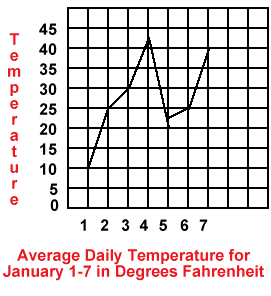
Line Graph of Temperatures

1. This graph shows the temperatures during the period of a

Week Month Year

2. The temperatures in the beginning of the week were rising or falling?

Rising Falling

3. There was the least amount of change between days

6 and 7

5 and 6

1 and two

4. If freezing is 32 degrees, which day was above freezing?

Day 1

Day 2

Day 4

5. When was the greatest drop in temperatures between?

Days 1 and 2

Days 3 and 4

Days 4 and 5

BAR GRAPH QUIZ

Click on the radio buttons in front of the correct answers to the questions about the graph.

Bar Graph

1. In the bar graph above, students favorite activity is

Using the computer

Visitng with friends

Earning money

2. According to the bar graph which is the least favorite after school activity?

Using on the computer

Visitng with friends

Earning money

3. Which two activities are favored by an equal number of students?

Playing sports and earning money

Using the computer and earning money

Talking on the phone and playing sports.

4. How many students said they their favorite after school activity is playing sports?

100 120 140

5. Based on this survey would you say more students like to be around people or be alone after school?

Be alone Be around people

Circle/Pie Graph Quiz

Click on the radio buttons in front of the correct answers to the questions.

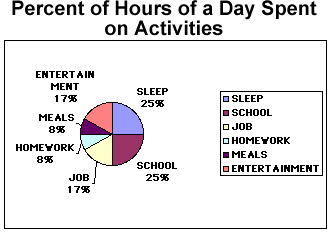
Chart of Day's Activities

1. A part of a circle/pie graph that explains the colors that represent each part or slice of the graph is a

legend grid axis

2. These two activities took up half of the time of the day.

Entertainment and school

Meals and school

Sleep and school

3. These two activities took up the least amount of time.

Sleep and school

Meals and homework

Sleep and job

4. Which of these took up one fourth of the day?

Entertainment

Sleep

Homework

5. What percent of the day does homework take up?

2 8 25

6. Which of these takes up the same amount of time as meals and entertainment together?

Job

School

Homework


Genetics Tutorial

%CODE1%

Javascript enabled

Name: 


Human Genetics Web Tutorial


True/False
Indicate whether the sentence or statement is true or false.
1.
Hemophilia is a recessive, sex-linked disorder.
2.
An autosomal trait will occur with equal frequency in both males and females.
3.
Sex-linkd traits appear more often in females than in males.
4.
An individual who expresses a genetic disorder is called a carrier.
5.
A male can produce sperm that contains either an X or a Y chromosome.
6.
Mutations are always harmful.
7.
A pedigree is a family record that shows how a trait is inherited over several generations.
 

Multiple Choice
Identify the letter of the choice that best completes the statement or answers the question.
8.
Hemophilia is a genetic disorder that is
a.
sex-linked.
c.
fairly common.
b.
sex-influenced.
d.
more common in women than in men.
9.
Parents of a color blind female could have the genotypes
a.
XCXc and XCY
c.
XCXc and XcY
b.
XcXc and XCY
d.
XCXC and XcY
10.
People who are heterozygous for sickle cell anemia are
a.
partially resistant to the effect of ultraviolet radiation.
b.
totally resistant to the effect of ultraviolet radiation.
c.
partially resistant to malaria.
d.
totally resistant to malaria.
11.
Both sickle cell anemia and hemophilia
a.
are caused by genes coding for defective proteins.
b.
are seen in homozygous dominant individuals.
c.
provide resistance to malaria infections.
d.
are extremely common throughout the world.
12.
This genetic disease occurs most frequently in the black population.
a.
cystic fibrosis
c.
sickle-cell anemia
b.
Tay-Sachs disease
d.
hemophilia
13.
The trait for skin color in humans is cause by
a.
crossing-over
c.
nondisjunction
b.
multiple genes
d.
mutations
14.
A hereditary disease in which the red blood cells have an abnormal shape is
a.
galactosemia
c.
polydactyly
b.
Tay-Sachs disease
d.
sickle-cell anemia
15.
Sex-linked traits appear more often in males than in females because
a.
males are produced in greater numbers
b.
females with a sex-linked trait will die
c.
males have only one X chromosome
d.
sex-linked traits are carried on the Y chromosome
16.
A diagram in which several generations of a family and the occurrence of certain genetic characteristics are shown is called a
a.
Punnett square.
c.
pedigree.
b.
monohybrid cross.
d.
family karyotype.
17.
What is the percentage of chance that two people who carry a sickle-cell gene will have a child having the disease?
a.
0
c.
50
b.
25
d.
100
18.
Which genetic trait is most influenced by the environment?
a.
blood type
c.
baldness
b.
eye color
d.
weight
19.
Very dark-skinned people have alleles at all gene positions for skin color that code for
a.
red-green colorblindness.
c.
the production of Rh antigens.
b.
albinism.
d.
the production of melanin.
20.
Sex-linked traits such as color blindness
a.
are never carried by females
c.
occur more frequently in males
b.
occur more frequently in females
d.
never occur in males
21.
What would be the blood type of a person who inherited an A allele from one parent and an O allele from the other?
a.
type A
c.
type AB
b.
type B
d.
type O.
22.
Genetic counseling is a process that
a.
helps identify parents at risk for having children with genetic defects.
b.
assists parents in deciding whether or not to have children.
c.
uses a family pedigree.
d.
All of the above
23.
If both parents carry the recessive allele that causes cystic fibrosis, the chance that their child will develop the disease is
a.
one in two.
c.
two in five.
b.
one in four.
d.
100 percent.
24.
People with Down syndrome have
a.
45 chromosomes.
c.
47 chromosomes.
b.
46 chromosomes.
d.
no X chromosomes.
25.
If nondisjunction occurs,
a.
there will be too many gametes produced.
b.
no gametes will be produced.
c.
a gamete will receive too many or too few homologues of a chromosome.
d.
mitosis cannot take place.
26.
A human female inherits
a.
one copy of every gene located on each of the X chromosomes.
b.
twice as many sex chromosomes as a human male inherits.
c.
one copy of every gene located on the Y chromosome.
d.
all of the same genes that a human male inherits.
27.
A pedigree CANNOT be used to
a.
determine whether a trait is inherited.
b.
show how a trait is passed from one generation to the next.
c.
determine whether an allele is dominant or recessive.
d.
none of the above
28.
If a man with blood type A and a woman with blood type B produce an offspring, what might be the offspring’s blood type?
a.
AB or O
b.
A, B, or O
c.
A, B, AB, or O
d.
AB only
29.
Sickle cell disease is caused by a
a.
change in one DNA base.
b.
change in the size of a chromosome.
c.
change in two genes.
d.
change in the number of chromosomes in a cell.
30.
Many sex-linked genes are located on
a.
the autosomes.
b.
the X chromosome only.
c.
the Y chromosome only.
d.
both the X chromosome and the Y chromosome.


Check Your Work     Reset

Genetics Practice Test Bi

%CODE1%

Chapter 9 Test, Form A
 

Multiple Choice
Identify the letter of the choice that best completes the statement or answers the question.
1.
The “father” of genetics was
a.
T. A. Knight.
c.
Gregor Mendel.
b.
Hans Krebs.
d.
None of the above
2.
Mendel obtained his P generation by allowing the plants to
a.
self-pollinate.
c.
assort independently.
b.
cross-pollinate.
d.
segregate.
3.
What is the probability that the offspring of a homozygous dominant individual and a homozygous recessive individual will exhibit the dominant phenotype?
a.
0.25
c.
0.66
b.
0.5
d.
1.0
4.
True-breeding pea plants always
a.
are pollinated by hand.
b.
produce offspring with either form of a trait.
c.
produce offspring with only one form of a trait.
d.
are heterozygous.
5.
The first filial (F1) generation is the result of
a.
cross-pollination among parents and the next generation.
b.
crosses between individuals of the parental generation.
c.
crosses between the offspring of a parental cross.
d.
self-fertilization between parental stock.
6.
Which of the following is the designation for Mendel’s original pure strains of plants?
a.
P
c.
F1
b.
P1
d.
F2
7.
A genetic trait that appears in every generation of offspring is called
a.
dominant.
c.
recessive.
b.
phenotypic.
d.
superior.
8.
To describe how traits can disappear and reappear in a certain pattern from generation to generation, Mendel proposed
a.
the law of independent assortment.
b.
the law of segregation.
c.
the law of genotypes.
d.
that the F2 generation will only produce purple flowers.
9.
When Mendel crossed pea plants with two contrasting traits, such as flower color and plant height,
a.
these experiments led to his law of segregation.
b.
he found that the inheritance of one trait did not influence the inheritance of the other trait.
c.
he found that the inheritance of one trait influenced the inheritance of the other trait.
d.
these experiments were considered failures because the importance of his work was not recognized.
10.
If an individual has two recessive alleles for the same trait, the individual is said to be
a.
homozygous for the trait.
c.
heterozygous for the trait.
b.
haploid for the trait.
d.
mutated.
11.
An individual heterozygous for a trait and an individual homozygous recessive for the trait are crossed and produce many offspring that are
a.
all the same genotype.
c.
of three different phenotypes.
b.
of two different phenotypes.
d.
all the same phenotype.
In humans, having freckles (F) is dominant to not having freckles (f). The inheritance of these traits can be studied using a Punnett square similar to the one shown below.
      evhm2gen-b_files/i0100000.jpg
12.
Refer to the illustration above. The genotype represented in box “1” in the Punnett square would
a.
be homozygous for freckles.
b.
have an extra freckles chromosome.
c.
be heterozygous for freckles.
d.
have freckles chromosomes.
13.
Refer to the illustration above. The genotype in box “3” of the Punnett square is
a.
FF.
c.
ff.
b.
Ff.
d.
None of the above
14.
How many different phenotypes can be produced by a pair of codominant alleles?
a.
1
c.
3
b.
2
d.
4
evhm2gen-b_files/i0130000.jpg
15.
Refer to the illustration above. The phenotype represented by the cell labeled “1” is
a.
green, inflated.
c.
yellow, inflated.
b.
green, constricted.
d.
yellow, constricted.
16.
2,000 yellow seeds : 8,000 total seeds ::
a.
1 : 6
c.
1 : 3
b.
1 : 8
d.
1 : 4
In rabbits, black fur (B) is dominant to brown fur (b). Consider the following cross between two rabbits.
      evhm2gen-b_files/i0160000.jpg
17.
Refer to the illustration above. Both of the parents in the cross are
a.
black.
c.
homozygous dominant.
b.
brown.
d.
homozygous recessive.
18.
Refer to the illustration above. The phenotype of the offspring indicated by box “3” would be
a.
brown.
c.
a mixture of brown and black.
b.
black.
d.
The phenotype cannot be determined.
19.
What is the expected phenotypic ratio resulting from a homozygous dominant ´ heterozygous monohybrid cross?
a.
1:3:1
c.
2:1
b.
1:2:1
d.
1:0
      evhm2gen-b_files/i0240000.jpg
20.
Refer to the illustration above. The phenotype represented by the cell labeled “1” is
a.
round, yellow.
c.
wrinkled, yellow.
b.
round, green.
d.
wrinkled, green.
21.
An organism that has inherited two of the same alleles of a gene from its parents is called
a.
hereditary.
c.
homozygous.
b.
heterozygous.
d.
a mutation.
22.
In pea plants, yellow seeds are dominant over green seeds. What would be the expected genotype ratio in a cross between a plant with green seeds and a plant that is heterozygous for seed color?
a.
1:3
c.
4:1
b.
1:2:1
d.
1:1
23.
codominance : both traits are displayed ::
a.
probability : crosses
b.
heterozygous : alleles are the same
c.
homozygous : alleles are the same
d.
Punnett square : chromosomes combine
24.
The difference between a monohybrid cross and a dihybrid cross is that
a.
monohybrid crosses involve traits for which only one allele exists, while dihybrid traits involve two alleles.
b.
monohybrid crosses involve self-pollination, while dihybrid crosses involve cross-pollination.
c.
monohybrid crosses involve one gene; dihybrid crosses involve two genes.
d.
dihybrid crosses require two Punnett squares; monohybrid crosses need only one.
25.
What fraction of the offspring resulting from a heterozygous ´ heterozygous dihybrid cross are heterozygous for both traits?
a.
9/16
c.
3/16
b.
1/4
d.
1/16


Submit          Reset