This page uses frames, but your browser doesn’t support them.
Category: 1st Semester
Karyotype Lab
| Karyotype lab | ![]() |
Introduction:
We can learn a lot by looking at chromosomes! They can tell us everything from the likelihood that an unborn baby will have a genetic disorder to whether a person will be male or female. Scientists often analyze chromosomes in prenatal testing and in diagnosing specific diseases. Fetal cells from an unborn child are contained in the amniotic fluid and can be tested for hereditary disorders such as Tay-Sachs or Phenylketonuria. Chromosomes are compact spools of DNA. If you were to stretch out all the DNA from one of your cells, it would be over 3 feet (1 meter) long from end to end! You can think of chromosomes as “DNA packages” that enable all this DNA to fit in the nucleus of each cell. Normally, we have 46 of these packages in each cell; we received 23 from our mother and 23 from our father. A karyotype is an organized profile of a person’s chromosomes. In a karyotype, chromosomes are arranged and numbered by size, from largest to smallest. This arrangement helps scientists quickly identify chromosomal alterations that may result in a genetic disorder.

To make a karyotype, scientists take a picture of someone’s chromosomes, cut them out and match them up using size, banding pattern and centromere position as guides. Homologous pairs are arranged by size in descending order (largest to smallest) with the sex chromosomes (XX for female or XY for male) as the last or 23 pair. Homologous chromosomes have genes for the same trait at the same location.

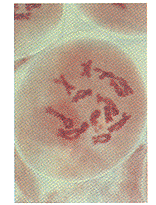
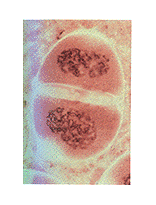
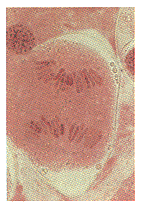
Since humans have 46 chromosomes in their somatic or body cells, they have 23 pairs of chromosomes in their karyotype. If chromosomes fail to separate in meiosis, a condition called nondisjunction, a person may have more or less than the normal 46 chromosomes on their karyotype. A disorder called Down Syndrome would be a example of this. A person with Down Syndrome will have 3 chromosomes in their 21st pair. The image below shows chromosomes as they are seen on the slide (left panel) and after arrangement (right panel).

karyotype background (run on colored paper), 1-3 sheets of numbered chromosomes, stick glue, scissors, envelope, black ink pen or fine-point marker
Procedure:
- Use your assigned sex and chromosome condition to determine how many of each chromosome you will need for your karyotype. (Assigned conditions include Normal male, Normal female, Female with Turner Syndrome, Male with Klinefelter’s Syndrome, Female with Down Syndrome, Male with Down Syndrome, Female with three X chromosomes, Male with no X chromosome, female with Cri-du-chat, Male with Cri-du-chat)
- Cut out this number of chromosomes keeping the homologous pairs together. (Do not cut off the chromosome numbers until you are ready to glue the chromosomes to your karyotype sheet.)
- Start arranging the chromosome pairs on the construction paper karyotype sheet in descending order by their size. Do not glue the chromosomes until all of them are arranged correctly.
- Evenly space out 4 rows of chromosomes on your karyotype sheet. Row 1 should contain pairs 1-6, row 2 has pairs 7-12, row 3 has pairs 13-18, and row 4 pairs 19 through the sex chromosomes.
- If any additional chromosomes are needed to complete your karyotype, cut these out from additional chromosome sheets.
- Make sure ALL PAIRS are in the same direction with their SHORTER END TOWARDS THE TOP OF THE CONSTRUCTION PAPER.
- Cut off the numbers from one homologous pair of chromosomes at a time and glue that pair to your construction paper karyotype sheet.
- With your ink pen or marker, neatly number each pair 1-23 below the glued pair.
- In the lower left corner of your karyotype, write the sex of your individual and their genetic condition (normal, Cri-du-chat, Down’s…).
- In the lower right corner, write the total number of chromosomes for this person.
Karyotype Template: (Click here for additional templates)
Questions & Observations:
- What is a karyotype?
2. How can a karyotype be useful to a couple wanting to have children?
3. What makes up chromosomes?
4. How is a karyotype of an unborn infant obtained?
5. What was the sex of the individual you were assigned?
6. What is this person’s GENOTYPE for sex?
7. What is a mutation?
8. What mutation, if any, occurred in this person’s karyotype?
9. How many chromosomes are in a somatic or body cell of this individual?
10. How many chromosomes are in a gamete or sex cell of this individual?
11. How many chromosomes are in a normal person’s somatic cells?
12. How many chromosomes are in a normal person’s gametes?
13. How many UNPAIRED chromosomes are their in this organism’s somatic cells?
14. What is the sex of an individual with 23 MATCHED pairs of chromosomes?
15. What is the diploid number for this organism?
16. Explain nondisjunction.
17. Name and explain 3 disorders due to nondisjunction of chromosomes.
Introduction to Life Study Guide bI
Introduction to Life Study Guide
| Study of life is known as? |
| How are genes used by organisms? |
| Which characteristic of living things relates to stability? |
| What does homeostasis mean? |
| What is ecology? |
| How do heterotrophs obtain energy? |
| List distinct properties of living things. |
| What is the smallest unit that can carry on life called? |
| What are all living things made of? |
| Which of the following are characteristics of ALL living things — growth, development, cellular organization, & movement? |
| A scientist noticed that bacteria weren’t growing in some test tubes. Is this observation, hypothesis, or experimentation? |
| The scientist suggests that bacteria aren’t growing in some test tubes because they aren’t getting the nutrients they need. Is this observation, hypothesis, experimentation, or conclusion? |
| A scientist adds a different nutrient to half of the test tubes in which he is growing bacteria. Is this observation, hypothesis, or experimentation? |
| Define hypothesis. |
| What is a theory? |
| A hypothesis is rejected if it does not explain what? |
| When scientists are planning experiments, do they have a good idea of the possible results? |
| If new evidence emerges, do theories change? |
| Are theories supported with some scientific knowledge? |
| Are theories proved scientific ideas? |
| For scientists to communication with each other about their data, what do they do with their data? |
| How do scientists organize data? |
| If a microscope has a 30X objective lens & a 10X ocular (eyepiece) lens, what is its magnification? |
| What are the base units for each of these SI measurements — length? second? volume? mass? |
Introduction Quiz
'; instructionText[1] = '
'; instructionIndex[0] = 0; instructionIndex[1] = 5; narrativeText[0] = '
' + '
'; narrativeIndex[0] = 0; numberText[0] = '1.'; questionText[0] = '
'; answerText[0] = '
'; numberText[1] = '2.'; questionText[1] = '
'; answerText[1] = '
'; numberText[2] = '3.'; questionText[2] = '
'; answerText[2] = '
'; numberText[3] = '4.'; questionText[3] = '
'; answerText[3] = '
'; numberText[4] = '5.'; questionText[4] = '
'; answerText[4] = '
'; numberText[5] = '6.'; questionText[5] = '
|
a.
|
minerals.
|
c.
|
the weather.
|
|
b.
|
life.
|
d.
|
energy.
|
'; answerText[5] = '
'; numberText[6] = '7.'; questionText[6] = '
|
a.
|
a change over long periods of time.
|
c.
|
rapid change.
|
|
b.
|
keeping things the same.
|
d.
|
the same thing as evolution.
|
'; answerText[6] = '
'; numberText[7] = '8.'; questionText[7] = '
|
a.
|
using water, carbon dioxide, and energy from the sun to produce ' + 'sugars
|
|
b.
|
using water and ' + 'carbon dioxide to produce energy-rich compounds
|
|
c.
|
consuming autotrophs
|
|
d.
|
consuming simple chemicals from the environment and using them to ' + 'assemble complex chemicals and structures needed by the organism
|
'; answerText[7] = '
'; numberText[8] = '9.'; questionText[8] = '
|
a.
|
homeostasis
|
c.
|
complexity
|
|
b.
|
metabolism
|
d.
|
reproduction
|
'; answerText[8] = '
'; numberText[9] = '10.'; questionText[9] = '
|
a.
|
diatoms.
|
c.
|
cells.
|
|
b.
|
cellulose.
|
d.
|
None of the ' + 'above
|
'; answerText[9] = '
'; numberText[10] = '11.'; questionText[10] = '
|
a.
|
Observation—A number of people in Zaire dying of a disease ' + 'outbreak
|
|
b.
|
Measurement—A record of the number of people with symptoms of the disease and the ' + 'number of people who had died from the disease
|
|
c.
|
Analysis of data—Comparison of the effects of mixing monkey cells ' + 'with virus-containing blood in test tubes and the effects of mixing of liquid from these test tubes ' + 'with fresh monkey cells
|
|
d.
|
Inference making—Identification of the Ebola virus as the cause of ' + 'the disease by taking electron micrographs of substances found in the blood of persons affected with ' + 'the disease
|
'; answerText[10] = '
'; numberText[11] = '12.'; questionText[11] = '
|
a.
|
communicating.
|
c.
|
experimenting.
|
|
b.
|
inferring.
|
d.
|
analyzing data.
|
'; answerText[11] = '
'; numberText[12] = '13.'; questionText[12] = '
|
a.
|
a definite answer to a given problem.
|
|
b.
|
a testable possible explanation of an ' + 'observation.
|
|
c.
|
a proven statement.
|
|
d.
|
a concluding statement.
|
'; answerText[12] = '
'; numberText[13] = '14.'; questionText[13] = '
|
a.
|
is known as an inaccurate forecast.
|
c.
|
is rejected.
|
|
b.
|
often predicts a different observation.
|
d.
|
None of the above
|
'; answerText[13] = '
'; numberText[14] = '15.'; questionText[14] = '
|
a.
|
is absolutely certain.
|
|
b.
|
is unchangeable.
|
|
c.
|
may be revised as new evidence is presented.
|
|
d.
|
is a controlled experiment.
|
'; answerText[14] = '
'; numberText[15] = '16.'; questionText[15] = '
|
a.
|
theory : observation
|
c.
|
certainty : investigation
|
|
b.
|
guess : hypothesis
|
d.
|
theory : control
|
'; answerText[15] = '
'; numberText[16] = '17.'; questionText[16] = '
|
a.
|
observing
|
c.
|
analyzing data
|
|
b.
|
measuring
|
d.
|
All of the ' + 'above
|
'; answerText[16] = '
'; numberText[17] = '18.'; questionText[17] = '
|
a.
|
observations, predictions, hypothesis, controlled testing, theory, ' + 'verification.
|
|
b.
|
predictions, ' + 'observations, hypothesis, theory, controlled testing, verification.
|
|
c.
|
observations, hypothesis, predictions, controlled testing, theory, ' + 'verification.
|
|
d.
|
observations, ' + 'hypothesis, predictions, controlled testing, verification, theory.
|
'; answerText[17] = '
'; numberText[18] = '19.'; questionText[18] = '
|
a.
|
30´.
|
c.
|
300´.
|
|
b.
|
200´.
|
d.
|
2000´.
|
'; answerText[18] = '
'; numberText[19] = '20.'; questionText[19] = '
|
a.
|
A—area
|
c.
|
s—second
|
|
b.
|
m—length
|
d.
|
mol—amount of ' + 'a substance
|
'; answerText[19] = '
'; studentName = StripSpaces(f.student_name.value); FixMTF(f); index = 0; for (i=0; i < f.length; ++i) { if (f.elements[i].name.indexOf(":") > 0) { text = StripSpaces(GetResponse(index, f.elements[i])); if (text.length == 0) ++numBlank; ++index; } } if (studentName == "") { alert("Student name cannot be blank."); return(false); } if (numBlank > 0) { if (numBlank == 1) msg = "1 question"; else msg = numBlank + " questions"; if (!confirm("You have not answered " + msg + " Are you sure you want to end the test?")) return(false); } index = 0; for (i=0; i < f.length; ++i) { if (f.elements[i].name.indexOf(":") > 0) { text = GetResponse(index, f.elements[i]); if (ansMap[index] == "") { prefixText[index] = "
"; ++numSubjective; } else { isCorrect = ScoreAnswer(index, text); if (isCorrect) ++numCorrect; ++numPossible; prefixText[index] = BuildPrefixText(index, text, isCorrect); } responseText[index] = TranslateHtmlString(text); ++index; } } if (showNotes) { for (i=0; i < numQuestions; ++i) { if (qtypeMap.charAt(i) == "2") notesText[i] = FixMCNotes(notesText[i], responseText[i]); } } if (numPossible > 0) scorePercent = Math.round(100.0 * numCorrect / numPossible); else scorePercent = 0; studentName = TranslateHtmlString(studentName); document.writeln("n
n"); document.writeln("
"); document.writeln("Name: " + studentName + ""); document.write("Score: " + numCorrect + " / " + numPossible + " (" + scorePercent + "%)"); if (numSubjective > 0) { document.write(" [" + numSubjective + " subjective "); if (numSubjective == 1) document.write("question"); else document.write("questions"); document.write(" not graded]"); } document.writeln(" "); document.writeln("
"); document.writeln("
|
"); document.writeln(instructionText[currentInstruction]); document.writeln("
"); document.writeln(" |
||||||||||
|
"); document.writeln(narrativeText[currentNarrative]); document.writeln("
"); document.writeln(" |
||||||||||
| " + prefixText[i] + " |
" + numberText[i] + "
|
" + questionText[i]); document.writeln("
"); document.writeln("
|
||||||||
"); document.writeln("
|
|
|
"); document.writeln("![]() |
"); document.write(""); document.writeln(" "); document.writeln(" |
"); document.writeln(""); document.writeln(""); document.close(); return(false); } function GetResponse(answerIndex, answer) { var listIndex; var responseText; if (listMap.charAt(answerIndex) == "1") { listIndex = answer.selectedIndex; responseText = answer.options[listIndex].text; } else responseText = answer.value; return(responseText); } function ScoreAnswer(answerIndex, responseText) { var listIndex; var answerText; answerText = ansMap[answerIndex]; if (qtypeMap.charAt(answerIndex) == "4") return(NumericCompare(responseText, answerText)); else if (qtypeMap.charAt(answerIndex) == "5") return(MultiCompare(responseText, answerText)); else if (responseText.toUpperCase() == answerText.toUpperCase()) return(true); else return(false); } function BuildPrefixText(answerIndex, responseText, isCorrect) { var text; var listIndex; text = "
" if (isCorrect) text += "" else text += "
" if (listMap.charAt(answerIndex) == "1") { if (responseText.length == 0) responseText = " "; text += " " + responseText + " "; } text += "
" return(text); } function StripSpaces(s) { var len; var i; len = s.length; for (i=len - 1; i >= 0 && s.charAt(i) == " "; --i) len = i; if (len == 0) s = ""; else if (len != s.length) s = s.substring(0, len); return(s); } function TranslateHtmlString(text) { var newText; var replaceString; var position; var length; var breakPos; var skipExtra; var i; newText = ""; position = 0; length = text.length; while (position < length) { skipExtra = 0; breakPos = -1; for (i=position; i < length && breakPos < 0; ++i) { switch(text.charAt(i)) { case '>': replaceString = ">"; breakPos = i; break; case '<': replaceString = "<"; breakPos = i; break; case '&': replaceString = "&"; breakPos = i; break; case 'r': if ((i + 1) < length && text.charAt(i + 1) == 'n') skipExtra = 1; replaceString = "
"; breakPos = i; break; case 'n': replaceString = "
"; breakPos = i; break; case ' ': if ((i + 1 < length) && text.charAt(i + 1) == ' ') { replaceString = " "; breakPos = i; } break; } } if (breakPos < 0) { newText += text.substring(position, length); position = length; } else { if (breakPos > position) newText += text.substring(position, breakPos); newText += replaceString; position = breakPos + 1 + skipExtra; } } return(newText); } function FixMCNotes(notesText, studentText) { var displayText; var searchText; var upperNotes; var charCode; var startIndex; var endIndex; displayText = ""; if (studentText.length > 0 && notesText.length > 0) { upperNotes = notesText.toUpperCase(); studentText = studentText.toUpperCase(); charCode = studentText.charCodeAt(0); searchText = "/" + String.fromCharCode(charCode) + "/"; startIndex = upperNotes.indexOf(searchText); if (startIndex >= 0) { startIndex += searchText.length; searchText = "/" + String.fromCharCode(charCode + 1) + "/"; endIndex = upperNotes.indexOf(searchText, startIndex); if (endIndex < startIndex) endIndex = notesText.length; displayText = notesText.substring(startIndex, endIndex); } else if (notesText.charAt(0) != "/") displayText = notesText; } return(displayText); } function NumericCompare(s1, s2) { var s1Sign; var s2Sign; var tempString; var decimalCount; var decimalPos; var numToDelete; var len; var ch; var i; s1.toUpperCase(); s2.toUpperCase(); if (s1 == s2) return(true); else { s1Sign = 1; s2Sign = 1; tempString = ""; for (i=0; i < s1.length; ++i) { ch = s1.charAt(i); if (ch == "-" && tempString.length == 0) s1Sign = -1; else if ((ch >= "0" && ch <= "9") || ch == ".") tempString += ch; } s1 = tempString; decimalCount = 0; decimalPos = -1; for (i=0; i < s1.length; ++i) { if (s1.charAt(i) == '.') { ++decimalCount; if (decimalPos < 0) decimalPos = i; } } if (decimalCount == 1 && decimalPos >= 0) { len = s1.length; for (i=len - 1; i >= decimalPos; --i) { if (i == decimalPos || s1.charAt(i) == '0') len = i; else break; } if (len < s1.length) s1 = s1.substring(0, len); if (s1.length == 0) s1 = "0"; } numToDelete = 0; for (i=0; i < s1.length; ++i) { if (s1.charAt(i) == "0") ++numToDelete; else break; } if (numToDelete > 0) { if (numToDelete == s1.length) --numToDelete; if (numToDelete > 0) s1 = s1.substring(numToDelete); } ///////////////////////////////////////////// tempString = ""; for (i=0; i < s2.length; ++i) { ch = s2.charAt(i); if (ch == "-" && tempString.length == 0) s2Sign = -1; else if ((ch >= "0" && ch <= "9") || ch == ".") tempString += ch; } s2 = tempString; decimalCount = 0; decimalPos = -1; for (i=0; i < s2.length; ++i) { if (s2.charAt(i) == '.') { ++decimalCount; if (decimalPos < 0) decimalPos = i; } } if (decimalCount == 1 && decimalPos >= 0) { len = s2.length; for (i=len - 1; i >= decimalPos; --i) { if (i == decimalPos || s2.charAt(i) == '0') len = i; else break; } if (len < s2.length) s2 = s2.substring(0, len); if (s2.length == 0) s2 = "0"; } numToDelete = 0; for (i=0; i < s2.length; ++i) { if (s2.charAt(i) == "0") ++numToDelete; else break; } if (numToDelete > 0) { if (numToDelete == s2.length) --numToDelete; if (numToDelete > 0) s2 = s2.substring(numToDelete); } if (s1Sign == s2Sign && s1 == s2) return(true); } return(false); } function MultiCompare(responseText, answerText) { var startIndex; var endIndex; var partialText; responseText = responseText.toUpperCase(); answerText = answerText.toUpperCase(); startIndex = 0; do { endIndex = answerText.indexOf("r", startIndex); if (endIndex < 0) partialText = answerText.substring(startIndex); else partialText = answerText.substring(startIndex, endIndex); if (responseText == partialText) return(true); startIndex = endIndex + 1; } while (endIndex > 0); return(false); } function FixMTF(f) { var text; var letter; var theList; var listIndex; var number; var i; for (i=0; i < f.length; ++i) { if (f.elements[i].name.indexOf("MTF:") == 0) { number = parseInt(f.elements[i].name.substring(4), 10); theList = f["MTF-" + number + "-1"]; if (theList) { listIndex = theList.selectedIndex; letter = theList.options[listIndex].text; } else letter = ""; text = StripSpaces(f["MTF-" + number + "-2"].value); if (text == "") f.elements[i].value = letter; else f.elements[i].value = letter + "," + text; } } } function AllowReset() { return(window.confirm("Do you want to clear all of your answers?")); } // -->
| Name:
Introduction Quiz |
|
True/False
Indicate whether the sentence or statement is true or false.
|
||||||||||
![]() |
||||||||||
| 1. |
Refer to the illustration above. Reproduction ensures the ongoing success of both species.
|
|||||||||
| 2. |
Refer to the illustration above. The sand dollar and paramecium both show organization.
|
|||||||||
| 3. |
Scientists have not discovered any new species on Earth in more than 20 years.
|
|||||||||
| 4. |
Publication of the results of scientific investigations enables other scientists to verify these results.
|
|||||||||
| 5. |
Resolution is a microscope’s power to increase an object’s apparent size.
|
|||||||||
|
Multiple Choice
Identify the letter of the choice that best completes the statement or answers the question.
|
||||||||||
| 6. |
Biology is the study of
|
|||||||||
| 7. |
Homeostasis means
|
|||||||||
| 8. |
Which of the following is a means by which heterotrophs can obtain energy?
|
|||||||||
| 9. |
Which of the following is not necessarily a distinct property of living things?
|
|||||||||
| 10. |
All organisms are composed of
|
|||||||||
| 11. |
Which example of scientific methodology is incorrect?
|
|||||||||
| 12. |
Scientific hypotheses are most often tested by the process of
|
|||||||||
| 13. |
A hypothesis is
|
|||||||||
| 14. |
A hypothesis that does not explain an observation
|
|||||||||
| 15. |
A scientific theory
|
|||||||||
| 16. |
observation : hypothesis ::
|
|||||||||
| 17. |
Which of the following components of a scientific investigation would benefit from communication between scientists?
|
|||||||||
| 18. |
Most typically, the order in which the steps of the scientific method are applied is
|
|||||||||
| 19. |
A light microscope that has an objective lens of 10´ and an ocular lens of 20´ has a magnification of
|
|||||||||
| 20. |
Which of the following associations between an SI base unit abbreviation and its base quantity is incorrect?
|
|||||||||
| |
|


" else text += "
" if (listMap.charAt(answerIndex) == "1") { if (responseText.length == 0) responseText = " "; text += " " + responseText + " "; } text += "