Diffusion and Osmosis


  Diffusion and Osmosis

Introduction:
In this exercise you will measure diffusion of small molecules through dialysis tubing, an example of a semi permeable membrane. The movement of a solute through a semi permeable membrane is called dialysis. The size of the minute pores in the dialysis tubing determines which substance can pass through the membrane. A solution of glucose and starch will be placed inside a bag of dialysis tubing. Distilled water will be placed in a beaker, outside the dialysis bag. After 30 minutes have passed, the solution inside the dialysis tubing and the solution in the beaker will be tested for glucose and starch. The presence of reducing sugars like glucose, fructose, and sucrose will be tested with Benedict’s Solution. The presence of starch will be tested with Lugol’s solution (iodine-potassium-iodide).

Procedure:

  1. Obtain a 30 -cm piece of 2.5-cm dialysis tubing that has been soaking in water. Tie off one end of the tubing to form a bag. To open the other end of the bag, rub the end between your fingers until the edges separate.
  2. Place 15 mL of the 15% glucose/ 1% starch solution in the bag. Tie off the other end of the bag, leaving sufficient space for the expansion of the bag’s contents. Record the color of the solution in Table 1.1.
  3. Test the 15% glucose / 1% starch solution in the bag for the presence of glucose. Your teacher may have you do a Benedict’s test. Record the results in Table1.1.
  4. Fill a 250 mL beaker or cup 2/3 full with distilled water. Add approximately 4 mL of Lugol’s solution to the distilled water and record the color in Table 1.1. Test the solution for glucose and record the results in Table 1.1.
  5. Immerse the bag in the beaker of solution.
  6. Allow your set up to stand for approximately 30 minutes or you see a distinct color change in the bag or the beaker. Record the final color of the solution in the bag, and of the solution in the beaker, in Table 1.1.
  7. Test the liquid in the beaker and in the bag for the presence of glucose. Record the results in Table 1.1.


Table 1.1

Initial Contents Initial Solution Color Final Solution Color Initial Presence of Glucose Final Presence of Glucose
Bag 15% Glucose & 1% starch
Beaker H2O + IKI

Analysis of Results:
1. Which substance(s) are entering the bag and which are leaving the bag? What experimental evidence supports your answer?

_______________________________________________________________________

_______________________________________________________________________

_______________________________________________________________________

_______________________________________________________________________

2. Explain the results you obtained. Include the concentration differences and membrane pore size in your discussion.

________________________________________________________________________

________________________________________________________________________

________________________________________________________________________

________________________________________________________________________

3. Quantitative data uses numbers to measure observed changes. How could this experiment be modified so that quantitative data could be collected to show that water diffused into the dialysis bag?

________________________________________________________________________

________________________________________________________________________

________________________________________________________________________

________________________________________________________________________

________________________________________________________________________

4. Based on your observations, rank the following by relative size, beginning with the smallest : glucose molecules, water molecules, IKI molecules, membrane pores, starch molecules.

_______________________________________________________________________

_______________________________________________________________________

5. What results would you expect if the experiment started with glucose and IKI solution inside the bag and only starch and water outside? Why?

________________________________________________________________________

________________________________________________________________________

________________________________________________________________________

________________________________________________________________________

Osmosis:
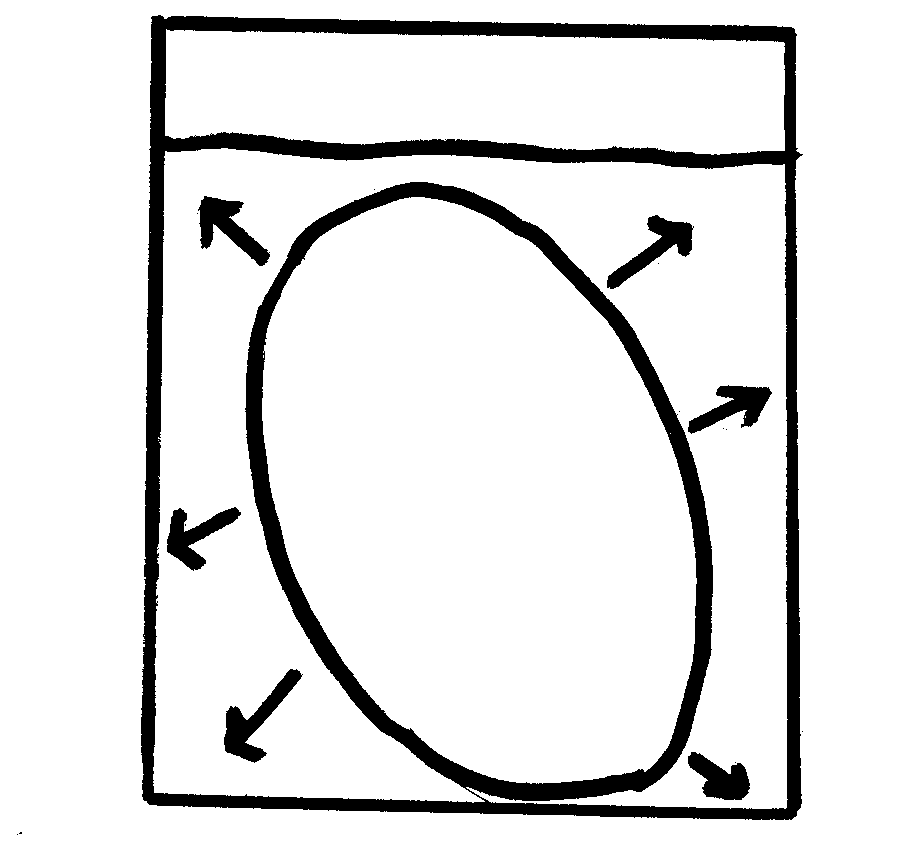
In this experiment you will use dialysis tubing to investigate the relationship between solute concentration and the movement of water through a semi permeable membrane by the process of osmosis. When two solutions have the same concentration of solutes, they are said to be isotonic to each other. If the two solutions are separated by a semi permeable membrane, water will move between the two solutions, but there will be no net change in the amount of water in either solution. If two solutions differ in the concentration of solutes that each has, the one with more solute hypertonic to the one with the less solute. The solution that has less solute is hypotonic to the one with more solute. These words can only be used to compare solutions.

Procedure:
1. Obtain six 30-cm strips of presoaked dialysis tubing.

2. Tie a knot in one end of each piece of dialysis tubing to form six bags. Pour approximately 25 mL of each of the following solutions into separate bags:

  • Distilled water
  • 0.2 M sucrose
  • 0.4 M sucrose
  • 0.6 M sucrose
  • 0.8 M sucrose
  • 1.0 m sucrose

Remove most of the air from the bags by drawing the dialysis bag between two fingers. Tie off the other end of the bag. Leave sufficient space for the expansion of the contents in the bag.

3. Rinse each bag gently with distilled water to remove any sucrose spilled during filling.

4. Carefully blot the outside of each bag and record in Table 1.2 the initial mass of each bag.

5. Fill six 250 mL beakers 2/3 full with distilled water.

6. Immerse each bag in one of the beakers of distilled water and label the beaker to indicate the molarity of the solution in the dialysis bag. Be sure to completely submerge each bag.

7. Let them stand for 30 minutes.

8. At the end of 30 minutes remove the bags from the water. Carefully blot and determine the mass of each bag.

9. Record your group’s results in Table 1.2. Obtain data from the other lab groups in your class to complete Table 1.3: Class Data.

Table 1.2 Dialysis Bag Results: Individual Data

Contents in Dialysis Bag Initial Mass Final Mass Mass Difference % Change in Mass
a). Distilled Water  


b). 0.2 M  


c). 0.4 M  


d). 0.6 M  


e). 0.8 M  


f). 1.0 M  


To Calculate:

% change in mass = Final Mass-Initial Mass X 100
———————–

Initial Mass

Table 1.3 Dialysis Bag Results: Class Data

percent change in Mass of Dialysis Bags


Bag Contents Group 1 Group 2 Group 3 Group 4 Group 5 Group 6 Total Class Average
Distilled Water
0.2 M
0.4 M
0.6 m
0.8 M
1.0 M

10. Graph the results for both your individual data and class average on the following graph. For this graph you will need to determine the following:

a). the independent variable. __________________________________

b). the dependent variable. ___________________________________

Graph Title ______________________________________________

Analysis of Results:
1. Explain the relationship between the change in mass and the molarity of sucrose within the dialysis bag.

________________________________________________________________________

________________________________________________________________________

________________________________________________________________________

________________________________________________________________________

________________________________________________________________________

2. Predict what would happen to the mass of each bag in this experiment if all the bags were placed in a 0.4 M sucrose solution instead of distilled water. Explain your response.

________________________________________________________________________

________________________________________________________________________

________________________________________________________________________

________________________________________________________________________

________________________________________________________________________

3. Why did you calculate the per cent change in mass rather than using the change in mass?

________________________________________________________________________

________________________________________________________________________

________________________________________________________________________

________________________________________________________________________

________________________________________________________________________

4. A dialysis bag is filled with distilled water and then placed in a sucrose solution. The bag’s initial mass is 20 g. and its final mass is 18 g. Calculate the percent change of mass, showing your calculations in the space below.


5. The sucrose solution in the beaker would have been ___________________ to the distilled water in the bag.


DNA Quiz

DNA QUIZ QUESTIONS


1. What is the general name for chemicals like DNA and RNA
2. What general shape does the DNA molecule have?
3. List 4 differences between RNA and DNA
4. Describe the function of the mRNA in Protein Synthesis
5. What is the definition of a codon
6. What is the definition of an anti-codon
7. How many amino acids will result from the following strand of DNA?
A C G C C C A A A T A C
8. Name the two stages that make up protein synthesis
9. Where in the cell does replication take place?
10. Describe the function of the tRNA in Protein Synthesis?
11. Describe briefly the events that occur during transcription?
12. Name 2 common environmental mutagens
13. Describe briefly the events that occur during translation?
14. What is the definition of     a) translation       b) transcription
16. Define complementary base pairing and give an example?
17. Describe the function of the ribosome during protein synthesis
18. From a given strand of DNA. Show the results of Transcription or Replication
19. Make a drawing of DNA or RNA nucleotide and label the parts
20. Give 2 examples of     a) purines          b) pyrimidines
21. Name the 4 bases that make up DNA or RNA molecules
22. Describe how an environmental mutagen could cause a mutation
23. Describe briefly the events that occur during replication?
24. List 3 functions of DNA
25. Describe the function of the DNA in Protein Synthesis
26. What is the definition of a chromosomal mutation
27. What is the definition of a gene mutation
28. If the Nucleic acids are like ladders: What chemicals form the backbone of DNA or RNA molecules?
29. If the Nucleic acids are like ladders: What chemicals form the rungs of DNA or RNA molecule?
30. Briefly describe what occurs during Protein synthesis 

31. What is recombinanant DNA. Give two uses of recombinant DNA


DNA SUBJECTIVE QUESTIONS
1. Describe 2 differences between the following pairs of terms
a. codon and anti codon                  b. replication and transcription              c. RNA and DNA  

d. transcription and translation          e. chromosomal and gene mutation       f. mRNA and tRNA           

g. purine and pyrimidine                    h. complementary base pairing and joining of adjacent nucleotides
2. Describe complementary base pairing. Show an example. 

3. Explain the roles/function of the following during Protein Synthesis:
a. DNA in the nucleus       b. Transfer RNA (tRNA)            c. Messenger RNA (mRNA)             d. Ribosome
4. Name 2 environmental mutagens and describe how they could cause a mutation in an organism 

5. Explain the process of DNA replication 

6. Make a drawing of an RNA or DNA nucleotide and label the parts 

7. Compare DNA and RNA with respect to the following things:
a. shape         b. chemical makeup         c. function         d. abundance in the cell

8. Explain the process of translation

9. Explain the process of transcription

10. Describe in sequence, the process of protein synthesis. Include in your answer the names of the various steps, the organelles involved, and the names of the major molecules.

11. Describe how radiation or another such substance could cause mutations to occur. 

12. From a given strand of DNA be able to determine the sequence of mRNA codons, and the amino acid strand produced.

Edible Cell Instructions


Edible Cells!


Construct a 3 dimensional, edible, eukaryotic cell that includes the following structures:
* cell membrane
*nucleus
*nucleolus
*chromatin
*rough ER
*smooth ER
*free ribosomes
*mitochondria
*lysosome
*Golgi bodies
*storage vacuole or vesicle

Make sure you use sanitary conditions when constructing your cell because we will eat them in class!

Include a key to your model and a short paper explaining the function of each cellular part.

BACK


DNA Technology


DNA Technology


Section 13-1

1. What is genetic engineering?

2. Give 2 ways it can be used.

3. What is the technology used in genetic engineering called?

4. What are some ways we are using DNA technology?

5. What are restriction enzymes?

6. When restriction enzymes cut DNA _____________________ ends are created.

7. What is a cloning vector?

8. Define plasmid & tell how they’re used in genetic engineering.

9. The gene for the protein ________________________ is made using bacterial plasmids.

10. What is the first step in genetically engineering insulin from bacterial cells?

11. What is a genomic library?

12. What is recombinant DNA?

13. A plasmid containing recombinant DNA is inserted into a host ____________called a _________________ organism.

14. Transgenic bacterium are placed in a _________________ where they reproduce and make large amounts of _____________.


Section 13-2 DNA Technology Techniques


15. What is a DNA fingerprint & how can they be used?

16. What is the method called that is used to make a DNA fingerprint?

17. Briefly describe the RFLP analysis method.

18. What is gel electrophoresis?

19. What causes DNA segments to separate during gel electrophoresis?

20. How accurate are DNA fingerprints & why?

21. If only a tiny amount of DNA is available for analysis, what process must be used & why?

22. With the PCR method, the amount of DNA _________________ every 5 minutes.

23. Give 3 situations in which PCR is useful.

24. What is the Human Genome Project?

25. Define gene therapy and name several diseases it may be used to treat.


Section 13-3 Uses of DNA Technology


26. Name 3 medicines produced by DNA technology.

27. Genetically engineered _________________________ are being produced to treat viral diseases.

28. Name several crops or plants that have had their yields increased due to genetic engineering.

29. _______________________ are applied to crops so plants will get enough nitrogen.

30. How are genetic engineers working to solve the problem of expensive fertilizers for crops?

31. What are some concerns about genetically engineered foods?

BACK


DNA History


History of DNA WebQuest


1.     Friedrich (Fritz) Miescher

http://www.dnai.org/timeline/index.html

Find Miescher on the timeline and click on the bucket with the Red Cross to watch the animation.  In 1869, he extracted a substance from white blood cells that he called nuclein.  What do you think he was actually extracting?


2.     Frederick Griffith

  http://biology.clc.uc.edu/courses/Bio104/dna.htm


Frederick Griffith’s famous experiment was conducted in 1928.  In his experiment, ______________ smooth virulent bacteria plus live rough ______________ bacteria killed mice.  His experiment demonstrated that DNA was the _______________ material.


Griffith’s Famous Experiment: Transformation


3.     Oswald Avery

http://library.thinkquest.org/20465/avery.html

In 1944, what did he discover that DNA is responsible for?


4.     Alfred Hershey and Martha Chase

http://users.rcn.com/jkimball.ma.ultranet/BiologyPages/H/Hershey_Chase.html


a.      In 1952, their experiments showed that ______ is the genetic material instead of ____________.


5.     Erwin Chargaff

http://www.dnai.org/timeline/index.html

Watch “Chargaff’s Ratios.”  Chargaff used relative proportions of bases in DNA to come up with his rules for base pairing.  What are four sources of DNA that he used?


http://fig.cox.miami.edu/~cmallery/150/gene/chargaff.htm

Adenine (A) pairs with _____________

Guanine (G) pairs with _____________

The bases that are purines include ___________ & ____________.

The bases that are pyrimidines include ___________ & ______________.


6.     Rosalind Franklin.

http://www.accessexcellence.org/RC/AB/BC/Rosalind_Franklin.php


http://www.dnai.org/timeline/index.html – Watch Franklin’s X-ray diffraction pattern


What is X-ray crystallography (a.k.a. X-ray diffraction)?


What did she discover about the shape of DNA?


7.     Linus Pauling

http://www.dnai.org/timeline/index.html – Watch the animation.

Linus Pauling proposed a structure for DNA that was incorrect.  Describe or draw it below:


8.     Maurice Wilkins

http://www.nzedge.com/heroes/wilkins.html

His research, with the help from ________________, led to the discovery of the DNA molecule structure.  This discovery was made by American biologist, ________________, and British physicist, ________________.


9.     James Watson and Francis Crick.

http://www.dnai.org/timeline/index.html


a.      What did they receive the Nobel Prize for in 1962?


b.     What is the difference between Pauling’s structure and the actual structure of DNA?


10. DNA Game

    http://nobelprize.org/educational_games/medicine/dna_double_helix/

    Play the game and record what three organisms you had:

1.

2.

3.