Chromosome Notes


 Chromosomes Linkage

Genes on the same chromosome are linked.

Example: Unlinked Genes

G = gray body

g = black (ebony) body


R = red eyes

r = purple eyes

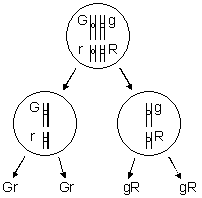
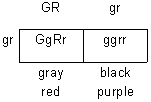
The diagrams below show that the locus for body color (G or g) is on a different chromosome than the locus for eye color (R or r).  These two loci will assort independently to produce either GR and gr gametes or Gr and gR gametes.

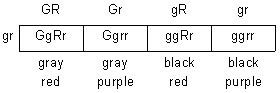
cross: GgRr X ggrr

gametes: GR, Gr, gR, gr X gr

Ratio expected: 1:1:1:1

Example: Linked Genes

Suppose G and R are linked as shown below. If the body color and eye color loci are on the same chromosome, they will not assort independently unless crossing-over occurs frequently.

In this case, GgRr can produce only two kinds of gametes: GR and gr.

GgRr X ggrr

gametes: GR, gr X gr

If G and R are linked, then whenever you have a G, you have an R. Any gray, purple offspring (G-rr) would result from crossing over because a Gr gamete is needed.

Suppose out of 100 offspring, you got 46 gray, red, 46 black purple, 4 gray purple and 4 black red.  Eight percent of the offspring resulted from crossing over. These offspring are recombinant.

Crossing Over

Crossing over is more likely to occur between genes that are far apart. The farther apart genes are, the greater the probability that crossing over will occur between them.

In the example above, we had 8% crossing over.

The percent of recombination (crossing over) can beused as a measure of how far apart genes are.   1% crossing over = 1 map unit.

Example

G = gray body

g = black (ebony) body


R = red eyes

r = purple eyes

Suppose that G and R are linked (on the same chromosome) in a particular individual and g and r are also linked

P1 GgRr X ggrr

If there is no crossing-over, possible gametes for the first parent are GR and gr.

If there is crossing-over, possible gametes are gR and Gr.

the following results were obtained:

How far apart are the G and R loci?

Sex Chromosomes

Humans have 23 pairs of chromosomes (46 total) chromosomes. Two of these are called sex chromosomes, the other 44 are called autosomes.

There are two kinds of sex chromosomes, called the X chromosome and the Y chromosome. The X chromosome is larger and contains many genes. The Y chromosome is much smaller and contains very few genes.

Normally, human females have two X chromosomes (XX) and males have one X and one Y chromosome (XY).

Occasionally, an accident happens in which a person is born with too many or too few sex chromosomes. In these cases, the person will be male if they inherit a Y chromosome and female if they do not.

Examples of four different possibilities that produce males are shown below. The last three are abnormal.

XY
XXY
XXXY
XYY

Examples of four different possibilities that produce females are shown below. Normal females are XX.

X
XX
XXX
XXXX

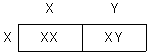
The cross below shows that normal females produce eggs that have one X chromosome. Half of the sperm produced by normal males have an X chromosome and the other half have a Y chromosome.

XX   x   XY

¯

This analysis shows that half of the offspring are expected to be male, half are expected to be female.


Chromosomal Determination of Sex

Males


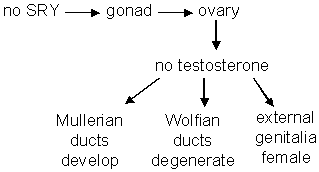
The Y chromosome contains a gene called SRY (for sex-determining region of Y).


Females


Testicular Feminization


The body cells of people with testicular feminization are insensitive to testosterone and therefore develop the female phenotype even though they have a Y chromosome.

It has an X-linked recessive mode of inheritance.

Guevodoces

Guevodoces refers to a condition in which the male phenotype develops after puberty.

It is due to delayed testosterone production.

X-Linkage

Morgan (Columbia U):

P1      red-eyed X white-eyed

¯

F1            all red-eyed

F2           3:1 (red:white) but all white were male

explanation:

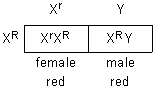
These genes are found on the X chromosome but not on the Y chromosome. An XrY male will therefore have red eyes. Details of this cross are below.

P1     XRXR       X XrY
   female male

gametes: XR (female) and Xr, Y (male)

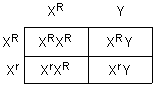
The offspring produced from the above cross are crossed with each other (below):

F1      XRXr   X   XRY

¯

gametes: XR and Xr (from female); XR and Y (from male)

F2:

Notice that there are three possible genotypes for females and two possible genotypes for males.

Females Males
Genotypes Phenotypes Genotypes Phenotypes
XRXR red XRY red
XRXr red XrY white
XrXr white

X-Linked Inheritance

Males inherit their X chromosome from their mother. Their Y chromosome comes from their father. A male, therefore, cannot pass an X-linked trait to his sons. Males inherit all of their X-linked traits from their mother.

If a male inherits an X-linked recessive trait, it will be expressed because males do not have a homologous X chromosome.

Females can be carriers of X-linked traits without expressing them because they might carry the dominant allele on the other X chromosome. For example, the following genotype will have a dominant phenotype: XAXa.

Dosage Compensation

Although females have twice as many X-linked genes, the amount of protein produced by these genes is the same in females as it is in males.


Reduced protein production (called dosage compensation) occurs as a result of inactivating one X chromosome by coiling and condensing it. When condensed, it cannot be transcribed, that is, it cannot be used to produce mRNA.

Condensed X chromosomes, called Barr bodies, are visible using ordinary light microscope techniques.

The table below shows the number of Barr bodies in normal cells and in the cells of people with an abnormal number of X chromosomes. Normal males do not have Barr bodies because they only have one X chromosome.

Genetic Condition  

# Barr Bodies per Cell

normal male 0
normal female 1
XXX female 2
XXXX female 3
XXY (Klinefelter male) 1

In summary, one X chromosome remains active, the others are inactivated by forming Barr bodies.


Inactivation


Inactivation occurs early in embryonic development (12-16 days).

In females, each cell normally contains two X chromosomes. The X chromosome that is inactivated is determined randomly.

img006.gif (6009 bytes)


img007.gif (6184 bytes)

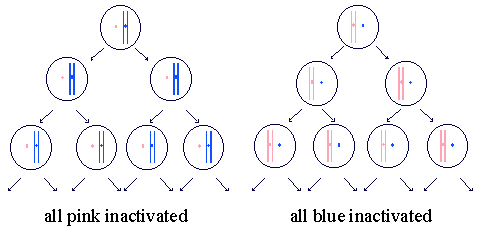
Once inactivation occurs, all daughter cells of a particular cell have the same X chromosome inactivated.

All of the “pink” chromosomes in the drawing below (left side of diagram) have been inactivated. All future cells produced by this cell will have the pink chromosome inactivated. In the diagram on the right, all of the blue chromosomes have been inactivated. All future generations of this cell will have the blue chromosome inactivated.

img008.gif (6206 bytes)

Females are therefore mosaics with respect to the X chromosome. Patches of body cells will have the maternally inherited X chromosome inactivated and other patches will have the paternally inherited one inactivated.


Example of Mosaicism: Calico Cats


A calico cat has patches of orange and patches of black

X = orange

X1 = black

MALES:

XY = orange

X1Y = black

FEMALES:

XX = orange

X1 X1 = black

X X1 = orange or black patches

All cells descended from an X1 cell (X is inactive) are orange-yellow.

All cells descended from an X cell (X1 is inactive) are black.


Human Example – Anhydrotic Dysplasia


Anhydrotic dysplasia is a disease that results in the absence of sweat glands.

It is inherited as an X-linked recessive disease.

Let X = normal sweat glands and X’ = absence of sweat glands. Normal males are XY. Affected males are X’Y and do not have sweat glands.

Normal females are XX, heterozygous females are XX’ and have patches of skin with sweat glands and patches of skin without sweat glands. Females that are X’X’ do not have sweat glands.


Other Information


Should heterozygous females for colorblindness be able to see color?

Suppose: X = color vision

x = colorblind


The Retina of a heterozygous (Xx) female will have some cells with the “X” inactivated and other cells with the “x” inactivated.

A heterozygous carrier of red-green colorblindness has some colorblind cells in her retina. The non-colorblind cells enable her to see color.

Turner’s syndrome is an abnormality in females where there is only one X chromosome; the other is missing.   These people have abnormalities that will be discussed in the next chapter.   Why aren’t Turners syndrome females normal?  Evidence indicates that some genes in the Barr body remain active. Their DNA is uncoiled and extends from the Barr body. If the Barr bodies of a normal female were missing, she would exhibit Turners Syndrome.


Home      General Biology 1      General Biology 2      Human Biology      Anatomy and Physiology

Chromosomes & Human Inheritance Notes


Chromosomes & Human Inheritance
All Materials © Cmassengale


Chromosomes:

  • Thomas Sutton in 1902 proposed that genes are located on chromosomes
  • Called the Chromosome Theory of Inheritance
  • For most of the life of the cell, chromosomes are too elongated to be seen under a microscope & are  called chromatin
  • Before a cell gets ready to divide, each chromosome is duplicated & condenses into short structures
  • Each chromosome is composed of a single, tightly coiled DNA molecule 
  • The two DNA strands are homologous (duplicates) and are held together by the centromere
  • While they are still attached, the duplicated chromosomes are called sister chromatids

  • Fertilization restores the diploid chromosome number and paired condition for alleles in the zygote
  • Chromosomes can be categorized as two types — autosomes & sex chromosomes
  • Autosomes are non-sex chromosomes that are the same number and kind between sexes
  • Sex chromosomes determine if the individual is male or female
  • Sex chromosomes in the human female are XX and those of the male are XY
  • Males produce X-containing and Y-containing gametes; therefore males determine the sex of offspring

Chromosome Numbers:

  • All animals have a characteristic number of chromosomes in their somatic or body cells called the diploid (or 2n) number.
  • The gametes or sex cells (egg & sperm)  contain half the number of chromosomes as a body cell; known as the haploid number (n) of chromosomes


Diploid (2n) numbers of Organisms
Man 46
Dog 78
Fruitfly 8
Crayfish 200
Corn 20


Pedigrees:

  • Also called a family tree
  • Squares represent males and circles represent females
  • Horizontal lines connecting a male and female represent mating
  • Vertical lines extending downward from a couple represent their children
  • A shaded symbol means the individual possess the trait
  • Half-shaded symbols are carriers


Sex Linkage:

  • Thomas Hunt Morgan worked with fruit flies & confirmed that  genes were on chromosomes
    a. Fruit flies are cheaply raised in common laboratory glassware
    b. Females only mate once and lay hundreds of eggs
    c. Fruit fly generation time is short, allowing rapid experiments
  • Experiments involved fruit flies with XY system similar to human system
  • Besides genes that determine sex, sex chromosomes carry many genes for traits unrelated to sex
  • X-linked gene is any gene located on the X chromosome that are missing on the Y chromosome
  • X-linked alleles are designated as superscripts to X chromosome
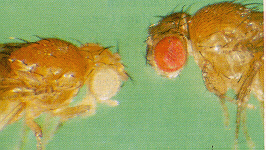
  • Newly discovered mutant male fruit fly had white eyes


Mutant White-eyed  & Wild, Red-eyed 

  • Cross of white-eyed male with dominant red-eyed female yield expected 3:1 red-to-white ratio; however, all white-eyed flies were males
  • An allele for eye color on the X but not Y chromosome supports the results of the cross
  • Heterozygous females are carriers that do not show the trait but can pass it on
  • Males are never carriers but express the one allele on the X chromosome
  • Red-green color-blindness is X-linked recessive
  • In humans, another well-known X-linked traits is hemophilia (free bleeders that lack clotting factors in their blood)
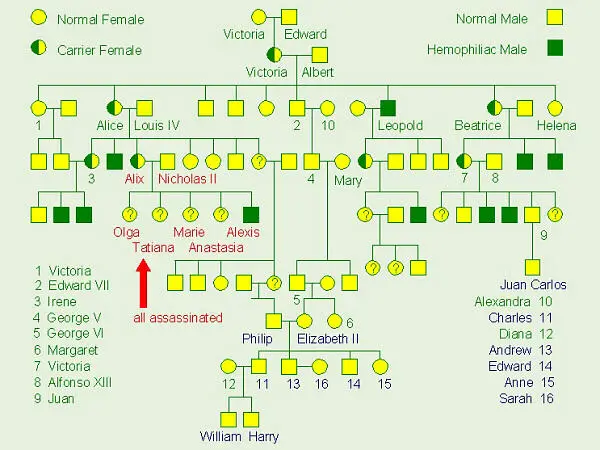
  • One of the most famous genetic cases involving hemophilia goes back to Queen Victoria who was a carrier for the disorder and married Prince Albert who was normal
  • Their children married other royalty, and spread the gene throughout the royal families of Europe


Royal Pedigree


Example Sex-Linked Problems:

1. What are the results of crossing a colorblind male with a female carrier for colorblindness?


Trait:     Red-Green Colorblindness

Alleles:     XC    normal vision
Xc    colorblindness

XCXc       x    Xc Y

XC Y   Genotypes:    XCXC ,XCY, XCXc, XcY
XC XCXC XCY   Genotypic Ratio: 1:1:1:1
Xc XCXc XcY   Phenotypes:
normal vision female, normal vision male, female carrier, colorblind male


2. What are the results of crossing a colorblind male with a colorblind female?


Trait:     Red-Green Colorblindness

Alleles:     XC    normal vision
Xc    colorblindness

XcXc       x    Xc Y

Xc Y   Genotypes:       XcXc , XcY 
Xc XcXc XcY    Genotypic Ratio: 1:1 ratio
Xc XcXc XcY   Phenotypes:       colorblind female, colorblind male
   Phenotypic ratio:  1:1 ratio


Linked genes:

  • Each chromosomes has 1000’s of genes
  • All genes on a chromosome form a linkage group that stays together except during crossing-over
  • Some genes located on the same chromosome tend to be inherited together
  • Linked genes were discovered by Thomas Hunt Morgan while studying fruit flies
  • Linked alleles do not obey Mendel’s laws because they tend to go into the gametes together
  • Crosses involving linked genes do not give same results as unlinked genes

Chromosome Mapping:

  • Recombinants result from chromosome crossing over during prophase I of meiosis
  • Geneticists can use recombination data to map a chromosome’s genetic loci (position on a chromosome)
  • A genetic map lists a sequence of genetic loci along a particular chromosome
  • Alfred Sturtevant, a student of Morgan, reasoned that different recombination frequencies reflect different distances between genes on a chromosome
  • The farther apart genes are, the greater likelihood of crossing-over
  • The closer together two genes are, the less likely of crossing-over occurring
  • A map unit equals 1% recombination frequency
  • If 1% of crossing-over equals one map unit, then 6% recombinants reveal 6 map units between genes
  • To determine the frequency of recombinants, the following formula is used:
Number of recombinants x 100%
Recombination Frequency =   ———————————————
     Total Number of Offspring


  • Humans have few offspring and a long generation time so biochemical methods are used to map human chromosomes (Human Genome Project)

Chromosome Mutations:

  • Mutations are changes in genes or chromosomes that can be passed on to offspring
  • Mutations increase the number of variations that occur
  • Chromosomal mutations include changes in chromosome number and/or structure
  • Monosomy occurs when an individual has only one of a particular type of chromosome
  • Turner syndrome (X0) is an example of monosomy
  • Trisomy occurs when and individual has three of a particular type of chromosome
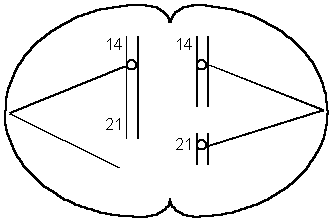
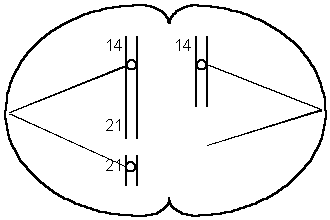
  • Examples of trisomy include Klinefelter’s Syndrome (XXY) and Down Syndrome or Trisomy 21 where the individual has three 21st chromosomes
  • Both monosomy & trisomy result when chromosomes fail to separate during meiosis; called nondisjunction
  • Monosomy and trisomy (aneuploidy) occur in plants and animals and may be lethal (deadly)
  • Polyploidy where the offspring have more than two sets of chromosomes occurs often in plants (3n, 4n …)
  • Environmental factors including radiation, chemicals, and viruses, can cause chromosomes to break causing a change in chromosomal structure
  • Inversion occurs when a piece of a chromosome breaks off & reattaches to the same place but in the reverse order
  • Translocation occurs when a chromosome segment breaks off & attaches to a different chromosome
  • Deletions occur when the end of a chromosome breaks off & is lost
  • Cri du chat syndrome (results in retardation & a cat-like cry) is due to a deletion of a portion of chromosome 5
  • Duplications occur when a section of a chromosome is doubled
  • Fragile X Syndrome caused by an abnormal number of repeats (CCG) results in retardation & long, narrow face becomes more pronounced with age

Gene Mutations:

  •  Change in genes caused by change in structure of the DNA
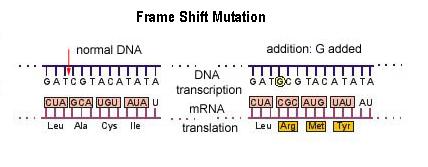
  • DNA bases may be substituted, added, or removed to cause gene mutation
  • When genes are added or removed, the mutation is called a frame shift mutation

Frame shift mutation

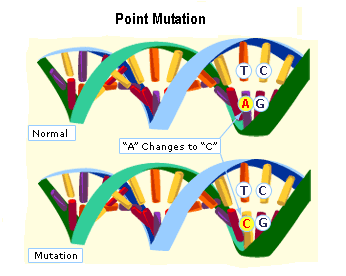
  • Adding or Removing genes is called a point mutation

point mutation

  • Sickle cell anemia (red blood cells are C-shaped so can’t carry as much oxygen) is an example of a gene mutation in African Americans

  • Tay-Sachs (a disorder where the nervous system deteriorates) is a fatal gene mutation in Jewish people of Central European Descent
  • Phenylketonuria or PKU occurs from the inability of a gene to synthesize a single enzyme necessary for the normal metabolism of phenylalanine and results in death


Class Data Table Sci Meth & Genetics

Table 2

Class Data on Right hand Width and Length (cm)

Class Period:

Student Gender
(M / F)
Hand Length (cm) Hand Width (cm)
1. M / F
2. M / F
3. M / F
4. M / F
5. M / F
6. M / F
7. M / F
8. M / F
9. M / F
10. M / F
11. M / F
12. M / F
13. M / F
14. M / F
15. M / F
16. M / F
17. M / F
18. M / F
19. M / F
20. M / F
21. M / F
22. M / F
23. M / F
24. M / F

Back

Darwin Events AP


Darwin Day Events
CHARLES DARWIN


Darwin Trivia Game Questions:


When was Charles Darwin born?
What was the name of the ship on which he was the naturalist?
What islands were the main source of his findings?
What was the complete title of his original book?
What famous American president shares the same birth date?
How long was his voyage scheduled to last?

“Darwin Trivia Game”
The Galapagos Islands

Adaptations of the Galapagos Finches
  The “Missing” Link

Darwin “Fortune” Cookies
Darwin only took with him a simple microscope on the Beagle to observe microscopic organisms.
When Darwin was sixteen, his father took him out of school because he felt that Charles was wasting time, and he sent him to Edinburgh University.
Charles Darwin was born on February 12, 1809 in Shrewsbury, England.
Darwin transferred to Cambridge to study the theology of the Church of England wanting to become an Anglican priest.
“Changes From Within”

Lyrics & music by:  Nicole Higham
Sung by:  Brett Rabeneck, Bradley Wise, & Carrie Steves

Changes From Within
Verse 1:
Once I read a book, and this is what it said,
That the Origin of Species, came from Darwin’s head.
He studied all the life, from some islands of the west,
and distinguished adaptations, and who survived the best.
He was much more successful than scientists before,
And his use of common logic, convinced them even more.
Chorus:
And it read:
You take two monkeys, and you put them to the test,
Check out their different habitats, and see nature at its best.
According to Darwin, a species can begin,
From an individual that changes from within.

Verse 2:
Natural selection, a theory he derived
Sys the strongest just get stronger while the weakest don’t survive.
So he published his ideas, he was sort of in a bind
There was another man, who wasn’t far behind.
Their ideas were the same, their timing coincided,
But Darwin finished first, and in the glory he delighted.

Verse 3:
About all of his theory, that I choose to sing about
Some people think it’s true, while others have their doubts.
To me it’s quite reasonable, to have either point of view
But think about it carefully, no matter what you do.
For starters think about that which, you really do believe
For me this includes a little story about Adam and Eve.

2nd Chorus:
I appreciate your patience, as an audience you’ve been kind
I bet this kind of song, wasn’t what you had in mind
I’ll leave you with this list of things that really matter most,
There’s life and love and happiness, but first the Holy Ghost.

Burying a Darwin Day Time Capsule

BACK


Evolution Quiz 2

Name: 

Theory of Evolution 


True/False
Indicate whether the sentence or statement is true or false.
1.
Within populations, divergence leads to speciation.
2.
Genetic similarities between species is evidence of common ancestry.
3.
Shared common traits are a clue to common ancestry.
4.
The pelvic (hip) bones of a snake are vestigial organs.
5.
Darwin would have explained giraffes having long necks as a trait that allowed the fittest to survive.
6.
Darwin was the first scientist to propose that living things evolve.
7.
Most organisms produce more offspring than can possibly survive.
 

Multiple Choice
Identify the letter of the choice that best completes the statement or answers the question.
8.
The change that results in a species being better suited to its environment is known as
a.
reproduction.
c.
adaptation.
b.
variation.
d.
selection.
9.
New species form
a.
when ecological races diverge more and more.
b.
because of natural selection.
c.
when members of the same species become adapted to new environments.
d.
All of the above
10.
Natural selection causes
a.
changes in the environment.
b.
plants and animals to produce more offspring than can survive.
c.
changes in the frequency of certain alleles in a population.
d.
All of the above
11.
The theory of evolution predicts that
a.
closely related species will show similarities in nucleotide sequences.
b.
if species have changed over time, their genes should have changed.
c.
closely related species will show similarities in amino acid sequences.
d.
All of the above
12.
Mutations are important to the understanding of evolution because they increase the
a.
value of natural selection of animals
c.
use of organs in animals
b.
production of variations in animals
d.
differentiation of animal embryos
13.
The human appendix is an example of a structure that is
a.
homologous
c.
a variation
b.
acquired
d.
vestigial
14.
The modern theory of evolution supports the concept that inheritable variations within a species may result from
a.
recombination of genes during fertilization
c.
changes in autosomes
b.
use and disuse
d.
acquired characteristics
15.
The occurrence of the same blood protein in a group of species provides evidence that these species
a.
evolved in the same habitat
c.
descended from a common ancestor
b.
evolved in different habitats
d.
descended from different ancestors
16.
According to modern ideas of evolution, the fittest individuals are those that
a.
are stronger
c.
are best adapted to their environment
b.
move faster
d.
have the largest brains
17.
After all the grass was eaten, early horses had to stretch for food on trees.  Consequently these horses developed longer legs and necks. This statement is consistent with the views of
a.
Darwin only
c.
both men
b.
Lamarck only
d.
neither man
18.
It has been observed that white mice live in areas with white soil and brown mice live in areas with dark soil.  Which statement best describes the situation?
a.
All organisms tend to increase in numbers at a geometric rate
b.
In each generation, the number of individuals in a species remains constant
c.
There is a struggle to survive
d.
Variations are passed to offspring.  Favorable variations aid survival and reproduction
19.
Squirrels on the north rim of the Grand Canyon differ in many respects from those on the south rim (the river prevents passage from one to the other).  Which statement best describes the situation?
a.
In each generation, the number of individuals in a species remains constant
b.
Variations, which may be inherited, are found among individuals in each species
c.
The inheritance of favorable variations may eventually lead to the development of a new species
d.
All organisms tend to increase in numbers at a geometric rate
20.
The idea of the survival of the fittest is part of the explanation of the theory of evolution called
a.
use and disuse
c.
natural selection
b.
inheritance of acquired characteristics
d.
continuity of the germ plasm
21.
The process of change with time during successive generations among living things is
a.
evolution
c.
extinction
b.
law of use and disuse
d.
none of these
22.
Which of the following is an example of a morphological adaptation?
a.
hibernation
c.
an enzyme
b.
crab’s claws
d.
migration
23.
Competition between individuals of a species occurs primarily because of
a.
a scarcity of resources
c.
low birth rates
b.
advantageous variations
d.
acquired characteristics
24.
The book, Origin of the Species, was written by
a.
Charles Darwin
c.
Jean Baptiste de Lamarck
b.
Alfred Russell Wallace
d.
Thomas Malthus
25.
Variation is most important to Darwin’s theory of evolution because it
a.
provides material on which natural selection acts
b.
allows individuals to explore new habitats
c.
minimizes competition within a species
d.
allows individuals to make the best use of limited resources
26.
Evolutionary change is a(n)
a.
assumption
c.
collection of hypotheses
b.
fact
d.
debatable opinion
27.
Unlike Lamarck’s theory of evolution, Darwin’s theory included the idea
a.
that species change over time
b.
of natural selection
c.
that acquired characteristics are inherited
d.
that organisms change by a desire to better themselves
28.
According to Darwin, the process in which organisms best suited to their environment survive and reproduce is called
a.
convergent evolution
c.
natural selection
b.
divergent evolution
d.
artificial selection
29.
Genes that are active during the early development of fishes, birds, and humans are the shared heritage from a(an)
a.
fish
c.
common ancestor
b.
bird
d.
early human
30.
Darwin began to formulate his concept of evolution by natural selection after
a.
experimentation with animals.
b.
observations of many species and their geographical location.
c.
reading the writings of Wallace.
d.
agreeing with Lamarck about the driving force behind evolution.
31.
Charles Lyell’s work suggests that
a.
Earth is many millions of years old.
b.
Earth is several thousand years old.
c.
all fossils were formed in the last 1000 years.
d.
all rocks on Earth contain fossils.
32.
Which is a major concept included in Lamarck’s theory of evolution?
a.
Change is the result of survival of the fittest.
b.
Body structure can change according to the actions of the organism.
c.
Population size decreases the rate of evolution.
d.
Artificial selection is the basis for evolution.
33.
An adaptation is an inherited characteristic that can be
a.
physical or behavioral.
b.
physical or geographical.
c.
acquired during the organism’s lifetime.
d.
the result of artificial selection.
34.
The hypothesis that species change over time by natural selection was proposed by
a.
James Hutton.
b.
Jean-Baptiste Lamarck.
c.
Thomas Malthus.
d.
Charles Darwin.
35.
Charles Darwin’s theory of evolution explains all of the following EXCEPT
a.
how species become extinct.
b.
how inherited traits are passed from parent to offspring.
c.
how species change over time.
d.
how evolution takes place in the natural world.


Check Your Work     Reset