Chapter 8 – An Introduction to Metabolism Lecture Outline

Chapter 8    An Introduction to Metabolism    Lecture Outline

Overview

A. Metabolism, Energy, and Life

1. The chemistry of life is organized into metabolic pathways.

·         The totality of an organism’s chemical reactions is called metabolism.

·         Metabolism is an emergent property of life that arises from interactions between molecules within the orderly environment of the cell.

·         Metabolic pathways begin with a specific molecule, which is then altered in a series of defined steps to form a specific product.

·         A specific enzyme catalyzes each step of the pathway.

·         Catabolic pathways release energy by breaking down complex molecules to simpler compounds.

°         A major pathway of catabolism is cellular respiration, in which the sugar glucose is broken down in the presence of oxygen to carbon dioxide and water.

·         Anabolic pathways consume energy to build complicated molecules from simpler compounds. They are also called biosynthetic pathways.

°         The synthesis of protein from amino acids is an example of anabolism.

·         The energy released by catabolic pathways can be stored and then used to drive anabolic pathways.

·         Energy is fundamental to all metabolic processes, and therefore an understanding of energy is key to understanding how the living cell works.

°         Bioenergetics is the study of how organisms manage their energy resources.

2. Organisms transform energy.

·         Energy is the capacity to do work.

°         Energy exists in various forms, and cells transform energy from one type into another.

·         Kinetic energy is the energy associated with the relative motion of objects.

°         Objects in motion can perform work by imparting motion to other matter.

°         Photons of light can be captured and their energy harnessed to power photosynthesis in green plants.

°         Heat or thermal energy is kinetic energy associated with the random movement of atoms or molecules.

·         Potential energy is the energy that matter possesses because of its location or structure.

°         Chemical energy is a form of potential energy stored in molecules because of the arrangement of their atoms.

·         Energy can be converted from one form to another.

°         For example, as a boy climbs stairs to a diving platform, he is releasing chemical energy stored in his cells from the food he ate for lunch.

°         The kinetic energy of his muscle movement is converted into potential energy as he climbs higher.

°         As he dives, the potential energy is converted back to kinetic energy.

°         Kinetic energy is transferred to the water as he enters it.

°         Some energy is converted to heat due to friction.

3. The energy transformations of life are subject to two laws of thermodynamics.

·         Thermodynamics is the study of energy transformations.

·         In this field, the term system refers to the matter under study and the surroundings include everything outside the system.

·         A closed system, approximated by liquid in a thermos, is isolated from its surroundings.

·         In an open system, energy and matter can be transferred between the system and its surroundings.

·         Organisms are open systems.

°         They absorb energy—light or chemical energy in the form of organic molecules—and release heat and metabolic waste products such as urea or CO2 to their surroundings.

·         The first law of thermodynamics states that energy can be transferred and transformed, but it cannot be created or destroyed.

°         The first law is also known as the principle of conservation of energy.

°         Plants do not produce energy; they transform light energy to chemical energy.

·         During every transfer or transformation of energy, some energy is converted to heat, which is the energy associated with the random movement of atoms and molecules.

·         A system can use heat to do work only when there is a temperature difference that results in heat flowing from a warmer location to a cooler one.

°         If temperature is uniform, as in a living cell, heat can only be used to warm the organism.

·         Energy transfers and transformations make the universe more disordered due to this loss of usable energy.

·         Entropy is a quantity used as a measure of disorder or randomness.

°         The more random a collection of matter, the greater its entropy.

·         The second law of thermodynamics states that every energy transfer or transformation increases the entropy of the universe.

°         While order can increase locally, there is an unstoppable trend toward randomization of the universe.

°         Much of the increased entropy of the universe takes the form of increasing heat, which is the energy of random molecular motion.

·         In most energy transformations, ordered forms of energy are converted at least partly to heat.

°         Automobiles convert only 25% of the energy in gasoline into motion; the rest is lost as heat.

°         Living cells unavoidably convert organized forms of energy to heat.

·         For a process to occur on its own, without outside help in the form of energy input, it must increase the entropy of the universe.

·         The word spontaneous describes a process that can occur without an input of energy.

°         Spontaneous processes need not occur quickly.

°         Some spontaneous processes are instantaneous, such as an explosion. Some are very slow, such as the rusting of an old car.

·         Another way to state the second law of thermodynamics is for a process to occur spontaneously, it must increase the entropy of the universe.

·         Living systems create ordered structures from less ordered starting materials.

°         For example, amino acids are ordered into polypeptide chains.

°         The structure of a multicellular body is organized and complex.

·         However, an organism also takes in organized forms of matter and energy from its surroundings and replaces them with less ordered forms.

°         For example, an animal consumes organic molecules as food and catabolizes them to low-energy carbon dioxide and water.

·         Over evolutionary time, complex organisms have evolved from simpler ones.

°         This increase in organization does not violate the second law of thermodynamics.

°         The entropy of a particular system, such as an organism, may decrease as long as the total entropy of the universe—the system plus its surroundings—increases.

°         Organisms are islands of low entropy in an increasingly random universe.

°         The evolution of biological order is perfectly consistent with the laws of thermodynamics.

4. The free energy change of a reaction tells us whether it is spontaneous.

·         How can we determine which reactions occur spontaneously and which ones require an input of energy?

·         The concept of free energy provides a useful function for measuring spontaneity of a system.

·         Free energy is the portion of a system’s energy that is able to perform work when temperature and pressure is uniform throughout the system, as in a living cell.

·         The free energy (G) in a system is related to the total enthalpy (in biological systems, equivalent to energy) (H) and the entropy (S) by this relationship:

°         G = H − TS, where T is temperature in Kelvin units.

°         Increases in temperature amplify the entropy term.

°         Not all the energy in a system is available for work because the entropy component must be subtracted from the enthalpy component.

°         What remains is the free energy that is available for work.

·         Free energy can be thought of as a measure of the stability of a system.

°         Systems that are high in free energy—compressed springs, separated charges, organic polymers—are unstable and tend to move toward a more stable state, one with less free energy.

°         Systems that tend to change spontaneously are those that have high enthalpy, low entropy, or both.

·         In any spontaneous process, the free energy of a system decreases.

·         We can represent this change in free energy from the start of a process until its finish by:

°         DG = Gfinal state − Gstarting state

°         Or DG = DH − TDS

·         For a process to be spontaneous, the system must either give up enthalpy (decrease in H), give up order (increase in S), or both.

°         DG must be negative for a process to be spontaneous.

§         Every spontaneous process is characterized by a decrease in the free energy of the system.

§         Processes that have a positive or zero DG are never spontaneous.

°         The greater the decrease in free energy, the more work a spontaneous process can perform.

°         Nature runs “downhill.”

·         A system at equilibrium is at maximum stability.

°         In a chemical reaction at equilibrium, the rates of forward and backward reactions are equal, and there is no change in the concentration of products or reactants.

°         At equilibrium DG = 0, and the system can do no work.

°         A process is spontaneous and can perform work only when it is moving toward equilibrium.

°         Movements away from equilibrium are nonspontaneous and require the addition of energy from an outside energy source (the surroundings).

·         Chemical reactions can be classified as either exergonic or endergonic based on free energy.

·         An exergonic reaction proceeds with a net release of free energy; DG is negative.

·         The magnitude of DG for an exergonic reaction is the maximum amount of work the reaction can perform.

·         The greater the decrease in free energy, the greater the amount of work that can be done.

°         For the overall reaction of cellular respiration: C6H12O6 + 6O2 -> 6CO2 + 6H2O

§         DG = −686 kcal/mol

°         For each mole (180 g) of glucose broken down by respiration, 686 kcal of energy are made available to do work in the cell.

§         The products have 686 kcal less free energy than the reactants.

·         An endergonic reaction is one that absorbs free energy from its surroundings.

°         Endergonic reactions store energy in molecules; DG is positive.

°         Endergonic reactions are nonspontaneous, and the magnitude of DG is the quantity of energy required to drive the reaction.

·         If cellular respiration releases 686 kcal, then photosynthesis, the reverse reaction, must require an equivalent investment of energy.

°         For the conversion of carbon dioxide and water to sugar, DG = +686 kcal/mol.

·         Photosynthesis is strongly endergonic, powered by the absorption of light energy.

·         Reactions in a closed system eventually reach equilibrium and can do no work.

°         A cell that has reached metabolic equilibrium has a DG = 0 and is dead!

·         Metabolic disequilibrium is one of the defining features of life.

·         Cells maintain disequilibrium because they are open systems. The constant flow of materials into and out of the cell keeps metabolic pathways from ever reaching equilibrium.

°         A cell continues to do work throughout its life.

·         A catabolic process in a cell releases free energy in a series of reactions, not in a single step.

·         Some reversible reactions of respiration are constantly “pulled” in one direction, as the product of one reaction does not accumulate but becomes the reactant in the next step.

·         Sunlight provides a daily source of free energy for photosynthetic organisms.

·         Nonphotosynthetic organisms depend on a transfer of free energy from photosynthetic organisms in the form of organic molecules.

5. ATP powers cellular work by coupling exergonic reactions to endergonic reactions.

·         A cell does three main kinds of work:

1.       Mechanical work, such as the beating of cilia, contraction of muscle cells, and movement of chromosomes during cellular reproduction.

2.       Transport work, the pumping of substances across membranes against the direction of spontaneous movement.

3.       Chemical work, driving endergonic reactions such as the synthesis of polymers from monomers.

·         Cells manage their energy resources to do this work by energy coupling, the use of an exergonic process to drive an endergonic one.

·         In most cases, the immediate source of energy to power cellular work is ATP.

·         ATP (adenosine triphosphate) is a type of nucleotide consisting of the nitrogenous base adenine, the sugar ribose, and a chain of three phosphate groups.

·         The bonds between phosphate groups can be broken by hydrolysis.

°         Hydrolysis of the end phosphate group forms adenosine diphosphate.

§         ATP -> ADP + Pi

§         This reaction releases 7.3 kcal of energy per mole of ATP under standard conditions (1 M of each reactant and product, 25°C, pH 7).

°         In the cell, DG for hydrolysis of ATP is about −13 kcal/mol.

·         While the phosphate bonds of ATP are sometimes referred to as high-energy phosphate bonds, these are actually fairly weak covalent bonds.

°         However, they are unstable, and their hydrolysis yields energy because the products are more stable.

·         The release of energy during the hydrolysis of ATP comes from the chemical change to a state of lower free energy, not from the phosphate bonds themselves.

·         Why does the hydrolysis of ATP yield so much energy?

°         Each of the three phosphate groups has a negative charge.

°         These three like charges are crowded together, and their mutual repulsion contributes to the instability of this region of the ATP molecule.

·         In the cell, the energy from the hydrolysis of ATP is directly coupled to endergonic processes by the transfer of the phosphate group to another molecule.

°         This recipient molecule is now phosphorylated.

°         This molecule is now more reactive (less stable) than the original unphosphorylated molecules.

·         Mechanical, transport, and chemical work in the cell are nearly always powered by the hydrolysis of ATP.

°         In each case, a phosphate group is transferred from ATP to another molecule and the phosphorylated molecule undergoes a change that performs work.

·         ATP is a renewable resource that can be regenerated by the addition of a phosphate group to ADP.

°         The energy to phosphorylate ADP comes from catabolic reactions in the cell.

°         A working muscle cell recycles its entire pool of ATP once each minute.

°         More than 10 million ATP molecules are consumed and regenerated per second per cell.

·         Regeneration of ATP is an endergonic process, requiring an investment of energy.

°         DG = 7.3 kcal/mol.

·         Catabolic (exergonic) pathways, especially cellular respiration, provide the energy for the exergonic regeneration of ATP.

·         The chemical potential energy temporarily stored in ATP drives most cellular work.

B. Enzymes Are Catalytic Proteins

1. Enzymes speed up metabolic reactions by lowering energy barriers.

·         Spontaneous chemical reactions may occur so slowly as to be imperceptible.

°         The hydrolysis of table sugar (sucrose) to glucose and fructose is exergonic.

§         DG = −7 kcal/mol

°         Despite this, your sugar sits in its bowl with no observable hydrolysis.

°         If we add a small amount of the enzyme catalyst sucrase to a solution of sugar, all the sucrose will be hydrolyzed within seconds.

·         A catalyst is a chemical agent that speeds up the rate of a reaction without being consumed by the reaction.

°         An enzyme is a catalytic protein.

·         Enzymes regulate metabolic pathways.

·         Every chemical reaction involves bond breaking and bond forming.

°         To hydrolyze sucrose, the bond between glucose and fructose must be broken and new bonds must form with hydrogen and hydroxyl ions from water.

·         To reach a state where bonds can break and reform, reactant molecules must absorb energy from their surroundings. When the new bonds of the product molecules form, energy is released as heat as the molecules assume stable shapes with lower energy.

·         The initial investment of energy for starting a reaction is the free energy of activation or activation energy (EA).

·         Activation energy is the amount of energy necessary to push the reactants over an energy barrier so that the reaction can proceed.

°         At the summit, the molecules are in an unstable condition, the transition state.

°         Activation energy may be supplied in the form of heat that the reactant molecules absorb from the surroundings.

°         The bonds of the reactants break only when the molecules have absorbed enough energy to become unstable and, therefore, more reactive.

°         The absorption of thermal energy increases the speed of the reactant molecules, so they collide more often and more forcefully.

°         Thermal agitation of the atoms in the molecules makes bonds more likely to break.

°         As the molecules settle into new, stable bonding arrangements, energy is released to the surroundings.

°         In exergonic reactions, the activation energy is released back to the surroundings, and additional energy is released with the formation of new bonds.

·         For some processes, EA is not high, and the thermal energy provided by room temperature is sufficient for many reactants to reach the transition state.

·         In many cases, EA is high enough that the transition state is rarely reached and that the reaction hardly proceeds at all. In these cases, the reaction will only occur at a noticeable rate if the reactants are heated.

°         A spark plug provides the energy to energize a gasoline-oxygen mixture and cause combustion.

°         Without that activation energy, the hydrocarbons of gasoline are too stable to react with oxygen.

·         Proteins, DNA, and other complex organic molecules are rich in free energy. Their hydrolysis is spontaneous, with the release of large amounts of energy.

°         However, there is not enough energy at the temperatures typical of the cell for the vast majority of organic molecules to make it over the hump of activation energy.

·         How are the barriers for selected reactions surmounted to allow cells to carry out the processes of life?

°         Heat would speed up reactions, but it would also denature proteins and kill cells.

·         Enzymes speed reactions by lowering EA.

°         The transition state can then be reached even at moderate temperatures.

·         Enzymes do not change DG.

°         They hasten reactions that would occur eventually.

°         Because enzymes are so selective, they determine which chemical processes will occur at any time.

2. Enzymes are substrate specific.

·         The reactant that an enzyme acts on is the substrate.

·         The enzyme binds to a substrate, or substrates, forming an enzyme-substrate complex.

·         While the enzyme and substrate are bound, the catalytic action of the enzyme converts the substrate to the product or products.

·         The reaction catalyzed by each enzyme is very specific.

·         What accounts for this molecular recognition?

°         The specificity of an enzyme results from its three-dimensional shape.

·         Only a portion of the enzyme binds to the substrate.

°         The active site of an enzyme is typically a pocket or groove on the surface of the protein into which the substrate fits.

°         The active site is usually formed by only a few amino acids.

·         The specificity of an enzyme is due to the fit between the active site and the substrate.

·         As the substrate enters the active site, interactions between the substrate and the amino acids of the protein causes the enzyme to change shape slightly, leading to a tighter induced fit that brings chemical groups in position to catalyze the reaction.

3. The active site is an enzyme’s catalytic center.

·         In most cases, substrates are held in the active site by weak interactions, such as hydrogen bonds and ionic bonds.

°         R groups of a few amino acids on the active site catalyze the conversion of substrate to product.

°         The product then leaves the active site.

·         A single enzyme molecule can catalyze thousands of reactions a second.

·         Enzymes are unaffected by the reaction and are reusable.

·         Most metabolic enzymes can catalyze a reaction in both the forward and reverse directions.

°         The actual direction depends on the relative concentrations of products and reactants.

°         Enzymes catalyze reactions in the direction of equilibrium.

·         Enzymes use a variety of mechanisms to lower activation energy and speed up a reaction.

°         In reactions involving more than one reactant, the active site brings substrates together in the correct orientation for the reaction to proceed.

°         As the active site binds the substrate, it may put stress on bonds that must be broken, making it easier for the reactants to reach the transition state.

°         R groups at the active site may create a microenvironment that is conducive to a specific reaction.

§         An active site may be a pocket of low pH, facilitating H+ transfer to the substrate as a key step in catalyzing the reaction.

°         Enzymes may briefly bind covalently to substrates.

§         Subsequent steps of the reaction restore the R groups within the active site to their original state.

·         The rate that a specific number of enzymes convert substrates to products depends in part on substrate concentrations.

°         At low substrate concentrations, an increase in substrate concentration speeds binding to available active sites.

°         However, there is a limit to how fast a reaction can occur.

°         At high substrate concentrations, the active sites on all enzymes are engaged.

§         The enzyme is saturated.

§         The rate of the reaction is determined by the speed at which the active site can convert substrate to product.

·         The only way to increase productivity at this point is to add more enzyme molecules.

4. A cell’s physical and chemical environment affects enzyme activity.

·         The activity of an enzyme is affected by general environmental conditions, such as temperature and pH.

·         Each enzyme works best at certain optimal conditions, which favor the most active conformation for the enzyme molecule.

·         Temperature has a major impact on reaction rate.

°         As temperature increases, collisions between substrates and active sites occur more frequently as molecules move more rapidly.

°         As temperature increases further, thermal agitation begins to disrupt the weak bonds that stabilize the protein’s active conformation, and the protein denatures.

°         Each enzyme has an optimal temperature.

§         Most human enzymes have optimal temperatures of about 35–40°C.

§         Bacteria that live in hot springs contain enzymes with optimal temperatures of 70°C or above.

·         Each enzyme also has an optimal pH.

·         Maintenance of the active conformation of the enzyme requires a particular pH.

°         This falls between pH 6 and 8 for most enzymes.

°         However, digestive enzymes in the stomach are designed to work best at pH 2, while those in the intestine have an optimum of pH 8.

·         Many enzymes require nonprotein helpers, called cofactors, for catalytic activity.

°         Cofactors bind permanently or reversibly to the enzyme.

°         Some inorganic cofactors include zinc, iron, and copper.

·         Organic cofactors are called coenzymes.

°         Many vitamins are coenzymes.

·         Binding by inhibitors prevents enzymes from catalyzing reactions.

°         If inhibitors attach to the enzyme by covalent bonds, inhibition may be irreversible.

°         If inhibitors bind by weak bonds, inhibition may be reversible.

·         Some reversible inhibitors resemble the substrate and compete for binding to the active site.

°         These molecules are called competitive inhibitors.

°         Competitive inhibition can be overcome by increasing the concentration of the substrate.

·         Noncompetitive inhibitors impede enzymatic reactions by binding to another part of the molecule.

°         Binding by the inhibitor causes the enzyme to change shape, rendering the active site less effective at catalyzing the reaction.

·         Toxins and poisons are often irreversible enzyme inhibitors.

·         Sarin is the nerve gas that was released by terrorists in the Tokyo subway in 1995.

°         Sarin binds covalently to the R group on the amino acid serine.

°         Serine is found in the active site of acetylcholinesterase, an important nervous system enzyme.

C. The Control of Metabolism

1. Metabolic control often depends on allosteric regulation.

·         In many cases, the molecules that naturally regulate enzyme activity behave like reversible noncompetitive inhibitors.

·         Regulatory molecules often bind weakly to an allosteric site, a specific receptor on the enzyme away from the active site.

°         Binding by these molecules can either inhibit or stimulate enzyme activity.

·         Most allosterically regulated enzymes are constructed of two or more polypeptide chains.

°         Each subunit has its own active site.

°         Allosteric sites are often located where subunits join.

·         The binding of an activator stabilizes the conformation that has functional active sites, while the binding of an inhibitor stabilizes the inactive form of the enzyme.

·         As the chemical conditions in the cell shift, the pattern of allosteric regulation may shift as well.

·         By binding to key enzymes, reactants and products of ATP hydrolysis may play a major role in balancing the flow of traffic between anabolic and catabolic pathways.

°         For example, ATP binds to several catabolic enzymes allosterically, inhibiting their activity by lowering their affinity for substrate.

°         ADP functions as an activator of the same enzymes.

°         ATP and ADP also affect key enzymes in anabolic pathways.

°         In this way, allosteric enzymes control the rates of key reactions in metabolic pathways.

·         In enzymes with multiple catalytic subunits, binding by a substrate to one active site stabilizes favorable conformational changes at all other subunits, a process called cooperativity.

°         This mechanism amplifies the response of enzymes to substrates, priming the enzyme to accept additional substrates.

·         A common method of metabolic control is feedback inhibition in which an early step in a metabolic pathway is switched off by the pathway’s final product.

°         The product acts as an inhibitor of an enzyme in the pathway.

·         Feedback inhibition prevents a cell from wasting chemical resources by synthesizing more product than is needed.

2. The localization of enzymes within a cell helps order metabolism.

·         Structures within the cell help bring order to metabolic pathways.

·         A team of enzymes for several steps of a metabolic pathway may be assembled as a multienzyme complex.

·         The product from the first reaction can then pass quickly to the next enzyme until the final product is released.

·         Some enzymes and enzyme complexes have fixed locations within the cells as structural components of particular membranes.

°         Others are confined within membrane-enclosed eukaryotic organelles.

·         Metabolism, the intersecting set of chemical pathways characteristic of life, is a choreographed interplay of thousands of different kinds of cellular molecules.


Chapter 50 AP Obj – Intro to Ecology


Chapter 50    Introduction to Ecology & the Biosphere
Objectives
The Scope of Ecology
1. Define ecology. Identify the two features of organisms studied by ecologists.
2. Describe the relationship between ecology and evolutionary biology.
3. Distinguish between abiotic and biotic components of the environment.
4. Distinguish among organismal ecology, population ecology, community ecology, ecosystem ecology, and landscape ecology.
5. Clarify the difference between ecology and environmentalism.
Interactions Between Organisms and the Environment Affect the Distribution of Species
6. Define biogeography.
7. Describe the questions that might be asked in a study addressing the limits of the geographic distribution of a particular species.
8. Describe the problems caused by introduced species and illustrate with a specific example.
9. Explain how habitat selection may limit distribution of a species within its range of suitable habitats.
10. Describe, with examples, how biotic and abiotic factors may affect the distribution of organisms.
11. List the four abiotic factors that are the most important components of climate.
12. Distinguish between macroclimate and microclimate patterns.
13. Provide an example of a microclimate.
14. Explain, with examples, how a body of water and a mountain range might affect regional climatic conditions.
15. Describe how an ecologist might predict the effect of global warming on distribution of a tree species.
16. Name three ways in which marine biomes affect the biosphere.
Aquatic and Terrestrial Biomes
17. Describe the characteristics of the major aquatic biomes: lakes, wetlands, streams, rivers, estuaries, intertidal biomes, oceanic pelagic biomes, coral reefs, and marine benthic biomes.
18. Define the following characteristics of lakes: seasonal turnover, thermal stratification, thermocline, photic zone.
19. Explain why the following statement is false: “All communities on Earth are based on primary producers that capture light energy by photosynthesis.”
20. Describe the characteristics of the major terrestrial biomes: tropical forest, desert, savanna, chaparral, temperate grassland, coniferous forest, temperate broadleaf forest, and tundra.
21. Give an example of a biome characterized by periodic disturbance.
BACK


Chapter 1 Worksheet BI


Biology – Science of Life


Section 1-1            Themes of Biology 

1. How many species of organisms are estimated to inhabit the Earth? 

2. About how many species have actually been identified? 

3. When did the first life forms probably arise on Earth? 

4. What was the first organism like? 

5.  What is an organism? 

6. Most unicellular organisms can only be seen with a __________________________.

7. Where did these first cells live? 

8. Over time, organisms _____________ and new kinds of _______________ arose from ___________ of organisms and came to inhabit every _______________ of the Earth. 

9. Define biology. 

10. Name several things that the study of biology would include. 

11. The study of biology is unified by ___________________________. 

12. Name 6 unifying themes of biology. 

13. What is a cell? Where are they found? 

14. What is the difference between a unicellular & a multicellular organism? 

15. Cells are ___________________ but highly _______________________.

16. Are all cells alike? Explain. 

17. All cells are surrounded by a ____________ & contain _____________  instructions. 

18. Genetic instructions are used by cells to make new __________ and new cell ________________. 

19. How do new cells produced by unicellular organisms compare to the parent unicellular organism? 

20. How do mature multicellular organisms begin their life? 

21. If multicellular organisms begin their life as one cell, how do they have so many cells? Explain. 

22. Give an example of an organism maintaining a stable internal environment. 

23. Define homeostasis and tell whether it occurs in unicellular&/or multicellular organisms. 

24. Genetic information is passed to offspring during _______________________.

25. What molecule contains the cell’s hereditary information?

26.  How does DNA exist in multicellular organisms? In unicellular organisms? 

27. What is a gene?

28. In multicellular organisms, each body cell has an _____________ copy of its DNA.

29. Does each cell in a multicellular organism use all the genes on its DNA? Explain. 

30. Explain sexual reproduction. 

31. When a sperm joins with an egg to make a fertilized cell, what happens next to this cell? 

32. New organisms from sexual reproduction have _______________ material from both parents.

33. Explain asexual reproduction. 

34. Name a unicellular organism that reproduces by asexual reproduction.

35. New cells or organisms from asexual reproduction have ____________ genetic information. 

36. What is evolution? 

37. Do individuals or populations evolve? 

38. What is the driving force for evolution? 

39. Explain natural selection and give an example. 

40. Competition for what types of resources drives natural selection? 

41. Why is it so important to a species for members to survive? 

42. Organisms that survive and reproduce are ones with ________________ traits.

43. Define ecology. 

44. What are ecosystems and give an example? 

45. Name 3 things organisms must get from the environment to survive. 

46. What has been the effect of man’s activities on many ecosystems? 

47. Living things are _______________ and need a constant supply of _________________.

48. What process supplies energy for organisms on Earth? 

49. Define autotroph. 

50. Autotrophs trap _________ and use this energy to combine __________ and  _________ into__________ and starches. 

51. Define heterotrophs. 

52. Give an example of an autotroph.

53. Give several examples of heterotrophs. 

54. How do heterotrophs get their food? 

Section 1-2            World of Biology 

55. List 6 characteristics shared by all living things. 

56. All living things composed of  _________________.

57. Cells may be specialized in _________________ organisms. What does this mean?

58. What is always true about cell size?

59. Living things are organized at what 2 levels?

60. How are cells organized in multicellular organisms?

61. Define metabolism. 

62. The energy from metabolism is used for ___________, ___________, and _______________ of organisms. 

63. What is homeostasis and give an example? 

64. Is growth a characteristic of living and nonliving things? Explain.

65. What 2 things must occur for living things to grow?


66. Define cell division.


67. Define development.


68. Explain why development is necessary for multicellular organisms?


69. Is reproduction essential to the survival of a species? Explain.


70. Sexual reproduction produces offspring ______________________ to the parents.


71. Have all organisms been identified? Explain.


Section 1-3            Scientific Method


72. Scientists solve problems using the ___________________________.


73. The first step of the scientific method is when scientists make ___________________ of the natural world.

74. Define data.


75. What does a scientist usually employ in making their observations?


76. What is quantitative data?


77. What is sampling & why is it used by scientists?


78. What 2 things must be true for samples to be useful?


79. To be useful, data must be _____________________ into ____________________,


       ______________________, and _____________________, or maps.


80. Once an observation is made, the second thing a scientist must do is to develop a(n) ___________________________.


81. Define hypothesis.


82. All hypotheses must be __________________ to give supporting evidence.


83. What is a prediction & how are they usually written?


84. What is an experiment?


85. Name the 2 groups in a controlled experiment.


86. Both groups in an experiment are identical except for ___________ factor called the


       ___________________.

87. Name the 2 types of variables in a controlled experiment.


88. After data is collected and organized, it must be __________________ to tell if it is reliable.


89. If experimental data does not support the hypothesis, what should be done?


90. What is a scientific model?


91. What is an inference?


92. How is a theory formed?


93. Define theory.


94. What is the difference between a field biologist and a laboratory biologist? Do they both use the scientific method?


95. What do scientists do with the results of their scientific studies?


Section 1-4            Microscopes & Measurement


96. What is a microscope?


97. What is the difference between resolution & magnification?


98. When would a microscope be used?


99. Do all microscopes have the same magnification & resolution?


100.  Draw and label the parts of a light (LM) microscope.


101. Tell the function of each of these parts of an LM — stage, light source, objective lens, ocular lens, & nosepiece.


102. To view specimens with a light microscope, they must be placed on a _______________


         and be ________________ so light will pass through to the lenses & your eyes.


103. What is the power of magnification & explain how it is determined?


104. Light microscopes can only magnify up to ______________ before the image becomes blurry.

105. What type of scope is used to view viruses & cell parts?


106. What produces an image with the electron microscope?


107. Name the 2 main types of electron microscopes.


108. What is the highest magnification for the TEM? For the SEM?


109. Can electron microscopes be used to view living cells?


110. What type of scope gives a magnified view of an object’s surface?


111. What is the standard unit of measurement used by scientists?


112. Name the SI base units, what they measure, & give their abbreviations (table 1-1, page 23)


113. The SI system is based on units of __________ with designated _________________.


114. Give the SI prefix for these base units — 1000, .01, .001, .000001, .000000001, & .000000000001.


115. Give the SI unit for area, volume, and time.


Chemistry of Organisms

Chemistry
All Materials © Cmassengale

Composition of Matter

Ø  Everything in the universe is made of matter

Ø  Matter takes up space & has mass

Ø  Mass is a measure of the amount of matter in the substance

Ø  Mass & weight are NOT the same

Ø  Weight is a measure of the pull of gravity on an object

Question: Is the mass of an object the same on the moon as it is on the Earth? Is its weight the same? (Hint: Gravitational pull on the moon is 1/6 of that on the Earth.)

Ø  Matter exists in 4 states – solid, liquid, gas, & plasma
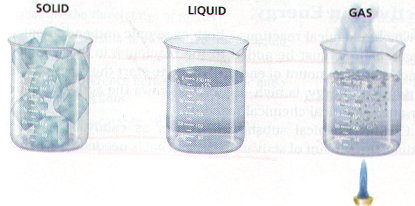
Ø  Solids have both a definite volume & definite shape (rock)

Ø  Liquids have a definite volume but no definite shape; they can be    poured (water)

Ø  Gases do not have a definite volume or definite shape, but they take the  volume & shape of their container

Ø  Plasmas have no definite volume, no definite shape, and only exist at extremely high temperatures such as the sun

Ø  Chemical Changes in matter are essential to all life processes

Ø  Biologists study chemistry because all living things are made of the same kinds of matter that make up nonliving things

Elements

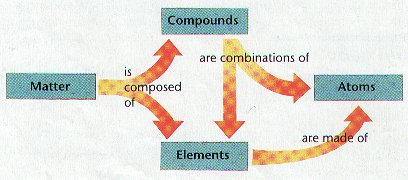
Ø     Elements are pure substances which cannot be chemically broken down into simpler kinds of matter

Ø     More than 100 elements have been identified, but only about 30 are important in living things

Ø     All of the Elements are arranged on a chart known as the Periodic Table

Ø     Periodic charts tell the atomic number, atomic mass, & chemical symbol for every element
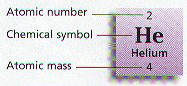
Ø     Four elements, Carbon – C, Hydrogen – H, Oxygen – O, and Nitrogen – N make up almost 90% of the mass of living things

Ø     Every element has a different chemical symbol composed of one to two letters

Ø     Chemical symbols usually come from the first letter or letters of an element like C for Carbon and Cl for Chlorine

Ø     Some chemical symbols come form their Latin or Greek name such as  Na for Sodium (natrium) or K for Potassium (Kalium)

Ø      Elements in the same horizontal period on the periodic table have the same number of energy levels (e.g. H & He in period 1 have only a K energy level)

[Periodic Table]
All Period 2 elements have 2 energy levels
(K & L)

Ø      Elements in the same vertical Family on the periodic table have the same number of electrons in their outermost energy level & react similar (e.g. Family IV, the Carbon family all have 4 electrons in their outermost energy level)
Atoms

Ø     Atoms are the simplest part of an element that keeps all of the element’s properties

Ø     Atoms are too small to be seen so scientists have developed models that show their structure & properties

Ø     Atoms consist of 3 kinds of subatomic particlesprotons & neutrons in the center or nucleus, and electrons spinning in energy levels around the center

Ø     The nucleus is the center of an atom where most of the mass is concentrated

Ø     Protons are positively charged ( p+ ),  have a mass of 1 amu (atomic mass unit) , are found in the nucleus, and determine the atomic number of the element

Example:  Carbon has 6 protons so its atomic number is 6

Ø     Neutrons are neutral or have no electrical charge (n), have a mass of 1 amu, are found in the nucleus, and when added to the number of protons, determine the atomic mass of the element

Example:  Sodium has 11 protons and 12 neutrons so its atomic mass is 11+12=23 amu

Ø     Electrons (e-) are negatively charged, high energy particles with little mass that spin around the nucleus in energy levels

Ø     Seven energy levels (K, L, M, N, O, P, & Q) exist around the nucleus and each holds a certain number of electrons

Ø     The K energy level is closest to the nucleus & only holds 2 electrons, while the  L – Q energy levels can hold 8 electrons  

Ø     Electrons in outer energy level are traveling faster & contain more energy than electrons in inner levels  

Ø     The number of protons (positive charges) and electrons (negative charges in an atom are equal so the net electrical charge on a atom is zero making it electrically neutral

Ø     Stable or non-reactive atoms have an outer energy level that is filled with electrons  

Compounds

Ø     Most elements do not exist by themselves; Most elements combine with other elements

Ø      Compounds are made of atoms of two or more elements chemically combined

Ø      Chemical Formulas represent a compound & show the kind & number of atoms of each element  (e.g. H2O has 2 hydrogen & 1 oxygen)

Ø      Compounds have different physical & chemical properties than the atoms that compose them  (e.g. hydrogen & oxygen are gases but H2O is a liquid)

Ø      The number & arrangement of electrons in an atom determines if it will combine to form compounds

Ø      Chemical reactions occur whenever unstable atoms (outer energy level not filled) combine to form more stable compounds

Ø      Chemical bonds form between atoms during chemical reactions

Types of Chemical Bonds

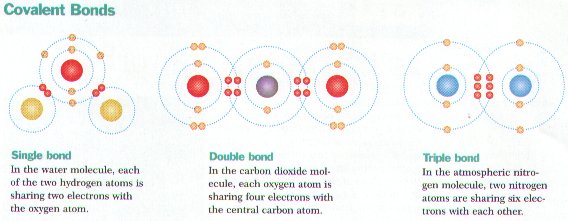
Ø     Covalent bonds form between atoms whenever they share 1 or more pairs of electrons (e.g. H2O)  
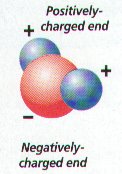
Ø     Molecules form from covalent bonding & are the simplest part of a compound (e.g. NaCl, H2O, O2)  
Ø     Ionic bonding occurs between a positively & negatively charged atom or ion  
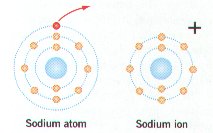
Ø     Positively charged ions have more electrons (-) than protons (+); negatively charged ions have more protons than electrons

Ø     Table salt (NaCl) forms when the 1 outer electron of Na is transferred to the outer energy level of chlorine that has 7 electrons (e-)
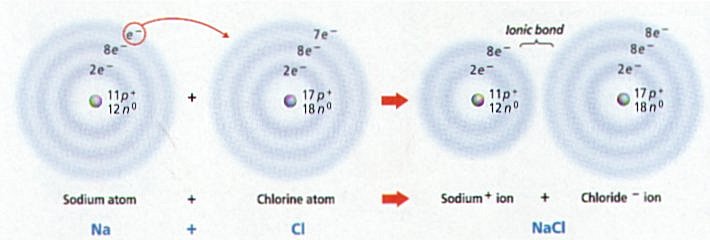
Ø     Sodium (Na) with 1 less e- becomes positively charged, while Chlorine (Cl) with 1 more e- becomes negatively charged; the + and – charges attract & form the ionic bond holding NaCl together

Ø     Other types of chemical bonding include hydrogen bonding

Energy

Ø     Energy is the ability to do work

Ø     Energy occurs in several forms & may be converted from one form to another

Ø     Sunlight is the ultimate energy for all life on earth

Ø     Forms of energy include chemical, electrical, mechanical, thermal, light, & sound

Ø     Free energy is the energy available for work (e.g. cells have energy to carry out cell processes)

Ø     Cells convert the chemical energy stored in food into other types of energy such as thermal & mechanical

Ø     Energy is used to change matter form one state into another (e.g. liquid into a gas)

Chemical Reactions

Ø     Living things undergo thousands of chemical reactions

Ø     Chemical equations represent chemical reactions

Ø     CO2 + H20—–goes to—–H2CO3  (carbonic acid) is a sample Chemical Reaction in living things

Ø     Reactants are on the left side of the equation, while products are on the right side

Ø Activation energy is required to start many reactions

Ø     Chemical bonds are broken, atoms rearranged, and new bonds form in chemical reaction

Ø     Plants use sunlight to produce sugars such as C6H12O6 glucose; the chemical energy from the sun is stored in the chemical bonds of glucose

Ø      Organisms eat plants, break down the sugars, and release energy along with CO2 & H2O

Ø      Exergonic reactions involve a net release of energy; while endergonic reactions involve a net absorption of energy

Ø      Energy must be added to the reactants for most chemical reactions to occur; called activation energy

Ø      Enzymes are chemical substances in living things that act as catalysts & reduce the amount of activation energy needed

Ø      Organisms contain thousands of different enzymes

Ø      Most enzymes end with –ase (e.g. lipase is the enzyme that acts on lipids)

Reduction-Oxidation (Redox) reactions

Ø     Reactions in which e- are transferred between atoms is a redox or reduction-oxidation reaction (e.g. formation of table salt NaCl)

Ø     In oxidation reactions, a reactant loses 1 or more e- & becomes positively (+) charged (e.g. Sodium atom becomes a Na+ ion)

Ø     In a reduction reaction, a reactant gains 1 or more e- and becomes negatively (-) charged (e.g. Chlorine atom becomes a Cl- ion)

Ø     REDOX reactions always occur together; the electron(s) from the oxidation reaction are then accepted by another substance in the reduction reaction

Solutions

Ø     A large percentage of the mass of organisms is water & many of the chemical reactions of life occur in water

Ø     A solution  is a uniform mixture of one substance in anther

Ø     Solutions may be mixtures of solids, liquids, or gases

Ø     The solute is the substance uniformly dissolved in the solution & may be ions, molecules, or atoms

Ø     The solvent is the substance in which the solute is dissolved

Ø     Water is known as the universal solvent 

Ø     Dissolving one substance in another does not alter their chemical properties

Ø     The concentration of a solution is a measure of the amount of solute dissolved in a given volume of solvent

Ø     Increasing the amount of solute increases the solution’s concentration

Ø     Aqueous solutions are solutions in which water is the solvent; these are important in living things (e.g. blood, cytoplasm of cell…)

Acids and Bases

Ø     The degree of acidity or alkalinity (basic) is important in organisms

Ø     The force of attraction between molecules is so strong that the oxygen atom of one molecule can actually remove the hydrogen from other water molecules; called Dissociation

Ø      H20—–GOES TO—– H+  +  OH-

Ø     OH- called hydroxide ion; H+ called hydrogen ion

Ø     Free H+ ion can react with another water molecule to form H3O+  (hydronium ion)

Ø     Acidity or alkalinity is a measure of the relative amount of H+ and OH- ions dissolved in a solution

Ø     Neutral solutions have an equal number of H+ and OH- ions

Ø     Acids have more H3O+ ions than OH- ions; taste sour; and can be corrosive

Ø     Bases contain more OH- ions than H3O+ ions; taste bitter; & feel slippery  


Examples of Common Acids

  • citric acid (from certain fruits and veggies, notably citrus fruits)
  • ascorbic acid (vitamin C, as from certain fruits)
  • vinegar (5% acetic acid)
  • carbonic acid (for carbonation of soft drinks)
  • lactic acid (in buttermilk)
Examples of Common Bases

  • detergents
  • soap
  • lye (NaOH)
  • household ammonia

PH Scale

Ø     Compares the relative concentration of H3O+ ions and OH- ions

Ø     Scale ranges from 0 to 14; 0-3 is very acidic; 7 is neutral; 11-14 is very basic or alkaline


Ø    Litmus paper, phenolphthalein, pH paper, & other indicators that change color can be used to measure pH

Buffers

Ø     Control of pH is important to organisms

Ø     Enzymes function only within a narrow pH range; usually neutral

Ø     Buffers neutral acids or bases in organisms to help control pH

Chemistry Study Guide Chemistry On-line


BACK

Chapter 20 AP Objectives


Chapter 20    DNA Technology
Objectives
DNA Cloning
1. Explain how advances in recombinant DNA technology have helped scientists study the eukaryotic genome.
2. Describe the natural function of restriction enzymes and explain how they are used in recombinant DNA technology.
3. Explain how the creation of sticky ends by restriction enzymes is useful in producing a recombinant DNA molecule.
4. Outline the procedures for cloning a eukaryotic gene in a bacterial plasmid.
5. Describe techniques that allow identification of recombinant cells that have taken up a gene of interest.
6. Define and distinguish between genomic libraries using plasmids, phages, and cDNA.
7. Describe the role of an expression vector.
8. Describe two advantages of using yeast cells instead of bacteria as hosts for cloning or expressing eukaryotic genes.
9. Describe two techniques to introduce recombinant DNA into eukaryotic cells.
10. Describe the polymerase chain reaction (PCR) and explain the advantages and limitations of this procedure.
11. Explain how gel electrophoresis is used to analyze nucleic acids and to distinguish between two alleles of a gene.
12. Describe the process of nucleic acid hybridization.
13. Describe the Southern blotting procedure and explain how it can be used to detect and analyze instances of restriction fragment length polymorphism (RFLP).
14. Explain how RFLP analysis facilitated the process of genomic mapping.
DNA Analysis and Genomics
15. Explain the goals of the Human Genome Project.
16. Explain how linkage mapping, physical mapping, and DNA sequencing each contributed to the genome mapping project.
17. Describe the alternate approach to whole-genome sequencing pursued by J. Craig Venter and the Celera Genomics company.
18. Explain how researchers recognize protein-coding genes within DNA sequences.
19. Describe the surprising results of the Human Genome Project.
20. Explain how the vertebrate genome, including that of humans, generates greater diversity than the genomes of invertebrate organisms.
21. Explain how in vitro mutagenesis and RNA interference help researchers to discover the functions of some genes.
22. Explain the purposes of gene expression studies. Describe the use of DNA microarray assays and explain how they facilitate such studies.
23. Define and compare the fields of proteomics and genomics.
24. Explain the significance of single nucleotide polymorphisms in the study of the human evolution.
Practical Applications of DNA Technology
25. Describe how DNA technology can have medical applications in such areas as the diagnosis of genetic disease, the development of gene therapy, vaccine production, and the development of pharmaceutical products.
26. Explain how DNA technology is used in the forensic sciences.
27. Describe how gene manipulation has practical applications for environmental and agricultural work.
28. Describe how plant genes can be manipulated using the Ti plasmid carried by Agrobacterium as a vector.
29. Explain how DNA technology can be used to improve the nutritional value of crops and to develop plants that can produce pharmaceutical products.
30. Discuss the safety and ethical questions related to recombinant DNA studies and the biotechnology industry.
BACK