Chapter 3 – Water Objectives


Chapter 3   Water & the Fitness of the Environment
Objectives
The Properties of Water

1.        With the use of a diagram or diagrams, explain why water molecules are:

a.         polar

b.         capable of hydrogen bonding with four neighboring water molecules

2.        List four characteristics of water that are emergent properties resulting from hydrogen bonding.

3.        Define cohesion and adhesion. Explain how water’s cohesion and adhesion contribute to the movement of water from the roots to the leaves of a tree.

4.        Distinguish between heat and temperature, using examples to clarify your definitions.

5.        Explain the following observations by referring to the properties of water:

n                      Coastal areas have milder climates than adjacent inland areas.

n                      Ocean temperatures fluctuate much less than air temperatures on land.

n                      Insects like water striders can walk on the surface of a pond without breaking the surface.

n                      If you slightly overfill a water glass, the water will form a convex surface above the top of the glass.

n                      If you place a paper towel so that it touches spilled water, the towel will draw in the water.

n                      Ice floats on water.

n                      Humans sweat and dogs pant to cool themselves on hot days.

6.        Distinguish among a solute, a solvent, and a solution.

7.        Distinguish between hydrophobic and hydrophilic substances.

8.        Explain how you would make up a one molar (1M) solution of ethyl alcohol.

The Dissociation of Water Molecules

9.        Name the products of the dissociation of water and give their concentration in pure water.

10.       Define acid, base, and pH.

11.       Explain how acids and bases may directly or indirectly alter the hydrogen ion concentration of a solution.

12.       Using the bicarbonate buffer system as an example, explain how buffers work.

13.       Briefly explain the causes and effects of acid precipitation.


BACK


Chapter 1 Worksheet BI


Biology – Science of Life


Section 1-1            Themes of Biology 

1. How many species of organisms are estimated to inhabit the Earth? 

2. About how many species have actually been identified? 

3. When did the first life forms probably arise on Earth? 

4. What was the first organism like? 

5.  What is an organism? 

6. Most unicellular organisms can only be seen with a __________________________.

7. Where did these first cells live? 

8. Over time, organisms _____________ and new kinds of _______________ arose from ___________ of organisms and came to inhabit every _______________ of the Earth. 

9. Define biology. 

10. Name several things that the study of biology would include. 

11. The study of biology is unified by ___________________________. 

12. Name 6 unifying themes of biology. 

13. What is a cell? Where are they found? 

14. What is the difference between a unicellular & a multicellular organism? 

15. Cells are ___________________ but highly _______________________.

16. Are all cells alike? Explain. 

17. All cells are surrounded by a ____________ & contain _____________  instructions. 

18. Genetic instructions are used by cells to make new __________ and new cell ________________. 

19. How do new cells produced by unicellular organisms compare to the parent unicellular organism? 

20. How do mature multicellular organisms begin their life? 

21. If multicellular organisms begin their life as one cell, how do they have so many cells? Explain. 

22. Give an example of an organism maintaining a stable internal environment. 

23. Define homeostasis and tell whether it occurs in unicellular&/or multicellular organisms. 

24. Genetic information is passed to offspring during _______________________.

25. What molecule contains the cell’s hereditary information?

26.  How does DNA exist in multicellular organisms? In unicellular organisms? 

27. What is a gene?

28. In multicellular organisms, each body cell has an _____________ copy of its DNA.

29. Does each cell in a multicellular organism use all the genes on its DNA? Explain. 

30. Explain sexual reproduction. 

31. When a sperm joins with an egg to make a fertilized cell, what happens next to this cell? 

32. New organisms from sexual reproduction have _______________ material from both parents.

33. Explain asexual reproduction. 

34. Name a unicellular organism that reproduces by asexual reproduction.

35. New cells or organisms from asexual reproduction have ____________ genetic information. 

36. What is evolution? 

37. Do individuals or populations evolve? 

38. What is the driving force for evolution? 

39. Explain natural selection and give an example. 

40. Competition for what types of resources drives natural selection? 

41. Why is it so important to a species for members to survive? 

42. Organisms that survive and reproduce are ones with ________________ traits.

43. Define ecology. 

44. What are ecosystems and give an example? 

45. Name 3 things organisms must get from the environment to survive. 

46. What has been the effect of man’s activities on many ecosystems? 

47. Living things are _______________ and need a constant supply of _________________.

48. What process supplies energy for organisms on Earth? 

49. Define autotroph. 

50. Autotrophs trap _________ and use this energy to combine __________ and  _________ into__________ and starches. 

51. Define heterotrophs. 

52. Give an example of an autotroph.

53. Give several examples of heterotrophs. 

54. How do heterotrophs get their food? 

Section 1-2            World of Biology 

55. List 6 characteristics shared by all living things. 

56. All living things composed of  _________________.

57. Cells may be specialized in _________________ organisms. What does this mean?

58. What is always true about cell size?

59. Living things are organized at what 2 levels?

60. How are cells organized in multicellular organisms?

61. Define metabolism. 

62. The energy from metabolism is used for ___________, ___________, and _______________ of organisms. 

63. What is homeostasis and give an example? 

64. Is growth a characteristic of living and nonliving things? Explain.

65. What 2 things must occur for living things to grow?


66. Define cell division.


67. Define development.


68. Explain why development is necessary for multicellular organisms?


69. Is reproduction essential to the survival of a species? Explain.


70. Sexual reproduction produces offspring ______________________ to the parents.


71. Have all organisms been identified? Explain.


Section 1-3            Scientific Method


72. Scientists solve problems using the ___________________________.


73. The first step of the scientific method is when scientists make ___________________ of the natural world.

74. Define data.


75. What does a scientist usually employ in making their observations?


76. What is quantitative data?


77. What is sampling & why is it used by scientists?


78. What 2 things must be true for samples to be useful?


79. To be useful, data must be _____________________ into ____________________,


       ______________________, and _____________________, or maps.


80. Once an observation is made, the second thing a scientist must do is to develop a(n) ___________________________.


81. Define hypothesis.


82. All hypotheses must be __________________ to give supporting evidence.


83. What is a prediction & how are they usually written?


84. What is an experiment?


85. Name the 2 groups in a controlled experiment.


86. Both groups in an experiment are identical except for ___________ factor called the


       ___________________.

87. Name the 2 types of variables in a controlled experiment.


88. After data is collected and organized, it must be __________________ to tell if it is reliable.


89. If experimental data does not support the hypothesis, what should be done?


90. What is a scientific model?


91. What is an inference?


92. How is a theory formed?


93. Define theory.


94. What is the difference between a field biologist and a laboratory biologist? Do they both use the scientific method?


95. What do scientists do with the results of their scientific studies?


Section 1-4            Microscopes & Measurement


96. What is a microscope?


97. What is the difference between resolution & magnification?


98. When would a microscope be used?


99. Do all microscopes have the same magnification & resolution?


100.  Draw and label the parts of a light (LM) microscope.


101. Tell the function of each of these parts of an LM — stage, light source, objective lens, ocular lens, & nosepiece.


102. To view specimens with a light microscope, they must be placed on a _______________


         and be ________________ so light will pass through to the lenses & your eyes.


103. What is the power of magnification & explain how it is determined?


104. Light microscopes can only magnify up to ______________ before the image becomes blurry.

105. What type of scope is used to view viruses & cell parts?


106. What produces an image with the electron microscope?


107. Name the 2 main types of electron microscopes.


108. What is the highest magnification for the TEM? For the SEM?


109. Can electron microscopes be used to view living cells?


110. What type of scope gives a magnified view of an object’s surface?


111. What is the standard unit of measurement used by scientists?


112. Name the SI base units, what they measure, & give their abbreviations (table 1-1, page 23)


113. The SI system is based on units of __________ with designated _________________.


114. Give the SI prefix for these base units — 1000, .01, .001, .000001, .000000001, & .000000000001.


115. Give the SI unit for area, volume, and time.


Chemistry of Organisms

Chemistry
All Materials © Cmassengale

Composition of Matter

Ø  Everything in the universe is made of matter

Ø  Matter takes up space & has mass

Ø  Mass is a measure of the amount of matter in the substance

Ø  Mass & weight are NOT the same

Ø  Weight is a measure of the pull of gravity on an object

Question: Is the mass of an object the same on the moon as it is on the Earth? Is its weight the same? (Hint: Gravitational pull on the moon is 1/6 of that on the Earth.)

Ø  Matter exists in 4 states – solid, liquid, gas, & plasma
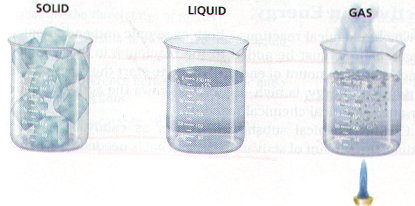
Ø  Solids have both a definite volume & definite shape (rock)

Ø  Liquids have a definite volume but no definite shape; they can be    poured (water)

Ø  Gases do not have a definite volume or definite shape, but they take the  volume & shape of their container

Ø  Plasmas have no definite volume, no definite shape, and only exist at extremely high temperatures such as the sun

Ø  Chemical Changes in matter are essential to all life processes

Ø  Biologists study chemistry because all living things are made of the same kinds of matter that make up nonliving things

Elements

Ø     Elements are pure substances which cannot be chemically broken down into simpler kinds of matter

Ø     More than 100 elements have been identified, but only about 30 are important in living things

Ø     All of the Elements are arranged on a chart known as the Periodic Table

Ø     Periodic charts tell the atomic number, atomic mass, & chemical symbol for every element
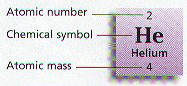
Ø     Four elements, Carbon – C, Hydrogen – H, Oxygen – O, and Nitrogen – N make up almost 90% of the mass of living things

Ø     Every element has a different chemical symbol composed of one to two letters

Ø     Chemical symbols usually come from the first letter or letters of an element like C for Carbon and Cl for Chlorine

Ø     Some chemical symbols come form their Latin or Greek name such as  Na for Sodium (natrium) or K for Potassium (Kalium)

Ø      Elements in the same horizontal period on the periodic table have the same number of energy levels (e.g. H & He in period 1 have only a K energy level)

[Periodic Table]
All Period 2 elements have 2 energy levels
(K & L)

Ø      Elements in the same vertical Family on the periodic table have the same number of electrons in their outermost energy level & react similar (e.g. Family IV, the Carbon family all have 4 electrons in their outermost energy level)
Atoms

Ø     Atoms are the simplest part of an element that keeps all of the element’s properties

Ø     Atoms are too small to be seen so scientists have developed models that show their structure & properties

Ø     Atoms consist of 3 kinds of subatomic particlesprotons & neutrons in the center or nucleus, and electrons spinning in energy levels around the center

Ø     The nucleus is the center of an atom where most of the mass is concentrated

Ø     Protons are positively charged ( p+ ),  have a mass of 1 amu (atomic mass unit) , are found in the nucleus, and determine the atomic number of the element

Example:  Carbon has 6 protons so its atomic number is 6

Ø     Neutrons are neutral or have no electrical charge (n), have a mass of 1 amu, are found in the nucleus, and when added to the number of protons, determine the atomic mass of the element

Example:  Sodium has 11 protons and 12 neutrons so its atomic mass is 11+12=23 amu

Ø     Electrons (e-) are negatively charged, high energy particles with little mass that spin around the nucleus in energy levels

Ø     Seven energy levels (K, L, M, N, O, P, & Q) exist around the nucleus and each holds a certain number of electrons

Ø     The K energy level is closest to the nucleus & only holds 2 electrons, while the  L – Q energy levels can hold 8 electrons  

Ø     Electrons in outer energy level are traveling faster & contain more energy than electrons in inner levels  

Ø     The number of protons (positive charges) and electrons (negative charges in an atom are equal so the net electrical charge on a atom is zero making it electrically neutral

Ø     Stable or non-reactive atoms have an outer energy level that is filled with electrons  

Compounds

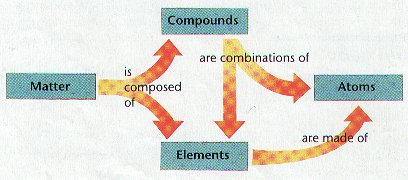
Ø     Most elements do not exist by themselves; Most elements combine with other elements

Ø      Compounds are made of atoms of two or more elements chemically combined

Ø      Chemical Formulas represent a compound & show the kind & number of atoms of each element  (e.g. H2O has 2 hydrogen & 1 oxygen)

Ø      Compounds have different physical & chemical properties than the atoms that compose them  (e.g. hydrogen & oxygen are gases but H2O is a liquid)

Ø      The number & arrangement of electrons in an atom determines if it will combine to form compounds

Ø      Chemical reactions occur whenever unstable atoms (outer energy level not filled) combine to form more stable compounds

Ø      Chemical bonds form between atoms during chemical reactions

Types of Chemical Bonds

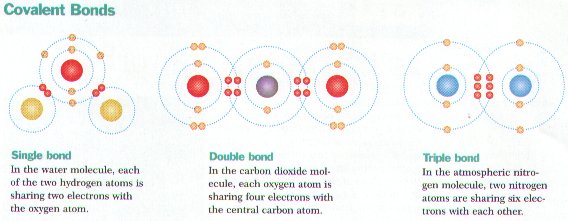
Ø     Covalent bonds form between atoms whenever they share 1 or more pairs of electrons (e.g. H2O)  
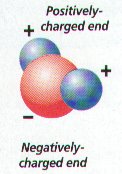
Ø     Molecules form from covalent bonding & are the simplest part of a compound (e.g. NaCl, H2O, O2)  
Ø     Ionic bonding occurs between a positively & negatively charged atom or ion  
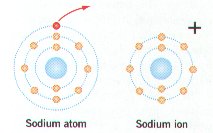
Ø     Positively charged ions have more electrons (-) than protons (+); negatively charged ions have more protons than electrons

Ø     Table salt (NaCl) forms when the 1 outer electron of Na is transferred to the outer energy level of chlorine that has 7 electrons (e-)
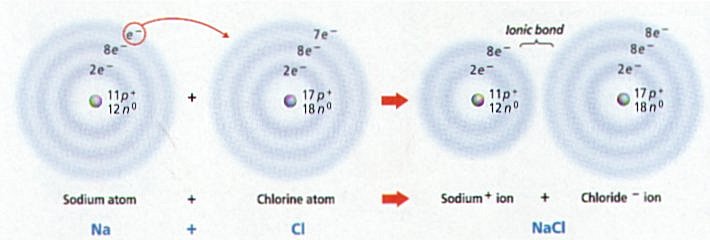
Ø     Sodium (Na) with 1 less e- becomes positively charged, while Chlorine (Cl) with 1 more e- becomes negatively charged; the + and – charges attract & form the ionic bond holding NaCl together

Ø     Other types of chemical bonding include hydrogen bonding

Energy

Ø     Energy is the ability to do work

Ø     Energy occurs in several forms & may be converted from one form to another

Ø     Sunlight is the ultimate energy for all life on earth

Ø     Forms of energy include chemical, electrical, mechanical, thermal, light, & sound

Ø     Free energy is the energy available for work (e.g. cells have energy to carry out cell processes)

Ø     Cells convert the chemical energy stored in food into other types of energy such as thermal & mechanical

Ø     Energy is used to change matter form one state into another (e.g. liquid into a gas)

Chemical Reactions

Ø     Living things undergo thousands of chemical reactions

Ø     Chemical equations represent chemical reactions

Ø     CO2 + H20—–goes to—–H2CO3  (carbonic acid) is a sample Chemical Reaction in living things

Ø     Reactants are on the left side of the equation, while products are on the right side

Ø Activation energy is required to start many reactions

Ø     Chemical bonds are broken, atoms rearranged, and new bonds form in chemical reaction

Ø     Plants use sunlight to produce sugars such as C6H12O6 glucose; the chemical energy from the sun is stored in the chemical bonds of glucose

Ø      Organisms eat plants, break down the sugars, and release energy along with CO2 & H2O

Ø      Exergonic reactions involve a net release of energy; while endergonic reactions involve a net absorption of energy

Ø      Energy must be added to the reactants for most chemical reactions to occur; called activation energy

Ø      Enzymes are chemical substances in living things that act as catalysts & reduce the amount of activation energy needed

Ø      Organisms contain thousands of different enzymes

Ø      Most enzymes end with –ase (e.g. lipase is the enzyme that acts on lipids)

Reduction-Oxidation (Redox) reactions

Ø     Reactions in which e- are transferred between atoms is a redox or reduction-oxidation reaction (e.g. formation of table salt NaCl)

Ø     In oxidation reactions, a reactant loses 1 or more e- & becomes positively (+) charged (e.g. Sodium atom becomes a Na+ ion)

Ø     In a reduction reaction, a reactant gains 1 or more e- and becomes negatively (-) charged (e.g. Chlorine atom becomes a Cl- ion)

Ø     REDOX reactions always occur together; the electron(s) from the oxidation reaction are then accepted by another substance in the reduction reaction

Solutions

Ø     A large percentage of the mass of organisms is water & many of the chemical reactions of life occur in water

Ø     A solution  is a uniform mixture of one substance in anther

Ø     Solutions may be mixtures of solids, liquids, or gases

Ø     The solute is the substance uniformly dissolved in the solution & may be ions, molecules, or atoms

Ø     The solvent is the substance in which the solute is dissolved

Ø     Water is known as the universal solvent 

Ø     Dissolving one substance in another does not alter their chemical properties

Ø     The concentration of a solution is a measure of the amount of solute dissolved in a given volume of solvent

Ø     Increasing the amount of solute increases the solution’s concentration

Ø     Aqueous solutions are solutions in which water is the solvent; these are important in living things (e.g. blood, cytoplasm of cell…)

Acids and Bases

Ø     The degree of acidity or alkalinity (basic) is important in organisms

Ø     The force of attraction between molecules is so strong that the oxygen atom of one molecule can actually remove the hydrogen from other water molecules; called Dissociation

Ø      H20—–GOES TO—– H+  +  OH-

Ø     OH- called hydroxide ion; H+ called hydrogen ion

Ø     Free H+ ion can react with another water molecule to form H3O+  (hydronium ion)

Ø     Acidity or alkalinity is a measure of the relative amount of H+ and OH- ions dissolved in a solution

Ø     Neutral solutions have an equal number of H+ and OH- ions

Ø     Acids have more H3O+ ions than OH- ions; taste sour; and can be corrosive

Ø     Bases contain more OH- ions than H3O+ ions; taste bitter; & feel slippery  


Examples of Common Acids

  • citric acid (from certain fruits and veggies, notably citrus fruits)
  • ascorbic acid (vitamin C, as from certain fruits)
  • vinegar (5% acetic acid)
  • carbonic acid (for carbonation of soft drinks)
  • lactic acid (in buttermilk)
Examples of Common Bases

  • detergents
  • soap
  • lye (NaOH)
  • household ammonia

PH Scale

Ø     Compares the relative concentration of H3O+ ions and OH- ions

Ø     Scale ranges from 0 to 14; 0-3 is very acidic; 7 is neutral; 11-14 is very basic or alkaline


Ø    Litmus paper, phenolphthalein, pH paper, & other indicators that change color can be used to measure pH

Buffers

Ø     Control of pH is important to organisms

Ø     Enzymes function only within a narrow pH range; usually neutral

Ø     Buffers neutral acids or bases in organisms to help control pH

Chemistry Study Guide Chemistry On-line


BACK

Chapter 20 AP Objectives


Chapter 20    DNA Technology
Objectives
DNA Cloning
1. Explain how advances in recombinant DNA technology have helped scientists study the eukaryotic genome.
2. Describe the natural function of restriction enzymes and explain how they are used in recombinant DNA technology.
3. Explain how the creation of sticky ends by restriction enzymes is useful in producing a recombinant DNA molecule.
4. Outline the procedures for cloning a eukaryotic gene in a bacterial plasmid.
5. Describe techniques that allow identification of recombinant cells that have taken up a gene of interest.
6. Define and distinguish between genomic libraries using plasmids, phages, and cDNA.
7. Describe the role of an expression vector.
8. Describe two advantages of using yeast cells instead of bacteria as hosts for cloning or expressing eukaryotic genes.
9. Describe two techniques to introduce recombinant DNA into eukaryotic cells.
10. Describe the polymerase chain reaction (PCR) and explain the advantages and limitations of this procedure.
11. Explain how gel electrophoresis is used to analyze nucleic acids and to distinguish between two alleles of a gene.
12. Describe the process of nucleic acid hybridization.
13. Describe the Southern blotting procedure and explain how it can be used to detect and analyze instances of restriction fragment length polymorphism (RFLP).
14. Explain how RFLP analysis facilitated the process of genomic mapping.
DNA Analysis and Genomics
15. Explain the goals of the Human Genome Project.
16. Explain how linkage mapping, physical mapping, and DNA sequencing each contributed to the genome mapping project.
17. Describe the alternate approach to whole-genome sequencing pursued by J. Craig Venter and the Celera Genomics company.
18. Explain how researchers recognize protein-coding genes within DNA sequences.
19. Describe the surprising results of the Human Genome Project.
20. Explain how the vertebrate genome, including that of humans, generates greater diversity than the genomes of invertebrate organisms.
21. Explain how in vitro mutagenesis and RNA interference help researchers to discover the functions of some genes.
22. Explain the purposes of gene expression studies. Describe the use of DNA microarray assays and explain how they facilitate such studies.
23. Define and compare the fields of proteomics and genomics.
24. Explain the significance of single nucleotide polymorphisms in the study of the human evolution.
Practical Applications of DNA Technology
25. Describe how DNA technology can have medical applications in such areas as the diagnosis of genetic disease, the development of gene therapy, vaccine production, and the development of pharmaceutical products.
26. Explain how DNA technology is used in the forensic sciences.
27. Describe how gene manipulation has practical applications for environmental and agricultural work.
28. Describe how plant genes can be manipulated using the Ti plasmid carried by Agrobacterium as a vector.
29. Explain how DNA technology can be used to improve the nutritional value of crops and to develop plants that can produce pharmaceutical products.
30. Discuss the safety and ethical questions related to recombinant DNA studies and the biotechnology industry.
BACK

Chapter 21 AP Objectives


Chapter 21    Genetic Basis of Development
Objectives
From Single Cell to Multicellular Organism
1. List the animals used as models for developmental biology research and provide a rationale for their choice.
2. Distinguish between the patterns of morphogenesis in plants and in animals.
Differential Gene Expression
3. Describe how genomic equivalence was determined for plants and animals.
4. Describe what kinds of changes occur to the genome during differentiation.
5. Describe the general process by which the ewe Dolly and the first mice were cloned.
6. Describe the characteristics of stem cells. Explain their significance to medicine.
7. Distinguish between determination and differentiation. Explain why determination precedes differentiation.
8. Describe the molecular basis of determination.
9. Describe the two sources of information that instruct a cell to express genes at the appropriate time.
Genetic and Cellular Mechanisms of Pattern Formation
10. Describe how Drosophila was used to investigate the basic aspects of pattern formation (axis formation and segmentation).
11. Explain how maternal genes affect polarity and development in Drosophila embryos.
12. Describe how gradients of morphogens may specify the axes of developing Drosophila embryos.
13. Describe how homeotic genes define the anatomical identity of the segments of a developing organism.
14. Describe how the study of nematodes contributed to an understanding of the role of induction in development.
15. Describe how apoptosis functions in normal and abnormal development.
16. Describe how the study of tomatoes has contributed to the understanding of flower development.
17. Describe how the study of Arabidopsis has contributed to the understanding of organ identity in plants.
18. Provide evidence of the conservation of homeobox patterns.


BACK