| Cell Structure and Function Assignment |
| Project Due – Tuesday, June 28
Instructions:
|
DRAWINGS:
|
.gif)
| Cell Structure and Function Assignment |
| Project Due – Tuesday, June 28
Instructions:
|
DRAWINGS:
|
| DNA Technology ppt Questions |
DNA Extraction
1. When cells are treated with certain chemicals, it causes the plasma membrane to __________ or lyse.
2. DNA can be pulled out of cells because it is ________________ and can be ______________.
3. Describe the appearance of DNA spooled from cells.
4. What may be used to cut DNA into smaller pieces?
5. Do all restriction enzymes cut DNA at the same place?
6. What 2 properties can be used to separate DNA fragments?
7. Why does DNA have a negative charge?
8. To separate DNA fragments, it is placed in a ____________ with a current of _____________ running through it.
9. This process is called ____________________.
10. What determines the direction DNA will move in a gel?
11. Which fragments move further and faster?
12. DNA fragments are loaded into depression on the gel called _____________.
13. The DNA gel floats in a chamber covered with a ____________ solution.
14. DNA fragments closest to the wells are ___________ in size, while the __________ DNA fragments are further from the wells.
Steps in DNA Sequencing
15. Many copies of a ______________ of DNA are placed in a test tube and ________________ is added to begin the process.
16. What else must be added?
17. How are the different nucleotide bases marked or tagged?
18. Dyed and _____________ nucleotides are added, but the large __________ molecules stop the chain from growing producing DNA fragments of _______________ sizes.
19. The fragments make banding patterns on an electrophoresis gel of different _____________ that can be identified.
20. The separated fragments are then read by _____________ from the ________ of the gel to the top.
Copying DNA
21. Define PCR and tell what it stands for.
22. To make many copies of DNA, DNA polymerase is added that can work at very high _______________.
23. DNA is _____________ to separate the two strands.
24. What is added next to the test tube of DNA and DNA polymerase?
25. What are primers?
26. When the tube is cooled, DNA polymerase adds new ___________ to the separated DNA strands.
27. Even though a small amount of DNA is used to start PCR, ___________ amounts of DNA can be copied.
Cloning
28. What is a clone?
29. Clones may be produced by _____________ reproduction.
30. What two types of cells are combined in order to clone an organism?
31. Once a body cell fuses to an egg cell, the cell divides like a normal _____________.
32. What was the first successfully cloned organism?
Human Genome Project
33. When was the project started?
34. What is the goal of the project?
35. How many nucleotides approximately make up the human genome? How many chromosomes?
36. Who is mapping the genes on the human chromosomes?
37. From working on the Human Genome project, scientists have discovered that only about ________ actually codes for proteins; these genes are called _____________.
38. What is the other 98% or non-coding genes of DNA known as?
39. How many genes have been found on DNA? Is this more or less than the expected number?
40. What are SNP’s that the scientists found?
41. Define proteome.
42. Human Genome researchers discovered transposons. What are these structures?
43. The Human Genome Project was produced an area of science known as bioinformatics. how is this helpful in sequencing DNA?
44. Define biotechnology.
45. Give an example of an agricultural crop grown in this area that has been improved by genetic engineering.
46. What product was 1st made in 1982 by genetic engineering to help diabetics?
47. Explain how biotechnology has improved each of these fruits or vegetables:
a. bananas
b. rice
c. garlic
d. potatoes
48. Give 4 ways biotechnology has helped the environment.
 |
Cells |
Section 4-1 Introduction to the Cell
1. What is a cell?
2. Who was the first person to use a simple microscope and view microscopic organisms?
3.. What English scientist was first to view dead plant cells?
4. State the 3 parts to the cell theory.
5. Tell how each of these scientists contributed to the cell theory — Matthias Schleiden, Theodor Schwann, and Rudolf Virchow.
6. Give 3 ways that cells are not alike.
7. What is one of the longest animal cells?
8. Explain why cells are limited in how large they can grow.
9. The shape of a cell reflects its ______________________. Give an example of this.
10. Define organelle & tell what they do for a cell.
11. What surrounds the outside of all cells?
12. Where is the nucleus of a cell & what does it do?
13. What two characteristics do all eukaryotes share?
14. What type of cell is a bacterium?
15. Where is the genetic information (chromosome) of a bacterium found?
16. What are prokaryotes & are they in the same kingdom as eukaryotes?
Section 4-2 Parts of the Eukaryotic Cell
17. Why can cells not survive if they are totally isolated from their environment?
18. What controls what enters or leaves a cell?
19. Define selectively permeable.
20. Describe the phospholipid make up of cell membranes.
21. Cells are bathed in an aqueous environment. What does this mean?
22. Sketch the lipid bilayer of a cell showing the inside & outside of the cell. Be sure to label all parts of the membrane.
23. What is the difference between peripheral & integral proteins in the cell membrane?
24. What is the purpose of the carbohydrate tails attached to some integral proteins?
25. Do all integral proteins look alike? Explain.
26. Explain the fluid mosaic model of the cell membrane.
27. Name 12 organelles found in cells. (See table 4-2)
28. In what part of a cell are organelles found?
29. What is cytosol & what does it contain?
30. Name 3 organelles found in plant, but not animal cells. (See bottom of table 4-2)
31. What is the function of mitochondria? What energy molecule is made there?
32. Why do liver & muscle cells have more mitochondria than other types of cells?
33. Describe the outer covering of the mitochondria.
34. What are cristae & what is their purpose?
35. Mitochondria are able to reproduce inside cells because they have their own ___________.
36. What organelles are the most numerous inside cells?
37. What two things make up ribosomes & are ribosomes surrounded by membrane like other organelles?
38. Ribosomes are made inside the _______________ of a cell.
39. Ribosomes may remain unattached or __________ in cytosol or attach to what other organelle’s surface?
40. What organic compounds to ribosomes synthesize or make?
41. What does ER stand for & what is the ER in a cell?
42. What is the ER’s function?
43. Name the two types of ER inside cells.
44. What is on the surface of rough ER?
45. Rough ER synthesizes large amounts of _________________ for cells.
46. Give 3 functions of smooth ER.
47. What is the Golgi apparatus?
48. Golgi is a system of ________________ or flattened _____________.
49. How does the Golgi work with the endoplasmic reticulum of a cell?
50. What are lysosomes & what do they do?
51. Name 8 things that the enzymes inside lysosomes digest?
52. In what type of cells are lysosomes common? In what type of cell are they rare?
53. Where is the cytoskeleton & what is its function?
54. What are the two major components of the cytoskeleton?
55. How do microfilaments & microtubules differ from each other?
56. What are spindle fibers & what are they made of?
57. What protein makes up microfilaments?
58. Compare cilia & flagella.
59. What is the purpose of the nuclear matrix?
60. What double membrane surrounds the nucleus?
61. Where is chromatin found & what 2 things is it made of?
62. When a cell is ready to divide, chromatin condenses & coils into _____________________.
63. What is the purpose of DNA inside the nucleus?
64. How do nuclear pores help RNA?
65. Where is the nucleolus found and what is made there?
66. Where is the cell wall in plants found, what is its function, and what is it made of?
67. What are the 2 types of cell walls in plants?
68. What is the difference between the primary & secondary cell walls?
69. What is found inside plant vacuoles?
70. What takes up much of the volume of plant cells? What happens to the other organelles?
71. How are plastids similar to mitochondria?
72. What is found inside of plastids?
73. Name the most familiar plastid & tell its function.
74. What are thylakoids?
Section 4-3 Multicellular Organization
75. Cells are organized into ______________________. Give an example.
76. What is an organ & give an example?
77. What forms organ systems?
78. The digestive system is an organ system. Name the organs that make up this system.
79. All the systems working together make up an ______________________ such as a plant or animal.
| Transport Across Membranes |
| PowerPoint Questions |
Membrane Structure
1. Cell membranes of unicellular organisms are ____________ so the organism can move.
2. What is meant by homeostasis?
3. Homeostasis is also called __________________.
4. How does the plasma membrane help maintain homeostasis?
5. Give 7 functions of the plasma membrane.
a.
b.
c.
d.
e.
f.
g.
6. What is meant by the term selectively permeable?
7. What are cell junctions?
8. Fluid inside the cell is called _________________.
9. Label the plasma membrane (phospholipids, cholesterol, peripheral proteins, integral proteins, cytoskeleton, glcocalyx…)

10. A ________________ bilayer makes up most of the cell membrane.
11. Are phospholipids heads polar or nonpolar? the tails?
12. How many fatty acid chains are in a phospholipid?
13. Describe the heads of a phospholipid.
14. The __________ _____________ ___________ describes the appearance of the cell membrane.
15. Why is the cell membrane said to act like a fluid?
16. What causes the mosaic pattern of the cell membrane when viewed from above?
17. The phospholipid ____________ of the cell membrane allows ____________ molecules to pass through easily, but _________________ do NOT.
18. Materials soluble in __________ can pass easily through the cell membrane.
19. Because the cell membrane is ___________________, only ___________ molecules and larger _______________ molecules can move through easily.
20. List 3 substances that pass easily through the cell membrane.
21. _________, _____________ molecules larger than water, and large __________ molecules do NOT move easily through the phospholipids of the cell membrane.
Types of Membrane Transport
22. Simple ____________ requires NO energy to move things across the cell membrane.
23. With simple diffusion, molecules move from an area of ________ concentration to an area of ______ concentration.
24.Why is diffusion considered a passive process?
25. With diffusion, molecules move by their own natural __________ energy or energy of motion.
26. Explain what happens to a drop of food coloring put into a beaker of water.
27. When solutes diffuse through a membrane, they move from __________ to _________ concentration.
28. __________ is the diffusion of _________ across a cell membrane.
29. If water potential is HIGH, solute concentration is __________.
30. If water potential is LOW, solute concentration is ___________.
31. Water moves from _________ water potential to ________ water potential.
32. Water diffuses through the pores called _____________ of the cell membrane.
33. Sketch a picture of a cell in an isotonic environment & show the direction of water movement?
34. What is meant by NO NET movement?
35. Sketch a picture of a cell in an Hypotonic environment & show the direction of water movement?
36. Sketch a picture of a cell in an hypertonic environment & show the direction of water movement?
37. Complete the following table:
| Direction of Osmosis | ||
| Environmental Condition | Net Movement of water | What happens to cell |
| Hypotonic | ||
| Hypertonic | ||
| Isotonic | ||
38. _____________ occurs whenever water moves out of a cell & the cell shrinks in size.
39. _____________ occurs whenever water moves into the cells causing them to swell and burst.
40. Explain what happens to a red blood cell placed in:
a. distilled water
b. a concentrated salt solution
41. Complete the following drawings.

42. Plants prefer ________________ environments, while animal cells do best in _____________ environments.
43. Describe these 3 types of movement across cell membranes.
a. simple diffusion
b. facilitated diffusion
c. active transport
44. Passive transport does _______ require additional energy & moves materials from ________ to _________ concentration.
45. Give 2 examples of passive transport in cells.
46. ___________ diffusion is a type of __________ transport because energy is NOT required.
47. Facilitated diffusion uses _____________ proteins to help move materials from _________ to __________ concentrations.
48. Name 2 materials that move into or out of cells by facilitated diffusion.
49. name 2 types of transport proteins found in cell membranes.
50. Describe channel proteins.
51. How do carrier proteins help move materials across a cell membrane?
52. Channel proteins have an opening or ___________ through which molecules can passively move by _____________ diffusion.
53. Do all carrier proteins extend across the cell membrane?
54. Explain how these carrier proteins move materials across the membrane.
55. Some carrier proteins can change ________ to move materials across the cell membrane.
56. __________ transport requires additional energy to move materials.
57. Active transport uses cellular energy known as _________.
58. Active transport moves materials AGAINST the concentration gradient or from _________ to ___________ concentration.
59. The _______________ pump is an example of active transport.
60. The sodium-potassium pump moves _______ sodium ions out for every ______ potassium ions moved into the cell creating voltage across the cell called the ____________ potential.
61. Moving very large particles out of the cell is called _____________.
62. In exocytosis, wastes are moved out of the cell in ___________ that fuse with the cell membrane.
63. __________ involves moving large particles into the cell.
64. taking in large liquid droplets is called ____________ or “cell drinking”.
65. __________ ____________ endocytosis involves protein ____________ recognizing hormones to help move them into the cell.
66. How does cholesterol get into a cell?
67. “Cell eating” is known as ______________.
68. White blood cells engulfing bacteria is an example of _____________.
69. _____________ is the opposite of exocytosis.
| Cellular Respiration All Materials © Cmassengale |
C6H12O6 + 6O2 —–> 6CO2 + 6H20 + energy (heat and ATP)

Energy
Laws of Thermodynamics
Energy can be converted from one form to another. The sum of the energy before the conversion is equal to the sum of the energy after the conversion.
During changes from one form of energy to another, some usable energy is lost, usually as heat. The amount of usable energy therefore decreases.
Adenosine triphosphate (ATP)
 |
 |
 |
Enzymes in Metabolic Pathways:


enzyme substrate complex

NADH: A second energy carrying molecule in the mitochondria; produces 3 ATP

 |
FADH2: A third energy carrying molecule in the mitochondria; produces 2 ATP
 |
Mitochondria:

Cellular Respiration Overview:
C6H12O6 + 6O2 —–> 6CO2 + 6H20 + energy (heat and ATP)
 |
Glycolysis:


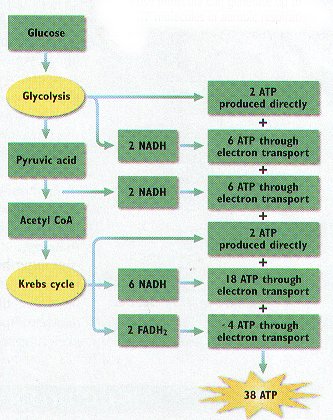
| Net Yield from Glycolysis |
| 4 NADH2 |
| 2 CO2 |
| 4 ATP ( 2 used to start reaction) |
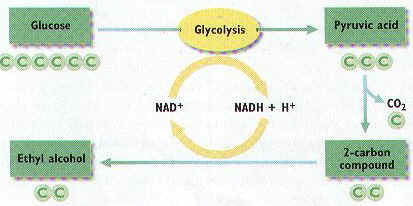
| Alcoholic Fermentation |
 |
| Lactic Acid Fermentation |
 |
Aerobic Respiration:
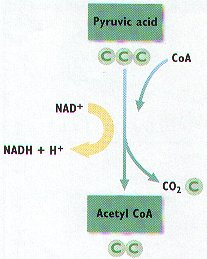
Kreb’s Cycle:

| Net Yield from Kreb’s Cycle (2 turns) |
| 6 NADH2 |
| 2 FADH2 |
| 4 CO2 |
| 2 ATP |
Electron Transport Chain:
O2 + 4e- + 4H+ 2H2O

| Energy Yield from Aerobic Respiration | ||
| Glycolysis | Kreb’s Cycle | Total |
| 4 NADH2 | 6 NADH2 | 10 NADH2 x 3 = 30 ATP |
| 0 FADH2 | 2 FADH2 | 2 FADH2 x 2 = 4 ATP |
| 2 ATP | 2 ATP | 4 ATP |
| 38 ATP | ||