Chapter 10 Protein Synthesis PPT Questions


Protein Synthesis
ppt Questions

DNA and Genes

1. What are genes and what do they code for?


2. Proteins are made of chains of _______________.

3. How do cells use proteins?


4. The subunits making up polypeptides are called _________________.

5. How many amino acids exist?

6. Sketch and label the basic structure of an amino acid.


7. The group that makes amino acids different from each other & gives the amino acid its unique properties is called the ___________ group.

8. DNA is found in the ____________ of a cell and begins the process of making a _______________.

9. Where are proteins made?

10. Describe the two types of ribosomes.


11. The first step in making a protein is to make a copy of ___________ in the nucleus.

RNA

12. What nucleic acid contains the master code for making proteins?

13. What nucleic acids acts as a blueprint in copying the master code?

14. Compare and contrast the sugars on DNA and RNA.


15. Compare and contrast the nitrogen bases on DNA and RNA.


16. RNA is made of a ____________ strand, while DNA is a ___________ stranded molecule.

17. What base replaces thymine on RNA?

18. Name the 3 types of RNA molecules.


19. What is the function of mRNA?


20. What is the function of rRNA?


21. What is the function of tRNA?


22. Describe the shape of mRNA.

23. How does mRNA get out of the nucleus once it has copied DNA’s instructions?

24. What bases pair together on RNA?

25. How long is mRNA?

26. What is a codon?


27. Methionine is called the __________ codon & is represented by the bases ________.

28. Name the 3 stop codons.

29. How long in rRNA?

30. What is the shape of rRNA?

31. What two things make up ribosomes?

32. What process occurs at the ribosomes?

33. Each codon stands for an _______________.

34. Can amino acids have more than one codon?

35. There are ______ amino acids and ______ possible codons.

36. How do you read the circular genetic codon table?


37. Use the genetic codon table and name these amino acids:

GGG?
UCA?
CAU?
GCA?
AAA?

38. Name the complementary bases on DNA.


39. Name the complementary bases on RNA.


40. What is the shape of tRNA?

41. What can attach to one end of a tRNA molecule for transport?

42. Opposite the attachment site on tRNA are 3 nucleotide bases called the ______________.

43. Make a sketch of a tRNA molecule with its attachment site and anticodon labeled.


44. A codon on mRNA is complementary to an _____________ on tRNA.

45. What anticodon is complementary to the codon – ACU?

Transcription and Translation

46. Sketch the pathway to making a protein.


47. define protein synthesis.


48. Name the 2 phases of protein synthesis.

49. Before mRNA can leave the nucleus it must be _______________ in order to correctly make proteins.

50. Define transcription and tell where it occurs.


51. What RNA copies DNA?

52. Are both strands of DNA copied?

53. What enzyme is required to copy DNA?

54. The DNA strand that is copied is called the _____________ strand.

55. What would be the complementary RNA sequence for the DNA sequence- 5′- GCGTATG-3′?

56. What enzyme separates the DNA strands in transcription?

57. RNA polymerase adds complementary ____________ to the DNA template strand.

58. ___________ are regions on DNA where RNA polymerase binds to start transcription.

59. The promoter contains a sequence called the _________ box.

60. Other sequences on DNA called __________ signals tell the RNA polymerase when to stop transcribing.

61. Newly made mRNA must be _________ to make the nucleic acid functional.

62. What are introns & what happens to them during mRNA processing?


63. What are exons and what happens to them during mRNA processing?


64. Describe the cap that is added to the new mRNA transcript.


65. What type of tail is added to the mRNA transcript?

66. The new mRNA transcripts is made of _____________ with a 5′ _________ and a 3′ ____________ tail.

67. What happens next to the newly made mRNA?

68. Define translation & tell where it occurs?


69. How do ribosomes read mRNA?

70. Describe the structure of a ribosome.


71. Ribosomes are composed of ________ rRNA and ________ protein.

72. Ribosomes have 2 tRNA sites called _______ and ______ along with an exit site.

73. The first part of translation is called ____________.

74. The small ribosomal subunit attaches to what codon on mRNA?

75. Once the mRNA and small subunit attach, what happens next?

76. Sketch an label a ribosome with both its subunits, its 2 tRNA sites, and the attached mRNA transcript.


77. The ______________ moves along the mRNA strand ________ codon at a time.

78. How many tRNA’s will fit into a ribosome at one time?

79. What happens to the two amino acids carried by the 2 tRNA’s inside a ribosome?

80. The joining of amino acids by ___________ bonds is the second part of translation called ______________.

81. Once an amino acid is joined to the growing polypeptide chain, the tRNA leaves the _______________ to pick up another ________________.

82. When a tRNA leaves the ribosome, the ribosome moves down the _________ strand allowing another ________ and its amino acid to enter.

83. each time the ribosome moves, it moves over _________ codon.

84. The last stage of translation is called _______________.

85. Name the 3 termination codons.

86. The sequence of amino acids in the polypeptide chain is called the ____________ protein structure.


Cell Size

THE SURFACE AREA TO VOLUME RATIO OF A CELL
INTRODUCTION:

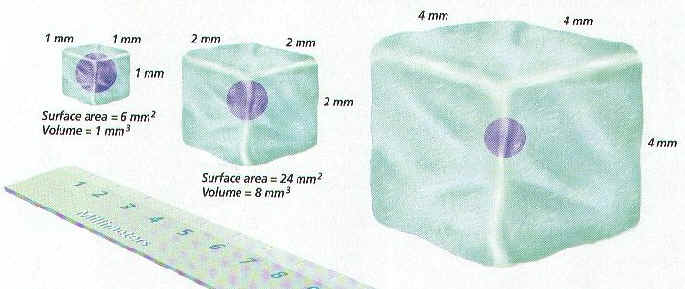
Cells are limited in how large they can be. This is because the surface area and volume ratio does not stay the same as their size increases. Because of this, it is harder for a large cell to pass materials in and out of the membrane, and to move materials through the cell.
In this lab, you will make cube shaped models to represent cells. The dimension along one side will be doubled with each model. You will then calculate the surface area, volume, and the ratio between the two.

MATERIALS:

Scissors
Construction paper
Tape
Metric ruler

PROCEDURE:

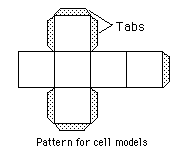
1. Construct three cell models like the pattern shown. The dimensions of a side will double each time, with the sides being 2 cm, 4 cm, and 8 cm. Fold and tape into cubes with the tabs to the inside. Record the dimensions in the DATA TABLE (the first one is done for you in the table).


DATA TABLE: Cell Size Comparison

Cell Dimensions
(cm)
Surface Area
(cm2)
Volume
(cm3)
Ratio
Surface area to Volume
1 2 X 2 X 2
2
3


CALCULATIONS:

2. Calculate the total surface area for each cell model by the following formula:

surface area = (Length X Width) X 6 sides


Record the surface areas in the DATA TABLE.

3. Calculate the volumes for each cell model by the following formula:

volume = length X width X height


Record the volumes in the DATA TABLE.

4. Calculate the surface area-to-volume ratio for each cell model by the following formula:

ratio = surface area
volume


Record the ratio values in the DATA TABLE.
These ratios show how many times larger the surface area is as compared to the volume. Notice that it becomes less than one very quickly.

QUESTIONS:

1. Which model has the largest surface area?

2. Which model has the largest volume?

3. Which model has the largest ratio?

4. To maintain life, and carry-out cellular functions, materials must be able to move into and out of the cell. Also, material needs to be able to move within the cell. What might be the advantage of having a large surface area?


5. What might be the disadvantage of having a large volume?


Chapter 10 Questions PPT

DNA & Replication
ppt Questions

History of DNA

1. Early scientists believed that _________ was the genetic material of the cell. Explain why.


2. Proteins are made of 20 different ________________.

3. Long chains of amino acids make up _________________.

4. Fred Griffith worked with what type of bacteria?

5. What did he find to be true after his experiments with the S and R strains of bacteria?


6. This process of picking up DNA from the environment is called ____________________.

7. Did Griffith’s experiment prove DNA was the genetic material?

8. What 2 main things make up chromosomes?

9. What did Hershey and Chase use in their experiments to prove DNA was the cell’s genetic material?

10. Hershey and Chase radioactively tagged the viral DNA with _______________ and the protein capsid with ______________.

11. Which radioactive substance was injected into and took over the host cell’s DNA?

12. What scientists showed the amount of the 4 nitrogen bases present in DNA?

13. Name the bases and their amounts found in somatic or body cells of humans.


14. What bases are complementary (pair with each other) on DNA?

15. What type of bonds join base pairs on DNA?

16. Are these strong or weak bonds?

17. What was Rosalind Franklin’s contribution to finding DNA’s structure?


18. Who built the first model of DNA and what did they use to help get the correct measurements for the molecule?

DNA Structure 

19. DNA is two coiled strands known as a ___________________.

20. What makes up the sides of a DNA molecule?

21. What bonds the deoxyribose sugars to the phosphate groups?

22. Where are the nitrogen bases found on DNA & how are they bonded?

23. Most DNA has a ______________ twist with ________ base pairs in a complete turn.

24. DNA stands for ___________________________.

25. ______________ are the subunits making up DNA.

26. Name the 3 parts of a nucleotide.


27. Why is deoxyribose called a pentose sugar?

28. Sketch a pentose sugar and include the carbons correctly numbered.


29. The sugars on one DNA strand of DNA are from 5′ to _________, while the sugars on the other strand are antiparallel running from _________ to ___________.

30. Double ring nitrogen bases are called ____________, while single ring nitrogen bases are called ________________.

31. Name the purines.

32. Name the pyrimidines.

33. Purines will only pair with ________________.

34. __________ hydrogen bonds are required to join guanine to cytosine, while only ________ bonds join adenine to thymine.

35. If there is 30% adenine, how much cytosine is present?

DNA Replication 

36. Cells must copy their DNA before they do what? Explain why.


37. During what part of the cell cycle is DNA copied?

38. In eukaryotes, where are the copies of DNA made?

39. The process of copying DNA is known as DNA ________________.

40. Replication of DNA begins at points called __________________________.

41. The two DNA strands ______________ at origins of replication forming Y-shaped areas called _______________________.

42. New DNA strands grow at the _____________.

43. As the two strands open at the origins of replication, replication _____________ form.

44. Prokaryotic chromosomes have a ___________ replication bubble, while eukaryotic cells have ___________ bubbles.

45. What enzyme uncoils DNA so it can be replicated or copied?

46. What other job does this enzyme perform?

47. What is the job of single-strand binding proteins?


48. What enzyme relieves stress on the DNA strands at the replication forks?

49. An RNA __________ must be present to start the addition of new nucleotides.

50. What enzyme makes the RNA primer?

51. DNA ______________ is the enzyme that adds new complementary base pairs.

52. DNA polymerase can only add nucleotides to what end of the DNA molecule?

53. Which DNA strand is synthesized continuously as a single strand?

54. The leading strand is made from the ______________ toward the _________________ as it opens.

55. The ____________ strand is synthesized ____________ the overall direction of replication.

56. The lagging strand is made in __________ short segments from the _____________ fork toward the _____________ of replication.

57. The short segments of the lagging strand are called ______________ fragments.

58. What enzyme joins Okazaki fragments together into one strand?

59. Sketch half of a replication bubble. Label the point of origin and the replication fork. Draw two arrows showing the leading strand and the lagging strand.


60. DNA polymerase initially makes how many errors?

61. Proofreading enzymes correct mistakes in DNA to a one in ______________ base pairing errors?

62. Explain the semiconservative model for DNA replication.


63. Who developed this idea about replication?

64. Chemicals and _____________ radiation can damage DNA in our body cells so it must be ________________ repaired.

65. What is excision repair?


66. What 2 enzymes replace damaged sections of DNA and rebind the molecule?

67. What is the complementary DNA strand for: 5′ -CGTATG -3′ ?


Structure & Function of the Cells


STRUCTURE AND FUNCTION OF THE CELL

All Materials © Cmassengale

I. All Organisms are Made of Cells


A. The cell is the basic unit of structure & function


B. The cell is the smallest unit that can still carry on all life processes

C. Both unicellular (one celled) and multicellular (many celled) organisms are composed of cells

D. Before the 17th century, no one knew cells existed

E. Most cells are too small to be seen with the unaided eye


F. In the early 17th century microscopes were invented & cells were seen for the 1st time

G. Anton Von Leeuwenhoek, a Dutchman, made the 1st hand-held microscope & viewed microscopic organisms in water & bacteria from his teeth


Leeuwenhoek’s microscope consisted simply of:

  • A) a screw for adjusting the height of the object being examined
  • B) a metal plate serving as the body
  • C) a skewer to impale the object and rotate it
  • D) the lens itself, which was spherical


H. In 1665, an English scientist named Robert Hooke made an improved microscope and viewed thin slices of cork viewing plant cell walls


I. Hooke named what he saw “cells”

J. In the 1830’s, Matthias Schleiden (botanist studying plants) & Theodore Schwann (zoologist studying animals) stated that all living things were made of cells


K. In 1855, Rudolf Virchow stated that cells only arise from pre-existing cells


L. Virchow’s idea contradicted the idea of spontaneous generation (idea that nonliving things could give rise to organisms)

M. The combined work of Schleiden, Schwann, & Virchow is known as the Cell Theory


Schwann Schleiden Virchow


II. Principles of the Cell Theory


A. All living things are made of one or more cells

B. Cells are the basic unit of structure & function in organisms

C. Cells come only from the reproduction of existing cells


III. Cell Diversity


A. Not all cells are alike

B. Cells differ in size, shape, and function


C. The female egg cell is the largest cell in the body & can be seen without a microscope

relative sizes of cells and their components

D. Bacterial cells are some of the smallest cells & are only visible with a microscope


E.coli Bacterial Cells

E. Cells need surface area of their cell membrane large enough to adequately exchange materials with the environment (wastes, gases such as O2 & CO2, and nutrients)


F. Cells are limited in size by the ratio between their outer surface area & their volume


G. Small cells have more surface area for their volume of cytoplasm than large cells

H. As cells grow, the amount of surface area becomes too small to allow materials to enter & leave the cell quickly enough

I. Cell size is also limited by the amount of cytoplasmic activity that the cell’s nucleus can control

J. Cells come in a variety of shapes, & the shape helps determine the function of the cell (e.g. Nerve cells are long to transmit messages in the body, while red blood cells are disk shaped to move through blood vessels)


IV. Prokaryotes


A. Prokaryotic cells are less complex

B. Unicellular

C. Do not have a nucleus & no membrane-bound organelles


D. Most have a cell wall surrounding the cell membrane & a single, looped chromosome (genetic material) in the cytoplasm


E. Include bacteria & blue-green bacteria


F. Found in the kingdom Monera


V. Eukaryotes


A. More complex cells

B. Includes both unicellular & multicellular organisms


C. Do have a true nucleus & membrane-bound organelles


D. Organelles are internal structures in cell’s that perform specific functions


a. Nucleus b. Chloroplast c. Golgi d. Mitochondria


E. Organelles are surrounded by a single or double membrane


F. Entire eukaryotic cell surrounded by a thin cell membrane that controls what enters & leaves the cell

G. Nucleus is located in the center of the cell

H. The nucleus contains the genetic material (DNA) & controls the cell’s activities

I. Eukaryotes include plant cells, animal cells, fungi, algae, & protists

J. Prokaryotes or bacteria lack a nucleus

K. Found in the kingdoms Protista, Fungi, Plantae, & Animalia


VI. Cell Membrane


A. Separates the cytoplasm of the cell from its environment

B. Protects the cell & controls what enters and leaves


C. Cell membranes are selectively permeable only allowing certain materials to enter or leave

D. Composed of a lipid bilayer made of phospholipid molecules


E. The hydrophilic head of a phospholipid is polar & composed of a glycerol & phosphate group and points to the aqueous cytoplasm and external environment.

F. The two hydrophobic tails are nonpolar point toward each other in the center of the membrane & are composed of two fatty acids

G. When phospholipids are placed in water, they line up on the water’s surface with their heads sticking into the water & their tails pointing upward from the surface.

H. The inside of the cell or cytoplasm is an aqueous or watery environment & so is the outside of the cell. Phospholipid “heads” point toward the water.

I. Phospholipid “tails” are sandwiched inside the lipid bilayer.

J. The cell membrane is constantly breaking down & being reformed inside living cells.

K. Certain small molecules such as CO2, H2O, & O2 can easily pass through the phospholipids


VII. Membrane Proteins


A. A variety of protein molecules are embedded in the cell’s lipid bilayer.

B. Some proteins called peripheral proteins are attached to the external & internal surface of the cell membrane

C. Integral proteins or transmembrane proteins are embedded & extend across the entire cell membrane. These are exposed to both the inside of the cell & the exterior environment.

D. Other integral proteins extend only to the inside or only to the exterior surface.

E. Cell membrane proteins help move materials into & out of the cell.

F. Some integral proteins called channel proteins have holes or pores through them so certain substances can cross the cell membrane.

G. Channel proteins help move ions (charged particles) such as Na+, Ca+, & K+ across the cell membrane

H. Transmembrane proteins bind to a substance on one side of the membrane & carry it to the other side. e.g. glucose


I. Some embedded, integral proteins have carbohydrate chains attached to them to serve as chemical signals to help cells recognize each other or for hormones or viruses to attach


VIII. Fluid Mosaic Model


A. The phospholipids & proteins in a cell membrane can drift or move side to side making the membrane appear “fluid”.

B. The proteins embedded in the cell membrane form patterns or mosaics.

C. Because the membrane is fluid with a pattern or mosaic of proteins, the modern view of the cell membrane is called the fluid mosaic model.


IX. Internal Cell Structure & Organelles of Eukaryotes

A. Cytoplasm includes everything between the nucleus and cell membrane.


B. Cytoplasm is composed of organelles & cytosol (jellylike material consisting of mainly water along with proteins.


C. Eukaryotes have membrane-bound organelles; prokaryotes do not


D. Mitochondria are large organelles with double membranes where cellular respiration (breaking down glucose to get energy) occurs

1. Energy from glucose is used to make ATP or adenosine triphosphate


2. Cells use the ATP molecule for energy

3. More active cells like muscle cells have more mitochondria


4. Outer membrane is smooth, while inner membrane has long folds called cristae


5. Have their own DNA to make more mitochondria when needed

E. Ribosomes are not surrounded by a membrane & are where proteins are made in the cytoplasm (protein synthesis)


1. Most numerous organelle

2. May be free in the cytoplasm or attached to the rough ER (endoplasmic reticulum)

F. Endoplasmic reticulum are membranous tubules & sacs that transport molecules from one part of the cell to another

1. Rough ER has embedded ribosomes on its surfaces for making proteins

2. Smooth ER lacks ribosomes & helps break down poisons, wastes, & other toxic chemicals

3. Smooth ER also helps process carbohydrates & lipids (fats)

4. The ER network connects the nucleus with the cell membrane


G. Golgi Apparatus modifies, packages, & helps secrete cell products such as proteins and hormones

1. Consists of a stack of flattened sacs called cisternae


2. Receives products made by the ER


H. Lysosomes are small organelles containing hydrolytic enzymes to digest materials for the cell

1. Single membrane

2. Formed from the ends of Golgi that pinch off


3. Found in most cells except plant cells

I. Cytoskeleton consists of a network of long protein tubes & strands in the cytoplasm to give cells shape and helps move organelles


1. Composed of 2 protein structures — microtubules, intermediate filaments, & microfilaments


2. Microfilaments are ropelike structures made of 2 twisted strands of the protein actin capable of contracting to cause cellular movement (muscle cells have many microfilaments)

3. Microtubules are larger, hollow tubules of the protein called tubulin that maintain cell shape, serve as tracks for organelle movement, & help cells divide by forming spindle fibers that separate chromosome pairs


Cytoskeleton Element  General Function
Microtubules Move materials within the cell
Move the cilia and flagella
Actin Filaments Move the cell
Intermediate Filaments Provides mechanical support


J. Cilia are short, more numerous hair like structures made of bundles of microtubules to help cells move


1. Line respiratory tract to remove dust & move paramecia


Cross section of Cilia & Flagella

K. Flagella are long whip like tails of microtubules bundles used for movement (usually 1-3 in number)

1. Help sperm cells swim to egg

L. Nucleus (nuclei) in the middle of the cell contains DNA (hereditary material of the cell) & acts as the control center


1. Most cells have 1 nucleolus, but some have several

2. Has a protein skeleton to keep its shape

3. Surrounded by a double layer called the nuclear envelope containing pores

4. Chromatin is the long strand of DNA in the nucleus, which coils during cell division to make chromosomes


5. Nucleolus (nucleoli) inside the nucleus makes ribosomes & disappears during cell division


M. Cell walls are nonliving, protective layers around the cell membrane in plants, bacteria, & fungi

1. Fungal cell walls are made of chitin, while plant cell walls are made of cellulose


2. Consist of a primary cell wall made first and a woody secondary cell wall in some plants


N. Vacuoles are the largest organelle in plants taking up most of the space

1. Serves as a storage area for proteins, ions, wastes, and cell products such as glucose


2. May contain poisons to keep animals from eating them

3. Animal vacuoles are smaller & used for digestion

O. Plastids in plants make or store food & contain pigments to trap sunlight

1. Chloroplast is a plastid that captures sunlight to make O2 and glucose during photosynthesis; contains chlorophyll

a. Double membrane organelle with an inner system of membranous sacs called thylakoids


b. Thylakoids made of stacks of grana containing chlorophyll

2. Other plastids contain red, orange, and yellow pigments

3. Found in plants, algae, & seaweed

X. Multicellular Organization


A. Cells are specialized to perform one or a few functions in multicellular organisms

B. Cells in multicellular organisms depend on each other


C. The levels of organization include:
Cells –> Tissues –> Organs –> Systems –> Organism

D. Tissues are groups of cells that performs a particular function (e.g. Muscle)


E. Organs are groups of tissues working together to do a job (e.g. heart, lungs, kidneys, brain)

F. Systems are made of several organs working together to carry out a life process (e.g. Respiratory system for breathing)

G. Plants have specialized tissues & organs different from animals

1. Dermal tissue forms the outer covering of plants

2. Ground tissue makes up roots & stems

3. Vascular tissue transports food & water

4. The four plant organs are the root, stem, leaf, & flower


H. Colonial organisms are made of cells living closely together in a connected group but without tissues & organs (e.g. Volvox)

Cell Cycle & Division


Cell Cycle & Division
All Materials © Cmassengale


Cell Division:

  • All cells are derived from preexisting cells (Cell Theory)
  • Cell division is the process by which cells produce new cells
  • Cell division differs in prokaryotes (bacteria) and eukaryotes (protists, fungi, plants, & animals)
  • Some tissues must be repaired often such as the lining of gut, white blood cells, skin cells with a short lifespan 
  • Other cells do not divide at all after birth such as muscle & nerve 

Reasons for Cell Division:

  • Cell growth
  • Repair & replacement of damaged cell parts
  • Reproduction of the species

Copying DNA: 

  • Since the instructions for making cell parts are encoded in the DNA, each new cell must get a complete set of the DNA molecules
  • This requires that the DNA be copied (replicated, duplicated) before cell division

Replication process

Chromosomes & Their Structure:

  • The plans for making cells are coded in DNA
  • DNA, deoxyribose nucleic acid, is a long thin molecule that stores genetic information
  • DNA in a human cell is estimated to consist of six billion pairs of nucleotides
  • DNA is organized into giant molecules called chromosomes
  • Chromosomes are made of protein & a long, single, tightly-coiled DNA molecule visible only when the cell divides
  • When a cell is not dividing the DNA is less visible & is called chromatin
  • DNA in eukaryotic cells wraps tightly around proteins called histones to help pack the DNA during cell division
  • Nonhistone proteins help control the activity of specific DNA genes
  • Kinetochore proteins bind to centromere and attach chromosome to the spindle in mitosis
  • Centromeres hold duplicated chromosomes together before they are separated in mitosis
  • Telomeres are the ends of chromosomes which are important in cell aging
  • When DNA makes copies of itself before cell division, each half of the chromosome is called a sister chromatid

  • DNA of prokaryotes (bacteria) is one, circular chromosome attached to the inside of the cell membrane

Chromosome Numbers:

  • Humans somatic or body cells have 23 pairs of chromosomes or 46 chromosomes (diploid or 2n number)
  • The 2 chromatids of a chromosome pair are called homologues (have genes for the same trait at the same location)


Homologs

  • Human reproductive cells or gametes (sperms & eggs) have one set or 23 chromosomes (haploid or n number)
  • Every organism has a specific chromosome number


Organism Chromosome Number (2n)
Human 46
Fruit fly 8
Lettuce 14
Goldfish 94


  • Fertilization, joining of the egg & sperm, restores the diploid chromosome number in the zygote (fertilized egg cell)
  • Sex chromosomes, either X or Y, determine the sex of the organism
  • Two X chromosomes, XX, will be female and XY will be male
  • All other chromosomes, except X & Y, are called autosomes
  • Chromosomes from a cell may be arranged in pairs by size starting with the longest pair and ending with the sex chromosomes to make a karyotype
  • A human karyotype has 22 pairs of autosomes and 1 pair of sex chromosomes (23 total)


Human Male Karyotype

Genes:

  • A section of DNA which codes for a protein is called a gene
  • Each gene codes for one protein
  • Humans have approximately 50,000 genes or 2000 per chromosome
  • About 95% of the DNA in chromosome is “junk” that does not code for any proteins

Cell Cycle:

  • Cells go through phases or a cell cycle during their life before they divide to form new cells 
  • The cell cycle includes 2 main parts — interphase, and cell division
  • Cell division includes mitosis (nuclear division) and cytokinesis (division of the cytoplasm)
  • Interphase is the longest part of a cell’s life cycle and is called the “resting stage” because the cell isn’t dividing
  • Cells grow, develop, & carry on all their normal metabolic functions during interphase
  • Interphase consists of 3 parts — G1, S, & G2phases

Interphase:

  • G1 or 1st Growth Phase occurs after a cell has undergone cell division
  • Cells mature & increase in size by making more cytoplasm & organelles while carrying normal metabolic activities in G1 
  • S or Synthesis Phase follows  G1  and the genetic material of the cell (DNA) is copied or replicated 

  • G2 or 2nd Growth Phase occurs after S Phase and the cell makes all the structures needed to divide

Cell division in Prokaryotes:

  • Prokaryotes such as bacteria do not have a nucleus
  • Prokaryotes divide into two identical new cells by the process of binary fission
  • Binary fission is an asexual method of reproduction
  • In binary fission,  the chromosome, attached to cell membrane, makes a copy of itself and the cell grows to about twice its normal size
  • Next, a cell wall forms between the chromosomes & the parent cell splits into 2 new identical daughter cells (clones)


Cell Division in Eukaryotes:

  • Eukaryotes have a nucleus & membrane-bound organelles which must be copied exactly so the 2 new cells formed from division will be exactly alike
  • The original parent cell & 2 new daughter cells must have identical chromosomes
  • DNA is copied in the S phase of the cell cycle & organelles, found in the cytoplasm,  are copied in the Growth phases
  • Both the nucleus (mitosis) and the cytoplasm (cytokinesis) must be divided during cell division in eukaryotes

Stages of Mitosis:

  • Division of the nucleus or mitosis occurs first
  • Mitosis is an asexual method of reproduction
  • Mitosis consists of 4 stages — Prophase, Metaphase, anaphase, & Telophase

  • Prophase:
    • Chromosomes become visible when they condense into sister chromatids
    • Sister chromatids attach to each other by the centromere
    • Centrioles in animal cells move to opposite ends of cell
    • Spindle forms from centriole (animals) or microtubules (plants)
    • Kinetochore fibers of spindle attach to centromere
    • Polar fibers of spindle extend across cell from pole to pole
    • Nuclear membrane dissolves
    • Nucleolus disintegrates
  • Metaphase:
    • Chromosomes line up in center or equator of the cell attached to kinetochore fibers of the spindle
  • Anaphase:
    • Kinetochore fibers attached to the centromere pull the sister chromatids apart
    • Chromosomes move toward opposite ends of cell
  • Telophase:
    • Nuclear membrane forms at each end of the cell around the chromosomes
    • Nucleolus reform
    • Chromosomes become less tightly coiled & appear as chromatin again
    • Cytokinesis begins

Cytokinesis:

  • Cytoplasm of the cell and its organelles separate into 2 new daughter cells
  • In animals, a groove called the cleavage furrow forms pinching the parent cell in two

  • In plants, a cell plate forms down the middle of the cell where the new cell wall will be

Summary of Mitosis:


 Interphase


  1. Cell matures & carries on normal activities
  2. DNA copied & appears as chromatin
  3. Nucleolus visible
 Early Prophase  


  1. Chromosomes condense & become visible
  2. Centrioles separate & spindle starts forming
 
 Late Prophase

  1. Spindle forms with aster at each pole
  2. Nuclear membrane & nucleolus disintegrate
  3. Centromere of chromosomes attaches to spindle fibers
 Metaphase

  1. Chromosomes line up at the equator of the cell attached to kinetochore fibers of spindle
 Anaphase

  1. Centromeres split apart
  2. Homologs move to opposite poles of the cell
 Telophase/Cytokinesis  

  1. Nuclear membrane & nucleolus reform
  2. Cell pinches into 2 cells in animals
  3. In plants, a cell plate separates the 2 new cells


Cancer is Uncontrolled Mitosis:

  • Mitosis must be controlled, otherwise growth will occur without limit (cancer)
  • Control is by special proteins produced by oncogenes
  • Mutations in control proteins can cause cancer

Meiosis & Sexual Reproduction

  • Reduces the number of chromosomes in new cells to half the number in the original cell
  • New cells have a single copy of chromosomes (23 total) but are not identical to each other or the original parent cell
  • Used for making gametes ( sperm and eggs) with the haploid or n number
  • In meiosis, cells divide twice after a single DNA duplication
  • Meiosis I separates homologs & the Meiosis II separates sister chromatids
  • Meiosis I stages are Prophase I, Metaphase I, Anaphase I, & Telophase I
  • Meiosis II stages are Prophase II, Metaphase II, Anaphase II, & Telophase II
  • Produces 4 haploid cells or gametes
  • When a sperm fertilizes an egg to form a zygote, the diploid number of chromosomes is restored (23 + 23 = 46)
  • Egg cells or ova (ovum, singular) are larger , nonmotile cells
  • Gametoogenesis is meiosis producing eggs & occurs in the female’s ovaries


Oogenesis

  • Sperms contain less cytoplasm so they’re smaller & have a flagellum to swim to the egg
  • Spermatogenesis is meiosis producing sperm cells & occurs in the testes


Spermatogenesis

Meiosis I:

  • The cell that undergoes Meiosis I is a primary spermatocyte or oocyte
  • Prophase I:
    • Chromosomes coil tightly & are visible
    • Nuclear membrane & nucleolus disintegrate
    • Spindle forms
    • Synapsis (joining) of homologous chromosomes occurs making tetrads
    • Kinetochore fiber forms on each chromosome
    • Chromosomes in tetrad exchange fragments by a process called crossing over

  • Metaphase I:
    • Tetrads become aligned in the center of the cell attached to spindle fibers
  • Anaphase I:
    • Homologous chromosomes separate
  • Telophase I:
    • May not occur in all species
    • Cytokinesis occurs producing 2 cells
    • In females,  2nd cell in females is called the 1st Polar Body
    • 1st Polar Body dies due to uneven splitting of the cytoplasm

  • Prophase II:
    • Cells called Secondary Spermatocytes or oocytes
    • DNA is not copied before cell divides
    • Chromatids attach to spindle fiber
  • Metaphase II:
    • Chromosomes become aligned in the center of the cell attached to spindle fibers
  • Anaphase II:
    • Sister chromatids separate randomly
    • Called independent assortment
  • Telophase I:
    • Cytokinesis occurs producing 4 cells in males called spermatids
    • Spermatids mature & form flagellum to become sperm
    • Cytokinesis in females produces a 2nd Polar Body that dies and an ootid 
    • Ootids mature to become ovum or egg

Asexual & Sexual reproduction:

  • Evolution is the slow process of change in living populations over time
  • Variations are differences that occur due to crossing-over among members of a sexually reproducing population
  • Variations are important to the survival of individuals in a population (some must survive to reproduce)
  • Asexually reproducing organisms rarely show variations because the organisms have identical genes